35,000+ smart investors are already getting financial news, market signals, and macro shifts in the economy that could impact their money next with our FREE weekly newsletter. Get ahead of what the crowd finds out too late. Click Here to Subscribe for FREE.
A mattress or sofa can look perfect under showroom lighting and still become an expensive frustration once it reaches home. Comfort matters, but so do dimensions, delivery access, construction, return restrictions, warranties, cleaning requirements and the final price after fees. Mattresses add another layer because firmness, foundation requirements and sleep trials can affect whether a purchase actually works over time.
For Canadian households spending hundreds or thousands of dollars on furniture intended to last for years, a little checking before payment can prevent surprisingly costly mistakes. These 20 things Canadians should check before buying a mattress or sofa cover the practical details that are easiest to overlook, from measuring hallways and reading fibre labels to questioning dramatic discounts, financing offers and second-hand bargains.
Measure the Room and the Entire Delivery Route
20 Things Canadians Should Check Before Buying a Mattress or Sofa
- Measure the Room and the Entire Delivery Route
- Verify the Exact Dimensions and Configuration
- Test How the Furniture Feels in Real Life
- Match Mattress Firmness to Actual Sleep Needs
- Understand the Trial and Return Window Before Paying
- Check the Conditions That Can Make a Return Ineligible
- Read the Warranty for Exclusions, Not Just Years
- Confirm the Mattress Works With the Existing Base
- Review Materials and Take Off-Gassing Seriously
- Check Safety Compliance and Search for Recalls
- Examine What Is Under the Sofa Cushions
- Understand What Is Inside the Cushions
- Check the Upholstery Fibre Content
- Ask for Abrasion Data Behind “Performance Fabric”
- Review Cleaning Instructions Before Choosing the Colour
- Make Sure the Sofa Fits the People Using It
- Match Upholstery to Children, Pets and Sunlight
- Add Delivery, Assembly and Removal to the Real Price
- Separate the Sale Price From the Financing Pitch
- Treat Used and Open-Box Furniture as a Different Purchase
- 16 Costco Canada Habits That Could Be Costing Shoppers More Than They Save

The measurement that matters is not simply the empty space where the new sofa or mattress will sit. Buyers should also measure door frames, hallways, stairwells, elevators, landings and tight corners along the delivery route. A sectional that fits comfortably against a living-room wall can still be impossible to turn through a narrow condominium hallway. Sofa-buying guidance routinely recommends measuring entrances and every area the furniture must pass through before delivery.
Canadian homes create very different access problems, from narrow staircases in older houses to condo elevators with restricted booking periods. Dimensions should therefore include height and depth, not merely width. Removable legs or modular sections can make the difference, but buyers should confirm those features rather than assume them. Marking the furniture footprint on the floor with painter’s tape is another simple way to see whether a seemingly reasonable size will overwhelm the room once installed.
Verify the Exact Dimensions and Configuration

Labels such as queen, king, three-seat sofa or sectional provide a useful starting point, but they are not substitutes for the manufacturer’s actual specifications. Sofa arms, back cushions, recliner mechanisms and chaise sections can substantially change the footprint. Even two pieces marketed for similar numbers of occupants can feel dramatically different because one devotes much more space to arms, cushions or an unusually deep seat.
Buyers should save the product page or specification sheet showing width, depth, height and individual module measurements. Configuration matters particularly with sectionals: a left-facing chaise cannot simply be assumed to work in a room designed around a right-facing version. Mattress shoppers should likewise confirm that the selected size matches the existing frame and bedding. A quick measurement before ordering can be far cheaper than discovering during delivery that the product blocks a doorway, radiator, balcony entrance or frequently used walking route.
Test How the Furniture Feels in Real Life

A few seconds sitting neatly on the edge of a sofa tells surprisingly little about how it will feel during a two-hour movie. Where possible, shoppers should sit in their normal position, lean against the back, stretch out and notice whether their feet reach the floor comfortably. Couples should test the piece together because cushion movement and usable seating space may feel different once several people are sitting on it.
Mattress testing deserves the same realism. Rather than simply pressing a hand into the surface, shoppers can spend several minutes lying in their usual sleeping position. Consumer testing organizations evaluate mattresses across multiple characteristics because comfort is influenced by more than a single firmness label. Online buyers lack the showroom test, making a clearly explained home-trial policy especially valuable. Ultimately, terms such as “luxury plush” or “extra supportive” are marketing descriptions; the household using the furniture determines whether those descriptions translate into everyday comfort.
Match Mattress Firmness to Actual Sleep Needs

The old assumption that the firmest mattress is automatically the healthiest choice is not supported by the best-known research. A randomized controlled trial involving 313 adults with chronic nonspecific low-back pain found better outcomes with medium-firm mattresses than with firm mattresses. Later systematic reviews have likewise concluded that medium-firm surfaces often perform well for comfort, sleep quality and spinal alignment, although individual preferences and medical circumstances still differ.
That does not mean every Canadian should buy the same firmness. Body size, sleeping position, pressure sensitivity and whether two people share the bed can change what feels supportive. A side sleeper may judge pressure around the shoulders and hips differently from someone who sleeps predominantly on the back. The practical lesson is to treat firmness labels as comparison tools rather than medical guarantees. Anyone dealing with persistent pain or a diagnosed condition should rely on appropriate health advice instead of assuming a retailer’s “orthopedic” terminology settles the question.
Understand the Trial and Return Window Before Paying

Mattress trials can sound reassuring, but the headline number of nights is only one part of the policy. Buyers should determine when the trial begins, whether there is a mandatory adjustment period, who arranges pickup, whether transportation costs apply and whether the remedy is a refund, exchange or store credit. Policies also vary between brands, retailers and products purchased through third-party sellers.
This matters because Canadian merchants generally do not have to accept a return simply because a consumer changed their mind, although defective products raise different legal considerations. Voluntary return policies therefore deserve careful reading before a major furniture purchase. Some mattress companies advertise home trials specifically because buyers cannot fully judge a sleeping surface during a quick store visit. A shopper comparing two similarly priced mattresses may discover that the product with clearer, less restrictive return terms carries considerably less financial risk—even if its promotional discount looks smaller at checkout.
Check the Conditions That Can Make a Return Ineligible

A generous-looking return policy can become much narrower once its conditions are considered. Furniture and mattress sellers may specify requirements involving cleanliness, damage, original ownership, pickup location, packaging or the type of product purchased. Custom upholstery, clearance merchandise, floor models and special-order configurations may also be treated differently from ordinary stocked items. Those details should be confirmed before the order becomes difficult or impossible to reverse.
Mattresses deserve particular attention because hygiene concerns can affect how retailers handle used products. Buyers should ask whether a protector is required during the trial and whether stains, odours, tears or other damage void eligibility. For sofas, custom fabric or made-to-order dimensions may carry stricter cancellation provisions. Canadian consumer guidance recommends understanding refund and exchange policies before buying rather than assuming unwanted goods can simply be returned. Saving a copy of the policy in effect on the purchase date can also prevent confusion if website wording changes later.
Read the Warranty for Exclusions, Not Just Years

A “10-year warranty” sounds substantial, but its usefulness depends on what the warranty actually covers. Furniture warranties commonly distinguish manufacturing defects from ordinary wear, accidental damage, stains, changes in softness or subjective comfort preferences. Buyers should read definitions of defects, claim procedures, transportation responsibilities and any requirements for proof of purchase. The longest advertised term is not necessarily the most important part of the document.
Canadian consumer guidance also notes that provincial and territorial sales laws provide implied warranties, generally requiring consumer goods to be fit for their intended purposes, although enforcement and interpretation depend on the circumstances. Manufacturer warranties exist alongside those legal rights rather than replacing the need to understand them. Mattress shoppers should pay particular attention to how visible sagging or indentations are defined. Sofa buyers can ask whether the frame, springs, cushions, mechanisms and upholstery have different coverage periods, because a single piece of furniture may effectively carry several warranties at once.
Confirm the Mattress Works With the Existing Base

Buying a premium mattress while ignoring the foundation underneath it can create both comfort and warranty problems. Mattress manufacturers may specify acceptable platform bases, foundations, adjustable bases, centre supports or maximum gaps between supporting slats. Those requirements vary, so an existing frame that worked with an older mattress should not automatically be assumed suitable for a replacement.
This is more than a technicality hidden in fine print. Casper Canada, for example, states in its mattress warranty that damage associated with an inappropriate foundation is excluded and specifies support requirements for its mattresses. Other manufacturers can set different conditions. Before buying, shoppers should identify the exact frame or foundation they plan to use and compare it with the mattress maker’s instructions. Couples moving to a larger mattress should also check whether additional centre support is required. Spending a few minutes on compatibility can protect both the mattress’s performance and the buyer’s ability to make a future warranty claim.
Review Materials and Take Off-Gassing Seriously

New furniture often has a noticeable smell, particularly when foams, adhesives, coatings or manufactured materials are involved. Health Canada explains that furniture, mattresses, cabinets, building materials and glues can emit gases into indoor air, a process commonly called off-gassing. Volatile organic compounds are among the pollutants that can be present, which is why ventilation is recommended as one way to improve indoor air quality.
That does not mean every new sofa or mattress represents a health hazard, nor does smell alone reveal the level of exposure. It does mean shoppers sensitive to odours may want to ask about materials, finishes and recommended airing procedures before delivery. A tightly packed foam mattress opened in a small bedroom offers a different ventilation situation from a sofa placed in a large living area with opening windows. Buyers can also distinguish specific, independently defined material certifications from vague phrases such as “eco-friendly,” “natural-inspired” or “clean,” which may communicate far less than their reassuring language suggests.
Check Safety Compliance and Search for Recalls

Mattresses sold in Canada are subject to federal flammability requirements. Health Canada maintains guidance explaining how the Mattresses Regulations apply to mattresses manufactured, imported, advertised or sold in the country. Textile products are also covered by Canadian safety requirements, although mattresses have their own specific regulatory framework. Safety compliance is therefore more than a marketing feature; it is part of the regulatory environment surrounding these products.
Checking recalls adds another layer of protection, especially when buying an unfamiliar brand, imported product, floor model or used item. Health Canada operates a recalls and safety alerts database, and its enforcement work has included compliance checks involving mattresses. A 2025 Canadian recall, for example, involved a cotton mattress that failed to meet federal flammability requirements. Buyers do not need to become product-safety specialists, but searching the brand and model before purchasing can reveal problems that a price tag or attractive online photograph would never show.
Examine What Is Under the Sofa Cushions
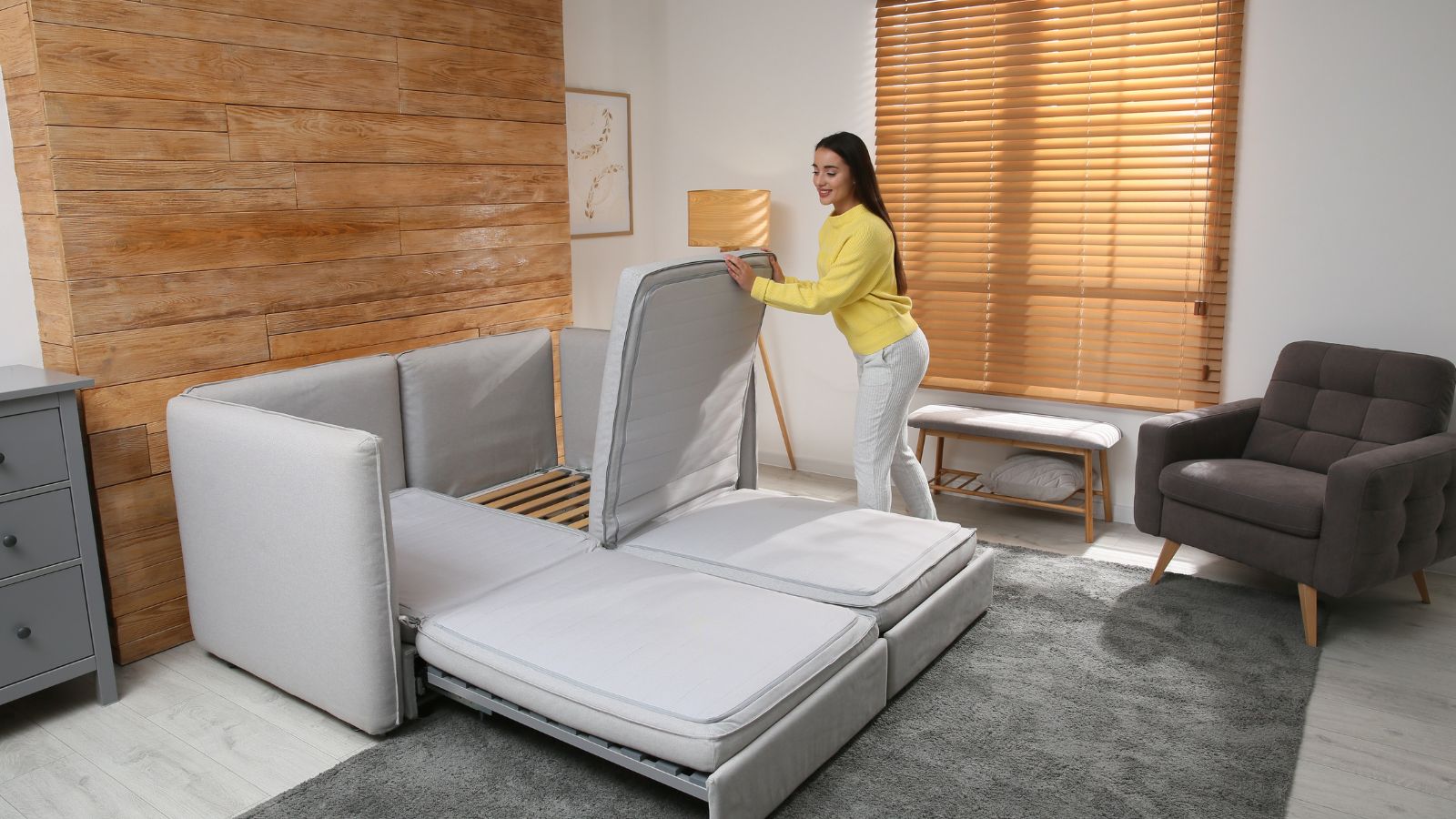
Upholstery is what shoppers see first, but the structure beneath it largely determines how a sofa behaves over years of use. Buyers should ask what the frame is made from, how corners are reinforced and what supports the cushions. Consumer Reports has identified frame construction and support systems as major indicators when evaluating furniture quality, with stronger construction generally carrying greater long-term value than pieces built mainly around appearance.
A useful showroom test is simply to interact with the furniture. Sit in several positions, gently move the arms and listen for excessive creaking. Lift removable cushions and examine the platform underneath. A sofa that twists noticeably when pressure is applied at one corner may inspire less confidence than one that feels structurally rigid. None of these checks guarantees decades of use, but they reveal more than decorative fabric alone. This is particularly important for a household where the sofa will serve as the everyday television seat, guest bed and family gathering place.
Understand What Is Inside the Cushions

Two sofas that look almost identical can feel completely different because of their cushion construction. Common approaches include foam, down or feather filling, and combinations in which a foam core is wrapped in softer material. Each has trade-offs. Better Homes & Gardens notes that down tends to require more regular fluffing, while foam generally returns toward its original shape more readily after someone stands up.
Instead of asking whether a cushion is simply “premium,” buyers can ask what it contains, whether the seat and back use different materials, and whether the cushion cores can eventually be replaced. Removable and reversible cushions may allow wear to be distributed more evenly. A household wanting a tidy, tailored appearance may find high-maintenance feather-filled cushions frustrating, while someone prioritizing a sink-in lounge feel may accept regular fluffing. The key is understanding the maintenance that accompanies the comfort. Showroom softness is only the beginning of the ownership experience, not the entire story.
Check the Upholstery Fibre Content

A fabric colour can be reproduced across very different fibres, so appearance alone reveals little about how upholstery will behave. Canadian federal textile-labelling requirements apply to upholstered furniture, and the Competition Bureau explains that the fibre content of the outer covering fabric must be disclosed using the required generic fibre names. That label gives shoppers a factual starting point when comparing materials.
Fibre content can matter for texture, maintenance, pilling, staining and the way a fabric ages, although construction and finishing also influence performance. A shopper choosing between two nearly identical grey sofas may discover that one uses a substantially different textile blend from the other. Leather products also deserve careful description because some furniture combines genuine leather on contact surfaces with different materials elsewhere. Rather than relying solely on phrases such as “linen look” or “leather match,” buyers can ask for the actual material specification. It is a small detail that makes comparison shopping considerably more meaningful.
Ask for Abrasion Data Behind “Performance Fabric”

“Performance fabric” sounds impressive, but shoppers should ask what performance has actually been measured. Upholstery abrasion is commonly assessed using tests such as Wyzenbeek or Martindale. The Association for Contract Textiles publishes voluntary guidance using abrasion thresholds for different levels of commercial use, while also warning that abrasion results alone cannot predict the full lifespan of a textile.
That qualification matters. A huge rub-count number should not automatically be interpreted as proof that a sofa will survive every pet claw, stain, snag or sunny window. Abrasion testing primarily provides standardized information about resistance to repeated surface wear under particular test conditions. Still, asking for a recognized test result is more informative than accepting an undefined durability claim. In a heavily used Canadian family room, the difference between decorative fabric and upholstery selected for substantial daily use can matter greatly. Shoppers should compare like with like and remember that Wyzenbeek and Martindale results are produced by different test methods.
Review Cleaning Instructions Before Choosing the Colour

A cream sofa can remain attractive in the right household, but colour is only half the maintenance decision. Buyers should determine whether cushion covers are removable, whether they can be washed, whether professional cleaning is recommended and what products should be avoided. Canadian textile rules make care labelling voluntary, but the Competition Bureau states that when care information is provided, it must not be false or misleading.
This creates a practical reason to ask questions before purchase. “Easy clean” may mean something very different from “machine washable.” Some cushions contain removable covers that still should not be placed in a washing machine. Others may require spot treatment or professional services. Households with young children, frequent guests or meals eaten on the sofa should weigh cleaning requirements as seriously as colour. Requesting a fabric swatch can also help buyers evaluate texture and appearance under their own lighting. A sofa that looks effortless in a staged showroom may demand considerably more maintenance at home.
Make Sure the Sofa Fits the People Using It

Sofa dimensions affect more than whether the piece fits between two walls. Seat height, seat depth, back height and arm position influence how comfortably different bodies can use it. Research on anthropometry and seating repeatedly demonstrates that mismatches between human measurements and furniture dimensions can affect fit. Although much ergonomic research focuses on work or classroom seating rather than sofas, the same basic principle applies: furniture proportions interact with body proportions.
A deep lounge sofa may suit a tall person who likes curling up but leave a shorter person unable to sit against the back while keeping their feet on the floor. A very low seat may look fashionable yet feel awkward for an older family member who finds standing difficult. Buyers should therefore test the sofa with the actual household in mind rather than selecting purely from photographs. A tape measure can record the dimensions of an existing comfortable chair or sofa and provide a useful reference when comparing models online.
Match Upholstery to Children, Pets and Sunlight

The best upholstery for a formal room used twice a month may be a poor choice for a sofa shared daily by children and pets. Buyers should think about scratches, spills, shedding, muddy paws and how often cushions will need cleaning. Better Homes & Gardens’ recent testing of pet- and kid-friendly sofas emphasizes durable upholstery as an important factor when furniture must withstand intensive household use.
Sun exposure deserves similar consideration. Fabrics positioned beside large windows can fade over time, while some materials and finishes are promoted specifically for improved fade resistance. A removable slipcover can also change the economics of ownership because the visible surface may be cleaned or replaced without replacing the complete sofa. None of these features is universally necessary. The important step is matching the product to the household it will actually enter. A sophisticated fabric that demands delicate care may simply be the wrong investment for a room where snacks, pets and weekend lounging are everyday realities.
Add Delivery, Assembly and Removal to the Real Price

The displayed furniture price may not be the amount ultimately leaving the household budget. Buyers should calculate delivery, stair or remote-area charges, assembly, white-glove service, packaging removal and old-mattress disposal where applicable. They should also confirm what “delivery” means. Curbside drop-off is very different from carrying a sectional upstairs, positioning it in the room and removing packaging.
Canada’s Competition Bureau has repeatedly addressed drip pricing—the practice of advertising a price and later adding mandatory fixed fees—under deceptive-marketing provisions. Not every optional furniture service represents drip pricing, but the broader consumer lesson is useful: compare the unavoidable total, not merely the attractive number printed in large type. Condo residents may also need elevator reservations or building approvals, creating additional logistical costs. Before payment, asking for an itemized delivered total makes comparisons between retailers much clearer and reduces the chance that a supposedly cheaper sofa or mattress becomes the more expensive purchase.
Separate the Sale Price From the Financing Pitch

Furniture is famously promotion-heavy, which makes the “regular” price worth examining. Canada’s Competition Bureau states that sellers cannot invent an inflated regular price simply to create the appearance of a large discount. The Bureau has previously pursued enforcement involving allegedly deceptive regular-price claims on sleep sets, illustrating why consumers should focus on the actual amount being paid rather than the dramatic percentage shown beside it.
Financing deserves a separate calculation. The Financial Consumer Agency of Canada explains that buy-now-pay-later arrangements are a form of credit and recommends understanding payment schedules, fees, interest and consequences of missed payments. A mattress advertised at 40% off can still become expensive if financing costs or other charges accumulate. Buyers should compare the cash price, financed total and payment obligations independently. A monthly figure can make a large purchase feel smaller, but the useful comparison is what the furniture ultimately costs and whether the payment schedule remains comfortable within the household budget.
Treat Used and Open-Box Furniture as a Different Purchase

Second-hand furniture can offer excellent value, but upholstered pieces deserve inspection that goes beyond scratches and stains. Health Canada specifically recommends checking second-hand products for recalls and inspecting furniture for signs of bedbugs. For sofas, that means examining seams, zippers, cushion creases, legs and areas where upholstery attaches to the frame. Bed frames and mattresses also contain numerous seams, joints and crevices where pests can hide.
Open-box and floor-model purchases require their own questions. Buyers should determine whether the manufacturer’s original warranty still applies, why the product was returned, whether parts are missing and whether the retailer treats the sale as final. Health Canada advises consumers buying second-hand goods to check both manufacturers and the federal recall database. The bargain should therefore be evaluated against its uncertainty. Saving several hundred dollars can be worthwhile, but not if the purchase introduces pests, carries unresolved safety concerns or leaves the buyer with virtually no practical return options.
16 Costco Canada Habits That Could Be Costing Shoppers More Than They Save

The Executive Membership can feel like an obvious upgrade because the 2% annual reward sounds straightforward. For households that spend heavily at Costco Canada, the extra fee may be easy to justify. But the habit becomes costly when shoppers upgrade first and calculate later. A Gold Star Membership costs less, while Executive costs more and only pays off if eligible annual spending is high enough to offset the difference.
16 Costco Canada Habits That Could Be Costing Shoppers More Than They Save
This Options Discord Chat is The Real Deal
While the internet is scoured with trading chat rooms, many of which even charge upwards of thousands of dollars to join, this smaller options trading discord chatroom is the real deal and actually providing valuable trade setups, education, and community without the noise and spam of the larger more expensive rooms. With a incredibly low-cost monthly fee, Options Trading Club (click here to see their reviews) requires an application to join ensuring that every member is dedicated and serious about taking their trading to the next level. If you are looking for a change in your trading strategies, then click here to apply for a membership.