35,000+ smart investors are already getting financial news, market signals, and macro shifts in the economy that could impact their money next with our FREE weekly newsletter. Get ahead of what the crowd finds out too late. Click Here to Subscribe for FREE.
Donald Trump’s escalating trade confrontation with Canada is reshaping more than the flow of goods across the border. It is also changing the political landscape in Ottawa.
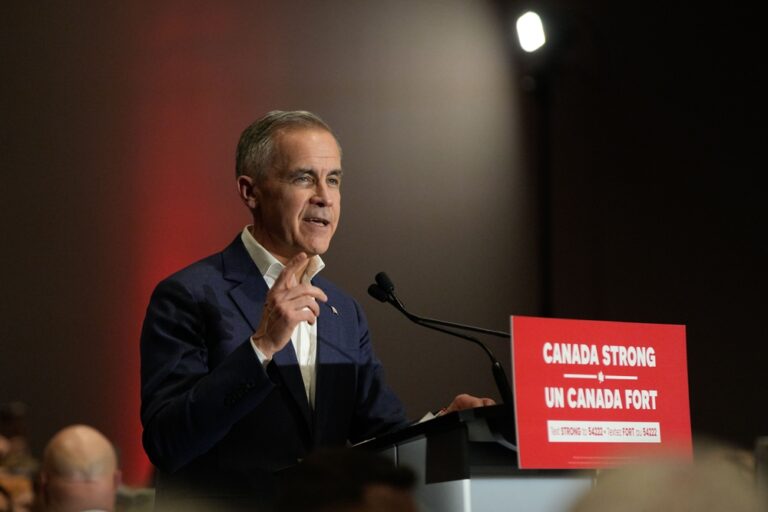
Prime Minister Mark Carney’s Liberals have opened a commanding advantage over Pierre Poilievre’s Conservatives, with new Angus Reid Institute data putting Liberal support at 46 per cent compared with 32 per cent for the Conservatives. The 14-point gap represents a dramatic widening from earlier in the summer as tariffs, retaliation and anxiety over Canada’s relationship with Washington move closer to the centre of national politics. While no single issue can fully explain a voter’s choice, the timing points to an unmistakable political reality: confrontation with Trump is currently playing much more comfortably to Carney’s strengths than Poilievre’s.
A Four-Point Liberal Lead Has Become 14 Points
Trump Trade War Gives Carney Liberals a 14-Point Lead Over Poilievre, Poll Finds
- A Four-Point Liberal Lead Has Become 14 Points
- The Liberal Advantage Is Showing Up in Other Polling
- Carney’s Personal Numbers Are Outrunning Poilievre’s
- Older Canadians Are Giving Carney an Enormous Advantage
- Poilievre’s Problem With Women Has Become Harder to Ignore
- Ontario and Quebec Are Building the Liberal National Lead
- Former NDP and Bloc Voters Are Helping Carney Expand His Coalition
- Cost of Living Has Not Disappeared — But Tariffs Have Joined It
- Washington Has Moved to the Centre of Canadian Politics
- Canada’s Dependence on U.S. Trade Makes the Fight Impossible to Ignore
- Three By-Election Wins Added to the Liberals’ Momentum
- Conservative Voters Have Not Abandoned Poilievre
- The Conservatives Were Much Closer to Power in 2025
- A 14-Point Lead Is Powerful, but the Trade War Is Still Evolving
The scale of the change is as significant as the headline number. Among decided and leaning voters questioned by the Angus Reid Institute from September 2 to 7, 46 per cent said they would support the Liberals if an election were held, compared with 32 per cent for the Conservatives. That gives Carney’s party a 14-point national advantage.
Only a couple of months earlier, the Liberal lead stood at four points. Angus Reid says the current gap is the largest recorded during its tracking period stretching back to the beginning of 2025. Support for the NDP, Bloc Québécois and Greens has been considerably more stable, suggesting that much of the movement has been occurring between the two parties competing to form government. The result does not establish that Trump alone caused the shift, but Angus Reid explicitly describes a renewed “Trump Bump” as one of the forces helping the Liberals.
The Liberal Advantage Is Showing Up in Other Polling
One poll can produce an unusually strong result, particularly when voter opinion is moving quickly. The striking part of the latest numbers is that other national pollsters are seeing a broadly similar political environment. Liaison Strategies reported on September 7 that the Liberals held 45 per cent support among decided and leaning voters, compared with 31 per cent for the Conservatives — another 14-point margin.
Nanos Research produced an even larger gap in its September 8 tracking, putting Liberal support at 47.3 per cent and Conservative support at 31.3 per cent. Its 16-point spread came as Donald Trump and Canada-U.S. relations moved to the top of its measure of Canadians’ national concerns. Different polling companies use different methodologies, so their numbers should not be treated as interchangeable. But three prominent national measurements showing double-digit Liberal leads makes it harder to dismiss the trend as a statistical curiosity.
Carney’s Personal Numbers Are Outrunning Poilievre’s
The party gap is being accompanied by an even more striking difference in how Canadians view the two leaders. Angus Reid found 61 per cent of Canadians approved of Carney’s performance as prime minister, while only 32 per cent held a favourable opinion of Poilievre. Angus Reid says the Conservative leader’s favourable rating has reached a new low in its tracking.
Nanos paints a similar picture when voters are asked who they prefer as prime minister. Its latest measurement put Carney at 55.2 per cent compared with 21.3 per cent for Poilievre. Those questions are not identical to approval ratings, but together they point toward a sizeable leadership advantage for the prime minister. Carney built much of his political identity around economic management and navigating a difficult relationship with Washington. With tariffs once again dominating political discussion, the national agenda happens to be emphasizing precisely the terrain on which his government most wants to compete.
Older Canadians Are Giving Carney an Enormous Advantage
The leadership difference becomes particularly dramatic among Canadians over the age of 54. Angus Reid found that 73 per cent of men in that age group approved of Carney’s performance. Among women over 54, approval climbed to 80 per cent. Poilievre’s positive ratings among the same groups were substantially lower.
That matters because older Canadians are also among the voters most likely to identify health care and Canada’s relationship with the United States as major concerns. In other words, the demographic giving Carney some of his strongest leadership marks is also paying particularly close attention to the issues currently putting the prime minister on television beside premiers, business leaders and international counterparts. For voters who remember decades in which Canada-U.S. trade was treated as a relatively stable economic foundation, the sudden uncertainty surrounding tariffs and market access can make competence in managing Washington feel unusually important.
Poilievre’s Problem With Women Has Become Harder to Ignore
One of the Conservatives’ longer-running electoral challenges is also evident in the new data. Only 27 per cent of Canadian women told Angus Reid they had a favourable opinion of Poilievre. The institute says his favourability among women has never exceeded 31 per cent during approximately four years of its tracking of him as Conservative leader.
The weakness predates the current trade dispute. In August 2025, 53 per cent of women questioned by Angus Reid said the Conservative Party did not represent “people like me.” A similar result had been recorded years earlier, suggesting that the problem cannot simply be blamed on a difficult month of headlines. What the Trump confrontation may be doing is making an existing vulnerability more consequential. As Carney benefits from a leadership-focused political environment, Conservatives need to persuade voters who are uneasy about Poilievre personally to separate those impressions from their assessment of the party’s policies — an increasingly difficult task when national politics revolves around leadership.
Ontario and Quebec Are Building the Liberal National Lead
Canada’s national popular vote is ultimately assembled province by province, and two of the country’s largest electoral battlegrounds currently favour the Liberals heavily. Angus Reid reports that the Liberals lead the Conservatives by 16 points in Ontario. In Quebec, they hold a 28-point advantage over the Bloc Québécois, their nearest competitor in the province.
Those numbers are particularly important because Ontario and Quebec contain well over half of the seats in the House of Commons. Conservative strength remains formidable elsewhere: Angus Reid found majority Conservative support in both Alberta and Saskatchewan. That western advantage, however, cannot easily compensate for large Liberal margins in the two most populous provinces if those margins persist into another election. The regional picture therefore resembles a familiar Conservative challenge — highly efficient support in Prairie strongholds combined with a need to win many more suburban and urban constituencies in Ontario, Quebec and British Columbia to form government.
Former NDP and Bloc Voters Are Helping Carney Expand His Coalition
The Liberals are not building their advantage simply by holding their 2025 supporters. Angus Reid found both the Liberals and Conservatives retaining roughly four out of five people who voted for them in the last federal election. The more important difference is what is happening among people who previously backed smaller parties.
About 31 per cent of 2025 NDP voters now say they would support the Liberals, while 21 per cent of former Bloc Québécois voters say the same. Comparatively few are moving to the Conservatives. That gives Carney access to a much larger pool of potential swing voters, particularly on the centre-left and among federalist voters in Quebec. It also illustrates why a two-party-looking national race can be difficult for Poilievre: even if Conservative voters remain loyal, the Liberals can widen their lead by consolidating people who previously viewed the NDP or Bloc as viable alternatives.
Cost of Living Has Not Disappeared — But Tariffs Have Joined It
The Liberal surge does not mean Canadians have suddenly stopped worrying about affordability. Angus Reid continues to find cost of living and inflation at the top of the country’s concerns. Other economic pressures remain prominent as well, with 27 per cent identifying tariffs as a major issue, 24 per cent pointing to the broader economy and 21 per cent citing housing affordability.
That creates an unusual political tension for the government. Carney can benefit politically from appearing to stand up to Trump while simultaneously facing the possibility that a prolonged trade war raises costs for households and businesses. Tariffs can make imported products more expensive, disrupt supply chains and squeeze companies that depend on cross-border inputs. The political advantage therefore carries a built-in risk: Canadians may approve of Ottawa’s resistance to Washington today but become less patient if retaliation eventually shows up more visibly in grocery bills, factory layoffs, investment decisions or consumer prices.
Washington Has Moved to the Centre of Canadian Politics
For much of Canadian political history, elections have been dominated by domestic questions such as taxes, health care, housing, jobs and public spending. Trump’s second-term confrontation with Canada has made the bilateral relationship itself a kitchen-table political issue. Angus Reid found concern about U.S. relations particularly elevated among past Liberal and Bloc voters, while Quebec respondents were the most likely provincially to identify American tariffs as a major concern.
Nanos reached an equally noteworthy conclusion in early September. Its latest tracking showed Donald Trump and the Canada-U.S. relationship becoming Canadians’ leading national issue of concern for the first time in roughly a year. That change helps explain why Carney’s political fortunes are moving alongside developments in Washington. The prime minister cannot control Trump’s decisions, but as long as Canadians view dealing with the United States as one of Ottawa’s central responsibilities, every new tariff announcement effectively places Carney back on politically favourable ground.
Canada’s Dependence on U.S. Trade Makes the Fight Impossible to Ignore
The political intensity is understandable because the economic relationship is enormous. Statistics Canada reported that 71.7 per cent of Canadian merchandise exports went to the United States in 2025, even after that share fell from 75.9 per cent the previous year. In June 2026 alone, Canada exported roughly $53.9 billion in merchandise to the United States out of approximately $77.5 billion in total exports.
The newest retaliation is therefore not a symbolic diplomatic disagreement. Canada imposed new counter-tariffs ranging from 15 to 50 per cent on September 8, covering $27.6 billion in U.S. imports, according to the Department of Finance. Washington has subsequently announced additional measures of its own, including import bans on certain Canadian products beginning September 29. For manufacturers, farmers and exporters whose supply chains were built around a largely open continental market, every escalation adds another layer of uncertainty — and keeps the political battle with Trump firmly in the national spotlight.
Three By-Election Wins Added to the Liberals’ Momentum
The polling boost arrived immediately after something more concrete than an opinion measurement: actual votes. On August 31, the Liberals won all three federal by-elections being contested in Ontario, Quebec and British Columbia. Elections Canada’s validated results show Liberal candidate Tanveer Shahnawaz taking 55.8 per cent in Beaches—East York and Braeden Caley winning North Vancouver—Capilano with 58.7 per cent.
The most politically significant result came in Chicoutimi—Le Fjord, where Liberal Daniel Gobeil captured 51.6 per cent. The Conservative candidate finished with 12.6 per cent, behind the Bloc Québécois candidate at 32.8 per cent. Angus Reid specifically points to the three-election sweep as part of the Liberals’ late-summer momentum. By-elections have local dynamics and cannot be treated as miniature national elections, but winning three geographically distinct contests just before national polling moved sharply in the government’s favour reinforces the perception that Carney’s Liberals are entering the fall with momentum.
Conservative Voters Have Not Abandoned Poilievre
The latest numbers are uncomfortable for Conservatives, but they do not show a party base in revolt against its leader. Among people who voted Conservative in 2025, Angus Reid found 67 per cent satisfied with Poilievre’s performance since the election. Another 57 per cent said he should remain leader and take the party into the next federal campaign.
There is nevertheless evidence that Conservative voters are becoming more open to adjustment. Fifty-eight per cent said the party should maintain its current ideological approach, yet roughly half were also prepared to accept “big changes” if those changes were necessary to win the next election. The distinction is important. Many Conservative supporters appear to like Poilievre and broadly agree with the direction of the party while also recognizing that its current coalition may be too narrow. The strategic challenge is finding additional voters without alienating the highly motivated supporters who helped produce one of the strongest Conservative popular-vote performances in decades.
The Conservatives Were Much Closer to Power in 2025
The size of the current Liberal polling advantage can obscure just how competitive the previous federal election actually was. Elections Canada’s official results show the Liberals receiving 43.8 per cent of valid votes in 2025, compared with 41.3 per cent for the Conservatives. The Liberals won 169 seats while the Conservatives captured 144.
That 41.3 per cent Conservative vote share was formidable and illustrates how quickly the political landscape has changed. Poilievre entered that contest after years of focusing on inflation, housing, taxation and dissatisfaction with the Trudeau government. Carney’s arrival and Trump’s threats altered the agenda, allowing the Liberals to fight on economic sovereignty and Canada-U.S. relations rather than simply defending the previous government’s record. The latest 46-to-32 Angus Reid result therefore represents something larger than routine movement inside a close race: it suggests a considerable portion of the electorate that was recently prepared to consider the Conservatives is currently looking elsewhere.
A 14-Point Lead Is Powerful, but the Trade War Is Still Evolving
The most important caution is timing. Angus Reid collected its responses between September 2 and September 7. Canada’s newest round of counter-tariffs took effect on September 8, immediately after the fieldwork ended. The Trump administration then announced additional measures, including import bans scheduled to begin September 29. Canadians therefore answered before experiencing the full political and economic consequences of the latest escalation.
The House of Commons is also scheduled to return on September 21, bringing the government and opposition back into a much more confrontational environment. Carney will have to defend the economic costs of retaliation, while Poilievre will have an opportunity to argue that Canadians need a different strategy for protecting jobs and affordability. For now, however, the evidence is unusually consistent: Trump’s confrontation with Canada has coincided with a stronger Liberal position, elevated approval for Carney and a significantly more difficult political landscape for Poilievre.
This Options Discord Chat is The Real Deal
While the internet is scoured with trading chat rooms, many of which even charge upwards of thousands of dollars to join, this smaller options trading discord chatroom is the real deal and actually providing valuable trade setups, education, and community without the noise and spam of the larger more expensive rooms. With a incredibly low-cost monthly fee, Options Trading Club (click here to see their reviews) requires an application to join ensuring that every member is dedicated and serious about taking their trading to the next level. If you are looking for a change in your trading strategies, then click here to apply for a membership.