
35,000+ smart investors are already getting financial news, market signals, and macro shifts in the economy that could impact their money next with our FREE weekly newsletter. Get ahead of what the crowd finds out too late. Click Here to Subscribe for FREE.
Canada’s inflation rate has cooled from its peak, but that has not translated into broad relief at the household level. Essentials still consume a large share of paycheques, food bank use remains at record highs, and housing costs continue to shape financial decisions in ways that ripple through everything else. The pressure is no longer just about one headline number. It is showing up in rent, groceries, debt, insurance, and the way households cut back.
These 21 signs capture why the squeeze still feels stubbornly real across the country. Taken together, they show a cost-of-living story that is less about panic than persistence: a long stretch of higher everyday costs that continues to wear down budgets, confidence, and flexibility.
Grocery Carts Are Still Costing More
21 Signs Canada’s Cost-of-Living Squeeze Still Isn’t Letting Up
- Grocery Carts Are Still Costing More
- Eating Out Feels Like a Bigger Luxury
- Food Insecurity Remains Widespread
- Food Banks Are Breaking Records Again
- More Working Canadians Still Need Help to Eat
- Rent Still Commands a Large Share of Income
- Family-Sized Rentals Haven’t Really Let Go
- Shelter Remains One of the Most Stubborn Pressure Points
- Owning a Home Is Still Hard to Call Affordable
- Mortgage Renewals Are Still Raising Monthly Payments
- Families Are Leaning on the “Bank of Mom and Dad”
- Household Debt Is Still Towering Over Income
- Debt-Service Relief Has Been Shallow
- Missed Payments Are Climbing in Parts of the Credit Market
- Credit Card Balances Keep Swelling
- Insolvency Filings Are Still Uncomfortably High
- Lower-Income Households Are Losing Ground
- Essentials Are Outrunning Breathing Room in Household Budgets
- Driving Still Comes With Rising Fixed Costs
- Canadians Themselves Say High Prices Are Still Shaping Behaviour
- A Softer Job Market Makes Every Bill Feel Heavier
- 19 Things Canadians Don’t Realize the CRA Can See About Their Online Income

Headline inflation can make the overall picture look calmer than it feels in the checkout line. In the latest official CPI release available in mid-April, food prices were still up 5.4% year over year in February 2026, far faster than the all-items inflation rate of 1.8%. Meat was one of the standout pressure points, rising 8.2%. That kind of gap matters because food is not a discretionary category. Families can delay a renovation or a vacation, but they still need to buy dinner.
Statistics Canada’s broader consumer analysis helps explain why the pain still feels real. Households spent, on average, 7.4% more on food purchased from stores in 2023 than in 2021, and shoppers increasingly shifted purchases toward general merchandise retailers, warehouse clubs, supercentres, and dollar stores. That kind of trading down is one of the clearest signs of strain: when people start reorganizing where they buy basics, the squeeze has already moved beyond theory and into habit.
Eating Out Feels Like a Bigger Luxury

Restaurant meals have become a quiet but potent reminder that everyday living costs remain elevated. Statistics Canada reported that food purchased from restaurants was up 7.8% year over year in February 2026, making it one of the main upward contributors to the CPI. That is a meaningful jump in a category many households once treated as a manageable convenience rather than a splurge. Even occasional takeout can start to feel like a budgeting decision instead of a routine choice.
The psychological effect matters as much as the arithmetic. When the cost of prepared food rises notably faster than overall inflation, it changes how households experience the economy day to day. People do not need to be dining at upscale places to feel it; higher menu prices show up in coffee runs, lunch pickups, family pizza nights, and quick meals between work and errands. A squeezed middle class often becomes visible not in luxury spending disappearing, but in ordinary conveniences becoming harder to justify.
Food Insecurity Remains Widespread

One of the starkest signs that the cost-of-living problem is not over is the scale of food insecurity. Statistics Canada said that in 2023, about 10 million people, or 25.5% of the population in the provinces, lived in a household experiencing some level of food insecurity. That marked the third straight annual increase. Among one-parent families, the figure was even harsher: 47.8% lived in food-insecure households. Those are not fringe numbers; they describe a broad affordability problem touching millions.
The human side of that data is easy to picture. A parent who can cover rent but not enough groceries by month-end is not counted as financially secure just because shelter is paid. Food insecurity also tends to reveal how thin the margin has become for many households. When so many people are struggling to consistently afford meals, it suggests that the cost-of-living squeeze is still hitting the most basic layer of household survival, not merely reducing discretionary comfort around the edges.
Food Banks Are Breaking Records Again
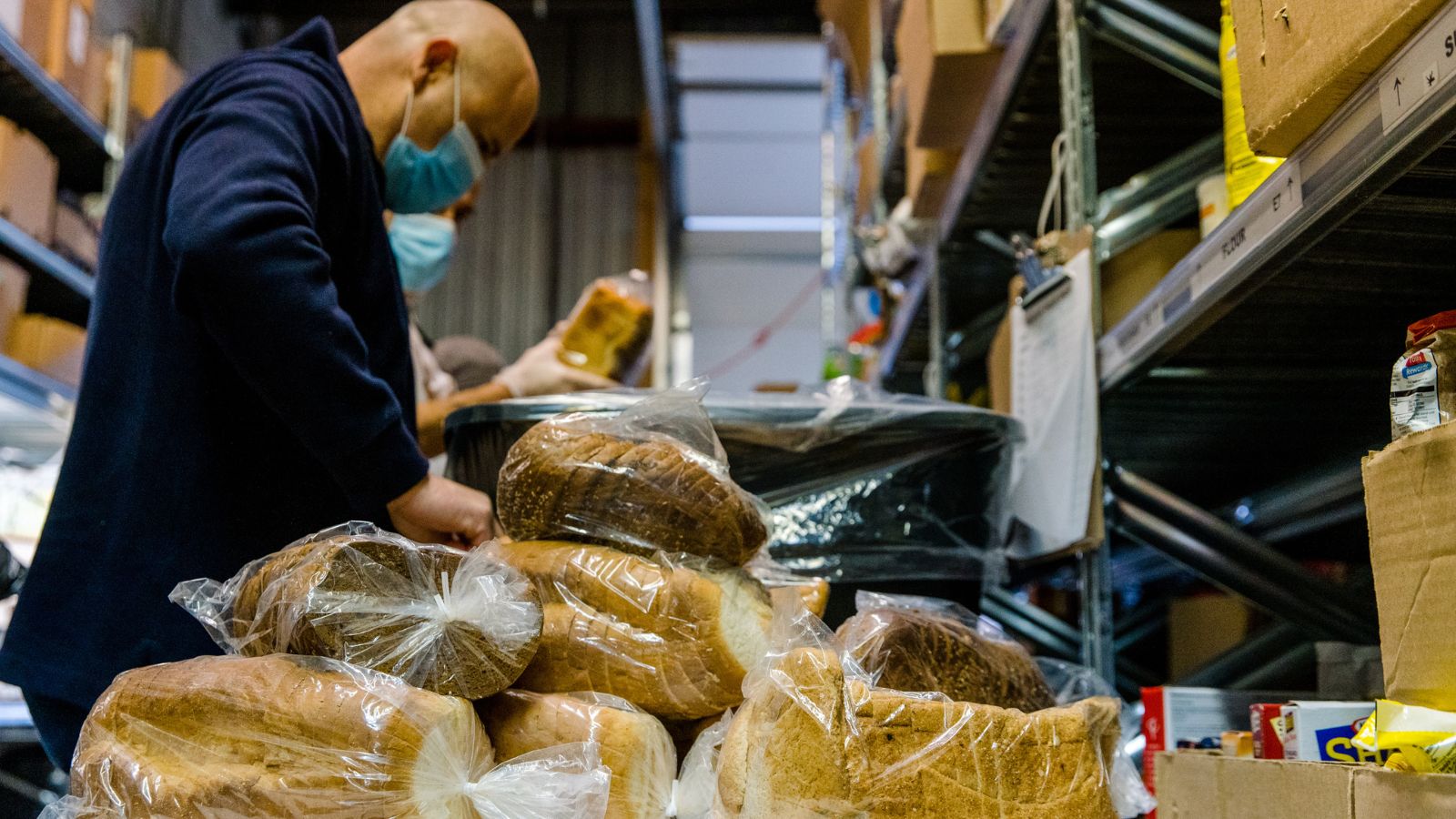
Food bank use is often one of the clearest real-world indicators of whether affordability has truly improved. Food Banks Canada’s 2025 HungerCount found nearly 2.2 million food bank visits in March 2025, the highest number in history. More specifically, the report counted 2,165,766 visits that month, up 5.2% from 2024 and 99.4% from 2019. Those numbers matter because they show demand continuing to rise even after the worst of the inflation spike had already passed.
That is what makes the trend so revealing. If the crisis had genuinely eased for a large share of households, a sharp retreat in emergency food support would be easier to see. Instead, demand remains exceptional. Food banks were built as temporary relief, but record visitation suggests they are increasingly serving as a recurring part of many households’ coping strategy. When charity infrastructure is still absorbing this level of need, it is hard to argue that affordability pressures have meaningfully let up for the people feeling them most.
More Working Canadians Still Need Help to Eat

The old assumption was that paid work, even modestly paid work, offered at least some protection against severe financial hardship. That assumption is looking shakier. Food Banks Canada reported that 19.4% of food bank clients in 2025 listed employment as their main source of income, up from 18.1% the year before and about 12% in 2019. In other words, a growing share of people using food banks are not disconnected from the labour market; they are working and still coming up short.
That is a powerful sign of a lingering squeeze because it challenges the idea that employment alone solves affordability stress. A paycheque can still be too thin once rent, transportation, debt payments, and groceries are all taken into account. The image of food bank use as mainly a symptom of unemployment has become outdated. In a high-cost environment, even steady workers can end up rationing food or seeking help, which says a great deal about how far everyday costs have outrun what many jobs actually support.

Rents have softened in some major markets, but that does not mean the rental burden has disappeared. Rentals.ca reported that the average asking rent in Canada was $2,030 in February 2026. It also estimated that a household would need an annual income of $81,213 to afford that average rent at the standard 30% affordability benchmark. Even with some recent easing, that is still a demanding threshold for a large share of renters, especially single earners or families in high-cost cities.
The recent improvements are real, but they should not be mistaken for comfort. Rentals.ca said the average rent-to-income ratio for renter households improved to 29%, down from 31% a year earlier and 34% two years earlier. That is better, but only relative to a punishing recent past. For many households, being closer to the affordability benchmark is not the same as feeling financially relaxed. When rent still absorbs such a large chunk of after-tax resources, there is less room for food, savings, childcare, transportation, and any surprise expense that lands at the wrong moment.
Family-Sized Rentals Haven’t Really Let Go

The rental market can look softer in headlines while still staying difficult for households that need more space. Rentals.ca found that three-bedroom rents were the only major unit type still showing national growth, rising 0.6% year over year across all property types to $2,486 in February 2026. For purpose-built rental apartments, three-bedroom units were up 1.7% to $2,734. That matters because larger households cannot easily solve affordability by squeezing into a smaller unit.
This is one reason the cost-of-living squeeze can feel uneven across family types. A renter looking at studio or one-bedroom listings may see more signs of relief than a household with children needing multiple bedrooms. That creates a more frustrating reality than the simple “rents are falling” narrative suggests. A broad easing in the market does not necessarily reach the unit types that matter most to families. When family-sized rents keep pressing upward or stay stubbornly high, the sense of squeeze can persist even as the national averages appear to cool.
Shelter Remains One of the Most Stubborn Pressure Points

Shelter may no longer be driving inflation the way it did at the peak, but it is still one of the most persistent stress points in household budgets. Statistics Canada’s February 2026 CPI data showed rent up 3.9% year over year, making it one of the main upward contributors to inflation. In January, rent had been up 4.3%. That steady pace matters because shelter costs are recurring and hard to escape. Unlike a postponed purchase, rent arrives every month whether wages have kept pace or not.
The same data show why many households still do not feel broad relief. Shelter is a huge part of the CPI basket, and its influence lingers even when categories like gasoline fall. A country can post softer headline inflation while families still feel pinned down by rent, mortgages, and related housing bills. That is why shelter remains such a central symbol of the ongoing squeeze. It is not only expensive; it is the type of expense that narrows every other choice, from savings to food quality to whether a household can absorb one bad financial week.
Owning a Home Is Still Hard to Call Affordable

There has been some improvement in housing affordability, but the level remains uncomfortable by historical standards. RBC said its national aggregate affordability measure eased to 52.4% in the fourth quarter of 2025 from the peak of 63% at the end of 2023. That sounds like progress, and it is. But RBC also noted that affordability gains have become weaker and more uneven, with several markets deteriorating again. A measure above 50% still signals ownership costs that consume a very large share of a typical household budget.
CMHC’s updated housing-supply framework underscores the deeper problem. The agency says Canada still needs enough supply to restore affordability closer to pre-pandemic norms over the next decade, not just a few quarters of slightly better conditions. That broader context matters. House prices or mortgage rates do not need to be exploding for homeownership to remain deeply strained. If the country still requires a major structural affordability reset, then the squeeze on aspiring owners has plainly not ended; it has simply shifted from acute to entrenched.
Mortgage Renewals Are Still Raising Monthly Payments

One of the clearest signs that the squeeze is lingering is that many homeowners are still walking into higher monthly payments at renewal. A Bank of Canada staff note said about 60% of all outstanding mortgages in Canada were expected to renew in 2025 or 2026, and about 60% of renewing mortgage holders were expected to see a payment increase. Compared with December 2024 payments, average monthly payments could be 10% higher for those renewing in 2025 and 6% higher for those renewing in 2026.
The averages also hide sharper pain in certain segments. The Bank said five-year fixed borrowers renewing in 2025 or 2026 could face average payment increases of roughly 15% to 20%. Equifax’s Q4 2025 consumer credit report added that mortgage renewals and payment shock remained major concerns, especially in Ontario and British Columbia, and that missed payments were rising on higher-value mortgages in Ontario as post-renewal payments proved too high for some borrowers. That is not the picture of a squeeze that has vanished. It is the picture of one still rolling through household budgets in slow motion.
Families Are Leaning on the “Bank of Mom and Dad”

Housing stress is also showing up in who has to step in to make ownership possible. The Bank of Canada said rising housing costs are leading to an increasing share of first-time homebuyers seeking financial support from parents through mortgage co-signing. That is a revealing development because it shows affordability pressure spilling beyond the buyer and into the family network. When entry into the market increasingly depends on intergenerational help, it suggests ownership is not becoming broadly easier on its own.
The underlying research is just as telling. A Bank of Canada study found the share of first-time homebuyer mortgages involving parental co-signing rose from 4% in 2004 to 13% by 2022. That does not mean every first-time buyer now relies on family support, but it does show a structural shift. What used to be an advantage for some households is becoming more common as a coping mechanism for high housing costs. In practical terms, it is another sign that affordability remains strained enough that many young buyers cannot bridge the gap with income and savings alone.
Household Debt Is Still Towering Over Income

Canada’s household debt burden remains one of the biggest signs that affordability pressure is still embedded in the system. Statistics Canada reported that household credit market debt surpassed $3.2 trillion in the fourth quarter of 2025. The ratio of household credit market debt to disposable income rose for the fifth consecutive quarter to 177.2%, meaning households held $1.77 in credit market debt for every dollar of disposable income. That is not just a large number; it is a sign of how much future income has already been spoken for.
Debt at that scale changes how households experience everyday prices. A grocery increase or rent hike hurts more when there is already a large stack of fixed obligations sitting underneath it. Higher indebtedness also reduces flexibility. Households with major mortgage or consumer debt commitments often have fewer easy places to cut when basic living costs rise. Even if some macro indicators look stable, a debt load this large leaves many households sensitive to small shocks, which is one reason the squeeze can persist long after the sharpest inflation headlines fade.
Debt-Service Relief Has Been Shallow

There has been some modest relief in debt-service costs, but not enough to declare the pressure gone. Statistics Canada said the household debt-service ratio edged down to 14.57% in the fourth quarter of 2025 from 14.61% in the previous quarter. That was the second straight quarterly decrease. Still, the ratio remains high in practical terms because it measures the share of disposable income already committed to principal and interest payments. A slight dip is welcome, but it does not suddenly free up a meaningful amount of room in many monthly budgets.
That nuance matters because households do not live in quarter-over-quarter decimal changes. They live in cash flow. A family that is still sending a large slice of income to service debt can feel squeezed even when the macro trend has improved. The same Statistics Canada release noted that obligated mortgage principal payments kept rising, even as mortgage interest payments fell slightly. That combination helps explain why many households still feel financially tight. Lower rates may have reduced the pressure at the margin, but they have not restored the kind of breathing room many Canadians remember from earlier years.
Missed Payments Are Climbing in Parts of the Credit Market

Another sign that the squeeze is still active is the rise in missed payments, especially outside the mortgage market. Equifax reported that missed payments on non-mortgage debt rose in Q4 2025, with the 90-plus-day balance delinquency rate increasing from 1.64% to 1.73% year over year. Ontario saw the fastest acceleration in non-mortgage delinquency, up 10.31% from a year earlier. That is a meaningful warning signal because these are the kinds of bills households often fall behind on only after a budget has already become strained.
The Bank of Canada’s 2025 Financial Stability Report reinforced that picture. It said arrears on credit cards and auto loans had risen further for households without a mortgage and were now above historical levels. In other words, while some homeowners may be getting modest relief from lower rates, other households are still moving deeper into visible stress. Missed payments are not simply an accounting detail. They are often one of the last stages before harder choices, damaged credit access, or insolvency. When delinquencies are still climbing, the squeeze is plainly not over.
Credit Card Balances Keep Swelling

Credit cards often act as the pressure valve when incomes and everyday expenses stop lining up cleanly. Equifax found that even though inflation-adjusted holiday card spending fell 0.7% year over year in December 2025, total credit card balances still climbed to a historic $131 billion, up 4.04%. That combination is telling. Households were not spending freely; many were actually pulling back. Yet balances still rose, suggesting that more consumption was being carried forward rather than fully paid down.
That distinction matters because rising balances paired with cautious spending point to fragility, not confidence. When people are more restrained and debt still grows, it usually means essentials and fixed costs are doing more of the damage than discretionary indulgence. It also hints at a harder next phase of the squeeze: not just higher prices, but the interest costs that follow when more spending sits on revolving credit. A rising card balance can look manageable for a while, then quickly become another monthly burden that leaves even less room for rent, groceries, or savings.
Insolvency Filings Are Still Uncomfortably High

Consumer insolvency filings remain an important sign that many households have not regained their footing. The Office of the Superintendent of Bankruptcy said consumer insolvencies for the 12 months ending December 31, 2025 were up 2.3% from the prior year. CAIRP described 2025’s total of 140,457 consumer insolvencies as the second-highest annual volume on record and the highest in 16 years. Those figures suggest that even if the pace of deterioration has slowed, the level of distress is still historically serious.
The language around those numbers is revealing too. CAIRP said the modest annual increase still reflected ongoing financial strain tied to higher living costs, rising debt loads, and lingering uncertainty. That feels consistent with the broader household picture: not an explosive emergency, but a long-running erosion that keeps pushing some budgets past the breaking point. Insolvency data matter because they show where the squeeze ends when households run out of room. When filings remain this elevated, it signals that the cost-of-living problem is still biting hard enough to produce lasting financial damage.
Lower-Income Households Are Losing Ground

The squeeze is not hitting all Canadians evenly, and one of the clearest signs of that is the widening gap between lower- and higher-income households. Statistics Canada reported that the lowest-income households increased their average disposable income by 2.6% in 2025, compared with 3.8% for all households, while the highest-income households saw gains of 4.1%. Lower-income households also faced weaker wage growth and weaker investment income. In other words, the households with the least cushion are not the ones gaining the most ground.
The spending side makes the divide even clearer. Statistics Canada said net saving worsened for lower-income households because growth in consumption, especially for housing and utilities, insurance and financial services, and transportation and storage, outpaced income growth. These households may be bridging the gap through borrowing. That is an especially troubling sign because it suggests the squeeze is not just reducing comfort; it is forcing weaker households to absorb recurring essentials with increasingly fragile finances. When the people with the least slack fall further behind, the cost-of-living problem is no longer simply broad. It becomes more unequal and harder to reverse.
Essentials Are Outrunning Breathing Room in Household Budgets

Some of the clearest evidence of a persistent squeeze comes from how spending on basics keeps overtaking income growth. Statistics Canada said that for lower-income households, consumption growth in 2025 outpaced disposable income growth, especially because of housing and utilities, insurance and financial services, and transportation and storage. Food Banks Canada described a similar pattern in plainer terms, noting that cumulative increases in the cost of shelter, food, and transportation since 2021 have aligned with the surge in food bank usage.
That alignment matters because it points to a squeeze rooted in essentials, not lifestyle excess. Households can trim entertainment, delay electronics purchases, or skip travel, but they cannot easily stop paying to live somewhere, get to work, or feed a family. When those categories rise together, budgets lose flexibility from several directions at once. That is often what makes affordability pressure feel so relentless. Even if one bill moderates, another basic necessity is waiting. A household does not need to face crisis-level inflation to feel trapped; it just needs too many unavoidable costs rising faster than its margin for error.
Driving Still Comes With Rising Fixed Costs

For many households, especially outside dense urban cores, car ownership is not optional. That makes rising vehicle costs another sign that affordability pressure remains stubborn. Statistics Canada’s February 2026 CPI data showed passenger vehicle insurance premiums up 8.2% year over year and purchase of passenger vehicles up 2.7%. Auto insurance was one of the major upward contributors to inflation that month. Even when gasoline falls, those fixed ownership costs can keep the broader cost of getting around feeling expensive.
Statistics Canada has also linked rising auto insurance premiums to higher claims costs, repair costs, parts prices, and vehicle values. That matters because these are not one-off spikes tied to a weekend at the pump. They are part of the structural cost of maintaining mobility. A household may cheer lower fuel prices and still feel no real relief if insurance renews higher and the next repair estimate lands harder than expected. In a country where many workers depend on a car, transportation costs do not need to dominate headlines to keep the squeeze alive in real budgets.
Canadians Themselves Say High Prices Are Still Shaping Behaviour

Official statistics tell one story, but household sentiment tells another, and it still sounds strained. The Bank of Canada’s Q4 2025 Canadian Survey of Consumer Expectations said concerns over high prices and economic uncertainty continued to weigh on consumers. The survey found spending plans remained weak, and the top barriers to spending were still high prices, economic uncertainty, and elevated housing costs. Those responses matter because they reflect how households are actually processing the economy, not just how economists measure it.
There is also something revealing in the tone of the survey responses. People described budgeting more carefully, looking harder for discounts, and cutting “wants” in favour of “needs.” That behavioural shift is a sign in itself. A cost-of-living squeeze does not only show up in bankruptcies or CPI tables; it also shows up when households become more defensive, more selective, and less confident about spending even when they are still employed. When high prices continue to shape behaviour this way, it suggests the financial after-effects of the inflation surge are still firmly embedded in everyday decision-making.
A Softer Job Market Makes Every Bill Feel Heavier

The final sign is not a price at all. It is the labour market backdrop against which households are trying to manage those prices. Statistics Canada reported that the national unemployment rate was 6.7% in March 2026, above the 2017-to-2019 average of 6.0%. Youth unemployment was 13.8%, and Ontario’s unemployment rate stood at 7.6%. None of those figures alone proves a crisis, but they do suggest that many households are navigating higher living costs without the reassurance of a clearly strong job market.
The Bank of Canada’s consumer-expectations survey captures how that feels. Consumers reported a higher likelihood of missing a debt payment and a slightly greater chance of losing their job, while the labour-market index remained well below pre-pandemic levels. That combination is potent. The cost-of-living squeeze becomes heavier when households worry not just about what things cost, but about whether their income is as secure as it needs to be. High prices are hard enough to absorb in a confident labour market. In a softer one, they can feel much more threatening.
19 Things Canadians Don’t Realize the CRA Can See About Their Online Income

Earning money online feels simple and informal for many Canadians. Freelancing, selling products, and digital services often start as side projects. The problem appears at tax time. Many people underestimate how much information the CRA can access. Online platforms, banks, and payment processors create detailed records automatically. These records do not disappear once money hits an account. Small gaps in reporting add up quickly.
Here are 19 things Canadians don’t realize the CRA can see about their online income.
This Options Discord Chat is The Real Deal
While the internet is scoured with trading chat rooms, many of which even charge upwards of thousands of dollars to join, this smaller options trading discord chatroom is the real deal and actually providing valuable trade setups, education, and community without the noise and spam of the larger more expensive rooms. With a incredibly low-cost monthly fee, Options Trading Club (click here to see their reviews) requires an application to join ensuring that every member is dedicated and serious about taking their trading to the next level. If you are looking for a change in your trading strategies, then click here to apply for a membership.