35,000+ smart investors are already getting financial news, market signals, and macro shifts in the economy that could impact their money next with our FREE weekly newsletter. Get ahead of what the crowd finds out too late. Click Here to Subscribe for FREE.
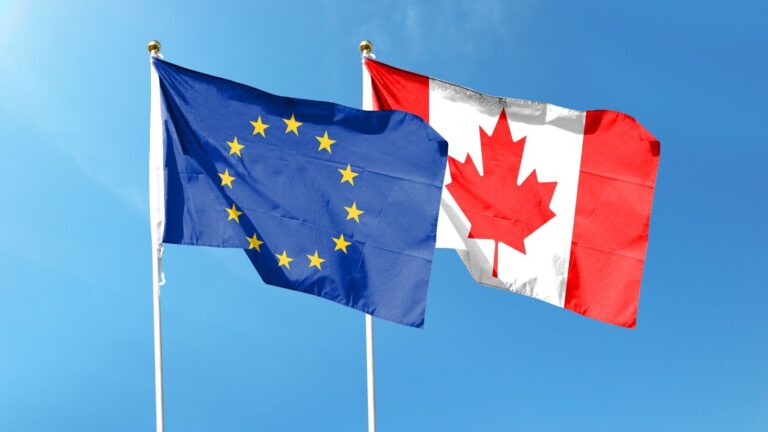
Canada’s economic map is being redrawn faster than Ottawa expected. With the trade relationship with the United States deteriorating under another round of tariffs and threats, Prime Minister Mark Carney is looking across the Atlantic for markets, investment and strategic partnerships that can give Canadian businesses more room to manoeuvre.
Europe has moved to the centre of that effort. Energy contracts with German buyers are becoming tangible, critical-mineral partnerships are drawing European capital, and talks with the European Union increasingly cover artificial intelligence, data infrastructure and advanced technology. Carney is now preparing another European push, including stops in Strasbourg and Liverpool. Yet the strategy is not about replacing the United States overnight. It is about making Canada less vulnerable to decisions made in Washington and building alternatives before the next trade shock arrives.
Europe Is Becoming a Bigger Part of Carney’s Economic Strategy
Carney Turns to Europe for Energy, AI and Critical-Mineral Deals as U.S. Trade Relationship Deteriorates
- Europe Is Becoming a Bigger Part of Carney’s Economic Strategy
- The U.S. Trade Fight Has Made Diversification More Urgent
- Carney Is Talking About a ‘Unique Alliance’ With the EU
- Canadian LNG Has Already Found Long-Term European Buyers
- Critical Minerals May Be Canada’s Strongest European Bargaining Chip
- AI Cooperation Is Moving From Regulation Toward Infrastructure
- Norway Shows Europe Means More Than the European Union
- CETA Gives Canada a Foundation It Does Not Have to Build From Scratch
- Europe Still Cannot Replace the U.S. Market
- The Next Few Weeks Will Show How Much of the Pivot Becomes Real
Carney is scheduled to travel to Strasbourg, France, and Liverpool, United Kingdom, from September 15 to 17, putting European economic and security ties near the top of Ottawa’s agenda. In Strasbourg, he is expected to address the European Parliament, attend European Commission President Ursula von der Leyen’s State of the Union address and meet European lawmakers. The trip provides a highly visible platform for a Canadian government increasingly talking about diversification not as a long-term aspiration, but as an immediate economic necessity.
Liverpool adds another dimension. Carney is expected to meet British Prime Minister Andy Burnham, with energy, artificial intelligence, critical minerals, defence and security all listed among the planned subjects. The combination is revealing. Ottawa is no longer treating trade policy, national security, energy and technology as separate files. Critical minerals can feed defence and battery industries; electricity and LNG can support European energy security; AI depends on data centres, electricity and secure infrastructure. Europe potentially offers markets for all of them.
The U.S. Trade Fight Has Made Diversification More Urgent
The European push comes as Canada’s relationship with its largest trading partner has entered another difficult phase. Washington imposed tariffs of 50% on $27.6 billion worth of Canadian goods effective August 22, according to the federal government. Ottawa responded with counter-tariffs covering an equivalent $27.6 billion of American imports beginning September 8, with rates of 15%, 25% or 50% depending on the product. The affected sectors include steel, dairy products, agricultural machinery, electronics, appliances, pulp and paper.
The political language has become equally sharp. On September 13, U.S. President Donald Trump called Canada the “worst country to deal with” while also claiming it was eager to reach an agreement. He has additionally threatened new restrictions involving Canadian vehicles. Ottawa, meanwhile, suspended negotiations rather than accept U.S. terms it considered damaging to Canadian interests. For companies deciding where to build a factory or sign a decade-long supply agreement, that unpredictability matters almost as much as the tariff itself.
Carney Is Talking About a ‘Unique Alliance’ With the EU
The most ambitious part of Carney’s strategy may go considerably beyond selling additional Canadian goods to Europe. On September 13, he confirmed that Canada intends to begin discussions with the European Union about what he called a “unique alliance.” He explicitly rejected the idea that Canada was seeking conventional EU membership, but the language signals an effort to build something deeper than the existing trading relationship.
Discussions reported around the proposal involve making it easier for Canadian goods, services and workers connected to strategic industries to move between Canada and Europe. Energy, artificial intelligence, defence and critical minerals have all been identified as potential priority sectors. Ideas reportedly being explored also include submarine data cables, cloud infrastructure, data centres, satellite networks and infrastructure capable of moving Canadian energy to European customers. Many details remain exploratory rather than finalized policy. Still, the scope shows how far the conversation has moved from simply lowering tariffs on finished goods.
Canadian LNG Has Already Found Long-Term European Buyers
Energy is one area where diversification is beginning to produce concrete commercial commitments. In July, Ksi Lisims LNG and Germany’s Uniper announced a binding agreement under which the European energy company is expected to buy two million tonnes of Canadian LNG annually for as long as 20 years. Deliveries are planned to begin in 2032, with the gas intended for markets including Germany, the United Kingdom, Sweden and the Netherlands.
That agreement followed another arrangement announced in May involving Germany’s state-owned energy company SEFE. The proposed deal covers one million tonnes of LNG per year for as long as 20 years. Both arrangements centre on Ksi Lisims, the Indigenous-led LNG project proposed for British Columbia’s north coast. For decades, nearly all Canadian natural-gas exports flowed south to the United States. Ottawa estimates that less than 0.01% went to non-U.S. markets in 2024. These European contracts therefore represent something Canada has talked about for years but struggled to accomplish: establishing long-term overseas customers for Canadian natural gas.
Critical Minerals May Be Canada’s Strongest European Bargaining Chip
Europe’s effort to reduce its dependence on concentrated foreign supplies of critical minerals closely matches Canada’s desire to attract investment into mines, processing plants and refining capacity. Canada and the EU already operate a Strategic Partnership on Raw Materials covering supply chains, investment, research and environmental standards. That cooperation has accelerated as governments have become more concerned about access to lithium, nickel, graphite, copper, rare earths and other materials needed for batteries, electrical equipment and defence systems.
Several partnerships are moving beyond diplomatic declarations. European institutions have backed Canadian projects, while European companies are participating directly. France’s Schneider Electric is working with Torngat Metals on rare-earth development in Quebec. Belgian institutions have been connected to First Phosphate’s proposed operations in Saguenay–Lac-Saint-Jean, and Canada has opened discussions with the European Investment Bank on potential project cooperation. Ottawa said a collection of 30 international critical-mineral partnerships announced in March could help unlock $12.1 billion in projects. For mining regions, that foreign capital can matter as much as the eventual export market.
AI Cooperation Is Moving From Regulation Toward Infrastructure
Artificial intelligence is another area where Canada and Europe see complementary interests, although the relationship is less commercially developed than the LNG deals. Canada and the EU launched a Digital Partnership in 2023 and held their first Digital Partnership Council in Montreal in December 2025. Artificial intelligence sits alongside cybersecurity, digital identity, semiconductors, quantum technology, data governance and research as one of the partnership’s central areas.
The next phase could be more physical. Discussions around the proposed deeper Canada-EU alliance reportedly include data centres, cloud-storage infrastructure, satellite networks and undersea data cables. That matters because AI is no longer only a software industry. Training and operating large models requires enormous computing capacity, secure data infrastructure and large quantities of reliable electricity. Canada has abundant hydroelectric resources, a comparatively clean power grid in several provinces and a growing policy focus on domestic computing capacity. The potential European opportunity therefore connects AI policy directly to energy development, infrastructure construction and questions of technological sovereignty.
Norway Shows Europe Means More Than the European Union
Carney’s European strategy is also extending beyond the EU itself. Norwegian Prime Minister Jonas Gahr Støre is scheduled to visit Ottawa on September 20 and 21, with talks expected to focus on energy, critical minerals, artificial intelligence, aerospace, Arctic security and other sovereign technologies. Norway is a particularly relevant partner because it combines major energy expertise with advanced technology industries, NATO membership and one of the world’s largest pools of investment capital.
Canada and Norway have already signed a memorandum of understanding on critical-mineral cooperation, while the two governments have been discussing investment and emerging technologies more broadly. Their economic relationship remains modest compared with Canada-U.S. trade: merchandise trade between Canada and Norway totalled about $3.8 billion in 2025. Yet that smaller starting point illustrates the diversification strategy. Ottawa is looking for a network of reliable partners rather than one European country capable of replacing American demand. Norway can offer expertise and capital; Germany can buy energy; France can cooperate on technology and defence; the EU can provide market scale.
CETA Gives Canada a Foundation It Does Not Have to Build From Scratch
Canada’s European pivot has one major advantage: a trade framework already exists. The Comprehensive Economic and Trade Agreement between Canada and the EU was signed in 2016 and has been provisionally applied since September 2017. The European Union is already Canada’s second-largest trading partner for combined goods and services after the United States. Canada-EU trade in goods and services reached roughly $178.6 billion in 2025.
Investment ties are substantial as well. European companies employ hundreds of thousands of people in Canada, while Canadian businesses have built major operations throughout Europe. That means Ottawa does not need to create an economic relationship from zero. The challenge is turning existing market access into substantially higher trade in strategic sectors. There are still limits: CETA has yet to receive full ratification from every EU member state, even years after provisional implementation. That experience demonstrates why proposals for a deeper political and economic alliance may take time even when leaders on both sides are enthusiastic.
Europe Still Cannot Replace the U.S. Market
For all the momentum, geography and decades of industrial integration continue to give the United States an enormous advantage. In July, 66.3% of Canadian merchandise exports still went to the U.S. market. Supply chains in vehicles, energy, agriculture, machinery and manufacturing routinely cross the border multiple times. A company in Ontario can put a truckload of components on the road and have them at a U.S. plant within hours. Selling the same goods overseas involves very different logistics.
The diversification trend is nevertheless becoming visible in trade data. Canadian exports to countries other than the United States increased 7.4% in July to a record $25.6 billion, giving non-U.S. destinations a 33.7% share of Canadian merchandise exports that month. Shipments to the Netherlands, Germany and China helped drive the increase. Those numbers suggest businesses are already searching for additional customers. But the scale of U.S. trade means Europe should be viewed as a second pillar rather than a substitute. The practical goal is reducing concentration risk, not attempting an economically disruptive decoupling.
The Next Few Weeks Will Show How Much of the Pivot Becomes Real
Canada’s diplomatic calendar will provide several tests in quick succession. Carney’s September 15–17 European trip puts him before European lawmakers and the British government. Norway’s prime minister arrives in Ottawa on September 20. Canada and the European Union are then scheduled to hold their next formal summit in Montreal on October 29 and 30. Negotiations on a Canada-EU digital trade agreement are already underway, alongside expanding cooperation on critical minerals and economic security.
The measure of success will not be the number of meetings or communiqués. It will be whether governments can turn political alignment into investment decisions, supply contracts, infrastructure and jobs. The LNG agreements demonstrate what that can look like: a Canadian project secures a European buyer for decades, creating an alternative to dependence on the American market. Critical minerals could follow a similar path, while AI cooperation remains earlier-stage. With Washington once again demonstrating how quickly trade rules can change, Ottawa’s calculation is increasingly straightforward: Canada needs more doors open before another one closes.
This Options Discord Chat is The Real Deal
While the internet is scoured with trading chat rooms, many of which even charge upwards of thousands of dollars to join, this smaller options trading discord chatroom is the real deal and actually providing valuable trade setups, education, and community without the noise and spam of the larger more expensive rooms. With a incredibly low-cost monthly fee, Options Trading Club (click here to see their reviews) requires an application to join ensuring that every member is dedicated and serious about taking their trading to the next level. If you are looking for a change in your trading strategies, then click here to apply for a membership.