35,000+ smart investors are already getting financial news, market signals, and macro shifts in the economy that could impact their money next with our FREE weekly newsletter. Get ahead of what the crowd finds out too late. Click Here to Subscribe for FREE.
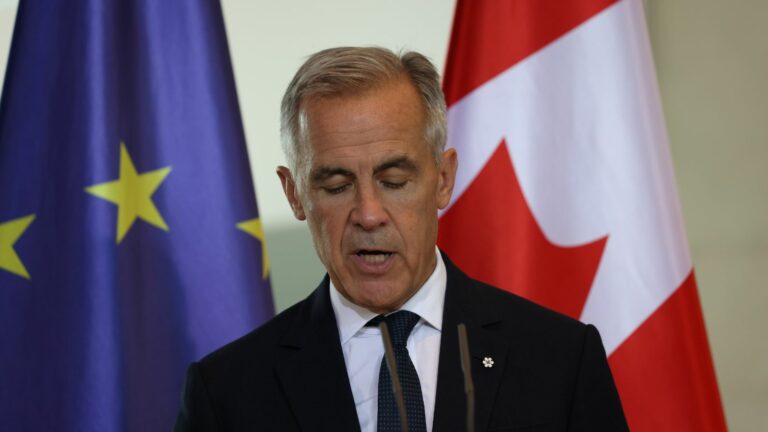
Canada’s worsening trade fight with the United States is pushing Ottawa to think beyond tariffs and export markets. Prime Minister Mark Carney is now exploring a deeper relationship with Europe that could eventually make it easier for Canadians to live and work there, particularly in strategic industries, even as his government insists Canada is not seeking formal European Union membership. The timing is difficult to miss. U.S. President Donald Trump has threatened to raise tariffs on Canadian cars, trucks and automotive parts to 50 per cent on January 1, 2027, while other trade restrictions are already reshaping cross-border business. The result is a two-track Canadian strategy: defend an auto industry still deeply tied to the U.S., while building economic links with Europe strong enough to give workers and companies more room to move.
A Deeper European Partnership Is Moving From Theory to Policy
Carney Looks to Let Canadians Work More Freely in Europe as Trump Threatens New Auto Tariffs
- A Deeper European Partnership Is Moving From Theory to Policy
- CETA Already Gives Some Canadians a Head Start
- Europe Is Already Canada’s Second-Largest Trade Partner
- Defence, Critical Minerals and Digital Trade Are Pulling the Two Sides Closer
- Trump’s Auto Tariff Threat Raises the Pressure
- Canada’s Auto Industry Has Little Room for a Sudden Break With the U.S.
- Europe Is a Hedge, Not a Replacement for the United States
- The Biggest Obstacles Are Political and Legal, Not Just Economic
Reports that Carney was considering “associate membership” in the European Union created an immediate stir, but Ottawa has since pushed back on that label. Carney’s position is more carefully framed: Canada is seeking what he has described as a unique alliance with Europe, not membership in the bloc. The distinction matters. The concept under discussion is less about Canada joining EU institutions and more about removing practical barriers between two economies that already have a trade agreement, shared security interests and expanding industrial ties.
Labour mobility is one of the most striking ideas under consideration. Reporting by Reuters and The Wall Street Journal says discussions have included ways for Canadian workers connected to energy, artificial intelligence, defence and critical-mineral supply chains to move more freely between Canada and Europe. The same reporting says Carney has discussed with French President Emmanuel Macron the possibility of Canadians living and working in the EU without the traditional visa hurdles. No such broad right has been agreed, but even exploratory talks mark a significant expansion of what Ottawa has previously pursued with Brussels.
CETA Already Gives Some Canadians a Head Start
Canada is not starting from zero on labour mobility. The Comprehensive Economic and Trade Agreement, or CETA, already contains a chapter designed to make temporary entry easier for certain business people and skilled professionals. It covers categories such as intra-corporate transferees, investors, contractual service suppliers, independent professionals and short-term business visitors. For some categories, economic-needs tests and numerical limits are restricted, while eligible short-term business visitors can enter without a work permit for up to 90 days in a six-month period.
Those rules are much narrower than the kind of arrangement now being discussed. CETA explicitly does not create general access to the European labour market, permanent employment rights, residency or citizenship. That is why the new conversation is potentially important. A Canadian engineer transferred to a European subsidiary already has pathways that a retail worker or new graduate may not. One recent example of deeper professional integration came in January 2026, when an EU-Canada mutual-recognition agreement for architects became binding, making it easier for qualified architects to have their credentials recognized across the Atlantic.
Europe Is Already Canada’s Second-Largest Trade Partner
The economic foundation for a deeper relationship is substantial. The European Union is Canada’s second-largest trading partner for goods and services after the United States. Canada and the EU recorded about $178.6 billion in two-way goods and services trade in 2025, according to Global Affairs Canada. The European Commission says EU-Canada trade in goods and services has risen sharply since CETA began provisional application in 2017, reaching roughly €130 billion in 2025.
That growth makes worker mobility more than a symbolic diplomatic idea. European companies already employ hundreds of thousands of people through their Canadian affiliates, while Canadian companies maintain large investments across EU member states. Easier movement of specialists, technicians, managers and researchers could make those cross-border investments more useful in practice. A Canadian clean-technology firm opening a facility in France, for example, benefits more from market access if it can also move experienced staff quickly. For Ottawa, that practical link between trade, investment and people is central to turning Europe from a secondary market into a deeper economic partner.
Defence, Critical Minerals and Digital Trade Are Pulling the Two Sides Closer
The labour-mobility discussion is arriving after a year of unusually fast Canada-EU integration in other areas. Canada became the first non-European country allowed to participate in the EU’s Security Action for Europe, or SAFE, procurement instrument. That gives Canadian defence companies a path into joint European procurement at a time when governments across the continent are spending heavily on military readiness and domestic industrial capacity.
The partnership is broadening beyond defence. Canada and the EU launched negotiations in March 2026 for a digital trade agreement designed to complement CETA, while officials are also expanding cooperation on critical minerals, industrial policy and economic security. Those sectors all depend on scarce technical talent. A mine, battery-material project, AI data centre or defence contract may involve engineers, cybersecurity specialists, researchers and managers moving between jurisdictions. In that sense, freer movement for workers is not an isolated immigration proposal. It fits a wider effort to build supply chains in which capital, technology and skilled people can move with fewer barriers.
Trump’s Auto Tariff Threat Raises the Pressure
The urgency on Canada’s side is being driven in large part by Washington. On August 24, Trump threatened to raise U.S. tariffs on Canadian cars, trucks and automotive parts to 50 per cent beginning January 1, 2027. The threat followed the collapse of bilateral trade negotiations and would represent a major escalation from the tariff regime already affecting Canadian vehicle production. Separate U.S. actions in September have also modified 50 per cent duties on selected Canadian products and announced import restrictions affecting certain Canadian goods.
For Canadian auto communities, January is not an abstract deadline. Assembly plants and suppliers make investment decisions months or years ahead, and tariff uncertainty can change where a future vehicle platform is placed. The same is true for parts makers deciding whether to expand tooling in Ontario or follow customers into the United States. Trump has repeatedly argued that manufacturers can avoid tariffs by producing in America. Ottawa’s problem is that the Canadian industry was built around a North American production system in which vehicles and parts routinely cross the border before a finished vehicle reaches a dealership.
Canada’s Auto Industry Has Little Room for a Sudden Break With the U.S.
Canada’s automotive sector supports more than 500,000 workers when the broader supply chain is included, with about 125,000 direct manufacturing jobs. The federal government says the sector contributes more than $16 billion annually to GDP and produced more than 1.2 million passenger vehicles in 2025. Most importantly, more than 90 per cent of Canadian-made vehicles and roughly 60 per cent of Canadian-made auto parts are exported to the United States.
That dependence explains why a 50 per cent tariff threat lands differently in the auto sector than in many other industries. A plant in Ontario cannot simply redirect hundreds of thousands of North American-spec vehicles to Europe overnight. Vehicle standards, dealer networks, shipping costs, consumer preferences and existing contracts all matter. Reuters has also reported that Toyota and Honda together account for more than three-quarters of Canadian vehicle production, illustrating how the dispute reaches well beyond Detroit-based automakers. Europe can provide investment and diversification opportunities, but it cannot instantly replace the scale and geography of the U.S. market.
Europe Is a Hedge, Not a Replacement for the United States
Carney’s European push is therefore better understood as risk reduction than economic separation. Canada remains deeply integrated with the United States, but recent trade data show diversification is no longer theoretical. Global Affairs Canada reported that the U.S. share of Canadian goods and services exports fell to 64.1 per cent in the first quarter of 2026, the lowest level in the available Statistics Canada series, as exports to non-U.S. markets increased. By July, Canadian goods exports to the EU were up 16.6 per cent year over year on a year-to-date basis.
Ottawa is trying to turn that momentum into a structural advantage. Canada has free-trade agreements covering about 1.5 billion consumers and is using its current investment campaign to pitch itself as a stable base for energy, critical minerals, manufacturing and technology. A labour-mobility arrangement with Europe would strengthen that pitch because investors often care as much about access to people as access to tariff-free markets. The strategic goal is not to move Canadian dependence from Washington to Brussels, but to create enough alternatives that a single trade dispute cannot dominate national industrial policy.
The Biggest Obstacles Are Political and Legal, Not Just Economic
Any broad Canada-EU worker agreement would face a complicated path. CETA itself has been provisionally applied since 2017, yet only 17 of the EU’s 27 member states have completed national ratification. Ten still have not. That history is a reminder that ambitious transatlantic agreements can move slowly even when the federal government in Ottawa and European institutions are broadly supportive. Labour mobility also touches immigration rules, professional licensing, labour standards and national authorities in ways that ordinary tariff reductions do not.
There is also a political messaging challenge. Canadian officials have rejected the idea that Ottawa is pursuing EU membership “in any capacity,” even as European and Canadian officials openly talk about a unique new partnership. The next milestones should clarify how ambitious that partnership really is. Carney is scheduled to visit Strasbourg from September 15 to 17 and address the European Parliament, while Canada is due to host the next Canada-EU summit on October 29 and 30. Until a formal proposal appears, visa-free work should be treated as an option under discussion—not a promised new entitlement.
This Options Discord Chat is The Real Deal
While the internet is scoured with trading chat rooms, many of which even charge upwards of thousands of dollars to join, this smaller options trading discord chatroom is the real deal and actually providing valuable trade setups, education, and community without the noise and spam of the larger more expensive rooms. With a incredibly low-cost monthly fee, Options Trading Club (click here to see their reviews) requires an application to join ensuring that every member is dedicated and serious about taking their trading to the next level. If you are looking for a change in your trading strategies, then click here to apply for a membership.