35,000+ smart investors are already getting financial news, market signals, and macro shifts in the economy that could impact their money next with our FREE weekly newsletter. Get ahead of what the crowd finds out too late. Click Here to Subscribe for FREE.
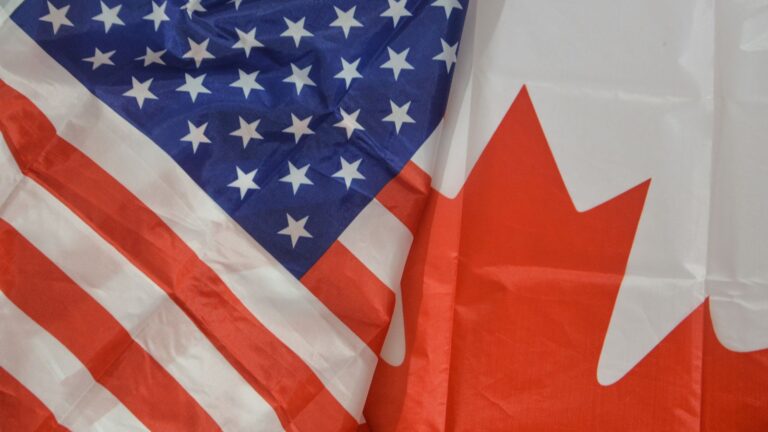
A few kilometres of cold Atlantic water separate Newfoundland from Saint-Pierre-et-Miquelon, but the small French archipelago has suddenly become the setting for a much larger geopolitical conversation. Prime Minister Mark Carney and French President Emmanuel Macron are gathering there as Canada and France deepen cooperation on energy, defence, critical minerals and advanced technology, while questions about sovereignty have gained new prominence across the North Atlantic. The timing is especially striking after U.S. President Donald Trump posted a map showing Canada, Greenland, Iceland and other territories beneath the American flag. Macron has since publicly reaffirmed that Saint-Pierre-et-Miquelon is French territory. Behind the symbolism, however, the meeting also reflects increasingly practical Canadian and European efforts to diversify trade, strengthen security links and reduce strategic dependencies.
A Tiny Territory Is Carrying Outsized Diplomatic Weight
Carney and Macron Meet Off Newfoundland as Trump’s U.S.-Flag Map Raises Sovereignty Stakes
- A Tiny Territory Is Carrying Outsized Diplomatic Weight
- Trump’s Map Changed the Optics of the Visit
- Canada and France Have Been Building a Much Broader Partnership
- Energy Has Given the Meeting an Immediate Economic Purpose
- The North Atlantic Security Picture Is Changing at the Same Time
- Satellites, Quantum Technology and Supercomputing Are Part of the Sovereignty Story
- Canada’s Expanding European Relationship Is Moving Into Uncharted Territory
- For Newfoundland, International Geopolitics Is Also a Local Relationship
- The Real Test Comes After the Symbolic Photographs
Saint-Pierre-et-Miquelon is easy to overlook on a map. France’s official population figures put the archipelago at just 5,790 residents, while the territory covers roughly 242 square kilometres. Yet its location is exceptional: it sits roughly 25 kilometres from Newfoundland and Labrador and gives France a physical presence in North America. Canada and France consequently share an actual maritime border, not merely historical or cultural ties across the Atlantic.
That geography explains why hosting Carney there carries more weight than another bilateral meeting in Paris or Ottawa. Carney is set to become the first Canadian prime minister to make an official visit to the archipelago, while Macron’s trip is the first by a French president since François Hollande visited in 2014. For people living around Newfoundland’s south coast, Saint-Pierre is not an abstract overseas territory. Ferry connections, fishing grounds, tourism and family ties have made the Canadian-French boundary a part of ordinary regional life for generations. The setting therefore allows both leaders to make a global sovereignty point from a place where international borders are remarkably tangible.
Trump’s Map Changed the Optics of the Visit
The diplomatic backdrop shifted on September 7 when Trump posted an image on Truth Social depicting the United States, Canada, Greenland, Iceland, Mexico, Central America and parts of the Caribbean covered by the U.S. flag and labelled “United States of America.” The president provided no explanation with the image. Whatever its intended meaning, governments in the North Atlantic treated the imagery seriously enough to respond publicly. Iceland summoned the U.S. ambassador, with its foreign ministry describing the post as inappropriate.
Saint-Pierre-et-Miquelon was also encompassed by the map, bringing France directly into the discussion. After arriving in the archipelago, Macron said the territory was French and attached to France, describing that status as beyond debate. He has also resisted portraying every part of the visit as a deliberate message to Washington, saying the Canada meeting should be understood as a strong gesture of friendship. That distinction matters. The map heightened the symbolism of the location, but the meeting was already connected to a broader Canada-France agenda involving security, energy and economic diversification.
Canada and France Have Been Building a Much Broader Partnership
The relationship being displayed off Newfoundland has developed well beyond ceremonial diplomacy. Canadian government figures show that merchandise trade between Canada and France reached $15.2 billion in 2025. Canada exported roughly $5 billion in goods to France and imported $10.2 billion. Bilateral merchandise trade has increased by nearly two-thirds over the past decade, and France is now Canada’s third-largest merchandise export market within the European Union.
Security ties have been expanding as well. When Carney met Macron in Paris in June, the two governments announced a General Security of Information Agreement intended to make exchanging classified information easier in areas including defence, aerospace, cybersecurity, artificial intelligence and maritime systems. France has also ordered additional Canadian-built DHC-515 firefighting aircraft. Those developments help explain why the Saint-Pierre meeting includes aerospace, defence and advanced technology alongside sovereignty. The two governments are attempting to turn political alignment into contracts, industrial cooperation and shared research—areas capable of continuing long after the immediate diplomatic tensions with Washington change.
Energy Has Given the Meeting an Immediate Economic Purpose
Energy may be one of the most consequential subjects on the agenda. Macron said before travelling to Saint-Pierre-et-Miquelon that France was seeking to strengthen trade with Canada in petroleum products and liquefied natural gas as Paris works to secure alternative supplies during heightened Middle East instability and pressure on global fuel markets. French officials have specifically identified diesel, aviation fuel and natural gas as areas of concern.
Canada has increasingly strong production numbers to bring to that discussion. The Canada Energy Regulator reported that Canadian natural-gas output averaged about 19 billion cubic feet per day in 2025, setting an annual record, while production reached 20 billion cubic feet per day in November. LNG Canada also began exports from Kitimat, British Columbia, in June 2025. There is an important logistical limitation, however: those initial Canadian LNG shipments have primarily served East Asian markets from the Pacific coast. A deeper Canadian role in European energy security therefore requires more than political agreement. Infrastructure, shipping routes, long-term contracts and future export capacity determine whether diplomatic ambition becomes significant physical supply.
The North Atlantic Security Picture Is Changing at the Same Time
Saint-Pierre-et-Miquelon sits well south of the Arctic Circle, but the meeting is taking place within a wider debate over North Atlantic and Arctic security. Canada and France are both NATO members, and Ottawa says the two governments are also cooperating through the European Union’s SAFE defence initiative. Their discussions come as governments across the region invest more attention in maritime surveillance, defence procurement, critical infrastructure and the security of Arctic approaches.
Greenland makes the timing particularly notable. Denmark, Greenland and the United States announced on September 18 that they expect to conclude a new agreement strengthening security in Greenland and the wider Arctic and North Atlantic region. Copenhagen and Nuuk have said the arrangement recognizes the sovereignty and territorial integrity of the Kingdom of Denmark and Greenlanders’ right to self-determination, even as Washington gains a stronger long-term security role. The development illustrates the balance confronting Western governments: they continue to rely heavily on U.S. military capabilities while simultaneously emphasizing that sovereignty and territorial decisions remain with the territories and countries concerned.
Satellites, Quantum Technology and Supercomputing Are Part of the Sovereignty Story
Some of the most significant subjects on the agenda are less visible than ships or military bases. Ottawa says Carney and Macron plan to discuss satellites, quantum technologies and supercomputing alongside energy, aerospace and minerals. Canada and France already signed a joint statement on quantum science and technology cooperation in May, aimed at research, commercialization, workforce development and more resilient technological supply chains.
Saint-Pierre itself offers an unusually concrete example of how technology intersects with geography. France’s CNES space agency lists a satellite-navigation station on Saint-Pierre that tracks several constellations, including Europe’s Galileo network as well as GPS. European documents have also identified Saint-Pierre-et-Miquelon as part of Galileo ground infrastructure planning. Such facilities help explain why small territories can matter strategically far beyond their population. Satellite navigation, communications cables, computing capacity and secure data systems increasingly form part of national resilience. For Canada and France, technological sovereignty therefore means not simply developing sophisticated products but maintaining trusted infrastructure, research partnerships and supply chains that governments can continue operating during international disruption.
Canada’s Expanding European Relationship Is Moving Into Uncharted Territory
The Saint-Pierre meeting also arrives only days after European Commission President Ursula von der Leyen proposed opening the door to Canada becoming the European Union’s first “associate member.” That phrase sounds dramatic, but its meaning remains unsettled. No formal associate-member category currently exists in EU treaties, and creating a substantial new status would require political agreement among European governments. Carney has supported deeper integration with Europe while making clear that Canada is not pursuing ordinary EU membership.
There is already a major economic foundation through the Comprehensive Economic and Trade Agreement. CETA has been provisionally applied since September 2017 and removes tariffs on the overwhelming majority of tariff lines. Yet it also demonstrates how slowly major international arrangements can move: only 17 EU member states have completed national ratification, while 10—including France—still have not. The European Commission nevertheless says two-way goods trade has risen by more than 75% and services trade by 97% during the period of provisional application. The emerging conversation is therefore about building on an existing relationship rather than creating one from scratch.
For Newfoundland, International Geopolitics Is Also a Local Relationship
The Canada-France border around Saint-Pierre-et-Miquelon has generated practical issues long before the current tensions with Washington. A 1992 international arbitration established the maritime boundary around the islands after a long dispute over offshore jurisdiction. Fisheries remain particularly important. Fisheries and Oceans Canada says Canada and France have held annual consultations since 1994 concerning jointly managed stocks in the 3Ps fishing area, including cod, redfish, American plaice and witch flounder.
The modern relationship extends well beyond fish. Canadian officials describe cooperation with Saint-Pierre-et-Miquelon in marine safety, law enforcement, environmental protection, border management, tourism and transportation. Residents of the French territory also depend on Newfoundland and Labrador for some services and transportation connections. Those everyday links help humanize what can otherwise sound like abstract debate about sovereignty. A line on a map can determine fishing access, border procedures, ferry travel, emergency cooperation and livelihoods. It is one reason the U.S.-flag image received attention locally: maps in this region are connected to legal rights and economic arrangements that have been negotiated in detail over decades.
The Real Test Comes After the Symbolic Photographs
Carney’s official schedule underscores the combination of symbolism and substance. The Canadian itinerary calls for a working lunch with Macron, a wreath-laying ceremony and a joint statement before Carney returns to Ottawa. The memorial ceremony recognizes Free France volunteers, adding another historical layer to a visit already centred on sovereignty, security and international alliances. Regional cooperation involving fishing, transportation, travel, academic exchanges and trade is also expected to feature in discussions.
What should not be assumed before the leaders announce it is that every ambition discussed in Saint-Pierre will immediately become a binding deal. Energy exports depend on infrastructure and commercial contracts. A deeper Canada-EU framework must navigate European institutions and member governments. Defence cooperation requires procurement decisions, funding and implementation. Advanced-technology partnerships need investment and working projects. The significance of the meeting is therefore twofold: the location gives Canada and France a conspicuous opportunity to affirm existing borders, while the agenda provides several measurable areas in which closer cooperation could eventually become visible in trade flows, procurement, research and regional activity.
This Options Discord Chat is The Real Deal
While the internet is scoured with trading chat rooms, many of which even charge upwards of thousands of dollars to join, this smaller options trading discord chatroom is the real deal and actually providing valuable trade setups, education, and community without the noise and spam of the larger more expensive rooms. With a incredibly low-cost monthly fee, Options Trading Club (click here to see their reviews) requires an application to join ensuring that every member is dedicated and serious about taking their trading to the next level. If you are looking for a change in your trading strategies, then click here to apply for a membership.