35,000+ smart investors are already getting financial news, market signals, and macro shifts in the economy that could impact their money next with our FREE weekly newsletter. Get ahead of what the crowd finds out too late. Click Here to Subscribe for FREE.
Canada’s political debate over the United States is shifting from how to survive a tariff fight to what kind of relationship should emerge afterward. Conservative Leader Pierre Poilievre is making the case that Canada and the United States should tear down their trade barriers and rebuild around tariff-free commerce, arguing that decades of economic and security cooperation still provide a foundation for a reset. Industry Minister Mélanie Joly is taking a different view of what comes next. While also seeking the removal of tariffs, she says the relationship has undergone a lasting rupture and Canada must reduce its dependence on its largest trading partner. With billions of dollars of goods caught in retaliatory measures, CUSMA now subject to annual reviews and crucial industries facing uncertainty, the difference between those two outlooks is becoming increasingly consequential.
Poilievre Takes His Tariff-Free Pitch Directly to Americans
Poilievre Pushes Tariff-Free U.S. Reset as Joly Says Canada-U.S. Relationship ‘Will Never Be the Same’
- Poilievre Takes His Tariff-Free Pitch Directly to Americans
- Joly Says Removing Tariffs Would Not Undo the Rupture
- Ottawa and the Conservatives Agree on Tariffs More Than the Rhetoric Suggests
- The Tariff Fight Is Already Measured in Tens of Billions of Dollars
- Even a Damaged Relationship Remains Economically Enormous
- CUSMA Is Still Alive, but Its Future Has Become Less Predictable
- The Auto Industry Shows Why Canada Cannot Easily Untangle From the U.S.
- Canada Is Diversifying Faster, but Diversification Is Not the Same as Decoupling
- Uncertainty Can Hurt Even Companies That Never Pay a Tariff
- The Next Few Weeks Could Show How Far the Relationship Has Shifted
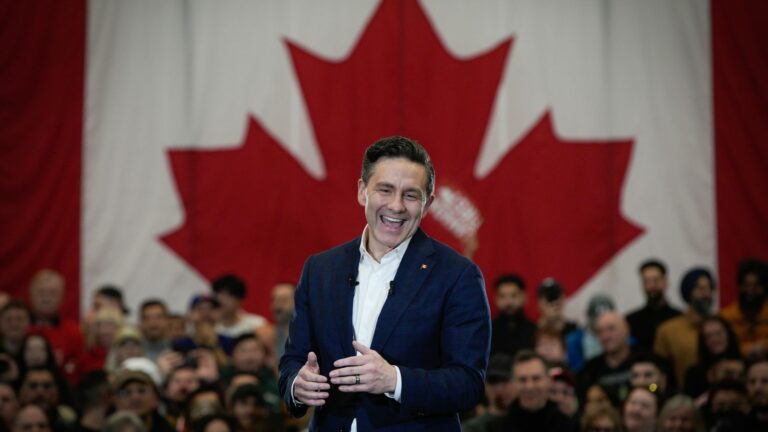
Poilievre’s argument is built around restoring an economic relationship that, for decades, treated increasingly open trade as a shared North American advantage. During a recent trip to New York, the Conservative leader met with investors, employers and business figures while taking his message to American television audiences. His central proposal was straightforward: Canada and the United States should dismantle the tariffs imposed during the current dispute and return to freer two-way trade. He has argued that tariffs raise costs, discourage investment and weaken two economies whose industries remain deeply interconnected.
The pitch is also deliberately broader than economics. Poilievre has emphasized the countries’ military cooperation, shared security interests and long history of cross-border ties, including Canada’s response after the September 11 attacks. His argument is that Washington should view Canada as part of a stronger North American economic bloc rather than as a commercial adversary. That does not mean ignoring diversification, which Poilievre has also acknowledged is already happening. It means attempting to repair the U.S. relationship rather than assuming its previous structure is permanently gone.
Joly Says Removing Tariffs Would Not Undo the Rupture
Joly’s position begins from a different strategic assumption. Speaking on September 19, the Industry Minister said Prime Minister Mark Carney was right to describe recent events as a rupture and said the relationship with the United States would never return to what it once was. She pointed specifically to building Canadian economic capacity and strengthening relationships with Europe and Asia as ways to reduce the country’s vulnerability to decisions made in Washington.
That does not mean Joly is advocating abandoning the American market. During a recent visit to Chicago, she met Illinois Governor J.B. Pritzker and discussed efforts to eliminate tariffs, while also meeting businesses. The distinction is important: the government continues seeking better access to the U.S. market while simultaneously treating excessive dependence on that market as a strategic risk. For a manufacturer deciding where to build its next plant, that change in thinking matters. Ottawa’s emerging position is that even a successful tariff settlement should not lead Canada back to the same level of economic reliance that existed before the dispute.
Ottawa and the Conservatives Agree on Tariffs More Than the Rhetoric Suggests
The political divide can sound sharper than it actually is on the immediate issue. Both Poilievre and the Carney government want major U.S. tariffs removed. Carney’s stated negotiating objectives have included preserving tariff-free U.S. access for most Canadian businesses, significantly reducing tariffs on strategic sectors and restoring greater predictability. Poilievre similarly argues for the elimination of barriers on both sides of the border. Neither side is proposing that permanent tariffs should become the normal foundation of Canada-U.S. commerce.
Where they differ more clearly is in the assumptions surrounding a successful settlement. Poilievre stresses the durability of the partnership and the possibility of rebuilding trust through free trade and shared North American interests. Carney and Joly emphasize resilience if Washington changes policy again. That produces two overlapping but distinct approaches: restore as much tariff-free continental trade as possible, or restore it while simultaneously reducing the consequences of losing it. Canadian companies making long-term investment decisions are effectively being asked to operate in both worlds—maintaining American customers while developing alternatives elsewhere.
The Tariff Fight Is Already Measured in Tens of Billions of Dollars
The dispute is no longer primarily about threats. On August 22, the United States implemented additional 50 per cent duties affecting roughly $27.6 billion of Canadian goods after bilateral negotiations failed to produce an agreement. Canada responded with matching countermeasures covering $27.6 billion of American imports. Those Canadian measures came into effect September 8, with rates of 15, 25 or 50 per cent depending on the product.
The targeted categories make the confrontation tangible for companies far removed from Ottawa or Washington. Canadian counter-tariffs cover goods across steel and aluminum, dairy, appliances, agricultural equipment, pulp and paper, electronics and other categories. Some steel and aluminum counter-tariffs that had previously been 25 per cent rose to 50 per cent, while existing Canadian measures on American automobiles also remain. Tariffs do not automatically translate into equivalent retail price increases because companies can absorb costs, change suppliers or qualify for relief. They nevertheless alter margins and purchasing decisions, especially for manufacturers that depend on components crossing the border before a finished product is sold.
Even a Damaged Relationship Remains Economically Enormous
Diversification has accelerated, but the scale of Canada-U.S. commerce explains why no federal government can realistically treat the relationship as secondary. U.S. government figures put total bilateral trade in goods and services at approximately US$872.3 billion in 2025. Statistics Canada reported that 71.7 per cent of Canadian merchandise exports still went to the United States that year, even after that share fell significantly from 75.9 per cent in 2024.
More recent numbers show both the vulnerability and the beginnings of a shift. Canadian merchandise exports to the United States dropped 6.6 per cent in July 2026, while imports from the U.S. increased 1.8 per cent. Canada’s monthly merchandise surplus with the United States consequently fell from $10.3 billion in June to $5.9 billion in July. At the same time, exports to countries other than the U.S. climbed 7.4 per cent to a record $25.6 billion. That combination helps explain why Ottawa can credibly talk about diversification without pretending that another market can quickly replace the United States.
CUSMA Is Still Alive, but Its Future Has Become Less Predictable
The North American trade agreement remains one of the biggest reasons most bilateral commerce continues without tariffs. The scheduled CUSMA joint review took place on July 1, 2026. Canada and Mexico supported extending the agreement for another 16-year period, but the United States did not agree to the extension at that time. Instead, Washington indicated that it wanted continued discussions over what it considers shortcomings in the agreement and its trade deficits with its neighbours.
That outcome did not terminate CUSMA. The agreement remains in force, potentially until 2036, but the three countries now enter an annual review process. Each review provides another opportunity to agree on a new 16-year extension. For businesses, the distinction between legal continuity and commercial certainty is significant. A factory may continue receiving CUSMA treatment today while executives remain unsure about the rules that will govern an investment expected to operate for 20 years. Poilievre’s tariff-free message targets that uncertainty directly, while the government’s diversification strategy is designed partly to reduce Canada’s exposure to it.
The Auto Industry Shows Why Canada Cannot Easily Untangle From the U.S.
Few sectors demonstrate the stakes more clearly than automobiles. Federal figures say more than 90 per cent of vehicles manufactured in Canada and about 60 per cent of Canadian-made auto parts are exported to the United States. The broader Canadian auto sector supports more than 500,000 workers, including approximately 125,000 direct manufacturing jobs, while contributing more than $16 billion annually to Canadian GDP.
That integration developed over generations, creating supply chains in which components can cross the border several times before a completed vehicle reaches a dealership. Since April 2025, Canadian-made vehicles have faced a 25 per cent U.S. tariff on their non-U.S. content, with U.S. content in qualifying CUSMA vehicles exempted. Canada has its own 25 per cent counter-tariffs on non-CUSMA-compliant U.S. vehicles and certain content in CUSMA-compliant American vehicles. For workers and suppliers in communities such as Windsor, Oshawa and the industrial corridor across southern Ontario, tariff policy is therefore not an abstract diplomatic dispute. It can influence production schedules, investment decisions and future model allocations.
Canada Is Diversifying Faster, but Diversification Is Not the Same as Decoupling
Joly’s argument that Canada must strengthen connections beyond the United States is already visible in trade statistics. Global Affairs Canada reported that Canadian exports to non-U.S. markets increased 11.1 per cent in 2025 while exports to the United States declined 3.7 per cent. Non-U.S. destinations accounted for 32.8 per cent of Canadian exports, the highest share in more than four decades. Europe, the Indo-Pacific and other markets are becoming more prominent in Canada’s trade strategy.
The government is now pushing that process further. Carney travelled to Europe in September to advocate a substantially deeper Canada-European Union partnership spanning critical minerals, defence, energy, artificial intelligence, financial services and digital trade. Canada-EU goods and services trade reached approximately $178 billion in 2025, making the EU Canada’s second-largest global trading partner. Even so, diversification operates from a very different base than the U.S. relationship. Geography, transportation networks and decades of integrated investment make replacing American commerce impractical. The realistic objective is greater choice and bargaining room rather than economic separation.
Uncertainty Can Hurt Even Companies That Never Pay a Tariff
A tariff’s direct cost is only part of its economic impact. Businesses considering a new factory, warehouse or equipment purchase must make assumptions about future market access, and those assumptions become harder when trade rules can change abruptly. The Bank of Canada warned in September that new U.S. tariffs and heightened uncertainty could cause Canadian companies to delay investment and hiring even outside the sectors directly targeted.
The Bank estimated that goods affected by the newest American tariffs represented roughly 5 per cent of Canadian exports to the United States. That suggests the immediate economy-wide hit from those specific measures may be limited compared with their effect on exposed industries. The broader concern is confidence. A parts supplier that avoids the tariff may still postpone expansion if its largest customer is affected. A company deciding between plants in Ontario and an American state may place greater value on tariff risk than it once did. That is where the Poilievre and Joly approaches converge indirectly: both seek greater certainty, but they differ over how much future certainty Washington can realistically provide.
The Next Few Weeks Could Show How Far the Relationship Has Shifted
Canada-U.S. tensions remain capable of escalating further. The White House has already announced that certain Canadian motor-vehicle-related products and certain alcoholic beverages currently facing additional duties are scheduled to be excluded from U.S. importation beginning September 29, unless the policy changes before then. Those measures turn the dispute from a question of how expensive some trade becomes into whether specific covered goods can enter the American market at all.
At the same time, diplomatic channels remain open. Carney is scheduled to be in New York from September 21 to 23 for the United Nations General Assembly, where his government says he will meet international leaders and investors as part of its broader diversification effort. As of September 19, Canadian officials said no meeting with the Trump administration had been scheduled. The central Canadian debate therefore remains unresolved. Poilievre is betting that shared interests can underpin a renewed tariff-free North American relationship. Joly and Carney are preparing for a future in which cooperation with Washington remains essential, but dependence on it carries costs Canada no longer wants to accept.
This Options Discord Chat is The Real Deal
While the internet is scoured with trading chat rooms, many of which even charge upwards of thousands of dollars to join, this smaller options trading discord chatroom is the real deal and actually providing valuable trade setups, education, and community without the noise and spam of the larger more expensive rooms. With a incredibly low-cost monthly fee, Options Trading Club (click here to see their reviews) requires an application to join ensuring that every member is dedicated and serious about taking their trading to the next level. If you are looking for a change in your trading strategies, then click here to apply for a membership.