35,000+ smart investors are already getting financial news, market signals, and macro shifts in the economy that could impact their money next with our FREE weekly newsletter. Get ahead of what the crowd finds out too late. Click Here to Subscribe for FREE.
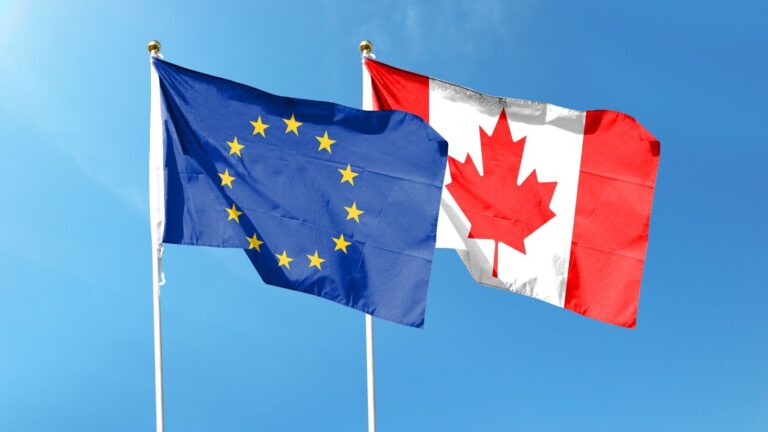
Canada’s effort to build a deeper relationship with Europe has suddenly moved from diplomatic ambition to a potentially historic experiment. European Commission President Ursula von der Leyen has opened the door to Canada becoming the European Union’s first “associate member,” proposing a new relationship that would reach well beyond the trade agreement already linking the two economies.
The proposal comes as Prime Minister Mark Carney’s government tries to reduce Canada’s vulnerability to disruptions in its relationship with the United States. Yet this is not an invitation to become a conventional EU member. The proposed status does not currently exist in EU treaties, and its rules have not been negotiated. What has emerged instead is the possibility of a new category of partnership built around trade, defence, technology, energy, critical minerals and economic security.
The Offer Is Historic, but It Is Still Only an Opening
EU Opens Door to Canada as Its First ‘Associate Member’ as Ottawa Looks Beyond the U.S.
- The Offer Is Historic, but It Is Still Only an Opening
- Carney Has Drawn a Line Between Membership and Alliance
- CETA Gives Both Sides a Ready-Made Economic Base
- Canada’s U.S. Dependence Explains the Urgency
- Defence Cooperation Is Already Moving Faster Than Trade
- Critical Minerals, Energy and Technology Are at the Centre
- The Proposed Status Would Need Rules That Do Not Yet Exist
- CETA’s Incomplete Ratification Shows How Slow Europe Can Move
- Political Ties Are Deepening Before the Legal Framework Exists
- The October Summit Is the Next Concrete Test
Von der Leyen delivered the proposal during her September 16 State of the European Union address in Strasbourg, with Carney in attendance. She said she wanted to work with Canada on opening the door for it to become the EU’s first associate member. The significance lies partly in the language: the European Union currently has 27 member states, but it has no formal category called “associate member” written into its treaties. Creating such a relationship would therefore require the two sides to define what the term actually means.
That makes the announcement more consequential than a routine diplomatic upgrade, but also much less settled than the word “member” might suggest. There is no agreement giving Canada votes in EU institutions, automatic access to the single market or a role in EU lawmaking. Those questions remain open. The immediate development is political: the head of the European Commission has publicly endorsed building a special institutional relationship with Canada that goes beyond the EU’s conventional arrangements with most outside partners.
Carney Has Drawn a Line Between Membership and Alliance
Carney had already tried to prevent the discussion from being interpreted as a Canadian attempt to join the EU in the conventional sense. Days before von der Leyen’s announcement, he said Canada was not seeking European Union membership. Instead, Ottawa was pursuing what he described as a “unique alliance,” built around areas where Canadian and European interests increasingly overlap. That distinction matters because the normal EU accession process is designed for European states.
The political logic is nevertheless clear. Ottawa’s own description of Carney’s European trip says the government is strengthening Canada at home while “diversifying our partnerships abroad.” Europe is being treated as one of the most important pieces of that strategy. Canada and the EU already cooperate on Ukraine, defence, trade and economic security, so neither side is starting from scratch. What could change is the depth of the relationship: rather than maintaining separate agreements for individual fields, an associate framework could potentially bring several forms of cooperation under a broader strategic umbrella.
CETA Gives Both Sides a Ready-Made Economic Base
The strongest foundation is the Comprehensive Economic and Trade Agreement, or CETA, which has been provisionally applied since September 2017. The results help explain why policymakers believe a deeper partnership has something concrete to build on. EU figures show that trade in goods and services between Canada and the bloc exceeded €130 billion in 2025. Combined goods-and-services trade was more than 81% higher than in 2016, the year before provisional application began.
CETA also removed the overwhelming majority of tariffs between the two markets. About 98% of tariff lines were eliminated when provisional application began, with the agreement designed to eliminate duties on 99% overall. The EU remains Canada’s second-largest trading partner after the United States. European investment is significant as well: EU foreign direct investment stocks in Canada were valued at €244.7 billion in 2024, while Canadian investment stocks in the EU stood at about €230 billion. Associate status, therefore, would deepen an economic relationship that is already large rather than create one from nothing.
Canada’s U.S. Dependence Explains the Urgency
No European relationship can quickly reproduce the extraordinary economic integration between Canada and the United States. Statistics Canada reported that 71.7% of Canadian merchandise exports still went to the U.S. in 2025, even after that share fell from 75.9% in 2024. Global Affairs Canada’s customs-based figures similarly put the share at roughly 72.5%. Geography, pipelines, highways, rail networks and decades of integrated manufacturing have created commercial links that cannot simply be redirected across the Atlantic.
But 2025 also demonstrated that diversification can happen when economic conditions change. Canadian merchandise exports to the United States declined, while exports to non-U.S. markets rose sharply. Statistics Canada reported a 17.2% increase in merchandise exports to countries other than the U.S. for the year. Ottawa’s European strategy is therefore better understood as an attempt to reduce concentration risk rather than replace the American market. Even a substantially expanded EU relationship would leave the United States as an indispensable Canadian economic partner for the foreseeable future.
Defence Cooperation Is Already Moving Faster Than Trade
One of the most concrete examples of the changing relationship is defence procurement. Canada formally joined the European Union’s Security Action for Europe, or SAFE, initiative in February 2026. The €150-billion financing instrument is intended to help eligible EU countries acquire military capabilities and expand joint procurement. Canadian government documents describe Canada as the only non-European country currently participating under such preferential terms.
The agreement also gives Canadian defence companies unusually broad access to SAFE-supported contracts. Canadian industry can account for as much as 80% of the contract value in qualifying procurements, compared with a substantially lower threshold normally applicable to third countries. That creates opportunities in areas including ammunition, air and missile defence, drones, military mobility and emerging technologies. Defence ties had already accelerated when Canada and the EU signed a Security and Defence Partnership in June 2025. In practical terms, this means one element of the proposed deeper alliance is already being tested: Canadian companies and European governments are learning how far industrial integration can go without Canada being an EU member.
Critical Minerals, Energy and Technology Are at the Centre
The envisioned relationship reaches far beyond conventional tariffs. Von der Leyen highlighted cooperation involving technology, energy, critical raw materials and the Arctic, areas that have become increasingly connected to national security. Canada possesses significant mineral and energy resources, while European governments are trying to diversify supply chains for materials needed in batteries, defence systems, renewable-energy infrastructure, semiconductors and advanced manufacturing.
Canada and the EU already operate a Strategic Partnership on Raw Materials, focused on strengthening secure and sustainable mineral supply chains. In March 2026, Canadian and European officials also formally launched negotiations for a Digital Trade Agreement intended to complement CETA. Those talks are expected to address the rules underpinning an increasingly digital transatlantic economy. By September, Global Affairs Canada was describing digital trade, critical minerals, economic security and defence-industrial cooperation as areas where substantial progress had occurred. An associate framework could therefore serve less as a traditional free-trade agreement and more as an organizing structure linking multiple strategic sectors that previously operated through separate initiatives.
The Proposed Status Would Need Rules That Do Not Yet Exist
The greatest uncertainty is legal rather than rhetorical. Article 49 of the Treaty on European Union says that a state seeking ordinary EU membership must be a European state and meet the bloc’s democratic and institutional criteria. Canada therefore does not fit the normal accession pathway. “Associate member,” meanwhile, is not an existing category in the treaties. Von der Leyen’s proposal effectively raises the possibility of designing something new.
That leaves major questions unanswered. It is not yet clear whether an eventual arrangement could include greater access to the EU single market, freer movement for workers, participation in research or education programs, mutual recognition of professional qualifications, regulatory coordination or financial contributions to European programs. Voting rights are another obvious issue. Norway, for example, participates deeply in the European single market without having a vote over EU legislation, but there is no indication that its model will simply be copied for Canada. Until negotiations produce text, comparisons with Norway, Switzerland or Britain remain useful illustrations rather than blueprints for what Canada would receive.
CETA’s Incomplete Ratification Shows How Slow Europe Can Move
The existing trade agreement also provides a warning about the institutional difficulties ahead. CETA has been provisionally applied for almost nine years, yet it has still not been fully ratified across the European Union. European Commission records show that 17 of the EU’s 27 member states have completed national ratification, leaving 10 that have not, including France, Italy, Belgium, Ireland and Poland.
Most commercially important sections of CETA continue to operate under provisional application, which is why trade has been able to grow despite the unfinished process. Still, the ratification record illustrates how an ambitious Canada-EU agreement can encounter domestic politics in individual European countries. A new associate relationship could raise even more complicated questions involving regulation, mobility, spending, institutional participation and sovereignty. Von der Leyen’s support gives the project considerable political momentum, but it does not eliminate the role of EU governments, institutions and, depending on the final legal structure, potentially national legislatures. The details will determine how quickly the idea can move beyond speeches.
Political Ties Are Deepening Before the Legal Framework Exists
The institutional courtship has already become unusually visible. Canada’s foreign affairs minister participated in an informal meeting of EU foreign ministers in Ireland in September, the first time a Canadian foreign minister had attended such a gathering. The European Parliament has also approved plans for an office in Ottawa to facilitate exchanges with Canadian parliamentarians and expand engagement on issues including the Arctic, security and transatlantic trade.
Carney’s presence in Strasbourg reinforces the symbolism. He attended von der Leyen’s State of the Union address and is engaging directly with the leadership of the European Parliament and Commission as Ottawa searches for a more formal relationship. These developments do not amount to associate membership, but they show how rapidly the political infrastructure around the partnership is expanding. The emerging pattern is unusual: defence access, ministerial participation, parliamentary infrastructure and economic negotiations are advancing before anyone has settled exactly what the final umbrella arrangement should be called or what legal privileges it will contain.
The October Summit Is the Next Concrete Test
The next major checkpoint is the Canada-EU summit scheduled for October 29 and 30, 2026, in Canada. Officials had already been preparing the meeting before von der Leyen publicly embraced the associate-member concept. The summit now offers a venue where both sides can begin turning broad political language into specific negotiating priorities. Digital trade, defence procurement, critical minerals and economic security are already on the agenda and could provide relatively practical early deliverables.
The larger question is whether “associate member” develops into a clearly defined legal and economic category or remains shorthand for an exceptionally close partnership. For Canada, the attraction is greater access to European markets, investment, technology and strategic supply chains while reducing exposure to any single trading relationship. For Europe, Canada offers resources, defence-industrial capacity and a politically aligned partner across the Atlantic. None of that means Canada is leaving the North American economy behind. What has changed is Ottawa’s willingness to build alternatives—and Europe’s willingness to consider a type of relationship it has never offered before.
This Options Discord Chat is The Real Deal
While the internet is scoured with trading chat rooms, many of which even charge upwards of thousands of dollars to join, this smaller options trading discord chatroom is the real deal and actually providing valuable trade setups, education, and community without the noise and spam of the larger more expensive rooms. With a incredibly low-cost monthly fee, Options Trading Club (click here to see their reviews) requires an application to join ensuring that every member is dedicated and serious about taking their trading to the next level. If you are looking for a change in your trading strategies, then click here to apply for a membership.