35,000+ smart investors are already getting financial news, market signals, and macro shifts in the economy that could impact their money next with our FREE weekly newsletter. Get ahead of what the crowd finds out too late. Click Here to Subscribe for FREE.
Prime Minister Mark Carney’s trip to Europe is landing at a moment when Canada’s economic map is being redrawn under pressure. Ottawa is trying to reduce the risks created by its overwhelming dependence on the United States just as President Donald Trump’s trade measures have widened into tariffs, import bans and an unsettled future for the North American trade framework.
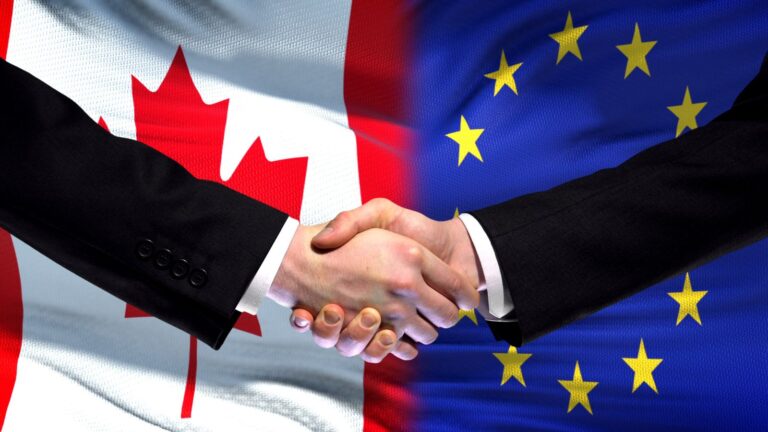
Carney’s September 15–17 visit to Strasbourg and Liverpool is therefore about more than diplomacy. It is a test of how far Canada can deepen economic, security and technology ties with Europe without pretending its geography has changed. The emerging Canada–EU agenda already spans trade, defence procurement, critical minerals, artificial intelligence and labour mobility. What remains unresolved is how much of that ambition can be turned into durable market access—and how quickly.
Europe Trip Becomes a Strategic Signal
Carney Heads to Europe as Trump Trade Fight Pushes Canada Toward a Deeper EU Alliance
- Europe Trip Becomes a Strategic Signal
- A “Unique Alliance” Stops Short of EU Membership
- The U.S. Trade Fight Adds Urgency
- CETA Gives Ottawa a Running Start
- Defence Cooperation Is Already Moving Faster
- Energy, Minerals and AI Could Define the Next Phase
- Mobility Could Become the Most Visible Test
- The Partnership Has Real Political and Legal Limits
- Europe Can Diversify Canada, But It Cannot Replace the U.S.
Carney’s European itinerary is unusually concentrated around institutions that can shape Canada’s next phase of foreign economic policy. The Prime Minister’s Office says he is travelling to Strasbourg, France, and Liverpool, United Kingdom, from September 15 to 17. In Strasbourg, he is scheduled to attend European Commission President Ursula von der Leyen’s State of the Union address, meet senior EU figures and, on September 17, deliver a formal address to the European Parliament. Parliament President Roberta Metsola’s published agenda lists Carney’s formal address for 11:30 a.m. local time, underscoring the attention European institutions are giving the visit.
The second leg moves from EU institutions to bilateral European ties. In Liverpool, Carney is scheduled to meet British Prime Minister Andy Burnham, with defence and security, energy, artificial intelligence and critical minerals on the agenda. That combination matters because Ottawa is not treating Europe as a single trade file. It is building overlapping relationships with the EU, the United Kingdom and individual European governments. The approach gives Canada more potential routes for investment, procurement and technology cooperation while Washington remains the country’s dominant economic partner.
A “Unique Alliance” Stops Short of EU Membership
Carney has been careful to define what Ottawa is seeking—and what it is not. After reports that Canadian and European officials had discussed some form of associate status, he said Canada was not seeking membership in the European Union. Instead, Ottawa intends to begin discussions toward what he called a “unique alliance,” arguing that Canada and Europe share many priorities and have complementary economic strengths. The distinction is significant because full EU membership would involve legal and political questions that neither government is currently proposing to resolve.
The European Commission has also avoided endorsing a specific new institutional label. During a September 14 briefing, a Commission spokesperson described Canada as a strategically important partner and close friend, said ambitions for cooperation were increasing and pointed toward the next Canada–EU summit scheduled for October 29–30. Officials declined to spell out what a new legal model might look like. That leaves the immediate project more practical than constitutional: expand access, investment and cooperation where interests overlap while working within existing European treaty structures. The emerging relationship is therefore more likely to be constructed sector by sector than through a sudden new membership category.
The U.S. Trade Fight Adds Urgency
The push toward Europe is unfolding against a much sharper Canada–U.S. trade confrontation than existed when the Canada–EU trade deal first took effect. In July, the Trump administration used Section 338 of the Tariff Act of 1930 to impose additional 50% tariffs on specified Canadian products, arguing that Canadian policies discriminated against American exports. Washington escalated again in September by banning certain Canadian products and changing the scope of earlier measures. Canada, meanwhile, imposed retaliatory tariffs on roughly $20 billion of U.S. exports, according to the White House’s description of the latest escalation.
The wider North American trade framework has also become less certain. The Trump administration declined in July to extend the U.S.-Mexico-Canada Agreement at its six-year review, beginning a longer process that could eventually lead to the pact expiring if the three countries cannot settle their differences. U.S. and Mexican officials have held bilateral negotiations covering automobiles, steel, aluminum, agriculture and other issues, while Canada has faced a separate confrontation with Washington. Against that backdrop, deeper European relationships are not simply about finding additional customers. Ottawa is trying to reduce the damage that can occur when one overwhelmingly important partner abruptly changes tariff treatment, procurement access or industrial rules.
CETA Gives Ottawa a Running Start
Canada is not arriving in Europe without an economic foundation. The Comprehensive Economic and Trade Agreement, better known as CETA, has been provisionally applied since September 2017 and removed tariffs on the overwhelming majority of goods traded between Canada and the European Union. European Commission figures show bilateral trade in goods and services reached roughly €130 billion in 2025, about 80% higher than the €72.1 billion recorded in 2016. Ottawa separately estimates Canada–EU goods-and-services trade at approximately C$178 billion in 2025 and identifies the EU as Canada’s second-largest global trading partner.
Those numbers give Carney something more useful than a blank negotiating page: a functioning commercial relationship that can be expanded. Canadian merchandise exports to the EU rose 23.4% in 2025, according to Global Affairs Canada, with particularly strong growth involving products such as mineral fuels and oils, aluminum and oilseeds. Yet CETA also illustrates how difficult deeper European integration can be. Seventeen of the EU’s 27 countries have completed national ratification, leaving 10 still outstanding. Most of the agreement already applies provisionally, but some provisions cannot fully take effect until the remaining ratifications are completed. Political ambition in Brussels does not always translate quickly into domestic approval across 27 capitals.
Defence Cooperation Is Already Moving Faster
Security may be the area where Canada–EU integration has advanced most visibly. At the June 2025 Canada–EU summit, the two sides signed a Security and Defence Partnership covering areas including defence-industry cooperation, military mobility, maritime security, cybersecurity, hybrid threats and support for Ukraine. The agreement provided a broader political framework for cooperation that had previously been spread across several channels. It also showed that the relationship was expanding well beyond conventional trade diplomacy into questions of industrial capacity, military readiness and strategic resilience.
That shift became considerably more concrete in 2026 when Canada joined the EU’s Security Action for Europe, or SAFE, framework. The Council of the European Union formally concluded Canada’s participation agreement in June, making Canada the first non-European country whose companies and products can participate under the instrument’s procurement arrangements. SAFE provides for up to €150 billion in loans to EU member states investing in defence. For Canadian aerospace, defence and technology firms, participation potentially opens doors into a much larger procurement ecosystem. It also offers a working example of what Carney’s broader alliance concept could become: negotiated Canadian access to important European programs without requiring Canada to join the EU itself.
Energy, Minerals and AI Could Define the Next Phase
The strongest economic logic for deeper ties may lie in industries where Canadian resources intersect with European strategic priorities. Canada and the EU already operate a strategic partnership on raw materials designed to connect supply chains, encourage investment and improve access to minerals considered essential for industrial resilience. At the 2025 Canada–EU summit, leaders agreed to explore additional two-way investment and expertise in critical minerals. Europe is seeking more diversified supplies for batteries, advanced manufacturing, clean technology and defence systems, while Canada is looking for additional investment, processing capacity and markets beyond the United States.
Technology cooperation is developing alongside the resource relationship. The Canada–EU framework includes work on artificial intelligence, high-performance computing, quantum technologies and digital infrastructure. In March 2026, Canada and the EU formally launched negotiations for a Digital Trade Agreement intended to complement CETA and establish updated rules for a more digitally intensive economy. Energy cooperation is another part of the emerging agenda, with existing plans covering areas such as liquefied natural gas, renewables, hydrogen and nuclear technologies. These sectors require long-lived infrastructure and major capital commitments. That makes them particularly important if Canada wants diversification to become something more permanent than a temporary response to the latest tariff dispute.
Mobility Could Become the Most Visible Test
For many Canadians and Europeans, the clearest sign of a deeper relationship would not be a tariff schedule or defence contract but greater freedom to work, study and build careers on the other side of the Atlantic. The strategic framework agreed by Canada and the EU already calls for stronger labour mobility, particularly involving highly skilled workers, and exploration of common interests around immigration partnerships. Recent reporting has described discussions that could go further, including easier movement for workers participating in strategic supply chains and potentially broader arrangements allowing Canadians to live and work in Europe more easily.
Those more expansive ideas remain proposals rather than settled policy. Reuters reported the discussions while citing reporting based partly on unnamed officials, and the European Commission has so far declined to provide detailed confirmation of a new mobility arrangement. That distinction matters. Visa-free short-term travel is not the same thing as an unrestricted right to work, and Europe’s internal market operates according to established legal principles. Even so, mobility is likely to remain prominent because it touches several other priorities at once: research, engineering, defence manufacturing, artificial intelligence, education and investment. If negotiations eventually produce concrete changes for workers, researchers or students, individuals could experience the effects of the new alliance before its impact becomes obvious in national trade totals.
The Partnership Has Real Political and Legal Limits
A closer alliance will encounter constraints on both sides of the Atlantic. CETA itself demonstrates the challenge. The European Commission says 17 of the EU’s 27 member states have completed national ratification, while Belgium, Bulgaria, Cyprus, France, Greece, Hungary, Ireland, Italy, Poland and Slovenia have yet to do so. Most of the agreement is already operating under provisional application, but full national ratification is necessary before every element can take permanent effect. Future arrangements touching sensitive subjects such as agriculture, government procurement, migration or regulation could attract the same kind of domestic scrutiny.
There is also a structural limit to what a country outside the bloc can obtain without accepting European rules and reciprocal obligations. The EU single market is built around the free movement of goods, services, people and capital—its four fundamental freedoms. That does not prevent customized agreements with outside countries; Canada’s participation in SAFE demonstrates that targeted access is possible. But it means a deeper Canadian relationship is likely to emerge through negotiations over individual programs, standards and sectors rather than simply giving Canada the benefits of membership without the associated commitments. The political vision may sound sweeping, while implementation is likely to remain detailed and incremental.
Europe Can Diversify Canada, But It Cannot Replace the U.S.
Canada’s argument for greater diversification is supported by recent trade data. Statistics Canada reported that the U.S. share of Canadian merchandise exports fell from 75.9% in 2024 to 71.7% in 2025, its lowest level since the early 1980s. Canadian exports to the United States declined 5.8% during the year, while exports to markets outside the U.S. increased 17.2%. The EU was part of that change: Canadian merchandise exports to the bloc increased 23.4% in 2025. Diversification, in other words, has already begun to appear in the trade numbers rather than existing only as a political objective.
Still, a market purchasing more than seven out of every 10 dollars of Canadian merchandise exports cannot be replaced quickly. Geography, integrated automotive production, pipelines, continental transportation networks and decades of cross-border investment make the U.S. relationship economically distinctive. That is why Carney’s European strategy is better understood as an attempt to create additional strategic options rather than swap one continent for another. If Canada can build larger European markets for energy, minerals, defence equipment, technology and services, it could become less vulnerable to disruptions in any single relationship. The central question after Strasbourg will be whether diplomatic momentum turns into investment, contracts, infrastructure and durable market access.
This Options Discord Chat is The Real Deal
While the internet is scoured with trading chat rooms, many of which even charge upwards of thousands of dollars to join, this smaller options trading discord chatroom is the real deal and actually providing valuable trade setups, education, and community without the noise and spam of the larger more expensive rooms. With a incredibly low-cost monthly fee, Options Trading Club (click here to see their reviews) requires an application to join ensuring that every member is dedicated and serious about taking their trading to the next level. If you are looking for a change in your trading strategies, then click here to apply for a membership.