35,000+ smart investors are already getting financial news, market signals, and macro shifts in the economy that could impact their money next with our FREE weekly newsletter. Get ahead of what the crowd finds out too late. Click Here to Subscribe for FREE.
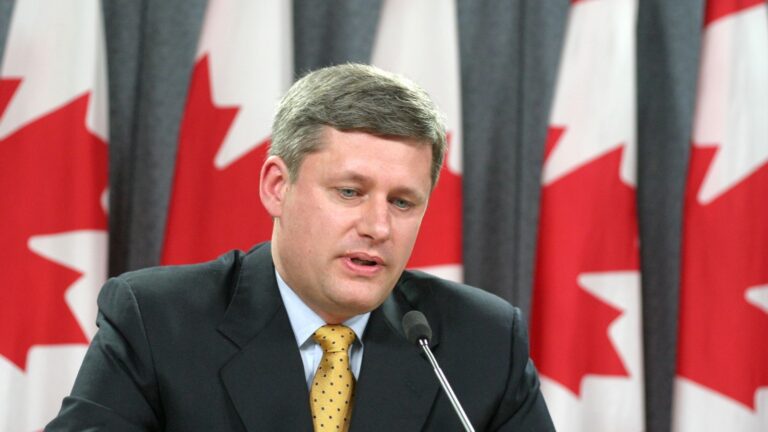
Canada’s increasingly bitter trade confrontation with the United States has produced an unusual moment of political agreement. Former prime minister Stephen Harper says Ottawa had “no choice” but to halt negotiations with Washington rather than accept terms the federal government considered damaging to Canadian interests.
Speaking at the Canada Investment Summit in Toronto, Harper backed the decision to stop the talks while warning that the larger problem will not disappear with one negotiating breakdown. Canada, he argued, must become less economically dependent on the United States and more competitive at home. His intervention comes as 50% U.S. tariffs hit billions of dollars in Canadian exports, Ottawa retaliates with its own duties, and Prime Minister Mark Carney increasingly looks toward Europe and other markets for growth.
Harper Backs a Decision Made by a Political Rival
Harper Says Ottawa Had ‘No Choice’ but to Walk Away From U.S. Trade Talks
- Harper Backs a Decision Made by a Political Rival
- The Breakdown Came After an Extraordinary Last-Minute Push
- A 50% Tariff Escalation Raised the Cost of Saying No
- Ottawa Chose Retaliation Rather Than Immediate Concessions
- Harper Framed the Dispute as a Question of Sovereignty
- The Numbers Show Why Diversification Is So Difficult
- Harper Has His Own History of Looking Beyond the U.S.
- Diversification Will Not Make the U.S. Market Replaceable
- Harper Also Put the Spotlight Back on Canada’s Own Economy
- The Trade Talks Are Suspended, Not Necessarily Finished Forever
Harper’s intervention stood out because the former Conservative prime minister was effectively supporting one of the most consequential trade decisions made by Carney’s Liberal government. Speaking during the closing portion of Canada’s national investment summit on September 15, Harper said Ottawa had reached a point where continuing the negotiations on the terms being offered by Washington was no longer realistic.
That did not amount to an endorsement of everything the Carney government has done. Harper also argued that Canada bears responsibility for improving its own competitiveness and removing barriers that make investment more difficult. His broader message was that external pressure from Washington cannot become an excuse for domestic policy failures. The result was a notably two-sided argument: Ottawa was justified in refusing the U.S. terms, in Harper’s view, but Canada now has to make itself less vulnerable to those terms in the future by strengthening its economy and developing more customers outside the United States.
The Breakdown Came After an Extraordinary Last-Minute Push
Canada did not enter August intending to abandon negotiations. Ottawa and Washington spent weeks trying to produce a wider trade arrangement, and the talks became especially intense as a deadline for new American tariffs approached. President Donald Trump initially delayed the threatened duties for three days in mid-August after the two sides reported progress, briefly raising expectations that a deal might still emerge.
Those expectations collapsed on August 21. Carney announced that he was suspending negotiations and ordering the Canadian negotiating team back to Ottawa. He said last-minute changes to the American proposal were unfair, economically unsound and raised questions about whether a resulting agreement would provide reliable certainty. Ottawa has not publicly disclosed every disputed provision, making it important to distinguish the government’s characterization of the U.S. demands from independently established details. What is clear is that the negotiating process stopped just before the higher tariffs took effect.
A 50% Tariff Escalation Raised the Cost of Saying No
Walking away from the negotiating table carried an immediate price. The United States proceeded with additional 50% tariffs on a group of Canadian products. Ottawa says the measures cover C$27.6 billion worth of Canadian goods, while U.S.-dollar estimates reported by international news organizations place the affected trade at roughly US$20 billion.
The measures do not represent a 50% tariff on everything Canada sells to the United States. Much North American commerce still operates under preferential CUSMA treatment, and earlier Bank of Canada analysis found that most continental trade remained tariff-free even as particular industries were hit hard. The distinction matters. The confrontation is severe for exposed companies without necessarily constituting a blanket tariff wall across the entire border. For a manufacturer whose particular product is caught by a 50% levy, however, that technical distinction offers little comfort. A business can lose an American order even when most other Canadian exports continue crossing the border under different rules.
Ottawa Chose Retaliation Rather Than Immediate Concessions
Canada answered the U.S. action with tariffs of its own. Beginning September 8, Ottawa imposed duties of 15%, 25% and 50% on C$27.6 billion in American products, with rates designed to match the corresponding U.S. measures. The targeted categories include steel, dairy products, appliances, agricultural equipment, pulp and paper, plastics and electronics.
The federal government also announced a $7.5-billion package of new and expanded assistance for workers and businesses affected by the trade confrontation. That support includes additional financing for smaller firms, diversification programs and measures intended to help employers deal with immediate disruptions. Counter-tariffs nevertheless create costs inside Canada as well. Research released by the Bank of Canada this year found that during the 2025 retaliation episode, prices of tariffed goods at major Canadian retailers eventually rose about 6% relative to comparable untariffed goods. Retaliation can pressure a trading partner, but some of the burden can also migrate into Canadian supply chains and consumer prices.
Harper Framed the Dispute as a Question of Sovereignty
Harper’s most significant argument went beyond tariffs. He said the current U.S. administration appears to view the extraordinarily high level of Canada-U.S. economic integration as difficult to reconcile with Canada pursuing a fully separate national economic strategy. His conclusion was that Canada should deliberately reduce its reliance on the American market, even if that transition imposes costs.
That framing turns the dispute from a conventional tariff negotiation into a larger discussion about economic sovereignty. Canada has spent decades building supply chains that treat the U.S. border as comparatively permeable. Automotive plants exchange parts repeatedly across the border, energy infrastructure links producers and consumers in both countries, and thousands of companies were built around predictable access to American customers. Replacing those relationships is neither quick nor inexpensive. Harper acknowledged that adjustment would carry significant costs, but argued that the alternative would leave Canada repeatedly exposed whenever Washington decided to use market access as leverage.
The Numbers Show Why Diversification Is So Difficult
Canada has already reduced its dependence on the United States somewhat, but the scale of the relationship remains enormous. Statistics Canada reported that 71.7% of Canadian merchandise exports went to the United States in 2025, down from 75.9% a year earlier. Canadian merchandise exports to the U.S. were still worth hundreds of billions of dollars.
The shift has accelerated during 2026. In July, Canadian exports to countries other than the United States reached a record $25.6 billion, rising 7.4% in a single month. Non-U.S. destinations accounted for 33.7% of merchandise exports that month. At the same time, exports to the U.S. fell 6.6%, helping narrow Canada’s monthly merchandise trade surplus with its neighbour from $10.3 billion to $5.9 billion. Those figures show that diversification is possible, but they also demonstrate why it cannot happen overnight. American buyers remain close, wealthy and deeply integrated into Canadian production networks.
Harper Has His Own History of Looking Beyond the U.S.
There is historical consistency behind Harper’s diversification message. His government made expanding Canada’s trade relationships outside North America a significant part of its economic strategy. One of its largest initiatives was the negotiation of the Comprehensive Economic and Trade Agreement with the European Union. Harper and European Commission president José Manuel Barroso announced an agreement in principle in 2013, and negotiators completed the text the following year.
That history is particularly relevant today because the Carney government is again looking toward Europe as relations with Washington deteriorate. Carney has been seeking deeper economic and security relationships with the European Union while setting a goal of substantially expanding non-U.S. commerce. The circumstances are different, but the underlying logic is familiar: Canada gains negotiating flexibility when businesses have credible alternatives. A country that has only one overwhelmingly dominant foreign customer has fewer options when that customer suddenly changes the price of access.
Diversification Will Not Make the U.S. Market Replaceable
Neither Harper’s argument nor Ottawa’s current strategy means Canada can simply substitute Europe or Asia for the United States. Geography gives American trade an enormous structural advantage. A truck can move components between southern Ontario and the American Midwest far more easily than those components can be shipped to another continent. Energy pipelines, electricity grids, railways and integrated factories represent decades of investment built around continental commerce.
The economic challenge is therefore better understood as reducing concentration rather than eliminating American trade. Even record growth in exports elsewhere has occurred alongside tens of billions of dollars in monthly Canadian shipments to the United States. CUSMA also remains in force despite the worsening political relationship. Canada’s government confirmed after the July joint review that the agreement continues until 2036 even though the United States declined to extend it for another 16-year period during the 2026 review. Annual reviews will now continue. The North American framework is under greater pressure, but it has not disappeared.
Harper Also Put the Spotlight Back on Canada’s Own Economy
The former prime minister did not place responsibility for Canada’s challenges entirely in Washington. Harper argued that Canada needs to become more internally competitive and make fuller use of its natural-resource advantages. He praised measures intended to accelerate major project approvals, particularly in energy, while saying more obstacles to investment still need to be removed.
Those remarks fit the setting in which they were delivered. The Canada Investment Summit brought together investors from nearly 30 countries representing more than $100 trillion in assets under management, according to the Prime Minister’s Office. Ottawa said the event generated or advanced nearly $500 billion in investment commitments, financing and strategic partnerships, although some of those figures represent financing capacity and developing commitments rather than money immediately entering projects. Carney’s government has set a goal of catalyzing $1 trillion in investment over five years. Harper’s message was that foreign diversification will work only if Canada itself becomes sufficiently attractive for capital and industry.
The Trade Talks Are Suspended, Not Necessarily Finished Forever
Harper’s use of the phrase “no choice” should not be read to mean Canada has permanently abandoned negotiation with the United States. Ottawa officially suspended the August talks; it did not announce the end of all future trade discussions. Carney has continued to say Canada is prepared to negotiate when conditions allow for an acceptable agreement.
The distinction could become crucial. Canada and the United States still share one of the world’s largest trading relationships, and businesses on both sides have powerful incentives to restore predictability. CUSMA remains legally in force, even as annual reviews and sector-specific disputes create uncertainty. For now, however, Harper’s remarks capture the strategic debate that has emerged from the breakdown. Canada can continue trying to preserve as much American market access as possible while simultaneously building enough domestic capacity and foreign trade relationships that refusing a future U.S. demand becomes economically survivable. That adjustment, rather than one negotiating deadline, may ultimately define this phase of Canada-U.S. relations.
This Options Discord Chat is The Real Deal
While the internet is scoured with trading chat rooms, many of which even charge upwards of thousands of dollars to join, this smaller options trading discord chatroom is the real deal and actually providing valuable trade setups, education, and community without the noise and spam of the larger more expensive rooms. With a incredibly low-cost monthly fee, Options Trading Club (click here to see their reviews) requires an application to join ensuring that every member is dedicated and serious about taking their trading to the next level. If you are looking for a change in your trading strategies, then click here to apply for a membership.