35,000+ smart investors are already getting financial news, market signals, and macro shifts in the economy that could impact their money next with our FREE weekly newsletter. Get ahead of what the crowd finds out too late. Click Here to Subscribe for FREE.
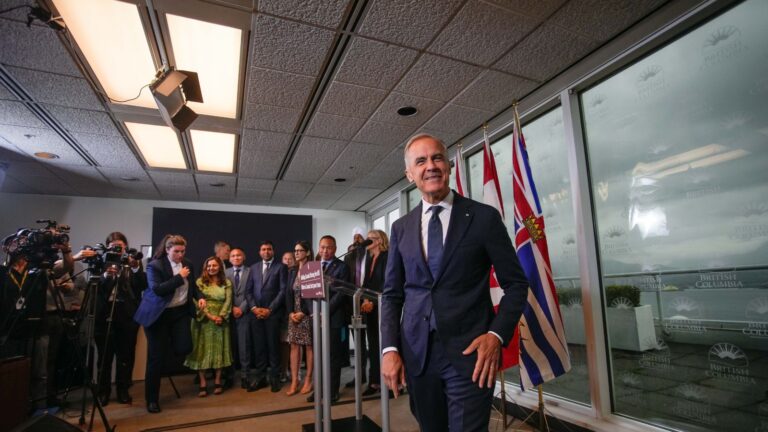
Canada’s fight for investment is becoming inseparable from its fight to reduce economic dependence on the United States. Prime Minister Mark Carney is bringing some of the world’s most powerful money managers to Toronto for the first Canada Investment Summit, pitching the country as a stable home for long-term capital while Donald Trump presses companies to manufacture and invest south of the border.
The two-day gathering on September 14 and 15 carries an unusual political bookend. Former Conservative prime minister Stephen Harper, now chair of Alberta Investment Management Corporation, is scheduled to deliver the closing remarks. Between Carney’s opening pitch and Harper’s closing message sits a much bigger question: can Canada turn global uncertainty, enormous resource wealth and more than 160 potential projects into the investment needed to reshape its economy?
Harper’s Closing Role Sends a Message Beyond Party Politics
Harper to Close Carney’s Investor Summit as Canada Battles Trump for Global Capital
- Harper’s Closing Role Sends a Message Beyond Party Politics
- Carney Is Putting a C$1-Trillion Target in Front of Global Investors
- Trump Has Turned Investment Location Into Part of the Trade War
- Canada’s Pitch Is Stability, Resources and Access to Markets Beyond America
- The Project List Shows What Canada Wants Its Next Economy to Look Like
- Canada Already Attracts Capital, but New Construction Is the Harder Test
- Ottawa Is Trying to Remove Some of the Friction Investors Complain About
- The Real Scorecard Will Not Be Available When Harper Leaves the Stage
Stephen Harper is not arriving in Toronto simply as a former Conservative prime minister. He now chairs the board of Alberta Investment Management Corporation, one of Canada’s major institutional investment managers, placing him directly inside the world the summit is trying to court. The Associated Press and Canadian Press both confirmed that Harper is scheduled to deliver the closing remarks. AIMCo’s own records show that he has chaired its board since November 2024, giving his appearance an institutional as well as political dimension.
His presence also creates a striking visual around Carney’s economic strategy. A Liberal prime minister with a background at Goldman Sachs, the Bank of Canada and the Bank of England will effectively hand the final word at his flagship investment gathering to a Conservative predecessor with his own global business and investment connections. That does not mean Harper has endorsed every element of Carney’s agenda. It does, however, allow Canada to present international investors with something valuable at a volatile moment: the impression that attracting long-term capital can transcend the normal rhythm of partisan politics.
Carney Is Putting a C$1-Trillion Target in Front of Global Investors
The scale of the gathering explains why Ottawa is treating it as more than another business conference. The federal government says its objective is to catalyse C$1 trillion in total investment in Canada over the next five years. AP reports that roughly 300 chief executives and senior executives are expected in Toronto, collectively representing institutions managing more than C$120 trillion in assets. Reuters says the summit is intended to start conversations around more than 160 Canadian projects.
The names illustrate the level of capital in the room. Confirmed participants reported by Reuters include BlackRock chief executive Larry Fink, Blackstone president Jon Gray, Temasek chief executive Dilhan Pillay and APG Groep chief executive Annette Mosman. CPP Investments and PSP Investments are partnering with the federal government to host the summit, helping Ottawa tap relationships built through decades of global pension investing. The math behind Carney’s pitch is simple but ambitious: Canada does not need to redirect all that money. Capturing even a small additional share of the capital represented in Toronto could finance projects worth tens of billions of dollars.
Trump Has Turned Investment Location Into Part of the Trade War
The summit would have been important even under normal circumstances. It carries far greater weight because the traditional Canadian investment proposition has been shaken by the escalating dispute with Washington. For decades, an investor putting a factory in Ontario or Quebec could count on relatively predictable access to the enormous U.S. market. Trump’s tariff strategy and his repeated demand that companies manufacture inside the United States have made that assumption less secure.
The pressure has become unusually explicit. Washington imposed 50% duties on categories of Canadian goods during the summer, while the White House justified measures against Canadian motor vehicles partly as a way to encourage American production and investment. More recently, Trump threatened Bombardier’s access to the U.S. market unless the Canadian aircraft maker moved production south. Canada has responded with retaliatory measures while Carney has simultaneously emphasized diversification. AP described the investment contest succinctly: Trump wants factories and capital moving south; Carney is trying to make billions flow north. For corporate boards choosing where to build the next plant, data centre or mine, that geopolitical rivalry is becoming a direct financial consideration.
Canada’s Pitch Is Stability, Resources and Access to Markets Beyond America
Carney cannot beat the United States on economic size, so the Canadian sales pitch emphasizes a different combination of advantages. Ottawa points to Canada’s AAA credit standing, relatively strong public finances, highly educated labour force and extensive resources in conventional energy, clean power and critical minerals. The government also says Canada has preferential access to roughly 1.5 billion consumers through 16 free-trade agreements covering 51 countries. That matters more as companies reconsider supply chains once designed almost entirely around North America.
Stability is another deliberate part of the message. Carney has repeatedly framed Canada as a predictable, rules-based jurisdiction at a time when tariff policy, geopolitical conflict and industrial subsidies are reshaping investment decisions elsewhere. The government also points to the Major Projects Office, which it says is connecting 27 nation-building initiatives representing more than C$192 billion of potential investment and over 330,000 jobs. None of those advantages guarantees that a global fund will choose Canada. Investors still compare taxes, approval timelines, energy costs and expected returns. But Ottawa is betting that reliability itself has acquired greater value as economic policy becomes more unpredictable around the world.
The Project List Shows What Canada Wants Its Next Economy to Look Like
The summit is not built entirely around broad promises. Reuters obtained details of a prospectus containing projects at stages ranging from early concepts to opportunities closer to construction. Technology features heavily. Canada reportedly has 96 data centres in development, while one opportunity involves an equity investment in Xanadu’s photonic quantum computer, which is targeted for commercialization around 2029 or 2030. Other pitches include an Alberta data-centre campus and financing for an AI-focused hyperscale facility in New Brunswick.
Resources and transportation sit beside those digital ambitions. The Crawford Nickel Project is included as a prospective source of lower-carbon nickel for batteries and steel, industries in which supply security has become increasingly strategic. The prospectus also includes roughly C$900 million in financing sought for a proposed high-speed transportation system between Calgary and Edmonton. That mixture is revealing. Canada is not asking investors to make one narrow bet on oil, mining or technology. The pitch combines the country’s traditional strengths in resources and infrastructure with newer opportunities in artificial intelligence, quantum computing, power demand and advanced manufacturing—the same sectors now attracting intense competition from the United States, Europe and Asia.
Canada Already Attracts Capital, but New Construction Is the Harder Test
The investment story is stronger than some pessimistic accounts suggest. Statistics Canada reported that foreign direct investment flows into the country reached C$96.8 billion in 2025, the highest annual level since 2007. At the end of that year, the stock of foreign direct investment in Canada stood at roughly C$1.6 trillion. U.S. investors alone held C$737.3 billion, or 46.1% of the total, while European holdings reached C$529.8 billion. Those figures show that global companies have not abandoned Canada even as the trade relationship with Washington has deteriorated.
The harder question is what kind of investment is arriving. Reuters noted that much recent activity has come through mergers and acquisitions or the reinvestment of earnings by existing foreign-owned businesses. Greenfield investment—the construction of new factories, facilities and other productive assets—has not experienced the same dramatic acceleration. That distinction matters for Carney’s goal. Buying an existing Canadian company can bring capital and expertise, but a new mine, data centre or manufacturing complex generally creates a more visible expansion of domestic productive capacity. The summit will ultimately be judged on whether conversations in Toronto produce more of that second category.
Ottawa Is Trying to Remove Some of the Friction Investors Complain About
Canada’s pitch is accompanied by an acknowledgment that natural resources and political stability are not enough. Investors frequently cite regulatory timelines, taxation, infrastructure constraints and policy uncertainty when deciding where to place capital. On the opening day of the summit, Ottawa announced that investors proposing projects worth at least C$1 billion would receive priority access to the Canada Revenue Agency’s Advance Income Tax Rulings program. Those rulings can provide binding clarification on how Canadian tax law will apply before capital is committed, reducing one source of uncertainty for very large projects.
Private financial institutions are also putting sizeable numbers behind the investment push. BMO announced plans to mobilize as much as C$70 billion over 10 years for areas including electricity, pipelines, transport, mining, critical minerals, AI computing, defence and oil and gas. Sun Life separately committed to seek deployment of C$5 billion over five years into Canadian infrastructure. Reuters has also reported new commitments from RBC and CIBC. These announcements are not equivalent to money already spent on completed projects, but they demonstrate that the summit is occurring alongside a broader effort to build financing capacity for projects Ottawa considers strategically important.
The Real Scorecard Will Not Be Available When Harper Leaves the Stage
There is an important reason to resist judging the summit by the number of deals announced during its two days. A Canadian official told both Reuters and AP that the largest outcomes could take 12 to 18 months to emerge. Infrastructure funds and pension plans routinely conduct lengthy technical, regulatory and financial reviews before committing billions of dollars. A handshake in Toronto therefore matters only if it eventually becomes financing, construction contracts, equipment orders and jobs.
That long timeline also makes Harper’s closing appearance an appropriate end to what Ottawa hopes will be a much longer process. Carney’s next steps include deeper outreach to Europe as Canada attempts to broaden trade and investment relationships beyond the United States. Meanwhile, the Bank of Canada expects business investment to play an important role in lifting productive capacity after U.S. tariffs and trade uncertainty weakened Canada’s economic trajectory. The summit’s real success will therefore be measurable months or years from now: how many projects reached financial close, how much genuinely new capital entered the country, and whether Canada became less vulnerable to decisions made in Washington. Harper can close the gathering. The competition for capital will continue long after the room empties.
This Options Discord Chat is The Real Deal
While the internet is scoured with trading chat rooms, many of which even charge upwards of thousands of dollars to join, this smaller options trading discord chatroom is the real deal and actually providing valuable trade setups, education, and community without the noise and spam of the larger more expensive rooms. With a incredibly low-cost monthly fee, Options Trading Club (click here to see their reviews) requires an application to join ensuring that every member is dedicated and serious about taking their trading to the next level. If you are looking for a change in your trading strategies, then click here to apply for a membership.