35,000+ smart investors are already getting financial news, market signals, and macro shifts in the economy that could impact their money next with our FREE weekly newsletter. Get ahead of what the crowd finds out too late. Click Here to Subscribe for FREE.
Canada’s attempt to build a new global defence-financing institution has reached a crucial stage. The proposed Defence, Security and Resilience Bank is designed to mobilize roughly €100 billion for military, security and resilience projects, yet Reuters reports that participating governments had committed only about €5 billion by August.
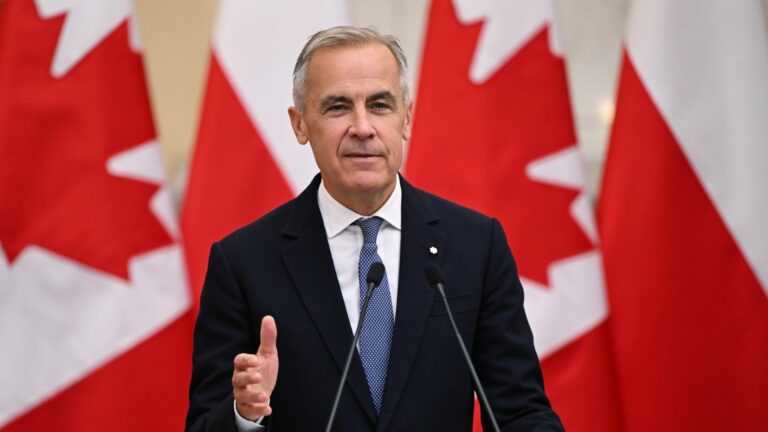
Prime Minister Mark Carney has made Canada the initiative’s most prominent political champion, and nine countries have publicly backed its creation. But the absence of Britain, Germany and other major economies is becoming increasingly important. Their hesitation raises questions about whether the bank can assemble enough highly rated sovereign support to obtain the triple-A credit rating at the heart of its financing model — and whether governments already facing sharply higher defence bills see another multilateral institution as worth the cost.
The €5 Billion Figure Shows How Far the Bank Still Has to Go
Carney-Backed Defence Bank Has Just €5 Billion Committed as Britain and Germany Hold Back: Reuters
- The €5 Billion Figure Shows How Far the Bank Still Has to Go
- Canada Has Nine Countries on Board — but Few Economic Heavyweights
- Britain Sees Value in the Idea but Has Not Joined
- Germany Questions Whether It Needs Another Financing Institution
- Europe Already Has a €150 Billion Defence Loan Programme
- The Triple-A Rating Is Central to the Entire Business Model
- Paid-In and Callable Capital Are Designed to Multiply Government Support
- Smaller Defence Companies Could Be the Bank’s Strongest Selling Point
- NATO’s New Spending Targets Have Made the Financing Problem Much Bigger
- Canada Has More Than Money Riding on the Project
- Private Banks Are Interested — but They Cannot Replace Governments
- The Autumn Charter Could Determine Whether €5 Billion Becomes €100 Billion
The contrast between what has been committed and what organizers ultimately want is striking. Two officials from countries involved in the project told Reuters that approximately €5 billion had been secured by August. The broader structure being discussed calls for roughly €20 billion in paid-in capital and another €80 billion that participating governments could be required to provide if needed. That would give the institution a far larger financial foundation than its current commitments suggest.
The €5 billion therefore should not be confused with the bank’s eventual lending ceiling. It represents an early stage in building the sovereign capital base behind the institution. Still, the figure illustrates the challenge facing Canada and its partners. Creating a multilateral lender depends heavily on governments making credible financial commitments before private bond investors are asked to provide much larger sums. With an autumn charter signing approaching, attracting additional countries — particularly large, creditworthy economies — has become one of the project’s most important tests.
Canada Has Nine Countries on Board — but Few Economic Heavyweights
Canada is currently joined by Albania, Belgium, Greece, Latvia, Luxembourg, Romania, Türkiye and Ukraine in supporting the Defence, Security and Resilience Bank. The nine governments announced their shared intention to establish the institution during July’s NATO summit in Ankara. Canada is expected to host the bank’s main headquarters, giving Ottawa an unusually prominent role in shaping a new piece of international financial architecture.
The group, however, remains noticeably short of large G7 economies beyond Canada. Earlier in the process, representatives from 18 countries attended negotiations in Montréal, demonstrating substantially wider interest than the eventual list of announced supporters. Reuters reported that Canada is the largest founding backer among the current group. The difference between participating in discussions and committing sovereign capital is significant. Governments must consider fiscal costs, governance rights and potential liabilities before joining, meaning diplomatic interest does not automatically translate into the financial backing required to make a large multilateral bank work.
Britain Sees Value in the Idea but Has Not Joined
Britain’s position has evolved without producing membership. The UK government originally ruled out backing the DSRB in 2025, arguing that the proposal did not sufficiently demonstrate value for money. British officials have instead been developing a Multilateral Defence Mechanism with the Netherlands, Finland and Poland, designed around joint purchasing and stockpiling of military equipment. That competing initiative is also intended to become operational around 2027.
The relationship has nevertheless become less confrontational. British officials subsequently described the two approaches as potentially complementary, and Defence Secretary Wes Streeting called the Canadian-backed bank an interesting and innovative mechanism at the Farnborough Airshow. Prime Minister Andy Burnham has also discussed the DSRB with Carney and Luxembourg’s Luc Frieden. Yet Britain still has not become a shareholder. For Ottawa, that distinction matters: political openness helps, but the bank ultimately needs capital commitments. Britain joining could also carry wider diplomatic weight because of its large defence industry and influence within NATO.
Germany Questions Whether It Needs Another Financing Institution
Germany’s hesitation reflects a different economic calculation. Berlin has previously argued that its government can raise money directly in financial markets on extremely favourable terms, weakening the case for paying capital into another institution simply to borrow money back through it. Germany’s finance ministry has also emphasized the importance of implementing financing mechanisms that already exist rather than continually creating new ones.
That position remains important because Germany combines economic scale, substantial defence spending and a major industrial base. Reuters reported in August that Berlin had participated in DSRB discussions as an observer and continued to review the outcome, but had not changed its decision to stay outside for now. Germany has previously pointed to the European Union’s SAFE programme as a preferred financing route. Its reluctance highlights one of the DSRB’s fundamental selling challenges: countries that already have excellent access to bond markets need to see benefits beyond simply obtaining cheaper sovereign loans.
Europe Already Has a €150 Billion Defence Loan Programme
The DSRB is entering a financing landscape that has become much more crowded since Russia’s full-scale invasion of Ukraine. The European Union’s Security Action for Europe programme, known as SAFE, can provide up to €150 billion in long-maturity loans to EU member states for major defence investments. The programme entered into force in May 2025 and is financed through EU borrowing backed by the Union’s budgetary capacity.
SAFE is already moving from policy into actual financing. Nineteen EU countries submitted investment plans, while countries including Lithuania, Greece and Cyprus received initial payments during 2026. DSRB supporters argue their proposed bank would perform functions SAFE does not, particularly direct support for defence companies and guarantees encouraging commercial banks to lend to smaller suppliers. Yet governments still have to decide whether those advantages justify another capital commitment. Reuters found that overlap with SAFE and Britain’s Multilateral Defence Mechanism was among the most frequently cited concerns during membership discussions.
The Triple-A Rating Is Central to the Entire Business Model
The DSRB is not designed simply as a pool into which governments deposit money and then spend it. Its ambition is to use sovereign backing to establish an exceptionally strong credit profile, borrow larger sums in capital markets and then provide long-term financing to governments and companies. Organizers are therefore targeting a triple-A rating, which could help the bank issue debt at favourable interest rates and transmit those financing advantages to borrowers.
That is why the identity of the shareholders matters almost as much as the amount they contribute. Credit-rating methodologies for multilateral lenders examine capitalization, liquidity, governance and the ability and willingness of shareholders to provide extraordinary support. Reuters quoted Morningstar DBRS saying the creditworthiness of multilateral institutions is driven principally by their core shareholders. Analysts interviewed by Reuters consequently argued that additional substantial governments would strengthen the DSRB’s case with rating agencies. Britain and Germany are important not only because they can contribute money, but because their participation could strengthen confidence in the institution itself.
Paid-In and Callable Capital Are Designed to Multiply Government Support
The proposed financing structure follows a model familiar from established multilateral lenders. Governments provide some money directly as paid-in capital while promising additional callable capital that can be requested under exceptional circumstances. Reuters reported that the DSRB is aiming for approximately €20 billion of paid-in capital alongside another €80 billion available to be called if required.
Callable capital can be powerful because it acts as a sovereign financial backstop without requiring every pledged euro to be transferred to the bank immediately. The World Bank uses a similar concept, with shareholder commitments helping reinforce confidence in its obligations. Research from the Bank of Canada has also identified callable capital and the strength of shareholders as important considerations in evaluating multilateral development banks. The approach allows a well-rated institution to borrow from investors and potentially deploy financing far beyond the cash governments initially contribute. But the mechanism works best when markets regard the shareholders themselves as financially strong and politically committed.
Smaller Defence Companies Could Be the Bank’s Strongest Selling Point
The case for the DSRB is potentially more compelling at the company level than at the sovereign level. Large countries such as Germany can already borrow cheaply, while major defence contractors generally have access to established banks and capital markets. Smaller businesses developing drones, electronics, software, specialized components or manufacturing equipment can face substantially greater difficulty obtaining affordable financing, particularly when lenders view defence contracts as complex or risky.
Canada says addressing these financing gaps is one of the institution’s central purposes. The DSRB is intended to lend across defence supply chains and provide guarantees that reduce the risk commercial banks take when financing smaller businesses. The Royal United Services Institute has argued that facilitating commercial lending could ultimately be one of the institution’s most important contributions. Membership could also determine which national industries benefit: Reuters reported warnings from British manufacturers that companies could miss DSRB-financed opportunities if Britain remains outside. That turns what appears to be a government-finance debate into an industrial competitiveness question as well.
NATO’s New Spending Targets Have Made the Financing Problem Much Bigger
The DSRB proposal is emerging during one of the largest increases in allied military spending since the Cold War. At NATO’s 2025 summit in The Hague, members committed to reaching defence and security-related investment equal to 5% of GDP annually by 2035. At least 3.5% is intended for core military requirements, while up to 1.5% can cover areas including infrastructure, resilience, networks and defence-industrial capacity.
The scale of that commitment creates enormous financing and production requirements. NATO reported that European allies and Canada increased core defence investment by more than $139 billion after adopting the new pledge, an increase of nearly 20% from the previous year. Governments are not merely being asked to purchase more equipment; they must expand factories, secure supply chains, modernize infrastructure and accelerate procurement. Supporters of the DSRB argue that conventional government budgets and commercial lending alone may struggle to finance that transition efficiently, creating space for a specialized multilateral institution.
Canada Has More Than Money Riding on the Project
For Ottawa, the DSRB has become part of a broader effort to position Canada as a leader in allied security and international economic coordination. Canada hosted negotiations on the bank’s founding documents in Montréal, and participating governments agreed that the institution should ultimately be headquartered in Canada once formally established and ratified. Luxembourg has been designated as its intended European base, giving the proposed lender a presence on both sides of the Atlantic.
The initiative also fits Carney’s broader emphasis on cooperation among middle powers at a time when the traditional international order is under growing strain. Canada has simultaneously been increasing its own military expenditure, developing a new defence industrial strategy and committing to NATO’s higher investment targets. Successfully launching the DSRB would therefore provide Ottawa with influence extending beyond the size of Canada’s military itself. Conversely, a launch without major additional shareholders could leave Canada carrying disproportionate responsibility for an institution whose effectiveness depends on broad international participation.
Private Banks Are Interested — but They Cannot Replace Governments
The DSRB has attracted support from the financial sector even while several governments remain cautious. Reuters reported that roughly a dozen banks, including JPMorgan and Deutsche Bank, had provided approximately $10 million through funding or services to assist the institution’s establishment. Banks including Commerzbank, ING and RBC have also appeared among the initiative’s private-sector supporters.
Their involvement provides expertise and indicates that commercial institutions see opportunities in a defence-financing market expected to expand sharply. Banks could potentially arrange bonds, structure transactions or finance projects supported by DSRB guarantees, producing significant fee income if the institution reaches scale. Yet private-sector participation cannot substitute for sovereign shareholders. The bank is supposed to be owned by member states, and its strongest financial advantage would derive from government backing. A dozen commercial banks supporting the concept therefore does not solve the central political problem. Before investors can confidently finance the DSRB, governments must establish the capital structure and credibility beneath it.
The Autumn Charter Could Determine Whether €5 Billion Becomes €100 Billion
The coming months could determine whether the DSRB develops into a major financial institution or remains a smaller coalition led by Canada. Officials have been working toward an autumn signing of the bank’s founding charter, while the nine supporting governments have stated an ambition to begin operations as early as 2027. Ottawa has indicated that it is prepared to move ahead with the existing group while leaving the door open for countries to join later.
That strategy allows the project to avoid becoming dependent on unanimous support from the largest NATO economies. It also carries risk. A smaller founding group could make the desired triple-A rating more difficult, restrict lending capacity or reduce the industrial reach that makes membership attractive in the first place. Britain remains a particularly important potential recruit, while Germany’s eventual decision could influence other European governments. The €5 billion secured so far demonstrates that the project is no longer only a concept. Whether it becomes a €100 billion institution now depends on convincing larger governments that joining produces benefits they cannot obtain elsewhere.
This Options Discord Chat is The Real Deal
While the internet is scoured with trading chat rooms, many of which even charge upwards of thousands of dollars to join, this smaller options trading discord chatroom is the real deal and actually providing valuable trade setups, education, and community without the noise and spam of the larger more expensive rooms. With a incredibly low-cost monthly fee, Options Trading Club (click here to see their reviews) requires an application to join ensuring that every member is dedicated and serious about taking their trading to the next level. If you are looking for a change in your trading strategies, then click here to apply for a membership.