35,000+ smart investors are already getting financial news, market signals, and macro shifts in the economy that could impact their money next with our FREE weekly newsletter. Get ahead of what the crowd finds out too late. Click Here to Subscribe for FREE.
A political tension that once lived mostly in petitions, panel discussions, and activist circles has moved squarely into the mainstream of Alberta politics. With Stephen Harper publicly distancing himself from the independence push and renewing his call for Canadian unity, the fight over Alberta’s future now carries more weight than a restless sideshow on the conservative fringe.
Danielle Smith’s government has put a province-and-country question on the October ballot, federal leaders are treating it like a national test, and courts and First Nations have already shown how difficult any real separation path would be. What makes this moment notable is not that Alberta is suddenly on the verge of leaving Canada. It is that a once-theoretical rupture is now being debated in the open, by serious political players, at a time when the stakes for national cohesion already feel unusually high.
Harper’s Intervention Changes the Tone
Harper Steps Into Alberta Unity Fight as Referendum Battle Gets Bigger
- Harper’s Intervention Changes the Tone
- How Alberta Reached This Point
- What the October Vote Actually Means
- Anger Is Real, but Separation Is Still a Minority Position
- Treaty Rights and the Constitution Stand in the Way
- Ottawa and the Conservatives Are Now Treating This as a Unity Test
- The Real Risk Is Uncertainty
Harper matters here because he is not just another retired politician weighing in from the sidelines. He remains the most recognizable architect of modern Canadian conservatism, an Alberta-based former prime minister who won three straight national elections and still carries unusual authority with many voters on the right. That is why his refusal earlier this year to sign the petition for an Alberta separation referendum landed so heavily. It was not merely a personal choice. It was a signal that even someone deeply identified with Alberta grievance politics would not cross the line into endorsing a break with Canada.
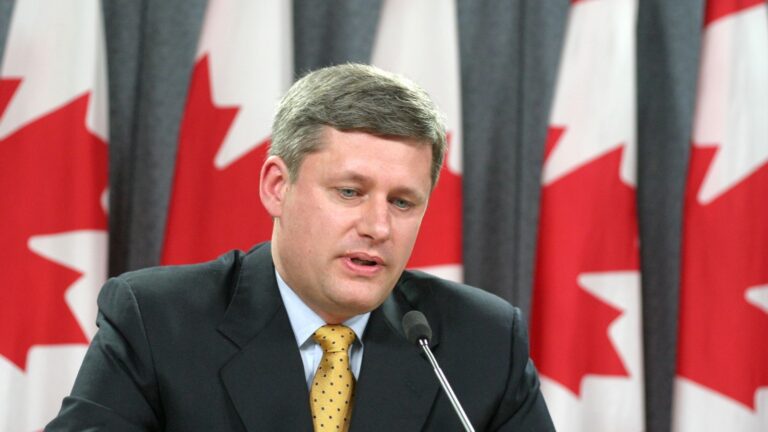
His later call for parties to work together in defence of national unity only sharpened that message. The image was striking: Harper, standing at the unveiling of his official portrait, using a ceremonial moment to talk not about nostalgia but about cohesion and independence. That does not make him the leader of a unity campaign, at least not formally. But it does make him a powerful boundary marker. Separatists can no longer easily claim that mainstream conservative elders are quietly with them. Harper’s intervention gives disaffected Albertans a different route: press hard for leverage, fairness, and policy change without embracing a constitutional rupture.
How Alberta Reached This Point
The current fight did not appear out of nowhere. It was built through a combination of grievance politics and procedural change. In 2025, Alberta changed the citizen initiative rules so constitutional petitions would need signatures equal to 10 per cent of ballots cast in the last provincial election, and proponents would get 120 days to gather them. Before that, constitutional initiatives faced a much steeper threshold: 20 per cent of registered voters province-wide, support in two-thirds of constituencies, and a shorter 90-day collection period. That technical shift mattered enormously, because it turned a hard-to-reach protest idea into something organizers could plausibly try to force onto the provincial agenda.
At the same time, Smith’s government launched the Alberta Next process, framing Ottawa as a chronic source of unfairness on everything from energy development to federal transfers and provincial jurisdiction. The branding was revealing: not outright secession, but “sovereignty within a united Canada.” That language allowed the government to hold together two impulses at once. One was federalist, but angry. The other was openly separatist. In practical terms, Alberta Next helped convert long-running western alienation into a referendum-era political machine. The debate stopped being just about emotion and became about timelines, thresholds, ballots, and public expectation.
What the October Vote Actually Means
The October vote is not a direct referendum on Alberta leaving Canada. That is one of the most important facts in the entire story. The question announced by Smith asks whether Alberta should remain a province of Canada or whether the provincial government should begin the legal process required under the Constitution to hold a binding referendum later on separation. In other words, even a “yes” vote would not mean Alberta wakes up independent the next morning. It would mean the province claims a mandate to pursue another, more legally significant stage.
Yet that procedural structure is also what makes the battle politically combustible. Angus Reid found the official question runs 37 words, and just over half of respondents said it was confusing. That matters because ambiguity is rarely neutral in referendum politics. Separatists can sell the question as a first real step toward independence. Federalists can argue it is an unnecessary gamble wrapped in technical language. Smith can present it as a democratic release valve rather than a leap into the unknown. All three narratives can exist at once because the ballot does not ask a clean emotional question. It asks a layered constitutional one, and that gives campaigners on every side plenty of room to shape what voters think they are actually endorsing.
Anger Is Real, but Separation Is Still a Minority Position
The separatist movement has undeniable energy. Organizers behind the independence petition submitted more than 300,000 signatures, far above the threshold required to trigger the process. That is not trivial. It shows there is real anger, real volunteer capacity, and real appetite for symbolic confrontation with Ottawa. In any other context, a petition of that size would be treated as a major warning flare. It also explains why the issue can no longer be dismissed as a handful of loud activists in parking lots and community halls.
But organizing strength is not the same thing as majority support. On the actual October question, Angus Reid found 60 per cent would vote no and 35 per cent yes. Asked more bluntly whether Alberta should stay in Canada or leave, the federalist side grows even stronger: 67 per cent would stay, 30 per cent would leave. One of the most telling findings goes deeper still. Among those who want Alberta to remain in Canada, 74 per cent said they would move elsewhere in Canada if separation ever happened, while fewer than a quarter said they would stay in an independent Alberta. That turns the issue from abstract identity politics into something more intimate. It suggests many Albertans may be angry with the federation, but they are still deeply woven into it.
Treaty Rights and the Constitution Stand in the Way
One reason this debate has become so consequential is that it has already collided with Indigenous rights and constitutional law. In May, Justice Shaina Leonard of Alberta’s Court of King’s Bench quashed the citizen-led independence petition after finding that First Nations had not been properly consulted. The ruling underscored that a secession push is not just a dispute between Edmonton and Ottawa. It also affects treaty relationships that predate Alberta itself. Once the issue is understood that way, separation stops looking like a simple expression of provincial self-assertion and starts looking like a challenge to overlapping legal orders that cannot be brushed aside with a popular slogan.
Even beyond that ruling, the constitutional path is steep. The Supreme Court’s Secession Reference made clear that a province cannot leave Canada unilaterally. The Clarity Act then set out the political test Ottawa would apply: a clear question, a clear majority of the population, and a process in which the House of Commons evaluates the result before any negotiations begin. The law also requires consideration of Indigenous perspectives and other governments’ views. That means a referendum can create pressure, headlines, and instability very quickly. It cannot, by itself, produce independence. The legal architecture of the federation is designed to slow exactly this kind of rupture.
Ottawa and the Conservatives Are Now Treating This as a Unity Test
Once both federal Liberals and federal Conservatives start talking like explicit defenders of Canadian unity in Alberta, the dispute stops being a provincial quarrel and becomes a national one. Mark Carney has warned that the referendum could become a reckless bluff with consequences beyond Alberta’s borders, drawing on the hard lessons of Britain’s Brexit vote. At the same time, he has tried to lower the temperature by emphasizing Alberta’s importance to the country and by working with the province on energy and market-access issues that have long fed western resentment. That combination is deliberate: oppose the referendum, but do not ignore the grievances that made it politically usable.
The Conservative response is just as telling. Pierre Poilievre has said Conservatives would campaign for Alberta to remain in Canada. That is a major strategic denial of oxygen to the separatist camp. It means the movement cannot rely on a wink-and-nod theory that federal conservatives secretly agree with its end goal. Taken together with Harper’s earlier refusal to sign the petition and his later unity rhetoric, the message is strikingly consistent across conservative generations. Alberta’s debate is no longer being framed as Ottawa versus the West. Increasingly, it is being framed as a fight over whether Alberta can force change from inside Canada without breaking the country in the process.
The Real Risk Is Uncertainty
The biggest damage may arrive long before any ballot is counted. Business groups have been unusually direct about that. The Canadian Chamber of Commerce has warned that prolonged uncertainty around constitutional or political separation threatens investor confidence, growth, and competitiveness. The Calgary Chamber has gone further, saying the province’s business community sees real economic harm in putting separation on the ballot. Its survey found 51 per cent of Calgary respondents said the current discourse around separation is already affecting Alberta’s economy, and 93 per cent of that group said the impact is negative. More than one in four said the debate is affecting their own operations.
That is why this fight feels bigger than a protest movement and bigger than a tactical referendum. For a company deciding whether to expand, a worker thinking about relocation, or a family deciding where to build a future, constitutional uncertainty acts like a drag on everyday confidence. It delays commitments even when no legal border has changed. That is also why Harper’s intervention resonates beyond symbolism. He appears to grasp an old truth of federation politics: once unity questions move from rhetoric into hiring plans, capital decisions, and household calculations, the cost is no longer abstract. Alberta may ultimately vote to stay, and still come away changed by how close mainstream politics came to normalizing the alternative.
This Options Discord Chat is The Real Deal
While the internet is scoured with trading chat rooms, many of which even charge upwards of thousands of dollars to join, this smaller options trading discord chatroom is the real deal and actually providing valuable trade setups, education, and community without the noise and spam of the larger more expensive rooms. With a incredibly low-cost monthly fee, Options Trading Club (click here to see their reviews) requires an application to join ensuring that every member is dedicated and serious about taking their trading to the next level. If you are looking for a change in your trading strategies, then click here to apply for a membership.