35,000+ smart investors are already getting financial news, market signals, and macro shifts in the economy that could impact their money next with our FREE weekly newsletter. Get ahead of what the crowd finds out too late. Click Here to Subscribe for FREE.
For generations, door-to-door mail was treated as a basic part of daily life in many Canadian neighbourhoods. On April 16, 2026, Canada Post signalled that this long-familiar service is no longer safe from overhaul. The Crown corporation says about 136,000 addresses in the first phase will move to community mailboxes, part of a broader five-year plan to convert the roughly four million remaining door-to-door addresses still on the system. The change reaches beyond a new pickup point at the end of the block. It touches household routines, labour tensions, accessibility, retail post office strategy, and the larger question of how a national postal service stays viable when letter volumes keep shrinking. These 10 sections explain what was announced, where it starts, why it is happening, and what it may mean next.
A First Wave With Real Street-Level Impact
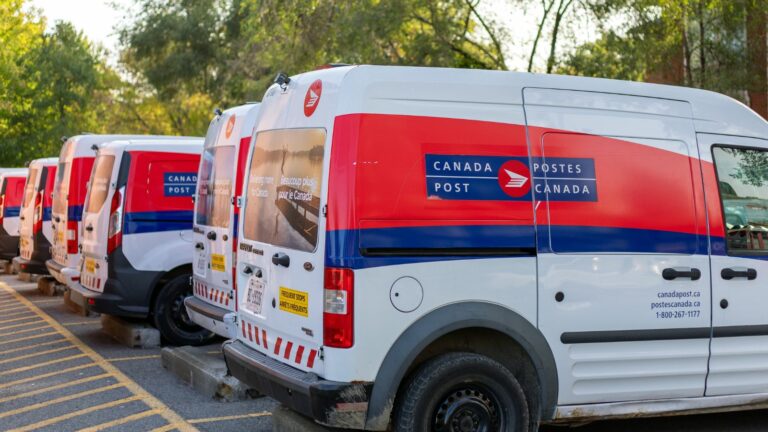
Canada Post names first 136,000 addresses set to lose door-to-door mail
- A First Wave With Real Street-Level Impact
- Door-to-Door Delivery Is Becoming the Exception
- The Financial Math Is Now Driving the Story
- Why These Neighbourhoods Were Chosen First
- What the Change Will Look Like on the Ground
- Community Mailboxes Are Being Sold as a Parcel-Era Solution
- Accessibility Will Be the Measure of Whether This Feels Fair
- Workers Are Caught in the Middle of the Overhaul
- The Mailbox Plan Is Only Half of the Overhaul
- Canada Post Is Being Asked to Redefine Universal Service
Canada Post’s announcement matters because it finally puts names, postal codes, and timing behind a shift that had mostly been discussed in policy language. The corporation says the first conversions will affect about 136,000 addresses in late 2026 and early 2027. The listed first-wave areas stretch across New Brunswick, Quebec, Ontario, Manitoba, and British Columbia, including Moncton and Riverview, Sept-Îles, La Prairie and Candiac, Ottawa, Etobicoke, Winnipeg, Abbotsford, Mission, and parts of the North Shore around North Vancouver and West Vancouver. In Ottawa alone, the affected postal-code prefixes include K1B, K1G, K1H, K1J, and K1K, while Etobicoke’s first group is centered on M9V and M9W.
That makes this more than a symbolic policy test. It is a concrete operational rollout with neighbourhood boundaries already sketched in. By choosing recognizable urban and suburban pockets instead of an abstract national timeline, Canada Post has moved the debate from Parliament Hill and bargaining tables straight into local communities. The scale is also large enough to be felt quickly. A change affecting 136,000 addresses is not a pilot in the ordinary sense; it is a major opening phase designed to show that the conversion plan is no longer theoretical and that door delivery, where it still exists, is now being treated as transitional rather than permanent.
Door-to-Door Delivery Is Becoming the Exception
One reason the announcement feels so dramatic is that it clashes with an older image of Canada Post that no longer reflects how most of the network already works. Canada Post says nearly three out of every four Canadian addresses already receive mail and parcels through some kind of centralized delivery, whether that is a community mailbox, a post office box, a rural mailbox, or an apartment mailroom. In that context, the roughly four million remaining door-to-door addresses are not the standard model anymore. They are the remainder of a legacy system concentrated largely in older established neighbourhoods.
That shift helps explain why Canada Post now frames home delivery as the costly outlier. In its own policy and annual-report material, the corporation has argued that less than one quarter of addresses still get mail at the door, while new developments have been built around centralized delivery for decades. The political sensitivity remains high because the remaining addresses are often in older urban areas where door delivery feels embedded in community identity. But the structural reality is harder to ignore. The service that once defined the postal experience has, over time, become a shrinking premium model inside a network that has already been redesigned around centralized access.
The Financial Math Is Now Driving the Story
Behind the mailbox debate sits a harsher financial story. Canada Post’s 2024 annual report said the corporation recorded a loss before tax of $841 million that year and had posted seven consecutive annual losses. The same report said losses from operations since 2018 had topped $4.5 billion. In early 2025, Ottawa announced access to up to $1.034 billion in repayable support to keep the corporation solvent. By late 2025, Canada Post reported that its loss before tax for the first nine months of that year had climbed to $989 million. Those figures make it difficult for management or government to sell the status quo as sustainable.
The underlying reason is simple and brutal. Canadian households used to receive about seven letters a week in 2006; now the average is about two. Yet the network still has to reach a growing address base across a massive country. Canada Post served more than 17.6 million addresses in 2024, up by millions from the mid-2000s, even as traditional letter volumes kept eroding. That means fewer letters are being delivered to more places at higher labour, fuel, and infrastructure costs. Once that math is understood, the push to trim expensive forms of legacy service stops looking like an ideological crusade and starts looking like a response to a business model that no longer matches the product being delivered.
Why These Neighbourhoods Were Chosen First
Canada Post did not present the first-wave map as random. The corporation says most of the addresses selected for this phase sit next to areas that already receive community-mailbox delivery. That detail matters because it suggests the rollout is being designed around operational efficiency, site planning, and route redesign rather than purely political geography. A conversion is easier to manage when nearby streets already use the same system, when delivery patterns can be consolidated, and when residents are not being introduced to an entirely unfamiliar setup from scratch.
The company also acknowledged that dense urban cores are harder to convert and will come later. That is a revealing admission. Installing community-mailbox sites in tightly built neighbourhoods raises tougher questions around curb space, walkability, winter access, aesthetics, and local opposition. Starting in areas adjacent to existing centralized-delivery zones allows Canada Post to move faster while postponing the most controversial urban design battles. In that sense, this first phase is not only about cost savings. It is also about sequencing. The corporation appears to be beginning where the infrastructure and land-use problems are more manageable, then leaving the politically and logistically trickier downtown environments for a later round.
What the Change Will Look Like on the Ground
For households, the actual experience of conversion will likely feel much slower and more administrative than the headline suggests. Canada Post says converting an address from door delivery to a community mailbox typically takes months. Before any switch happens, the corporation says it will engage communities, identify suitable mailbox locations, and notify residents and businesses about the upcoming change. That means the next chapter is likely to involve consultation letters, proposed site locations, local complaints about placement, and plenty of debate over convenience, safety, and snow clearance long before the first key is handed over.
That slower timeline is important because it gives communities space to react, but it also stretches out uncertainty. Residents may know their area is on the list long before they know exactly where their mailbox cluster will sit or how convenient it will be in practice. For some neighbourhoods, the change could amount to a short walk and a minor routine adjustment. For others, especially older residents or people used to direct home delivery for decades, the shift may feel like a meaningful downgrade in service. In other words, the operational process may be orderly, but the lived experience will vary sharply from one block to the next.
Community Mailboxes Are Being Sold as a Parcel-Era Solution
Canada Post’s case for community mailboxes is not just about letters. It is also rooted in the parcel-heavy world the corporation is trying to serve. The company says community mailboxes provide locked compartments for both mail and parcels, and that more than 80 per cent of parcels it delivers can fit either into an individual compartment or a dedicated parcel locker. Items that do not fit, or that require a signature, would still be delivered to the door or held for pickup at a nearby post office. That is the corporation’s answer to the argument that centralized delivery is inherently less useful in the age of e-commerce.
There is logic to that claim. Canada Post’s network already includes more than 22,500 indoor parcel lockers in apartment and condo buildings, and its 2024 annual report says more than 222,500 community mailbox sites provide 24/7 access for over six million Canadians. The postal system has clearly been evolving around secure centralized pickup rather than the old image of a carrier visiting every doorstep. But convenience remains partly situational. A parcel locker works well when it is close, well-lit, maintained, and easy to reach in bad weather. The promise of secure, round-the-clock access may be real, but public acceptance will depend on whether that promise holds up not in theory, but on a January evening in a Canadian subdivision.
Accessibility Will Be the Measure of Whether This Feels Fair
The strongest argument against large-scale conversion is not nostalgia. It is accessibility. Canada Post appears well aware of that political and ethical pressure point. The corporation says its Delivery Accommodation Program already supports more than 17,000 households across the country and offers measures such as Braille features, sliding trays, and more accessible compartments. In some cases, it says weekly home delivery can still be provided on a seasonal, temporary, or permanent basis for people whose functional limitations make standard mailbox access difficult. That carveout could become one of the most important features of the entire transition.
If the program works smoothly, Canada Post will have a stronger case that the move is modernization rather than abandonment. If it becomes hard to access, inconsistently applied, or poorly communicated, the backlash could intensify quickly. Accessibility disputes tend to crystallize broader public concerns because they turn an infrastructure change into a question of dignity and inclusion. That is why this part of the story deserves more attention than the usual debate over efficiency. For many households, the real issue is not whether a mailbox is secure or modern. It is whether an older adult, a disabled resident, or someone with limited mobility can still receive mail without the system quietly shifting the burden onto the people least able to absorb it.
Workers Are Caught in the Middle of the Overhaul
This plan is also landing in the middle of an unresolved labour story. Canada Post’s largest union, CUPW, represents about 55,000 workers, and the bargaining fight has dragged on since late 2023. A national strike began in November 2024 before the federal government intervened, sending workers back and launching an Industrial Inquiry Commission to examine the broader conflict. Tentative agreements were later finalized in January 2026, and union members are voting through the spring of 2026 on whether to ratify them. The result is a strange moment in which structural change is moving ahead even as the labour settlement around that change still feels unsettled.
That tension matters because delivery-model reform is never just about mailboxes. It is also about routes, staffing, job design, weekend parcel work, and who carries the risk of modernization. Canada Post has said the number of letter carriers will fall as door delivery disappears, though reporting on the announcement says the corporation does not expect outright job losses and instead plans reassignment. Even so, it is easy to see why workers view the transformation with suspicion. When an employer facing steep losses begins changing service models, employees hear efficiency; they also hear the possibility of fewer routes, altered schedules, and reduced bargaining power. That mistrust may shadow every step of the rollout.
The Mailbox Plan Is Only Half of the Overhaul
Buried inside the same announcement was another major clue about where Canada Post is heading. The corporation says it is also beginning retail-network modernization and reviewing urban and suburban post offices in areas it considers over-served. The company says retail revenue has fallen 30 per cent since 2021 as Canadians visit post offices less often and make fewer in-store purchases. That suggests the mailbox conversion is not a stand-alone fix. It is part of a broader effort to rethink both delivery and the physical postal footprint at the same time.
That broader review could be just as consequential for some communities as the end of door delivery. Canada Post says it wants to protect service in rural, remote, and Indigenous areas, while focusing early changes on urban and suburban markets where there may be overlapping service. Its annual-report material says the network still includes more than 5,700 post offices, with more than half located in rural areas. That means modernization is likely to fall hardest where population growth and commercial clustering have made the old network look duplicative. For residents, the implication is clear: the April 16 announcement was not just about where mail gets dropped off. It was also about how many places Canadians will still visit for postal service at all.
Canada Post Is Being Asked to Redefine Universal Service
The deepest issue in this story is philosophical. Canada Post is not an ordinary private courier. Under the Canada Post Corporation Act and the Canadian Postal Service Charter, it is expected to serve the whole country and operate in a financially self-sustaining way. Those two expectations are increasingly in tension. The charter still assumes five-day-a-week letter delivery and service standards built for a heavier-mail era, including letter delivery within two business days inside a community, three within a province, and four between provinces. Yet the corporation argues those rules were built for a time when mail volumes were strong enough to support them economically.
That is why the fight over community mailboxes is really a fight over the definition of public service in 2026. One view says home delivery in long-established neighbourhoods remains part of what Canadians reasonably expect from a national postal system. The other says universal service should mean reliable national access, not preserving the most expensive version of delivery for a shrinking minority of addresses. Canada Post, the federal government, and the Industrial Inquiry Commission have clearly moved toward the second interpretation. Whether the public accepts that shift may depend less on the logic of the balance sheet than on whether the replacement service feels dependable, humane, and meaningfully accessible once the keys are finally distributed.
This Options Discord Chat is The Real Deal
While the internet is scoured with trading chat rooms, many of which even charge upwards of thousands of dollars to join, this smaller options trading discord chatroom is the real deal and actually providing valuable trade setups, education, and community without the noise and spam of the larger more expensive rooms. With a incredibly low-cost monthly fee, Options Trading Club (click here to see their reviews) requires an application to join ensuring that every member is dedicated and serious about taking their trading to the next level. If you are looking for a change in your trading strategies, then click here to apply for a membership.