35,000+ smart investors are already getting financial news, market signals, and macro shifts in the economy that could impact their money next with our FREE weekly newsletter. Get ahead of what the crowd finds out too late. Click Here to Subscribe for FREE.
Doug Ford’s sharp answer to Donald Trump’s “51st state” rhetoric cut through a noisy trade fight with one unmistakable message: Canada’s sovereignty is not up for negotiation. The Ontario premier’s pushback came as Trump’s comments about Canada joining the United States collided with real economic pressure from tariffs, trade uncertainty, and anxiety across export-heavy industries.
For Ford, the line was more than a patriotic sound bite. Ontario sits at the centre of Canada’s auto, steel, aluminum, and manufacturing networks, making the province especially vulnerable when Washington turns trade policy into political leverage. His message carried the blunt style he often uses at Queen’s Park, but it also reflected a broader Canadian response: friendship with the United States may be vital, but independence remains non-negotiable.
Ford Turned a Taunt Into a Sovereignty Message
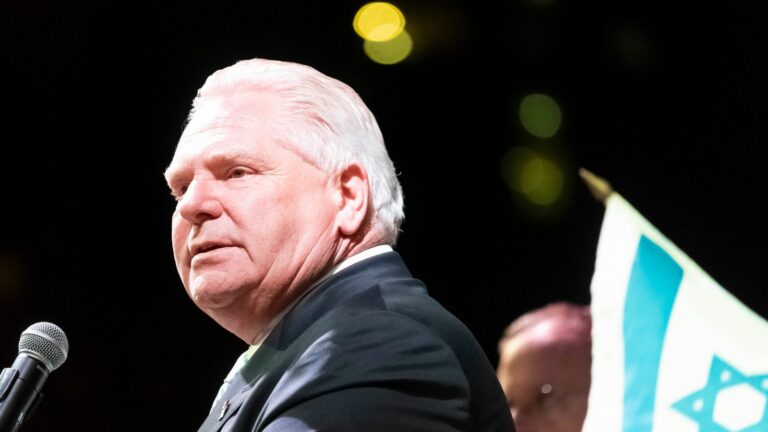
Doug Ford Fires Back at Trump: ‘We Will Never Be the 51st State’”
- Ford Turned a Taunt Into a Sovereignty Message
- Why the “51st State” Line Hit a Nerve
- Tariffs Made the Rhetoric Feel Real
- Ontario Had More at Stake Than Most Provinces
- The Auto Sector Showed How Hard It Is to “Unscramble” Trade
- Ford’s Political Moment Was Built Around Standing Up to Trump
- Canada’s Response Became a Rare Point of Political Unity
- The Real Test Is What Comes After the Sound Bite
Ford’s response landed because it was simple, direct, and emotionally clear. When he said Canada would never be the 51st state, he was not offering a technical trade argument or a diplomatic footnote. He was drawing a line that many Canadians already felt. Trump’s repeated comments about Canada joining the United States had moved from joke territory into something more serious for political leaders, especially as tariff threats and trade pressure escalated alongside the rhetoric.
That made Ford’s wording politically useful. It allowed him to sound protective without sounding overly complicated. Ontario families may not follow every tariff schedule or customs ruling, but they understand what it means when a foreign leader talks about their country as if it were negotiable. Ford’s message put national pride in everyday language, the kind that works in factory towns, border communities, and suburban households where the U.S. relationship is both familiar and sometimes frustrating.
Why the “51st State” Line Hit a Nerve
The phrase “51st state” has power because it touches identity, not just politics. Canada and the United States share the world’s longest undefended border, deeply linked supply chains, similar consumer habits, and enormous daily trade. That closeness can make the countries feel like family in ordinary times. But when the language shifts from partnership to absorption, Canadians often react strongly because the relationship has never been understood as ownership.
Polling has shown that support for Canada becoming part of the United States remains limited, with most Canadians rejecting the idea. That context helps explain why Ford’s response was not just aimed at Trump. It was also aimed at Canadians who wanted to hear their leaders say the obvious out loud. In moments of outside pressure, political language can become a form of reassurance. Ford’s line gave people a short, shareable answer to a question many considered insulting.
Tariffs Made the Rhetoric Feel Real
The backlash was sharper because Trump’s comments were not happening in isolation. His administration had already used tariffs as a central pressure tactic against Canada, including broad duties on Canadian exports and separate measures targeting steel, aluminum, and autos. Canada responded with countermeasures of its own, turning the dispute into a direct economic clash between two countries whose businesses are used to trading across the border as part of normal daily operations.
That is why Ford’s response carried economic weight. Ontario is not a province that can shrug off a trade war. Its factories, suppliers, and logistics corridors are built around North American integration. When tariffs hit, they do not only affect executives or politicians; they can affect shift schedules, investment plans, overtime hours, dealership prices, and the confidence of families whose income depends on manufacturing. The sovereignty fight and the jobs fight became part of the same story.
Ontario Had More at Stake Than Most Provinces
Ontario’s exposure to the United States is unusually high because of the province’s manufacturing base. Vehicles, parts, steel, aluminum, machinery, chemicals, and related services all depend on stable cross-border rules. A car assembled in Ontario may include parts, materials, engineering, and software tied to suppliers on both sides of the border. That makes tariffs especially disruptive because they hit not only finished products, but also the inputs that move through the system before anything reaches a consumer.
This is also why Ford often framed the issue as a practical fight, not only a patriotic one. Ontario’s economy is deeply connected to Michigan, Ohio, New York, and other U.S. states that rely on Canadian trade. When Ford pushed back, he was speaking to Washington, but also to governors, business leaders, workers, and consumers who could feel the cost of a prolonged dispute. The message was clear: pressure on Canada can easily become pressure on Americans too.
The Auto Sector Showed How Hard It Is to “Unscramble” Trade
Ford’s point about the integrated supply chain was especially visible in the auto industry. North American vehicle production does not work like a simple import-and-export chain where one country makes everything and ships it to another. Parts can cross borders multiple times before a finished vehicle reaches a dealership. That means a tariff can be applied at points where the same production network is still building value, raising costs in ways that are difficult to isolate.
This is why automakers, parts suppliers, and trade analysts warned that tariffs could cause damage on both sides of the border. The issue was not only Canadian jobs or American jobs, but the shared production model built over decades under NAFTA and later CUSMA/USMCA. Ford’s “not for sale” stance was therefore tied to a bigger economic argument: Canada is not a disposable appendage to the U.S. economy. It is a co-producer inside a continental system.
Ford’s Political Moment Was Built Around Standing Up to Trump
Ford’s posture also fit the political moment at home. His 2025 Ontario election campaign leaned heavily on the argument that the province needed a strong mandate to face Trump’s tariff threats. That helped turn a provincial campaign into something larger than roads, hospitals, housing, or local scandals. The ballot became partly about who could defend Ontario workers in a volatile U.S. trade environment.
That positioning gave Ford a national platform unusual for a provincial premier. He could speak as the leader of Canada’s largest province and the province most closely tied to U.S. manufacturing. His blunt style, which can be polarizing in quieter times, became an asset in a moment when many voters wanted certainty and confrontation. The “51st state” line worked because it matched the political identity Ford was building: a premier arguing that Ontario would cooperate with the U.S., but not bend to it.
Canada’s Response Became a Rare Point of Political Unity
The 51st-state comments produced a response that crossed partisan lines. Federal and provincial leaders who disagree on taxes, climate policy, housing, energy, and spending found common ground in rejecting the idea that Canada’s future could be decided by U.S. pressure. That unity mattered because Trump’s rhetoric was not aimed at one party or one region. It challenged the basic premise that Canada is a sovereign country with its own institutions, borders, and choices.
The political unity also reflected public sentiment. Canadians may argue fiercely about the economy, immigration, affordability, or federal leadership, but the idea of becoming part of the United States has not gained broad support. Ford’s response worked because it did not require complicated ideological framing. It sounded like a baseline national position. In a polarized environment, a simple sovereignty statement can travel farther than a policy speech.
The Real Test Is What Comes After the Sound Bite
Ford’s message may have been emotionally satisfying, but the harder challenge is what comes next. Canada still has to manage a relationship with its largest trading partner while reducing vulnerability to sudden tariff threats. That means strengthening domestic supply chains, deepening ties with other markets, and making the case to U.S. states that stable trade with Canada supports their own workers and businesses.
The strongest version of Ford’s argument is not just that Canada will never be the 51st state. It is that Canada can remain independent, economically serious, and strategically useful to the United States at the same time. Sovereignty does not have to mean isolation. It can mean negotiating from confidence, protecting workers, and refusing to confuse friendship with submission. Ford’s line cut through because it sounded final. The policy work behind it is what will determine how much that line matters.
This Options Discord Chat is The Real Deal
While the internet is scoured with trading chat rooms, many of which even charge upwards of thousands of dollars to join, this smaller options trading discord chatroom is the real deal and actually providing valuable trade setups, education, and community without the noise and spam of the larger more expensive rooms. With a incredibly low-cost monthly fee, Options Trading Club (click here to see their reviews) requires an application to join ensuring that every member is dedicated and serious about taking their trading to the next level. If you are looking for a change in your trading strategies, then click here to apply for a membership.