35,000+ smart investors are already getting financial news, market signals, and macro shifts in the economy that could impact their money next with our FREE weekly newsletter. Get ahead of what the crowd finds out too late. Click Here to Subscribe for FREE.
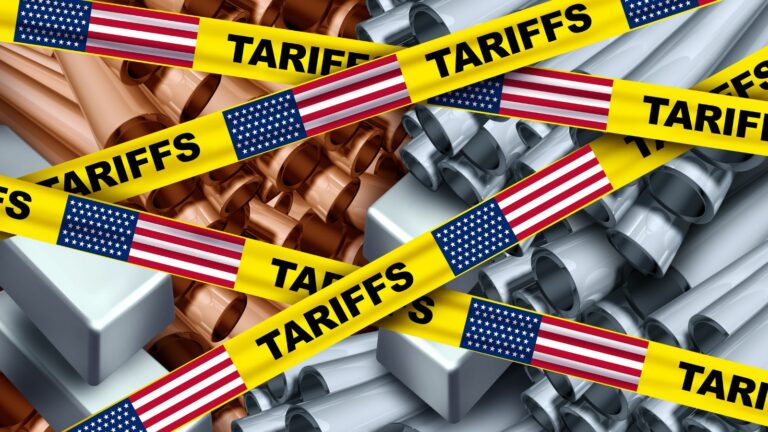
A bottle from Niagara, a hockey stick made in Brantford and a shipment of Canadian cement may soon arrive at the U.S. border with something new attached: an additional 50% tariff. The Trump administration announced the measure on July 20, saying it was responding to what it calls Canada’s discriminatory treatment of American products. The levy is scheduled to take effect in 30 days and will reach goods that had previously qualified for duty-free treatment under CUSMA.
The White House used wine, hockey sticks and cement as examples of the products covered, while saying energy, potash, fish and critical minerals would be exempt. The initial announcement did not include a complete public schedule of affected tariff lines, leaving exporters, importers and consumers trying to calculate the consequences of one of the sharpest escalations yet in the Canada–U.S. trade fight.
A Tariff Broad Enough to Break the Old Rules
Trump Targets Canadian Wine, Hockey Sticks and Cement in New 50% Tariff Strike
- A Tariff Broad Enough to Break the Old Rules
- Trump Reaches for a 1930 Trade Weapon
- Canadian Wine Is a Symbolic Target With Real Rural Stakes
- Hockey Sticks Put a Cultural Icon in the Crossfire
- Cement Could Turn the Tariff Into a Construction-Cost Story
- Washington Says the Strike Is Retaliation for Retaliation
- The Exemptions Reveal Where the U.S. Cannot Afford Disruption
- CUSMA’s Safety Net Is No Longer Protecting These Goods
- Who Pays First—and What Happens in the Next 30 Days
For much of the current trade dispute, CUSMA compliance acted as a protective shield. Canadian products that met the agreement’s rules of origin could generally avoid the broad U.S. tariffs applied to non-compliant goods. The new measure breaks with that approach. The administration says the additional 50% duty will reach products that previously entered tariff-free under the continental trade pact, dramatically widening the number of businesses exposed.
That matters because Canada and the United States do not trade like distant economies. Their goods trade totalled an estimated US$719.5 billion in 2025, with components, ingredients and finished products routinely crossing the border. A Canadian producer may sell to an American distributor that supplies a U.S. retailer or construction contractor. When a tariff suddenly adds half the customs value at the border, every company in that chain must decide whether to absorb the cost, raise prices, cancel orders or find another supplier. The headline rate is simple; the commercial disruption underneath it is not.
Trump Reaches for a 1930 Trade Weapon
Trump is relying on Section 338 of the Tariff Act of 1930, an obscure provision written during the era of the Smoot–Hawley tariff. The law allows a president to impose new or additional duties of up to 50% when a foreign country is found to discriminate against U.S. commerce. Legal analyses have long described it as a powerful but untested tool because no president had previously used it to impose tariffs.
Its sudden importance follows the U.S. Supreme Court’s February 2026 ruling that limited the president’s ability to impose sweeping tariffs under the International Emergency Economic Powers Act. The decision did not eliminate other tariff authorities, and the administration has moved toward statutes containing more specific trade powers. Section 338 gives Trump another route to act, but its novelty also creates uncertainty. Importers, trade lawyers and affected governments are likely to examine whether the required findings were made, whether the selected products fit the statute and whether the action conflicts with U.S. treaty commitments. The tariff may begin as an economic shock and quickly become a major legal test.
Canadian Wine Is a Symbolic Target With Real Rural Stakes
Canadian wine is a relatively small part of continental trade, but it carries an outsized regional identity. Vineyards in Niagara, the Okanagan, Quebec and Nova Scotia support growers, cellar workers, restaurants, hotels and tourism businesses. A 2026 Deloitte analysis commissioned by Wine Growers Canada estimated that the country’s wine supercluster supports about 21,700 full-time-equivalent jobs and functions as a roughly $10.1-billion economic engine.
A 50% U.S. duty could be especially difficult for smaller wineries that sell limited quantities abroad at premium prices. The tariff is collected from the American importer, not paid directly to Washington by the Canadian winery. That importer can absorb the charge, demand a lower wholesale price or pass part of it to distributors, restaurants and shoppers. Research on recent U.S. tariffs has repeatedly found substantial pass-through into importer and retail prices. For a family-run winery, the practical result may be fewer U.S. listings rather than a neat 50% increase on a shelf tag. Bottles can be replaced more easily than energy or potash, which helps explain why wine became available as a pressure point.
Hockey Sticks Put a Cultural Icon in the Crossfire
Hockey sticks give the tariff fight its most unmistakably Canadian image. Yet behind the symbolism are small manufacturers and workers whose margins are already thin. Roustan Hockey’s Brantford, Ontario, operation—the country’s last major wooden-stick factory—employs about 15 people and produces roughly 400,000 sticks a year. Around 100,000 are exported to the United States, according to reporting on the plant.
Those numbers make the exposure easy to picture. A U.S. buyer considering a Canadian wooden stick must now account for an additional border charge large enough to change purchasing decisions. The buyer could raise prices, switch suppliers, reduce orders or ask the factory to accept less. None is painless. Wooden sticks are already a smaller segment of a market dominated by composite models, so the tariff lands on a traditional product fighting to preserve its niche. The effect could reach community rinks and school programs, where equipment budgets are closely watched. A policy framed as punishment for Canadian trade practices may ultimately be felt by an American parent comparing prices in a sporting-goods aisle.
Cement Could Turn the Tariff Into a Construction-Cost Story
Cement may be the least glamorous product named by the White House, but it could have the broadest connection to everyday costs. It is an essential input for concrete used in homes, roads, bridges, factories and public infrastructure. Canada supplied about 20% of U.S. cement imports during the 2021–2024 period, making it the second-largest source after Turkey, according to the U.S. Geological Survey.
Because cement is heavy and expensive to move, geography matters. Canadian plants can serve nearby U.S. markets through established rail, truck and Great Lakes shipping routes. A 50% tariff could therefore create sharper pressure in regions where Canadian supply is the practical nearby option, even if the national impact is diluted by domestic production and imports from other countries. Substitution also takes time: contractors cannot always replace a shipment immediately without changing schedules or paying more for transportation. In Canada, the cement and concrete sector supports more than 62,000 direct and indirect jobs and generates over $5 billion in direct economic impact. The tariff threatens exporters, but delayed projects or higher material bills could make it a U.S. construction story as well.
Washington Says the Strike Is Retaliation for Retaliation
The administration is presenting the tariff as retaliation for Canada’s retaliation. In March 2025, Ottawa imposed 25% tariffs on $30 billion in U.S. goods and then added duties covering another $29.8 billion after Washington placed tariffs on Canadian products. Provincial liquor authorities also removed American alcohol from many government-controlled stores, dealing a visible blow to U.S. wine and spirits producers.
Trump officials say Canada has discriminated against American autos, alcohol and dairy products, including cheese, and argue that the new tariff is designed to force changes. Canada sees the sequence differently: its measures were announced as countermeasures against U.S. tariffs it considered unjustified. That disagreement is central to the escalating cycle. Each government describes its own action as defensive and the other side’s response as aggression. Wine is particularly symbolic because provincial alcohol removals hurt U.S. producers in a market that had been their largest foreign destination. By placing Canadian wine among the products covered by the new measure, Washington is effectively answering a politically visible boycott with a politically visible import tax.
The Exemptions Reveal Where the U.S. Cannot Afford Disruption
The exemptions are as revealing as the products being taxed. Energy, potash, fish and critical minerals will not face the new 50% rate, while steel and aluminum are already covered by separate U.S. tariffs. These carve-outs reduce the risk of immediate shocks in sectors where American buyers have limited replacement options or where supply is tied to food, fuel and national security.
Canada provides the overwhelming majority of U.S. potash imports, a fertilizer input farmers need to maintain crop yields. Canadian crude oil is also deeply embedded in U.S. refinery networks, particularly in the Midwest. Exempting those products suggests the administration is trying to maximize pressure on Canada without creating the most obvious domestic shortages. Wine and hockey sticks are replaceable consumer products; cement is more regionally sensitive but still has alternative sources. The pattern is strategic rather than random. It shifts pain toward Canadian exporters and U.S. importers in selected industries while protecting supply chains that could quickly translate tariffs into gasoline, fertilizer or food-price complaints. The exemptions therefore place a practical limit around an otherwise aggressive political message.
CUSMA’s Safety Net Is No Longer Protecting These Goods
The tariff also weakens confidence in CUSMA at the moment the agreement is undergoing its first six-year joint review. The United States, Canada and Mexico began that process on July 1, 2026. Washington declined to automatically extend the pact for another 16 years, but that decision does not immediately terminate the agreement. Instead, it opens a period of continuing reviews and negotiations that can stretch toward the agreement’s 2036 expiry date.
For businesses, however, legal survival is not the same as commercial certainty. A manufacturer may technically remain inside CUSMA while losing the tariff preference that made cross-border sales economical. The new measure demonstrates that rules of origin alone may no longer protect a qualifying Canadian product from U.S. duties. That changes investment calculations on both sides of the border. Companies planning a plant, warehouse or supplier contract must now consider political risk alongside labour, transportation and exchange rates. The United States and Mexico are already holding bilateral negotiating rounds connected to the review, increasing Canadian concern that continental rules could be reshaped through separate deals. CUSMA remains in force, but its role as a dependable shield has been seriously weakened.
Who Pays First—and What Happens in the Next 30 Days
The first bill will be presented to U.S. importers when the tariffs take effect. Customs duties are collected at the border from the importing company, which then decides how much of the cost to absorb or pass along. Studies of the 2018–2019 and 2025 tariff rounds found that U.S. importers bore most or nearly all of the initial cost, with retail prices rising more gradually as inventories turned over and contracts were renewed.
The next 30 days will therefore be a scramble. Businesses may accelerate shipments, renegotiate prices, pause orders or seek clarification about product codes and exemptions. Canadian producers will look for other markets, while Ottawa decides whether to retaliate, negotiate or challenge the measure. The first reports did not contain a complete list of affected tariff lines, so the full economic footprint remained uncertain. Wine, hockey sticks and cement are not Canada’s largest exports, but they make the conflict tangible: a restaurant bottle, a child’s piece of sports equipment and the material poured into a new building. That is how a trade dispute moves from government statements into ordinary life.
This Options Discord Chat is The Real Deal
While the internet is scoured with trading chat rooms, many of which even charge upwards of thousands of dollars to join, this smaller options trading discord chatroom is the real deal and actually providing valuable trade setups, education, and community without the noise and spam of the larger more expensive rooms. With a incredibly low-cost monthly fee, Options Trading Club (click here to see their reviews) requires an application to join ensuring that every member is dedicated and serious about taking their trading to the next level. If you are looking for a change in your trading strategies, then click here to apply for a membership.