35,000+ smart investors are already getting financial news, market signals, and macro shifts in the economy that could impact their money next with our FREE weekly newsletter. Get ahead of what the crowd finds out too late. Click Here to Subscribe for FREE.
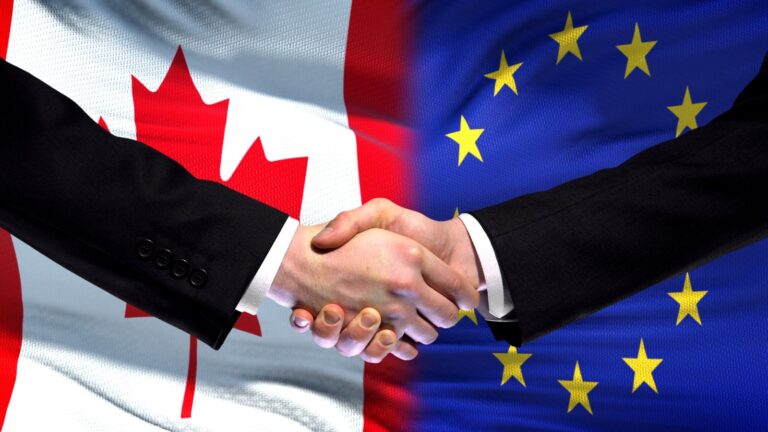
Canada’s push to widen its economic options is about to enter a more formal phase. Prime Minister Mark Carney said on October 27 that this week’s Canada–European Union summit in Montréal will launch negotiations on a deeper partnership over the coming year, moving beyond the broad political vision he and European leaders have been outlining since September.
The talks arrive as Ottawa is still trying to stabilize a bruising trade relationship with U.S. President Donald Trump, including negotiations over American steel and auto tariffs. Europe is not a substitute for the United States, which remains Canada’s dominant export market. But the EU offers something Ottawa increasingly values: a large, rules-based market where Canada already has a trade agreement, rising exports and expanding cooperation in defence, technology, energy and research.
Montréal Summit Will Start a Year of Formal Negotiations
Carney Confirms New Canada–EU Negotiations as Ottawa Looks Beyond Trump’s U.S. Trade Market
- Montréal Summit Will Start a Year of Formal Negotiations
- CETA Gives the New Talks a Running Start
- The U.S. Still Dominates Canada’s Trade—And That Is the Risk
- Digital Trade May Deliver an Early Business Win
- Critical Minerals Could Turn Diplomacy Into Investment
- Energy Is Another Test of Whether Diversification Can Become Physical
- Defence Integration Is Already Producing Concrete Deals
- Workers, Students and Researchers Could See the Most Visible Changes
- The Hard Part Comes After the Summit
Carney’s October 27 comments make the October 29–30 Montréal summit more than another diplomatic meeting. He said it will launch formal discussions and negotiations over the next year. European Council President António Costa and European Commission President Ursula von der Leyen are expected to attend, with trade, digital policy, critical raw materials, defence, education, research, innovation and youth all on the agenda. Ottawa is therefore pursuing something broader than a conventional tariff-cutting agreement between two established commercial partners.
The label remains unsettled. Von der Leyen has floated Canada as the EU’s first “associate member,” while Carney has stressed that Canada is not seeking full EU membership and that substance matters more than terminology. The practical questions are whether businesses gain easier market access, researchers get deeper collaboration and Canadians gain more opportunities to study, work and travel in Europe. The summit is expected to start defining those details, not finish them, leaving negotiators to turn political ambition into workable rules.
CETA Gives the New Talks a Running Start
The negotiations begin with a functioning trade framework already in place. CETA has been provisionally applied since September 2017, and by 2024 about 99% of tariff lines had been eliminated. Canada says two-way goods-and-services trade with the EU reached roughly $178.3 billion in 2025. Bilateral merchandise trade is more than 78% above pre-CETA levels, while services trade has risen about 90%, giving both sides a substantial commercial base.
The relationship is still gaining momentum. Global Affairs Canada reported that Canadian merchandise exports to the EU increased almost 21% from January through August 2026. The EU is Canada’s second-largest trading partner for goods and services and its second-largest source of foreign direct investment. That means the new talks are less about finding a market from scratch than making an existing one easier to use through better regulatory cooperation, investment links and access in strategic sectors where barriers are often more complicated than tariffs.
The U.S. Still Dominates Canada’s Trade—And That Is the Risk
Europe cannot quickly reproduce the scale or geography of Canada’s commercial relationship with the United States. Statistics Canada reported that 71.7% of Canadian merchandise exports still went to the U.S. in 2025, even after the share fell from 75.9% in 2024. Exports to the United States declined 5.8% that year, while exports to countries outside the U.S. rose 17.2%, showing diversification is growing from a heavily concentrated starting point.
That is why Carney’s European strategy is better understood as a hedge than a divorce. Canada and the Trump administration are still negotiating, and Reuters reported this week that officials are discussing possible relief from U.S. tariffs on Canadian steel and automobiles. Even if those talks succeed, Ottawa has learned that heavy concentration in one market creates leverage for Washington. More European trade would give Canadian exporters another large destination without dismantling the deeply integrated North American supply chains they still depend on for everyday business.
Digital Trade May Deliver an Early Business Win
One of the most advanced pieces is already under negotiation. Canada and the EU formally launched talks on a standalone Digital Trade Agreement in March 2026, and the European Commission lists five negotiating rounds through September. The deal is intended to complement CETA by improving legal certainty, regulatory predictability and interoperability for companies doing business digitally across the Atlantic, where many commercial barriers now come from rules rather than customs duties.
Those rules can matter as much as tariffs for software firms, fintech companies and professional-service exporters. Digital trade agreements can address electronic contracts, data flows, privacy, source-code protections and online consumer safeguards. Canada’s 2026 State of Trade report says services now account for nearly one-quarter of total exports, while digitally enabled services represented 13% of exports in 2025. Reducing digital friction could therefore help smaller Canadian firms reach Europe without needing the costly physical supply chains required for many traditional goods.
Critical Minerals Could Turn Diplomacy Into Investment
Critical minerals sit near the centre of the emerging partnership because both sides have something the other needs. Europe wants more secure supplies for batteries, clean technology, advanced manufacturing and defence. Canada wants long-term buyers, processing capacity and capital for projects that can take years to finance and build. In March, the European Investment Bank and Ottawa signed a letter of intent to explore cooperation on critical raw materials and more resilient supply chains.
That agreement opened discussions about institutional arrangements that could allow the EIB to operate in Canada and support future projects. The opportunity is larger than simply shipping ore overseas. Canadian officials and European partners have been discussing investment, refining, processing and supply-chain resilience. If European financing and purchase commitments help Canadian projects reach production, the relationship could create durable trade flows rather than one-time commodity sales, while giving Europe more alternatives to concentrated global sources of strategically important minerals.
Energy Is Another Test of Whether Diversification Can Become Physical
Energy cooperation gives the strategy a similar real-world test. Canadian and EU officials have identified liquefied natural gas, nuclear energy, electrification, critical minerals and clean technologies as priority areas. In June, Canada’s energy minister and the EU energy commissioner also held a business roundtable focused on stronger transatlantic supply chains and Europe’s need for diversified, reliable energy sources in a more volatile geopolitical environment and increasingly competitive global energy market.
The challenge is infrastructure. Canada may have resources Europe wants, but those resources need terminals, transmission, processing, shipping capacity and long-term commercial agreements before they can become large export flows. That is why closer investment ties matter alongside trade rules. Europe brings industrial demand and capital; Canada brings energy and resource potential. The success of the partnership will depend on whether governments and companies can convert that complementarity into projects that are commercially viable and large enough to change Canada’s existing trade patterns.
Defence Integration Is Already Producing Concrete Deals
Defence offers one of the clearest examples of deeper integration already moving beyond rhetoric. Canada and the EU signed a Security and Defence Partnership in June 2025. In February 2026, Canada signed on to the EU’s Security Action for Europe, or SAFE, becoming the only non-European country participating in the €150-billion loan facility designed to support joint defence procurement and expand European industrial capacity at a time of sharply higher security spending.
That access has already produced a Canadian contract. Montréal-based Marconi Technologies secured a deal worth more than $10 million to supply Canadian-made ORION tactical radios to the Polish Cyber Command. Ottawa described it as the first procurement secured through SAFE after Canada joined. The contract is modest relative to Europe’s overall defence spending, but strategically important: it shows Canadian suppliers can gain access to procurement channels tied directly to Europe’s defence-industrial expansion, creating a practical model for future aerospace, cyber and defence technology sales.
Workers, Students and Researchers Could See the Most Visible Changes
The people-to-people side may become the most noticeable part of the new relationship. Canada’s EU ambassador, Jonathan Wilkinson, said this week that the talks are not about unrestricted free movement of labour. Instead, officials are considering targeted mobility in specialized areas. A working example already exists: a Canada–EU mutual-recognition agreement now makes it easier for qualified architects to have their professional credentials recognized across the Atlantic, subject to licensing and experience requirements.
Education and research could expand too. Canada is already associated with Pillar 2 of Horizon Europe, allowing eligible Canadian researchers and organizations to join or lead consortia and receive direct funding. Ottawa has also discussed joining Erasmus+, the EU’s flagship education and training exchange program. None of that gives Canadians an automatic right to live or work anywhere in Europe, but easier credentials, exchanges and targeted mobility could make the alliance tangible in individual careers, especially for younger Canadians and highly specialized professionals.
The Hard Part Comes After the Summit
The enthusiasm around Montréal should not obscure the institutional difficulty ahead. The EU does not currently have a treaty category called “associate member,” so any new status must be designed rather than selected from an existing legal framework. Even CETA remains only provisionally applied: nine EU member states still have not completed national ratification. Deeper market access could also require more regulatory alignment from a Canadian economy historically built around U.S. standards, logistics and integrated continental supply chains.
Practical barriers matter as well. A 2026 Global Affairs Canada study found that Canadian exporters can struggle to use CETA preferences because of complex rules of origin, shipment patterns through third countries and the cost of proving eligibility. Signing a deeper agreement will not automatically create trade. The real test of Carney’s strategy will be whether the next year produces usable rules, financing and projects that companies, workers and researchers actually adopt, turning political diversification into measurable economic activity.
This Options Discord Chat is The Real Deal
While the internet is scoured with trading chat rooms, many of which even charge upwards of thousands of dollars to join, this smaller options trading discord chatroom is the real deal and actually providing valuable trade setups, education, and community without the noise and spam of the larger more expensive rooms. With a incredibly low-cost monthly fee, Options Trading Club (click here to see their reviews) requires an application to join ensuring that every member is dedicated and serious about taking their trading to the next level. If you are looking for a change in your trading strategies, then click here to apply for a membership.