35,000+ smart investors are already getting financial news, market signals, and macro shifts in the economy that could impact their money next with our FREE weekly newsletter. Get ahead of what the crowd finds out too late. Click Here to Subscribe for FREE.
Canada is placing a multibillion-dollar bet on satellites designed, manufactured and operated at home, yet the machinery carrying them into orbit will remain unmistakably American. The federal government has signed a C$2.3-billion contract with Ottawa-based Telesat to provide secure military communications across the Arctic, expanding the company’s Lightspeed network to 225 low-Earth-orbit satellites.
The agreement represents an important step toward greater control over communications in Canada’s North, where distance, weather and limited infrastructure can make dependable connections difficult. It also exposes a lingering weakness in the country’s sovereignty strategy. MDA Space will build the satellites in Montreal, and Canadian facilities will control the network, but SpaceX’s Falcon 9 rockets will launch the spacecraft from the United States. Canada is building an advanced space system while still relying on another country for the final trip into orbit.
The $2.3-Billion Contract Could Eventually Reach $2.7 Billion
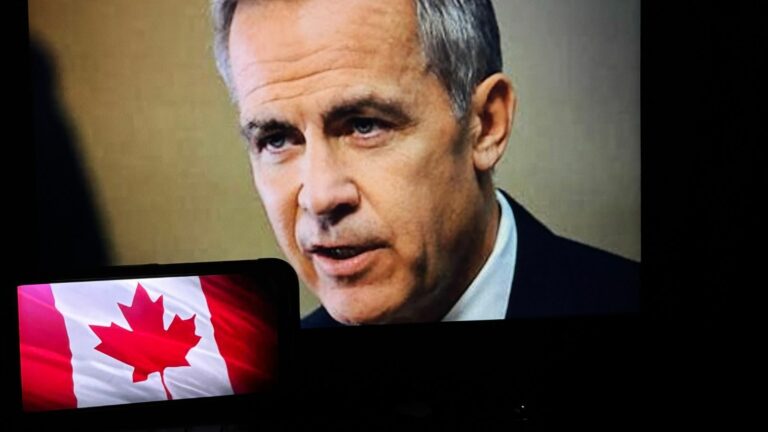
Carney Commits $2.3B to Canadian Arctic Satellites—But SpaceX Will Still Launch Them
- The $2.3-Billion Contract Could Eventually Reach $2.7 Billion
- The Satellites Will Cover the High Arctic
- The Lightspeed Constellation Is Growing by 44 Percent
- SpaceX Remains the Ride to Orbit
- Canada Still Does Not Have an Operational Launch System
- Ottawa Was Already Deeply Invested in Lightspeed
- The Deal Is Part of a Much Larger Arctic Build-Up
- The Real Test Comes Before 2028
Telesat announced on August 4, 2026, that its low-Earth-orbit subsidiary had signed the C$2.3-billion services contract with Canada’s Defence Investment Agency. It is the largest contract in Telesat’s history and forms part of the Enhanced Satellite Communications Project–Polar, commonly known as ESCP-P. The program is intended to give the Canadian Armed Forces secure and dependable communications across the country’s northernmost territory.
The agreement includes two five-year option periods worth approximately C$200 million each. Exercising both would raise the total value to roughly C$2.7 billion. Service is expected to begin in 2028, with Telesat targeting the first quarter of that year for the start of global Lightspeed operations. Federal payments for the expansion are structured around project milestones and are scheduled to begin in the third quarter of 2026. That structure offers Ottawa some protection because payments are connected to progress rather than being delivered as one unrestricted lump sum.
The Satellites Will Cover the High Arctic
The military service is designed to cover the region between 65 and 90 degrees north latitude. That area begins around the Arctic Circle and extends to the North Pole, encompassing much of Nunavut, the northern sections of the Northwest Territories and Yukon, and the waters surrounding the Canadian Arctic Archipelago. Conventional communications infrastructure is sparse across much of this territory, making satellite access essential for operations beyond the range of ordinary radio or terrestrial networks.
Lightspeed will provide Military Ka-band connectivity, offering high-capacity communications for personnel, aircraft, ships and other military platforms operating in the North. The broader ESCP-P program also calls for Ultra-High Frequency narrowband capability and X-band services. Separate arrangements are expected to cover user terminals, control systems, ground infrastructure, training and technical support. In practical terms, the satellites alone are not enough. Military units will also need compatible equipment and an integrated network capable of remaining available during emergencies, exercises and joint operations with allied forces.
The Lightspeed Constellation Is Growing by 44 Percent
The new contract allows Telesat to increase its fully funded constellation from 156 satellites to 225, an expansion of 69 spacecraft or approximately 44 percent. The numerical change is slightly more complicated on the manufacturing side. MDA Space had previously been contracted to produce 198 satellites, meaning the latest order adds 27 spacecraft to its existing production commitment while ensuring that all 225 satellites are funded within the expanded network plan.
MDA Space received a C$474-million increase to its manufacturing contract. That amount covers the additional satellites, long-lead components and the integration of 500 megahertz of military Ka-band capacity into satellites already under construction. The spacecraft will be designed, assembled and tested at MDA’s high-volume manufacturing facility in Montreal. Telesat now estimates that total investment in the 225-satellite network will reach approximately C$7 billion, with C$2.7 billion invested to date. The company expects the larger program to sustain thousands of Canadian positions across engineering, manufacturing, cybersecurity and satellite operations.
SpaceX Remains the Ride to Orbit
The Canadian content stops at the launch pad. Telesat signed an agreement with SpaceX in 2023 for 14 Falcon 9 launches, with each rocket capable of carrying as many as 18 Lightspeed satellites into low Earth orbit. Those missions are scheduled to depart from SpaceX facilities in California and Florida. The latest expansion will use those previously secured launches, along with another Falcon 9 mission that still requires a finalized launch-services agreement.
The arrangement creates an unusual commercial relationship. SpaceX is both Telesat’s launch provider and the operator of Starlink, the much larger satellite network competing for government, aviation, maritime and telecommunications customers. Telesat nevertheless selected Falcon 9 because of its established reliability, reusable design and ability to launch frequently. Deploying hundreds of satellites requires a provider capable of flying repeatedly without years between missions. From a scheduling perspective, SpaceX offers that capacity. From a sovereignty perspective, however, Canada’s access to its own defence infrastructure still depends on rockets, launch sites and regulatory approvals located outside the country.
Canada Still Does Not Have an Operational Launch System
Ottawa openly acknowledges the problem. Transport Canada has described Canada as the only G7 country without its own space-launch capability, leaving Canadian satellites dependent on foreign providers—most often those in the United States. The government introduced the Canadian Space Launch Act in April 2026 to establish rules for launches and spacecraft re-entry from Canadian territory, provide greater certainty to investors and support the development of domestic launch infrastructure.
The federal government has also announced a C$200-million investment in infrastructure for a Canadian-owned spaceport in Nova Scotia. These measures could eventually allow Canadian satellites to be built and launched domestically. They will not, however, eliminate Lightspeed’s immediate reliance on SpaceX. Telesat has already secured its main launch campaign, and the network is expected to begin service in early 2028. Developing a mature launch industry requires more than legislation and a launch pad; Canada will need proven rockets, qualified personnel, regulatory systems, insurance arrangements and a record of successful missions before defence payloads can routinely fly from Canadian soil.
Ottawa Was Already Deeply Invested in Lightspeed
The C$2.3-billion military contract is not the first major federal commitment to Telesat Lightspeed. In 2024, Ottawa completed a C$2.14-billion repayable loan agreement supporting the constellation’s development. Quebec added a C$400-million provincial loan. The federal government also committed as much as C$600 million to reserve Lightspeed capacity for broadband service in rural and remote communities once the network becomes operational.
These commitments serve different purposes and should not be treated as one combined grant. The C$2.14-billion arrangement is a loan that is expected to earn interest, and the federal government received warrants that could give taxpayers a financial benefit if the Lightspeed business succeeds. The new defence agreement, by contrast, purchases military satellite service and funds the constellation’s expansion through milestone payments. Telesat has also committed to invest more than C$4.4 billion in the Canadian economy over 15 years. A Gatineau operations campus, designed to house satellite control, network management and cybersecurity teams, was expected to create approximately 300 specialized positions.
The Deal Is Part of a Much Larger Arctic Build-Up
Prime Minister Mark Carney first highlighted an agreement in principle with Telesat during the NATO summit in Ankara on July 8. The government presented the satellite network as part of a wider effort to assume greater responsibility for Canada’s Arctic security and meet commitments to NORAD and NATO. Ottawa says it is investing more than C$40 billion in northern and Arctic defence, infrastructure and surveillance initiatives.
Other announced projects include C$4.67 billion over five years for Arctic over-the-horizon radar and C$6.4 billion for two polar icebreakers. Within that larger strategy, Lightspeed provides the communications layer connecting personnel and equipment spread across an enormous region. The full ESCP-P project has an official funding range exceeding C$5 billion because the C$2.3-billion Telesat agreement covers only its initial Military Ka-band phase. MDA Space is also expected to lead the UHF and X-band portion of the program, with negotiations continuing. The ultimate cost of Canada’s complete polar communications system will therefore be significantly higher than the contract announced with Telesat.
The Real Test Comes Before 2028
The contract transforms Lightspeed from a primarily commercial broadband project into a major component of Canadian defence infrastructure. It gives Telesat a large government customer, finances additional satellites and expands the potential market among NATO members seeking secure communications. Yet the toughest work remains unfinished. Satellites must be produced at scale, tested, launched, placed into their correct orbits and connected to ground stations, terminals and military networks.
Telesat’s own disclosures identify construction delays, launch failures, supply-chain disruptions, technical problems, regulatory restrictions and underperforming spacecraft as potential risks. The company must also coordinate a rapid series of Falcon 9 missions while preparing for commercial service in the first quarter of 2028. Until that happens, the system remains a promise rather than an operational capability. For military personnel working in Canada’s North, the measure of success will not be the size of the announcement. It will be whether a secure connection is available when an aircraft, patrol or emergency team needs it—hundreds of kilometres from the nearest conventional communications network.
This Options Discord Chat is The Real Deal
While the internet is scoured with trading chat rooms, many of which even charge upwards of thousands of dollars to join, this smaller options trading discord chatroom is the real deal and actually providing valuable trade setups, education, and community without the noise and spam of the larger more expensive rooms. With a incredibly low-cost monthly fee, Options Trading Club (click here to see their reviews) requires an application to join ensuring that every member is dedicated and serious about taking their trading to the next level. If you are looking for a change in your trading strategies, then click here to apply for a membership.