35,000+ smart investors are already getting financial news, market signals, and macro shifts in the economy that could impact their money next with our FREE weekly newsletter. Get ahead of what the crowd finds out too late. Click Here to Subscribe for FREE.
For several days in August, Canada and the United States appeared to be edging toward a deal that could have cooled one of the most disruptive periods in their modern trading relationship. Then the negotiations abruptly collapsed.
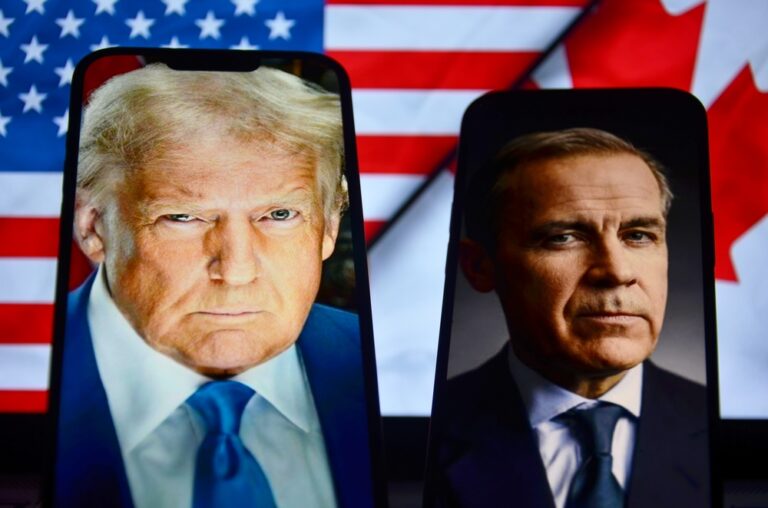
Prime Minister Mark Carney recalled Canada’s negotiators from Washington on August 21, saying last-minute changes to the American proposal had made the agreement unacceptable. Explaining the decision the next day, he said the United States had “asked too much and offered too little,” adding that Canada could not accept what Washington offered or give it what it wanted. The dispute was not simply about tariff percentages, according to Ottawa. It had expanded into questions involving strategic industries, economic sovereignty and how much control Canada was prepared to surrender for better access to its largest export market.
A Deal That Looked Close Suddenly Fell Apart
‘They Asked Too Much. We Wouldn’t Give It’: Carney Reveals Why Canada Walked Away From Trump
- A Deal That Looked Close Suddenly Fell Apart
- Canada Had Already Put Significant Concessions on the Table
- Ottawa Says Some Demands Crossed Its Red Lines
- The Auto Industry Became One of the Biggest Flashpoints
- Washington Says Canada Was the Side That Asked for Too Much
- Walking Away Came With an Immediate Economic Price
- CUSMA Still Shields Most Trade—But Not the Most Painful Sectors
- Canada Still Has Leverage, But the Dependence Runs Both Ways
- Carney Is Now Trying to Make Canada Less Dependent on Any One Deal
Only three days before Canada walked away, Carney had publicly described “substantial progress” in negotiations. Washington even postponed the planned introduction of new 50% tariffs from August 19 until the end of August 21, providing negotiators extra time. Canadian and American officials had spent days working through some of the most contentious areas of the relationship, including automobiles, steel, aluminum and other products facing U.S. duties.
That made the collapse particularly striking. Carney said Ottawa believed earlier in the week that a mutually beneficial agreement was within reach, but maintained that new American terms appeared late in the process and changed the economics of the package. On the evening of August 21, he suspended negotiations and ordered the Canadian team home. Washington disputes that account, making precisely who changed the deal—and when—one of the central unresolved questions surrounding the breakdown.
Canada Had Already Put Significant Concessions on the Table
Carney’s account makes clear that Canada was prepared to give Washington something substantial in exchange for tariff relief. Ottawa offered to remove its remaining retaliatory tariffs on American steel, aluminum and automobiles if the United States significantly reduced its own tariffs on those Canadian sectors. Those were not minor bargaining chips: metals and autos have been among the industries most exposed to the trade dispute.
Canada was also prepared to encourage provincial governments to return American alcohol to store shelves. Several provinces had removed U.S. products as part of their response to the trade conflict. Carney additionally said Ottawa would consider administrative measures involving supply management, provided the basic system, U.S. quotas and applicable tariff structure remained intact. In other words, Canada was signalling room for compromise, but Ottawa’s position was that compromise had boundaries. The eventual disagreement centred on where Washington believed those boundaries should be.
Ottawa Says Some Demands Crossed Its Red Lines
Carney identified several areas where his government would not compromise. He said Canada would not accept terms that undermined Canadian sovereignty or key domestic industries, and specifically said protection of French language and culture was not negotiable. He also said the United States continued pressing issues Ottawa considered off limits until the final stages of negotiations.
There is an important limitation to that account: Ottawa has not publicly released a complete draft agreement spelling out every American request. That has left some of the most politically sensitive details open to competing interpretations. The Conservatives subsequently called on the government to release the proposal Canada rejected so Canadians could examine the terms themselves. What can be documented is that Washington’s publicly stated grievances included Canadian measures involving dairy, alcohol and motor vehicles, while Carney has described broader disagreements involving sovereignty, industry and cultural protections.
The Auto Industry Became One of the Biggest Flashpoints
Carney later provided a sharper explanation of why the proposed terms worried Ottawa. On September 1, he said the American approach to core Canadian industries—particularly automobiles—would have risked leaving them effectively subordinate to U.S. industry or gradually winding down Canadian production. U.S. officials reject the suggestion that their proposal amounted to dismantling Canada’s industrial base.
The stakes are unusually high because Canadian auto manufacturing is deeply integrated with the American market. More than 90% of Canadian-made vehicles and about 60% of Canadian-made auto parts are exported to the United States, according to the federal government. Canada produced more than 1.2 million passenger vehicles in 2025, while the industry supports roughly 125,000 direct Canadian jobs. That means even relatively small changes to cross-border tariff rules can influence where automakers assign future production, investment and jobs. For Ottawa, the auto provisions were therefore about much more than the immediate tariff rate.
Washington Says Canada Was the Side That Asked for Too Much
The Trump administration tells almost the mirror image of Ottawa’s story. U.S. Trade Representative Jamieson Greer says Washington had developed a near-final agreement that would have given Canada exceptionally favourable treatment. He later accused Canada of walking away and continuing retaliation against American businesses instead of accepting the package.
Greer has said the U.S. offer included lowering steel tariffs from 50% to 25% for most Canadian steel under a quota arrangement, cutting aluminum duties from 50% to 25%, reducing auto tariffs and eliminating a newer U.S. tariff on Canadian lumber. The American side also says Canada introduced additional requests near the end of negotiations. Canadian officials, by contrast, say American changes made the package uneconomic. Without a jointly released negotiating text, those competing accounts cannot be fully reconciled from public information. What is clear is that both governments believed the other side moved the goalposts.
Walking Away Came With an Immediate Economic Price
Rejecting the proposed agreement did not restore the status quo. The United States proceeded with 50% tariffs covering C$27.6 billion worth of Canadian goods beginning August 22. Ottawa answered with counter-tariffs covering C$27.6 billion in American imports, with rates of 15%, 25% or 50% depending on the product. Canada’s measures took effect September 8 and cover goods including steel, dairy products, appliances, agricultural equipment, pulp and paper, plastics and electronics.
Ottawa also announced C$7.5 billion in new and expanded assistance for businesses and workers affected by tariffs, on top of earlier federal support. Washington subsequently escalated again. On September 8, the Trump administration announced that certain Canadian dairy, alcoholic-beverage and automotive products would be excluded from the U.S. market beginning September 29 rather than merely facing the existing 50% duty. The failure to reach a deal therefore produced consequences that continued growing weeks after the negotiating teams left the table.
CUSMA Still Shields Most Trade—But Not the Most Painful Sectors
Despite the escalating rhetoric, the Canada-U.S. border has not become a universal tariff wall. Canada’s 2026 Spring Economic Update estimated that approximately 85% of Canadian exports to the United States remained tariff-free because of protections associated with the Canada-United States-Mexico Agreement. It estimated an effective average U.S. tariff rate of 5.2% on Canadian goods at the time.
The problem is where the remaining tariffs are concentrated. Autos, steel, aluminum and forestry are economically important industries with production clustered in communities where a factory shutdown or lost contract can ripple through suppliers and local businesses. CUSMA itself remains a massive foundation for continental commerce: the U.S. Trade Representative says the agreement underpins nearly US$2 trillion in goods-and-services trade across Canada, Mexico and the United States. The current fight is therefore occurring inside a relationship that remains extraordinarily integrated even as both governments argue over its rules.
Canada Still Has Leverage, But the Dependence Runs Both Ways
Canada entered the negotiations with an obvious vulnerability: the United States remains its dominant export market. Statistics Canada reported that 71.7% of Canadian merchandise exports went to the U.S. in 2025, although that was down from 75.9% in 2024. Geography, pipelines, rail networks and decades of integrated manufacturing make replacing the American market quickly unrealistic.
But American businesses also have considerable exposure to Canada. The U.S. Commerce Department says Canada was the number-one export market for 32 states in 2024 and either the first- or second-largest for 44 states. American exports of goods and services to Canada approached US$441 billion that year. Energy creates another layer of interdependence: U.S. Energy Information Administration data show the United States imported about 3.9 million barrels of Canadian crude oil per day in 2025, while U.S.-Canada energy trade was worth an estimated US$137 billion. That mutual exposure helps explain why the dispute carries costs on both sides of the border.
Carney Is Now Trying to Make Canada Less Dependent on Any One Deal
Walking away from Washington did not mean Canada decided the American relationship no longer mattered. Carney has repeatedly left the door open to renewed negotiations, saying in September that Canada could wait until conditions were right for a mutually beneficial agreement. The much larger shift is that Ottawa is trying to make access to the U.S. less decisive to Canada’s economic fortunes.
That strategy is increasingly visible overseas. This week, Carney pushed for a significantly deeper economic relationship with Europe, while European Commission President Ursula von der Leyen floated the unprecedented concept of Canada becoming an EU “associate member.” The proposal remains undefined and faces substantial political and legal questions, but discussions are already expanding around critical minerals, energy, defence, artificial intelligence and digital trade. Canada cannot economically detach itself from the United States overnight, nor has Carney proposed doing so. The objective emerging from Ottawa is different: preserve American market access while ensuring that the next confrontation carries less power to dictate Canada’s choices.
This Options Discord Chat is The Real Deal
While the internet is scoured with trading chat rooms, many of which even charge upwards of thousands of dollars to join, this smaller options trading discord chatroom is the real deal and actually providing valuable trade setups, education, and community without the noise and spam of the larger more expensive rooms. With a incredibly low-cost monthly fee, Options Trading Club (click here to see their reviews) requires an application to join ensuring that every member is dedicated and serious about taking their trading to the next level. If you are looking for a change in your trading strategies, then click here to apply for a membership.