35,000+ smart investors are already getting financial news, market signals, and macro shifts in the economy that could impact their money next with our FREE weekly newsletter. Get ahead of what the crowd finds out too late. Click Here to Subscribe for FREE.
When a political dispute suddenly put Lake Ontario’s name in the headlines, Canadian businesses found themselves with an unexpected marketing moment. U.S. President Donald Trump signed an executive order on August 27 directing American federal agencies to use “Lake America,” while Lake Ontario remained the official name in Canada. Within hours and days, Canadian entrepreneurs were putting the familiar name on chocolate, clothing, leather goods and novelty merchandise.
The response has produced something more tangible than social-media commentary. Peace by Chocolate turned its Lake Ontario bar into a top-five seller, Province of Canada repeatedly sold through its themed fleece, and smaller makers reported unusually strong demand. Exact industry-wide revenue figures have not been disclosed, but the combination of sellouts, backorders and repeat production runs shows how quickly a political moment became a retail opportunity.
A Name Change Created an Instant Canadian Marketing Moment
Canadian Brands Turn Trump’s ‘Lake America’ Move Into a Lake Ontario Sales Boom
- A Name Change Created an Instant Canadian Marketing Moment
- Peace by Chocolate Moved From Headline to Product in a Day
- Hides in Hand Found Demand for a Much Smaller Symbol
- Province of Canada Turned One Fleece Into Multiple Production Runs
- One Toronto Marketer Built an Entire Fake Tourism Brand Around It
- The Products Arrived During a Much Bigger Buy-Canadian Shift
- Patriotism Helps, but Canadian Shoppers Still Watch the Price
- The Lake Ontario Name Carries History Beyond the Current Dispute
- Geography Made the Rebranding Dispute Especially Resonant
- The “Sales Boom” Is Real Demand, but Not a Published Dollar Figure
Trump’s August 27 executive order, formally numbered Executive Order 14422, instructed the U.S. Department of the Interior and Board on Geographic Names to replace Lake Ontario with “Lake America” in U.S. federal geographic systems and government references. The order did not change the Canadian government’s designation. Natural Resources Canada’s geographical names database continues to list Lake Ontario and Lac Ontario as the official names on the Canadian side.
That distinction gave Canadian businesses an unusually simple message to work with. They did not need complicated slogans or lengthy explanations; the words “Lake Ontario” themselves became the statement. A centuries-old place name was suddenly recognizable as merchandise with a current-events connection. For smaller brands, that kind of moment is difficult to manufacture through conventional advertising. The political controversy had already created national awareness, while products gave consumers a comparatively low-stakes way to participate in the conversation through something they could eat, wear or give as a gift.
Peace by Chocolate Moved From Headline to Product in a Day
Peace by Chocolate was among the fastest companies to react. Chief executive Tareq Hadhad and his family arrived in Antigonish, Nova Scotia, as Syrian refugees in 2016 and rebuilt the family chocolate business there. After the Lake America order, the company developed a Lake Ontario bar within a day. The 92-gram product combines milk chocolate with maple-flavoured cream and uses packaging featuring the Canadian flag, the Lake Ontario name and information about its Indigenous origins.
The speed mattered because consumers were still intensely engaged with the story when the product arrived. The Canadian Press reported that the Lake Ontario creation quickly became one of Peace by Chocolate’s five bestselling bars, drawing interest from across Canada along with inquiries from Americans. Its current online store lists the bar at $6.75 and, as of September 30, was showing it as backordered. For a company with dozens of chocolate-bar varieties, reaching the top five almost immediately provided a clear indication that buyers were responding to more than flavour alone.
Hides in Hand Found Demand for a Much Smaller Symbol
The opportunity was not limited to companies with national distribution. Teresa Paul, owner of Rockwood, Ontario-based leather business Hides in Hand, responded by creating zippered Lake Ontario coin purses. The red and blue leather pouches feature an embroidered outline of the lake along with its name. The products use Canadian components and are embroidered in Ontario, giving the merchandise another selling point at a time when the origin of consumer goods has become increasingly important to Canadian shoppers.
Paul told The Canadian Press that the pouches had become a particularly strong seller at craft fairs and through a store in Erin, Ontario. Customers were not necessarily stopping at one, either; she described shoppers buying additional purses for relatives. That behaviour is significant for a small maker because gift purchases can turn one politically inspired product into several transactions. Rather than producing confrontational merchandise, Paul described the purse as a practical expression of home and Canadian identity. That approach appears to have widened its appeal beyond highly political consumers.
Province of Canada Turned One Fleece Into Multiple Production Runs
Toronto clothing company Province of Canada already built much of its identity around domestic manufacturing, so the Lake Ontario dispute presented an obvious fit. The brand developed a fleece half-zip carrying the Lake Ontario name and initially offered it through preorder. It also committed 15 per cent of each purchase to Indspire, which supports education for First Nations, Inuit and Métis students.
Demand quickly exceeded the first release. Company representatives told The Canadian Press that the original fleece sold out rapidly, another production round was ordered and stock again dwindled. The company then arranged a third batch for December and another version in a new colourway ahead of Christmas. Province of Canada’s own website currently lists Lake Ontario fleece products at $128, with Canadian manufacturing prominently highlighted. Its navy version was being offered through a preorder expected to ship December 10. Turning what could have been a one-week novelty into several manufacturing runs suggests the design developed staying power beyond the first burst of news coverage.
One Toronto Marketer Built an Entire Fake Tourism Brand Around It
The fastest business response may have come before the executive order was even finished generating headlines. Toronto digital marketer Wesley Almeida registered LakeAmerica.ca after seeing the naming controversy develop and built a tongue-in-cheek tourism brand around it. Merchandise includes “Lake America Department of Tourism” clothing alongside products declaring “Still Lake Ontario,” with the site carefully describing the collection as “officially unofficial.”
The operation also illustrates how quickly modern businesses can monetize a news cycle without committing to traditional inventory. Products are made through print-on-demand fulfilment, meaning shirts, hoodies, hats, mugs and stickers can be produced after orders arrive rather than manufactured in bulk beforehand. The Washington Post reported that Almeida was already receiving inquiries about larger orders shortly after launching. The website also explicitly states that Lake Ontario remains the name in Canada and says it is unaffiliated with either government or any political campaign. That mixture of humour, topicality and limited inventory risk made the controversy unusually easy to turn into commerce.
The Products Arrived During a Much Bigger Buy-Canadian Shift
Lake Ontario merchandise did not enter a neutral consumer environment. Canadians had already been changing some purchasing habits in response to prolonged trade tensions with the United States. The Bank of Canada’s first-quarter 2026 consumer expectations research found that households continued substituting toward goods made in Canada while planning to reduce spending on U.S.-made products. Most respondents expected those changes to persist even if the bilateral trade relationship later improved.
That broader movement accelerated again during the renewed trade dispute in August. The founder of Canadian-product directory The Canada List told The Canadian Press that he estimated daily traffic had jumped roughly 10,000 per cent over several days as consumers searched for domestic alternatives. Against that backdrop, Lake Ontario merchandise offered something ordinary Canadian-made products often lack: instant recognition. Consumers already motivated to support Canadian businesses could identify the message at a glance. Brands therefore benefited from both a sudden cultural moment and a purchasing trend that had been developing for more than a year.
Patriotism Helps, but Canadian Shoppers Still Watch the Price
The popularity of Lake Ontario merchandise should not be mistaken for unlimited consumer willingness to pay. Business Development Bank of Canada research involving nearly 1,500 consumers found that 66 per cent said price drives most of their purchasing decisions. At the same time, 57 per cent said they were willing to pay more for Canadian-made goods. Among those willing to pay a premium, the average amount they reported accepting was 23 per cent.
That tension helps explain why the Lake Ontario products attracting attention are relatively straightforward purchases. A $6.75 chocolate bar is an inexpensive way to participate in the moment, while a Canadian-made fleece can appeal on quality, identity and origin rather than politics alone. BDC also found that 37 per cent of respondents considered Canadian products difficult to identify, making obvious origin signals valuable. A maple leaf, Canadian manufacturing claim or unmistakably Canadian geographic name eliminates much of that uncertainty. The strongest Lake Ontario products effectively tell buyers what they are supporting before the shopper has to investigate the label.
The Lake Ontario Name Carries History Beyond the Current Dispute
The merchandise also benefited from a story deeper than a temporary Canada-U.S. disagreement. Canadian government sources trace the word Ontario to Indigenous Iroquoian language traditions. Natural Resources Canada gives the form “kanadario,” translated as “sparkling water,” while other documented Indigenous forms and interpretations vary. What is consistent is that the name’s roots predate both modern Canada and the United States by centuries.
Several businesses incorporated that history rather than relying solely on nationalism. Peace by Chocolate placed information about the name’s Indigenous origins on its packaging. Province of Canada connected its fleece to Indspire through the 15-per-cent donation commitment. Those decisions added another layer to products that otherwise could have been dismissed as temporary political merchandise. Ontario’s own geographic-naming policies emphasize that place names can carry deep cultural and linguistic connections. In this case, the historical significance of the existing name became part of the commercial story, giving buyers a reason to see “Lake Ontario” as heritage branding rather than simply a reaction to Trump.
Geography Made the Rebranding Dispute Especially Resonant
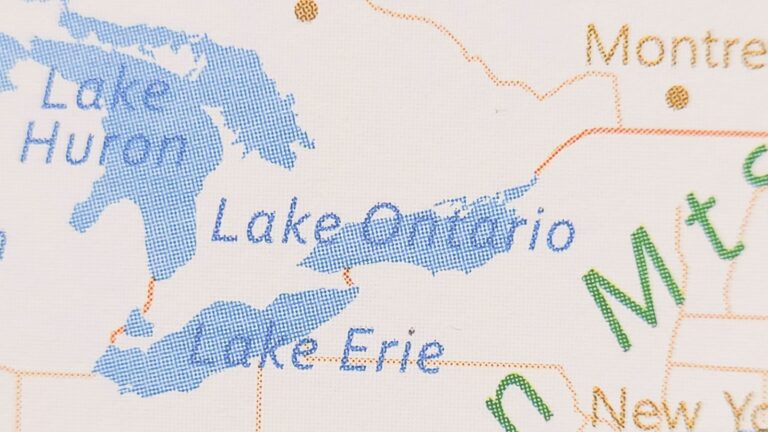
Lake Ontario is not a small feature that sits entirely inside one country. NOAA’s current Coast Pilot records roughly 3,990 square miles of its water surface on the Canadian side and 3,560 square miles on the U.S. side when the connected areas used in its measurement are included. The lake stretches roughly 193 miles from west to east and reaches a maximum recorded depth of about 802 feet. It is the smallest Great Lake by surface area, but it remains a major binational waterway linking the upper Great Lakes system to the St. Lawrence.
That shared geography helps explain why a naming decision made in Washington created such an immediate response north of the border. Canadians were not reacting to the rebranding of a distant American landmark; they were hearing a different government rename a body of water forming part of their own country’s boundary. Canadian geographic records did not change, leaving two naming systems operating around the same physical lake. That unusual circumstance gave Canadian merchandise makers a remarkably clear visual and emotional symbol around which to build products.
The “Sales Boom” Is Real Demand, but Not a Published Dollar Figure
A month after the original order, the strongest evidence points to sustained product demand rather than a single viral weekend. Peace by Chocolate’s Lake Ontario bar reached its top five sellers and was listed as backordered when checked September 30. Hides in Hand reported customers buying multiple purses. Province of Canada sold through its initial fleece offering, produced another round and lined up additional batches extending into the Christmas shopping period. Canadian companies have also been selling related caps, candles and cottage-themed goods.
What remains unavailable is a combined revenue figure showing exactly how much Canadians have spent on Lake Ontario merchandise. The businesses covered publicly have generally discussed rankings, sellouts, production runs and customer interest rather than revealing sales dollars or unit volumes. That makes “sales boom” best understood as a documented surge across individual products, not a measured national market category. Even with that qualification, the pattern is striking: a U.S. geographic naming decision created a Canadian retail opportunity almost overnight, and several brands managed to keep selling long after the first headlines faded.
This Options Discord Chat is The Real Deal
While the internet is scoured with trading chat rooms, many of which even charge upwards of thousands of dollars to join, this smaller options trading discord chatroom is the real deal and actually providing valuable trade setups, education, and community without the noise and spam of the larger more expensive rooms. With a incredibly low-cost monthly fee, Options Trading Club (click here to see their reviews) requires an application to join ensuring that every member is dedicated and serious about taking their trading to the next level. If you are looking for a change in your trading strategies, then click here to apply for a membership.