35,000+ smart investors are already getting financial news, market signals, and macro shifts in the economy that could impact their money next with our FREE weekly newsletter. Get ahead of what the crowd finds out too late. Click Here to Subscribe for FREE.
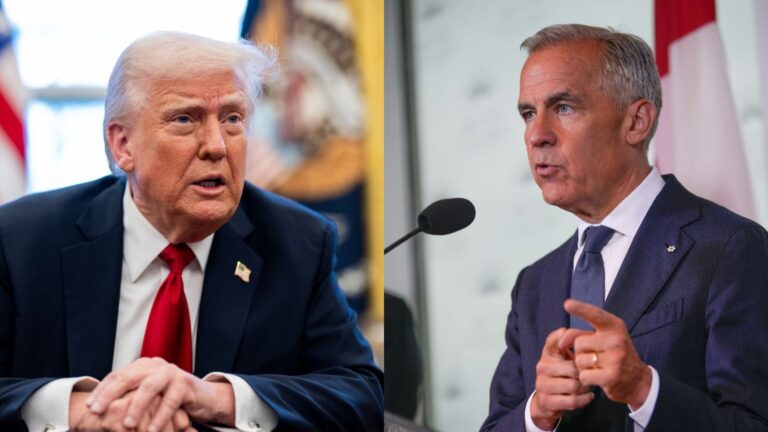
For decades, Canada and the United States built one of the world’s most closely connected automotive industries, sharing factories, workers, suppliers and investment across the border. Now, Prime Minister Mark Carney is warning that President Donald Trump’s trade policies are weakening that partnership at a particularly dangerous moment.
As Chinese automakers expand their global influence, Carney argues that North America cannot afford to undermine its own manufacturing advantages through tariffs and disrupted supply chains. His latest comments have raised questions about whether Canada should continue relying so heavily on American automakers or pursue new partnerships with manufacturers in China, Europe and Japan.
The dispute is increasingly about more than tariffs. It concerns jobs, electric vehicle technology, industrial competitiveness and whether two longtime economic partners can keep pace with a rapidly changing global automotive market.
Carney Warns That North America Is Losing Its Competitive Advantage
Carney Warns Trump’s Auto Trade War Is Leaving Canada and the U.S. Behind China
- Carney Warns That North America Is Losing Its Competitive Advantage
- Trump’s Auto Tariffs Are Reshaping a Decades-Old Partnership
- Canada’s Automotive Industry Depends Heavily on American Buyers
- Ottawa Is Opening the Door to More Chinese Electric Vehicles
- The Stellantis Dispute Shows What’s at Stake for Canadian Workers
- Chinese Investment Could Create Jobs but Also Raises Serious Concerns
- Carney and Trump Face a Critical Decision About North America’s Automotive Future
Speaking in Phnom Penh, Cambodia, on November 16, Carney argued that American trade measures were weakening the deeply integrated automotive market that Canada and the United States had spent decades building. His comments came ahead of discussions with Chinese President Xi Jinping, as Ottawa explored opportunities to strengthen its international manufacturing partnerships. Carney emphasized that preserving North American cooperation remained his preferred outcome, particularly because Canadian factories and American consumers both benefit from an efficient continental production system.
However, he also made clear that Canada could not indefinitely depend on an arrangement that was becoming increasingly uncertain. European, Japanese and Chinese manufacturers could offer alternative opportunities if negotiations with Washington failed to protect Canadian production. The broader competitive concern is that North America risks spending valuable time defending internal trade barriers while Chinese companies continue expanding internationally. Carney’s warning highlights a fundamental problem: protecting domestic manufacturing does not necessarily make an industry more competitive when the production network itself is being disrupted.
Trump’s Auto Tariffs Are Reshaping a Decades-Old Partnership
The Trump administration’s automotive tariffs have fundamentally changed how manufacturers assess production costs across North America. Beginning in April 2025, the United States introduced additional 25% duties on imported passenger vehicles and light trucks. For qualifying vehicles under the Canada-United States-Mexico Agreement, American-made content can be excluded from that additional tariff. Qualifying automotive parts also benefit from exemptions, but the remaining duties continue to complicate investment decisions for manufacturers operating on both sides of the border.
Canada responded with its own 25% counter-tariffs on certain American-made vehicles, while introducing exemptions connected to domestic manufacturing commitments. Trump’s objective has been to encourage companies to manufacture more vehicles in the United States and protect American industrial employment. Yet the policy also creates difficulties for manufacturers whose operations rely on Canadian facilities and suppliers. A vehicle may be assembled in Ontario while containing substantial American-made components. Tariffs imposed at the border can therefore affect American businesses as well as Canadian workers, creating costs within an industry that previously depended on relatively unrestricted trade.
Canada’s Automotive Industry Depends Heavily on American Buyers
The scale of Canada’s dependence on the American automotive market explains why the trade dispute carries such enormous consequences. According to the federal government, more than 90% of Canadian-made vehicles and approximately 60% of Canadian-made automotive parts are exported to the United States. Canada’s automotive industry directly employed more than 125,000 people in 2024, with hundreds of thousands of additional jobs supported through related activities. Manufacturing communities throughout Ontario are especially exposed to changes in American trade policy.
The economic connections run deeper than export statistics suggest. Engines, transmissions, electronic systems and other components can move between facilities in different countries before a finished vehicle reaches a dealership. Statistics Canada estimated that American demand supported 76.4% of payroll jobs in Canada’s automobile and light-duty vehicle manufacturing industry in 2024. This dependence creates a difficult reality for Ottawa: finding new international partners cannot immediately replace the American market. However, maintaining the existing relationship without greater stability could leave Canadian factories vulnerable whenever trade policies change in Washington.
China’s Electric Vehicle Industry Is Advancing at Remarkable Speed
While Canada and the United States debate the future of their manufacturing relationship, China has established a commanding position in the global electric vehicle industry. The International Energy Agency reported that worldwide electric car sales exceeded 20 million in 2025, accounting for approximately one-quarter of new car sales. More than 13 million were sold in China, where electric vehicles represented nearly 55% of the new-car market. Chinese automakers supplied approximately 60% of electric car sales worldwide, demonstrating the scale of their manufacturing reach.
China’s advantage extends beyond vehicle assembly. Its companies dominate major portions of battery manufacturing and materials processing, helping manufacturers develop affordable electric cars for international markets. According to the IEA, Chinese battery pack prices averaged roughly 30% below North American levels in 2025. These advantages reflect years of industrial investment, intense domestic competition and established supply chains. North America’s tariff disputes did not create China’s technological position, but prolonged trade uncertainty could make it harder for Canadian and American manufacturers to coordinate investment and compete with increasingly sophisticated Chinese rivals.
Ottawa Is Opening the Door to More Chinese Electric Vehicles
Carney’s government has already taken steps to expand Canada’s relationship with Chinese automakers. In January 2026, Ottawa agreed to allow an initial annual quota of 49,000 Chinese electric vehicles to enter Canada at a reduced 6.1% tariff, replacing the previous 100% surtax for vehicles admitted under the arrangement. The initial quota represents less than 3% of Canada’s new-vehicle market. Federal figures released in November showed that 16,211 vehicles had been imported through the arrangement since March, with roughly half carrying an import price below $35,000.
The policy could bring more affordable choices to Canadian consumers while encouraging Chinese manufacturers to consider investing in Canadian factories. However, imports alone do not guarantee new manufacturing jobs. Carney’s November 17 meeting with Xi Jinping also produced additional tariff relief covering approximately $400 million in Canadian agricultural and seafood exports, demonstrating the wider economic relationship taking shape. For Ottawa, the challenge is to convert improved access to Chinese technology and investment into durable Canadian industrial benefits rather than simply increasing dependence on another foreign manufacturing powerhouse.
The Stellantis Dispute Shows What’s at Stake for Canadian Workers
The consequences of North America’s changing automotive landscape are already visible in Brampton, Ontario. Stellantis abandoned plans to produce the Jeep Compass at its Brampton assembly plant, shifting the planned production to Illinois amid Trump’s tariff campaign. More than 2,000 Canadian autoworkers have been left without regular employment at the facility. In November, Stellantis signed an agreement to sell the idled plant to Canadian defence manufacturer Roshel, which hopes to return the property to productive industrial use and potentially create new jobs.
Ottawa argues that the proposed sale does not resolve Stellantis’s earlier commitments to Canadian workers. Industry Minister Mélanie Joly issued a notice alleging breaches of a federal funding agreement and gave the company 30 days to address the concerns or face possible financial consequences. The federal government had committed up to $529 million in 2022 to support retooling at Stellantis facilities in Brampton and Windsor. Meanwhile, Unifor reported on November 18 that Stellantis had presented proposed closure terms for Brampton, which the union continued to oppose. For affected families, the dispute illustrates why promises of future investment matter little without actual production and secure employment.
Chinese Investment Could Create Jobs but Also Raises Serious Concerns
Carney has stressed that attracting Chinese automotive investment must involve meaningful manufacturing activity in Canada rather than simply importing finished vehicles or assembling prepackaged components. His proposed conditions include Canadian production facilities, appropriate labour standards, expanding domestic supply chains and the use of Canadian critical minerals. Such partnerships could potentially help Canadian manufacturers gain access to advanced battery technology while creating new demand for local suppliers and skilled workers. However, none of these potential benefits is guaranteed simply because Chinese companies enter the market.
The strategy has also attracted significant opposition. Ontario Premier Doug Ford has warned that inexpensive, state-supported Chinese vehicles could undermine domestic employment and put Canada’s access to American markets at risk. White House trade adviser Peter Navarro has similarly criticized Ottawa’s willingness to consider Chinese manufacturers. Security concerns add another complication, particularly because modern connected vehicles contain sophisticated software and data-collection systems. The United States has already adopted restrictions on certain connected-vehicle technologies linked to China and Russia. Ottawa must therefore balance new industrial opportunities with legitimate questions about economic dependence, security and market access.
Carney and Trump Face a Critical Decision About North America’s Automotive Future
Despite the growing dispute, Carney has not abandoned negotiations with Washington. On November 14, he insisted that Canada would not accept an American trade agreement that failed to preserve a viable domestic automotive industry. Four days later, Carney and Trump met in Shenzhen during the Asia-Pacific Economic Cooperation summit. According to the Prime Minister’s Office, the leaders discussed ongoing negotiations and agreed to continue working toward a mutually beneficial agreement. No breakthrough on automotive tariffs was announced. The uncertainty is compounded by Washington’s decision in July not to renew the existing North American trade agreement in its current form, although the agreement remains in force.
Meanwhile, Chinese manufacturers continue competing through enormous production capacity, increasingly affordable electric vehicles and advanced battery supply chains. During his November 18 appearance at the APEC CEO Summit, Carney pointed to Shenzhen’s transformation into a centre for electric vehicles, batteries and advanced manufacturing. The competitive lesson is increasingly difficult to ignore. Canada and the United States retain substantial engineering expertise, industrial infrastructure and established suppliers, but maintaining those advantages requires investment and predictable trade rules. Whether the two countries cooperate or continue fragmenting their automotive industry could help determine how successfully North America competes in the next generation of vehicle manufacturing.
This Options Discord Chat is The Real Deal
While the internet is scoured with trading chat rooms, many of which even charge upwards of thousands of dollars to join, this smaller options trading discord chatroom is the real deal and actually providing valuable trade setups, education, and community without the noise and spam of the larger more expensive rooms. With a incredibly low-cost monthly fee, Options Trading Club (click here to see their reviews) requires an application to join ensuring that every member is dedicated and serious about taking their trading to the next level. If you are looking for a change in your trading strategies, then click here to apply for a membership.