35,000+ smart investors are already getting financial news, market signals, and macro shifts in the economy that could impact their money next with our FREE weekly newsletter. Get ahead of what the crowd finds out too late. Click Here to Subscribe for FREE.
Canada’s widening trade confrontation with the United States has landed directly on the factory floor in Valcourt, Quebec. BRP has confirmed that its Canadian-built Can-Am Spyder and Canyon three-wheel vehicles are no longer eligible to enter the U.S. market under new American import restrictions that took effect September 29.
For the maker of Ski-Doo, Sea-Doo and Can-Am vehicles, the immediate financial damage may be manageable because most of the current season’s production and deliveries had already been completed. The longer-term question is considerably larger. The United States is BRP’s biggest market, the affected vehicles are built at one of its most important Canadian manufacturing sites, and Washington has escalated what had been a 50 per cent tariff into an outright border barrier for the targeted models.
The Ban Is Now More Than Another Tariff
BRP Confirms Can-Am Spyder and Canyon Shut Out of U.S. Market as Canada Trade Fight Spreads to Quebec
- The Ban Is Now More Than Another Tariff
- Spyder and Canyon Land Directly Inside the Targeted Category
- The Ryker Escapes Because Its Manufacturing Story Is Different
- BRP Bought Itself Some Time With Its Seasonal Shipping Cycle
- BRP Was Already Counting a Major Tariff Bill
- Valcourt Makes This a Quebec Manufacturing Story
- The United States Is Too Important for BRP to Treat This as a Side Issue
- Washington Is Using a Trade Law That Was Once Largely Dormant
- BRP Is Caught Inside a Much Larger Retaliation Cycle
- What Happens Next Depends More on Trade Policy Than Rider Demand
The change that took effect September 29 matters because BRP is no longer simply deciding whether it can absorb, offset or pass along an unusually high U.S. tariff. The affected Canadian vehicles are now excluded from importation altogether. Washington’s proclamation applies to Canadian motorcycles and cycles equipped with reciprocating internal-combustion engines above 800 cc, a category that catches both the Can-Am Spyder and Canyon.
Those products had already been caught by an earlier 50 per cent additional U.S. duty under Section 338 of the Tariff Act of 1930. The September action went considerably further. For covered products entering the United States from 12:01 a.m. Eastern on September 29, the tariff effectively gave way to an import prohibition. Vehicles that had already cleared the border before the restriction are a different matter, which helps explain why BRP is not forecasting an immediate collapse in its current-year business. The real pressure builds when dealers need fresh Canadian-made inventory.
Spyder and Canyon Land Directly Inside the Targeted Category
There is little ambiguity about why the two Can-Am families were affected. Both use BRP’s Rotax 1330 ACE three-cylinder engine, well above the 800 cc threshold written into the U.S. measure. The 2026 Canyon, for example, uses the 1,330 cc engine with a stated 115 horsepower, as do current Spyder F3 and Spyder RT models.
These are also substantial purchases rather than inexpensive recreational machines. Before the restriction, BRP’s U.S. website listed the 2026 Canyon from US$25,999, while the Spyder RT started at US$27,999 and higher-equipped versions climbed well beyond US$30,000. That positioning makes the situation particularly awkward. BRP spent years developing three-wheel vehicles as an alternative for riders seeking greater stability, touring comfort or a different experience from a conventional motorcycle. The Canyon, introduced only recently, expanded that idea into the adventure-touring market. Its second full model year is now beginning with the largest neighbouring export market unavailable to newly imported Quebec-built units.
The Ryker Escapes Because Its Manufacturing Story Is Different
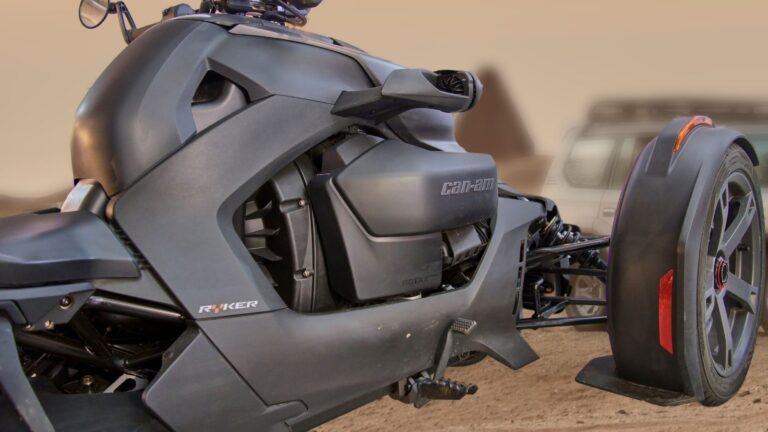
The restriction does not remove BRP’s entire Can-Am three-wheel lineup from American dealerships. The lower-priced Ryker follows a different manufacturing path and therefore does not carry the same Canadian origin as the Spyder and Canyon. BRP’s fiscal 2026 corporate filings show Spyder and Canyon assembly taking place in Valcourt, while Ryker assembly had been located at the company’s Juárez operations in Mexico.
BRP was already changing that footprint before the latest trade move. Its annual information form says Ryker production was being transitioned from Mexico to a new manufacturing facility in Vietnam beginning in fiscal 2027. That distinction demonstrates how country-of-origin rules can produce dramatically different outcomes within one brand. A Canadian-designed three-wheel lineup can contain one model family that remains available to U.S. importers while two others become prohibited because of where final manufacturing occurs. The 2027 Ryker has also received significant updates, including a 900 cc three-cylinder engine across the range, making it particularly important to BRP while the larger Canadian-built models face uncertainty.
BRP Bought Itself Some Time With Its Seasonal Shipping Cycle
For all the severity of an outright import restriction, BRP does have one important short-term advantage: timing. The company has said the vast majority of production and shipments for the current season were already completed when the new U.S. measures arrived. That means many Spyder and Canyon units intended for American showrooms had already crossed the border.
Existing inventory therefore gives dealers a temporary cushion. A customer walking into a U.S. Can-Am dealership does not necessarily find every Spyder or Canyon suddenly unavailable. The barrier applies to new imports after the effective date, not to a machine that had already been imported and entered into the American market. BRP consequently expects the new measure to have a limited impact on its current fiscal 2027 results. That cushion has limits, however. Powersports manufacturers work around model-year production schedules, dealer ordering and seasonal inventory cycles. If the prohibition remains in place as dealers begin replenishing inventories for the next riding season, what looks manageable in autumn 2026 could become substantially more disruptive in 2027.
BRP Was Already Counting a Major Tariff Bill
The import ban did not arrive in isolation. BRP entered September already dealing with a much wider collection of U.S. trade costs affecting its products. At its September 3 earnings presentation, management said it expected approximately C$200 million in net Section 232 and Section 338 tariff exposure during fiscal 2027 and about C$225 million on an annualized basis after mitigation measures.
CFO Sébastien Martel also gave investors a remarkably specific indication of how important Spyder had become to that calculation. Under the tariff conditions BRP was dealing with before the outright ban was announced, Martel estimated that Spyder alone could create roughly a C$60 million to C$65 million headwind in the next fiscal year. The new prohibition changes the underlying situation, so that figure should not be treated as a forecast of the cost of the ban itself. It does show, however, that the company was already preparing for significant pressure on the product. Across its broader business, executives had discussed roughly C$425 million in net tariff exposure over the current and following fiscal years.
Valcourt Makes This a Quebec Manufacturing Story
The affected vehicles come from somewhere with far more significance to BRP than a simple assembly address. Valcourt is the company’s corporate home and one of the centres of the Canadian powersports industry. BRP’s filings describe an approximately 815,000-square-foot manufacturing facility there producing Ski-Doo snowmobiles as well as Can-Am Spyder and Canyon three-wheel vehicles and related components.
That makes the U.S. restriction unusually tangible for Quebec. The machines rolling off the Valcourt line are not generic components that can quietly disappear into a larger international supply chain. They are finished, recognizable vehicles carrying one of BRP’s major brands. BRP employed close to 17,000 people globally at the end of fiscal 2026 and generated C$8.44 billion in annual revenue. Its headquarters, engineering functions and manufacturing operations give the company a deep connection to the Eastern Townships. Even without an announced production cut or job reduction tied specifically to the ban, prolonged loss of access to the largest neighbouring market creates an obvious planning challenge for production volumes, suppliers and future investment decisions.
The United States Is Too Important for BRP to Treat This as a Side Issue
BRP is a global company selling products in more than 110 countries, but the United States remains its dominant individual market. Financial statements for fiscal 2026 show approximately C$4.70 billion of BRP’s C$8.44 billion in revenue came from the United States. That works out to roughly 56 per cent of the company’s annual sales.
The scale becomes even clearer at the retail level. BRP said when announcing its 2026 Can-Am three-wheel products that more than 1,050 dealers across North America supported the category, including more than 870 in the United States. Those businesses sell machines, arrange financing, perform repairs and warranty work, stock accessories and build relationships with riders who may keep a vehicle for years. BRP even launched its own branded U.S. retail financing operation in August 2026 to strengthen its dealer network and make purchases easier. An import prohibition affecting two major products therefore reaches beyond factory shipments. It touches a large American distribution and service ecosystem that BRP has spent years building.
Washington Is Using a Trade Law That Was Once Largely Dormant
One of the more unusual elements of the dispute is the legal mechanism behind it. The Trump administration invoked Section 338 of the Tariff Act of 1930, which allows a U.S. president to impose additional duties of as much as 50 per cent when another country is found to discriminate against American commerce. The law also allows imports to be excluded if the alleged discrimination continues and the president determines an exclusion serves U.S. interests.
That authority existed for nearly a century without becoming a normal instrument of American trade policy. Congressional Research Service analysis published before the current measures noted that the United States had never previously imposed tariffs under Section 338, although the provision had occasionally surfaced as negotiating leverage. The 2026 actions against Canada therefore represent an important departure from modern practice. The White House says Canada’s treatment of U.S. motor vehicles created discriminatory conditions that justified the measures. Canada disputes Washington’s characterization and has described the broader U.S. tariff actions as unjustified. Those competing positions now have direct commercial consequences for BRP.
BRP Is Caught Inside a Much Larger Retaliation Cycle
The motorcycle restriction is only one piece of a rapidly expanding bilateral dispute. The September 29 U.S. import bans also reached Canadian alcoholic beverages and selected dairy products. Reporting on the measures estimated that approximately US$967 million in Canadian exports were covered, with alcohol representing the large majority of that amount. For BRP, however, the relatively small overall value of the motorcycle category does not make an import prohibition any less absolute.
Canada had already responded to earlier U.S. measures. Ottawa announced counter-tariffs covering C$27.6 billion worth of American imports beginning September 8, using rates of 15, 25 and 50 per cent depending on the product and matching several U.S. tariff actions. Washington says those Canadian measures contributed to its decision to intensify restrictions; Ottawa says its tariffs are responses to previous American action. The disagreement is unfolding against one of the world’s largest trading relationships. U.S. government data put bilateral goods and services trade with Canada at about US$872 billion in 2025, illustrating how even narrowly targeted measures can ripple across heavily integrated industries.
What Happens Next Depends More on Trade Policy Than Rider Demand
BRP has not publicly announced that Spyder or Canyon production will leave Valcourt because of the ban. That distinction is important. The company operates a large international manufacturing network in Canada, Mexico, the United States, Austria, Finland, Australia and other locations, and executives have acknowledged that manufacturing moves are among the contingency options evaluated when managing tariffs. Evaluating an option is not the same as committing to one.
For now, the company has room to watch how the dispute develops because current-season shipments are largely complete. Longer term, the available choices become harder. BRP could continue serving markets outside the United States from Quebec, alter production volumes, pursue manufacturing changes, or wait for a negotiated policy reversal. Each path carries costs and operational complications. What makes the Spyder and Canyon episode significant is that consumer demand is no longer the only factor determining whether BRP can sell the products in its largest foreign market. A trade measure written in Washington now has the power to decide whether a vehicle assembled in Valcourt can cross the border at all.
This Options Discord Chat is The Real Deal
While the internet is scoured with trading chat rooms, many of which even charge upwards of thousands of dollars to join, this smaller options trading discord chatroom is the real deal and actually providing valuable trade setups, education, and community without the noise and spam of the larger more expensive rooms. With a incredibly low-cost monthly fee, Options Trading Club (click here to see their reviews) requires an application to join ensuring that every member is dedicated and serious about taking their trading to the next level. If you are looking for a change in your trading strategies, then click here to apply for a membership.