
Some stocks become so familiar that the case for owning them starts to sound automatic. A giant dividend, a household brand, a dominant market share, or a comeback story can all feel persuasive enough on their own. That shortcut is often where the trouble begins.
These 15 names are not necessarily bad businesses. In several cases, they are excellent companies. The real problem is that many Canadians keep buying them for reasons that are too shallow, too backward-looking, or too dependent on one appealing headline. A stronger case usually requires looking past yield, nostalgia, or size and into cash flow, debt, valuation, execution, and the conditions that actually drive returns.
BCE Inc.
15 Stocks Canadians Keep Buying for the Wrong Reasons
- BCE Inc.
- TELUS Corp.
- Enbridge Inc.
- TC Energy Corp.
- Toronto-Dominion Bank
- Bank of Nova Scotia
- Royal Bank of Canada
- Shopify Inc.
- Brookfield Corporation
- Canadian National Railway
- Canadian Pacific Kansas City Ltd.
- Canadian Natural Resources Ltd.
- Suncor Energy
- Air Canada
- BlackBerry Ltd.
- 19 Things Canadians Don’t Realize the CRA Can See About Their Online Income

BCE still shows up in many Canadian portfolios because the old story lingers: telecom is essential, the dividend is generous, and the stock should behave like a steady income machine. That logic used to feel almost self-evident, especially for retirees and conservative investors who associated Bell with reliability rather than disruption. But BCE’s recent history has been a reminder that even essential-service businesses can become awkward investments when leverage, competition, capital intensity, and payout pressure all collide at the same time.
The weaker reason to own BCE is simple yield-chasing. The better question is whether the company’s balance-sheet repair and operating plan can support future returns from here. That is a very different thesis. BCE now has to prove that cost cuts, network strategy, and free-cash-flow improvement can outweigh a slower legacy backdrop. Buying it because “it has always been a widow-and-orphan stock” is not analysis. It is memory. And memory can be expensive when the underlying investment case has already changed.
TELUS Corp.

TELUS attracts a similar kind of automatic loyalty. Many Canadians buy it because they know the brand, use the service, and assume the dividend story is permanently intact. That familiarity matters less than investors think. A phone bill arriving every month does not mean a telecom stock is free from execution risk, capital-spending pressure, or balance-sheet strain. In fact, TELUS has spent the last few years trying to balance network investment, deleveraging, and growth ambitions across businesses that extend well beyond traditional wireless service.
The wrong reason to buy TELUS is the assumption that a familiar telecom must also be a simple income vehicle. The more useful reason would be confidence in free-cash-flow growth, debt reduction, and disciplined capital allocation. Those are more demanding tests. TELUS may still work for patient shareholders, but the easy version of the thesis has clearly weakened. When a company pauses dividend growth and starts emphasizing deleveraging, it is signaling that the old comfort narrative is no longer enough on its own.
Enbridge Inc.

Enbridge is one of those names that Canadians often treat like a substitute for a bond fund with upside. The appeal is easy to understand: pipelines sound stable, regulated assets sound defensive, and the payout has long been a central part of the pitch. That creates a dangerous shortcut. Enbridge is not just a coupon with a ticker symbol. It is a massive infrastructure company that still depends on capital deployment, acquisitions, financing conditions, regulatory approvals, and project execution to keep compounding.
That makes “I’m buying it for the yield” a thinner thesis than it appears. Enbridge’s business is broadening, especially through gas utilities and a large growth backlog, and that can be a strength. But it also means the company must keep integrating assets, funding big projects, and delivering expected returns in a world where rates, demand assumptions, and capital costs can shift. The right reason to own Enbridge is confidence in that long-cycle capital-allocation machine. The wrong reason is assuming the distribution does all the analytical work by itself.
TC Energy Corp.

TC Energy gets bought for many of the same reasons as Enbridge, but often with an extra layer of false comfort. Pipelines look boring, and boring is frequently mistaken for low-risk. That misses the core reality of the business. TC Energy is still a heavy builder and operator of long-lived infrastructure, and the payoff depends on how well management matches future demand with present spending. A pipeline company can have durable assets and still expose investors to large timing risks, financing needs, and policy changes that unfold over years rather than quarters.
The weak thesis is that natural gas demand growth automatically turns TC Energy into an easy winner. Demand growth can help, but it does not remove the burden of disciplined project selection, contract structure, and balance-sheet control. With large capital plans and new expansion projects moving ahead, this is not a passive holding disguised as one. Investors buying only because it “feels like a utility with a dividend” may miss the fact that the stock remains tied to execution in a capital-intensive industry where even good projects take time to prove themselves.
Toronto-Dominion Bank

TD still benefits from enormous everyday familiarity. For a lot of Canadians, the stock inherits the trust attached to the branch network, the debit card, and the green logo. That is a classic behavioral trap. A bank can be well known, well capitalized, and still face serious strategic and regulatory setbacks. TD’s recent U.S. anti-money-laundering problems showed exactly how quickly a reputation for steadiness can be interrupted by compliance failures that drag on earnings power, management focus, and growth flexibility.
The wrong reason to buy TD is to assume that a bruised blue-chip bank is automatically a bargain because the name is respected and the bad news is “already known.” Sometimes that works; sometimes the recovery takes longer than expected because the operational cleanup is real, expensive, and reputation-heavy. A stronger thesis would focus on whether TD can rebuild growth while living with constraints, cost cuts, and strategic changes in its U.S. business. That requires patience and evidence. Brand comfort alone does not explain when, or how well, a turnaround will actually translate into shareholder returns.
Bank of Nova Scotia

Scotiabank often attracts buyers who think they are getting a cheap Big Six bank with a higher yield and a clear mean-reversion path. That is one of the most common oversimplifications in Canadian investing. A low valuation is not a catalyst. It is often a summary of concerns the market wants resolved first. Scotiabank’s story has included geographic repositioning, portfolio changes, restructuring, and a continued effort to define what a more focused North American profile should look like after years of heavier international exposure.
That does not make the stock uninvestable. It does mean “it looks cheaper than RBC” is not a complete case. Cheapness can persist when investors are still waiting for cleaner earnings, simpler geography, or better proof that the strategic reset is working. A bank customer may see the familiar red logo and think the gap will inevitably close. Markets rarely reward inevitability without evidence. The better question is whether Scotiabank’s newer shape can produce more predictable profitability. Until that answer becomes clearer, yield and discount-to-peers are only the beginning of the conversation.
Royal Bank of Canada
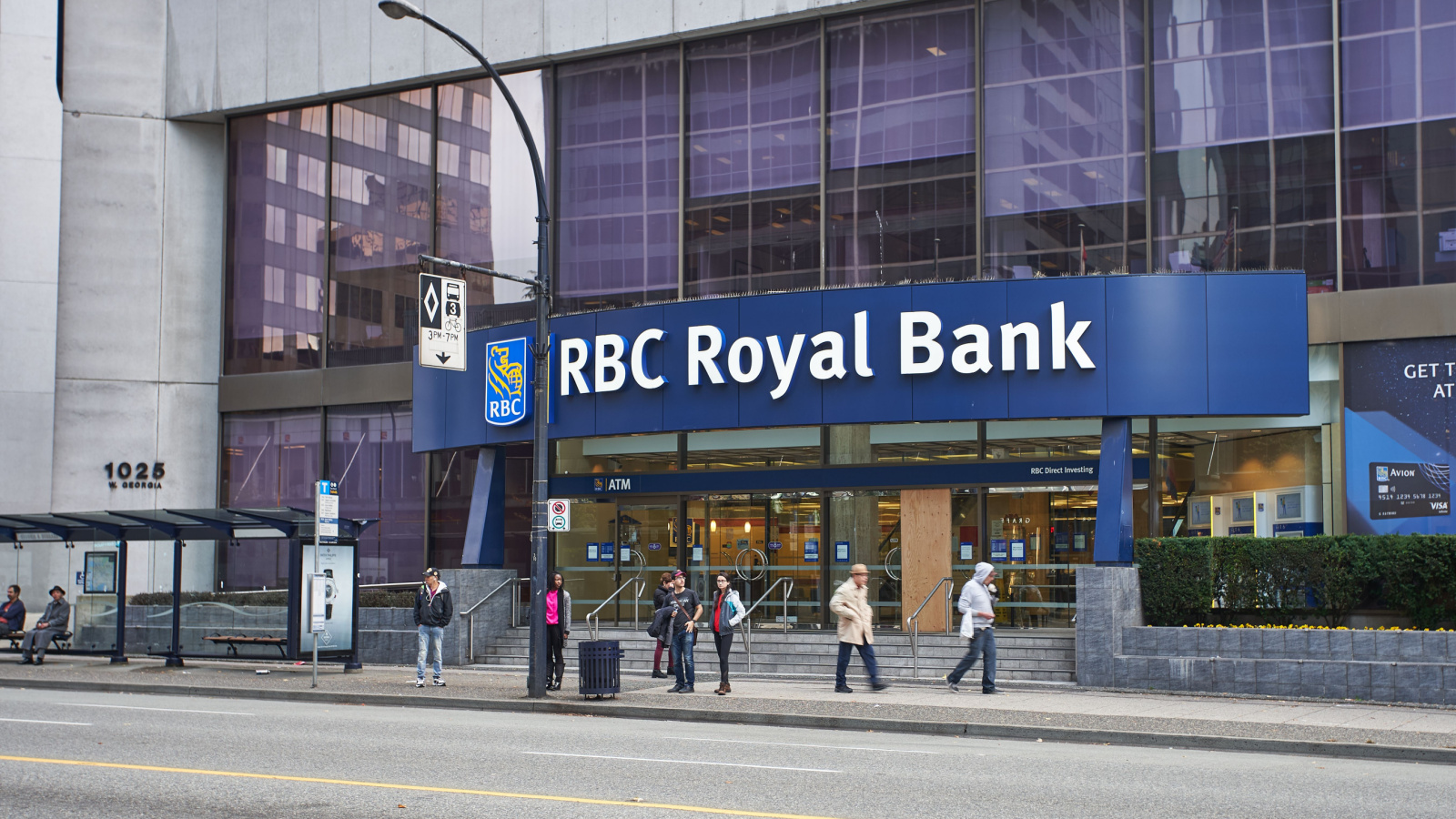
RBC is usually bought for the opposite reason: not because it looks cheap, but because it looks untouchable. It is the biggest bank in the country by market value, it has broad operations, and it carries the aura of a national champion. That leads some investors to believe there is never really a bad time to buy it. Size and quality are real advantages, but they do not suspend valuation, integration work, or cyclicality. Even elite banks can become less attractive investments when expectations move too far ahead of what the business can actually deliver.
The weak thesis here is “RBC is the best bank, so it must be the best stock.” Those are not always the same thing. Great franchises can still be priced for near-perfection, especially after strong runs or major transactions. A more disciplined case for RBC should consider what investors are paying for that quality, how acquired businesses are being absorbed, and how much future growth is already embedded in the shares. Buying it purely because it is the market’s default favorite is often less a strategy than a transfer of confidence from the institution to the stock price.
Shopify Inc.

Shopify is one of the easiest Canadian stocks to buy for the wrong reason because it gives investors a story they want to believe. It is the homegrown tech success, the global platform, the software winner, and now an AI-adjacent name as well. That cocktail can make the stock feel almost culturally important, as if owning it is a vote for Canadian innovation. But the market does not reward cultural symbolism. It rewards results relative to expectations, and high-expectation stocks are uniquely vulnerable when margins, operating expense, or guidance fail to thrill.
That is why “great company” can still be the wrong reason to buy Shopify. It may be a great company and still be a difficult stock at certain prices or in certain quarters. Recent results showed strong growth, but they also showed how unforgiving the market can be when expense expectations climb or profitability guidance feels less impressive than hoped. Investors who buy simply because Shopify once made fortunes, or because every dip feels like a patriotic opportunity, are skipping the hardest part of the work: deciding whether the future is already over-discounted into the stock.
Brookfield Corporation

Brookfield is often purchased on a kind of managerial faith. The argument usually sounds like this: Brookfield has world-class assets, world-class operators, and a long record of value creation, so the details can be trusted to sort themselves out. That confidence has been rewarded many times, which is exactly why it can become lazy. Brookfield is not a straightforward utility or bank. It is a layered, complex enterprise tied to alternative asset management, monetizations, carried interest, fundraising, and operating subsidiaries that do not move in one simple line.
The wrong reason to buy Brookfield is to treat complexity as proof of genius rather than something that still demands careful interpretation. Investors can easily admire the platform without fully understanding which earnings streams are recurring, which depend on realizations, and which are sensitive to capital markets. That is where mistakes happen. Brookfield may still deserve admiration, but admiration is not a valuation framework. A more rigorous thesis has to separate durable fee economics from the more episodic parts of the machine. Otherwise, the stock becomes a prestige purchase rather than a properly-understood investment.
Canadian National Railway

Canadian National is often bought with one simple sentence doing all the work: railways have moats. That is true, but incomplete. Strong moats do not eliminate operating challenges, volume mix shifts, weather costs, tax effects, or broader macro uncertainty. Rail investors sometimes lapse into the belief that a great network means almost any entry point is acceptable. That has always been too easy. Even dominant railroads can go through periods where the business executes well but the stock still disappoints because revenue, margin, or valuation assumptions stop lining up.
The more thoughtful way to approach CN is to recognize that quality and price must still meet somewhere sensible. Strong free cash flow, efficiency gains, and network productivity matter, but so does the fact that revenues can flatten or slip when conditions are uneven. Buying CN because “it’s a railroad, so just hold it forever” misses the operational nuance that drives returns from one period to the next. The moat is real. What varies is how much investors pay for it and how much near-term turbulence they are quietly accepting when they buy on reputation alone.
Canadian Pacific Kansas City Ltd.

CPKC invites a slightly different shortcut. Many investors buy it because the merger story is so intuitively appealing: one railroad stitched across Canada, the United States, and Mexico must be a long-term winner. That strategic logic is powerful, but it can also become a substitute for disciplined analysis. Cross-border reach does not mean smooth earnings progression. A merged network still has to absorb acquisition accounting, defend margins, improve service, and navigate uneven freight conditions while convincing investors that the promised synergies will show up in a durable, not just promotional, way.
The wrong reason to buy CPKC is to assume the continental narrative settles every question. Big strategic ideas can stay true while a stock remains vulnerable to integration costs, leverage, or a quarter where operating performance is merely decent rather than exceptional. Investors who fall in love with the map may ignore the math. That is usually the danger with merger-celebrity stocks: the strategic picture is so compelling that people stop asking what is happening to expenses, debt, and per-share earnings along the way. A great network story still needs clean execution to become a great investment story.
Canadian Natural Resources Ltd.

Canadian Natural is beloved by many income and value investors because it seems to offer the full package: strong production, disciplined management, buybacks, and a long culture of returning cash. That reputation has substance behind it. The danger comes when investors start believing those strengths have somehow neutralized the commodity cycle. They have not. Canadian Natural may be better run than many peers, but it is still tied to oil and gas prices, differentials, operating conditions, and the market’s willingness to reward energy cash flow at a given point in time.
The weak thesis is that a shareholder-friendly producer becomes a safe substitute for a utility once the dividend record gets long enough. It does not. What Canadian Natural really offers is exposure to a well-run resource business that has historically allocated capital effectively. That can be attractive, but it is not the same as owning predictable earnings. Investors who buy CNQ only because the dividend keeps rising may be underestimating how much the whole model still depends on the commodity backdrop staying supportive. Discipline helps, but discipline is not immunity.
Suncor Energy

Suncor gets bought for another familiar reason: the integrated model looks like a built-in hedge. If crude prices wobble, refining should help. If refining softens, upstream production should carry more of the weight. There is truth in that structure, and it is one reason Suncor remains a core Canadian energy name. The mistake is turning that truth into overconfidence. Integration smooths some volatility, but it does not erase exposure to crude prices, product spreads, operational incidents, turnaround schedules, or the broader geopolitical shocks that move fuel markets.
That matters because Suncor’s recent operating strength can make the stock feel safer than it really is. Record production and high refinery utilization are good signs, but investors buying only because buybacks are large and the downstream segment looks strong may be confusing a good quarter with a low-risk thesis. Suncor is still an energy stock, not an all-weather machine. The better reason to own it is belief in asset quality and capital returns across cycles. The wrong reason is assuming the integrated model has transformed a cyclical business into a defensive one.
Air Canada

Air Canada is a classic reopening-and-recovery stock that never fully escapes the temptation of obviousness. People see full planes, expensive tickets, airport crowds, and strong travel demand, then conclude the investment case must be equally straightforward. Airlines rarely work that way. Demand can look excellent while the stock remains hostage to fuel costs, route economics, labor, currency, fleet spending, and sudden geopolitical shocks. That gap between what travelers see and what shareholders need is where many bad airline theses are born.
The wrong reason to buy Air Canada is “travel is booming, so this has to go higher.” Travel can be booming and margins can still come under pressure very quickly. The company’s recent results showed strong momentum, but the decision to suspend its 2026 outlook in response to fuel uncertainty was a sharp reminder that airlines operate with more moving parts than most casual buyers appreciate. This is not a simple consumer-confidence bet. It is a complex operating system tied to volatile inputs. A crowded departure lounge is not the same thing as a durable equity margin of safety.
BlackBerry Ltd.

BlackBerry may be the most emotionally loaded stock on this list. It still triggers nostalgia, comeback fantasies, and periodic bursts of headline-driven excitement that feel larger than the company’s actual scale. That is understandable. For many Canadians, BlackBerry is more than a stock; it is a national tech memory. But nostalgia is one of the worst reasons to buy an equity. The old handset glory days are gone, and the modern company is a very different software business built around secure communications and embedded systems such as QNX.
That current business may well deserve attention. The problem comes when attention turns into projection. A rally, a partnership headline, or a jump in QNX optimism can quickly bring back the idea that BlackBerry is on the verge of becoming a market darling again. Maybe it keeps improving, but the modern investment case depends on software execution, backlog conversion, and product relevance in safety-critical systems, not on reliving a national icon. Buying because the ticker feels familiar or because the turnaround finally sounds cinematic is closer to story-chasing than disciplined investing.
19 Things Canadians Don’t Realize the CRA Can See About Their Online Income

Earning money online feels simple and informal for many Canadians. Freelancing, selling products, and digital services often start as side projects. The problem appears at tax time. Many people underestimate how much information the CRA can access. Online platforms, banks, and payment processors create detailed records automatically. These records do not disappear once money hits an account. Small gaps in reporting add up quickly.
Here are 19 things Canadians don’t realize the CRA can see about their online income.
This Options Discord Chat is The Real Deal
While the internet is scoured with trading chat rooms, many of which even charge upwards of thousands of dollars to join, this smaller options trading discord chatroom is the real deal and actually providing valuable trade setups, education, and community without the noise and spam of the larger more expensive rooms. With a incredibly low-cost monthly fee, Options Trading Club (click here to see their reviews) requires an application to join ensuring that every member is dedicated and serious about taking their trading to the next level. If you are looking for a change in your trading strategies, then click here to apply for a membership.