35,000+ smart investors are already getting financial news, market signals, and macro shifts in the economy that could impact their money next with our FREE weekly newsletter. Get ahead of what the crowd finds out too late. Click Here to Subscribe for FREE.
Prime Minister Mark Carney is signalling that Canada does not intend to add another layer of trade pressure on the United States as Washington moves toward its November midterm elections. The message came at a tense moment: new U.S. import bans on selected Canadian alcohol, dairy products and motorcycles had just taken effect, while formal negotiations between the two countries remained suspended.
Carney insists the U.S. electoral calendar is not dictating Canadian policy. Instead, Ottawa is presenting restraint as part of a broader strategy that leaves existing countermeasures intact, keeps diplomatic channels open and pushes Canada to reduce its economic dependence on a single market. That approach is being tested by tariffs, threatened restrictions on autos and steel, and continuing uncertainty over the future of CUSMA.
Carney Is Drawing a Line Between Restraint and Retreat
Carney Says Canada Won’t Add Trade Pressure as U.S. Midterms Approach
- Carney Is Drawing a Line Between Restraint and Retreat
- The U.S. Import Bans Have Raised the Stakes Again
- The U.S. Midterms Are Now Part of the Political Environment
- Formal Trade Negotiations Have Been Frozen Since August
- Canada Already Has Billions of Dollars in Counter-Tariffs
- Carney Is Making a Cost-of-Living Argument to Americans
- Autos and Steel Remain the Most Economically Sensitive Flashpoints
- Diversification Has Become More Than a Political Slogan
- CUSMA’s Unresolved Review Keeps Long-Term Uncertainty Alive
- Restraint Leaves Ottawa With Several Other Ways to Respond
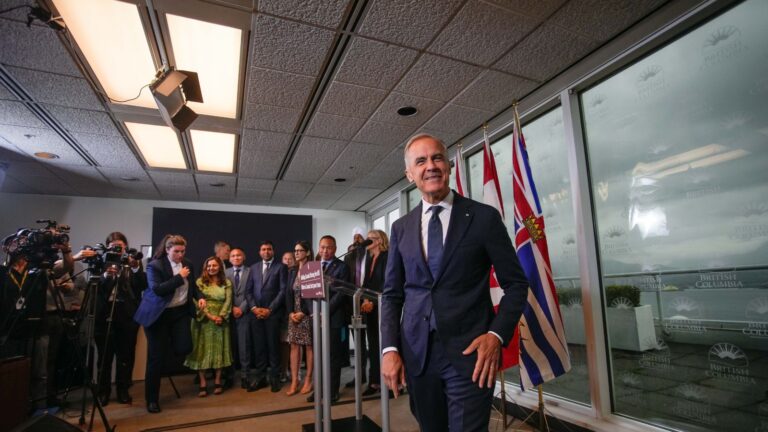
Carney’s clearest message is that Ottawa does not currently intend to escalate the dispute. Speaking in Vancouver on September 29, he said Canada had no plans to apply additional trade pressure against the United States. He also stressed that Canadian decisions were not being scheduled around American politics, saying the government’s timing was not dictated by a particular part of the U.S. calendar. At the same time, he stopped short of promising that Canada would never take further action, leaving the government flexibility if circumstances change.
That distinction matters because Canada has already imposed substantial countermeasures. The government is not reversing those tariffs or abandoning support programs for affected industries. Instead, the current position amounts to holding the line rather than adding another round. Carney has also argued that Canada has goods the United States needs and can contribute to lowering costs there. That gives Ottawa another way to frame the relationship: not simply as a contest over tariffs, but as an argument over whether deeply connected supply chains continue to benefit households and businesses on both sides of the border.
The U.S. Import Bans Have Raised the Stakes Again
The latest restraint from Ottawa comes after Washington introduced another significant trade restriction. On September 29, the United States began blocking imports of selected Canadian alcoholic beverages, dairy-related products and motorcycles. The measures cover nearly US$1 billion in annual imports, a relatively small portion of overall Canada-U.S. commerce but a potentially serious shock for individual companies that depend heavily on American buyers.
Alcohol makes up most of the trade affected by the restrictions. Smaller distillers, brewers and wineries can be particularly vulnerable because shifting production, packaging or distribution to another country is expensive. Certain Canadian motorcycle products are also caught in the restrictions, including vehicles produced by Quebec-based BRP. The broader economic effect may be limited compared with the hundreds of billions of dollars in annual bilateral commerce, but the concentration of the impact makes the ban much more significant for particular communities and employers. It also demonstrates how the dispute has moved beyond broad tariffs into outright market-access restrictions for selected categories of Canadian products.
The U.S. Midterms Are Now Part of the Political Environment
The American midterm elections are scheduled for November 3, placing every seat in the U.S. House of Representatives and roughly one-third of the Senate on the electoral calendar. President Donald Trump said on September 29 that he was beginning a 32-day period of campaign travel ahead of the vote. That means trade policy is unfolding at the same time that both parties are competing over economic issues, including prices, manufacturing and employment.
The political atmosphere became more contentious when White House trade adviser Peter Navarro warned Canadians against interfering in U.S. elections and sharply criticized Canadian lobbying efforts in Washington. Navarro specifically referred to races in Maine and Michigan and told Canadians working through Washington’s lobbying industry that previous approaches would no longer be accepted. Those were Navarro’s allegations and warnings; they do not establish that the Canadian government interfered in an election. Carney’s response has been to emphasize that Ottawa makes trade decisions according to Canadian economic interests rather than the U.S. campaign calendar, even as the election inevitably forms part of the diplomatic environment surrounding those decisions.
Formal Trade Negotiations Have Been Frozen Since August
The current standoff traces directly back to the breakdown of negotiations in August. On August 21, Carney suspended Canadian participation in formal trade talks and ordered negotiators back to Ottawa. The Canadian government said last-minute U.S. proposals were economically unacceptable and raised questions about whether any resulting agreement could provide the stability Canadian businesses needed. Carney later described the decision as walking away from a deal that demanded too much from Canada while offering too little.
Washington tells the episode differently. U.S. Trade Representative Jamieson Greer has said Canada walked away from a near-final agreement that offered unusually favourable treatment. That competing description remains important because the two governments disagree not only over the appropriate tariff levels but over why negotiations failed in the first place. There have been no renewed negotiations over detailed legal text since the breakdown. Canada-U.S. Trade Minister Dominic LeBlanc has nevertheless confirmed that officials remain in contact. Ottawa therefore has not closed the diplomatic channel; it has simply declined, so far, to return to the type of intensive bargaining that was underway before August 21.
Canada Already Has Billions of Dollars in Counter-Tariffs
A decision against further escalation should not be confused with an absence of Canadian retaliation. After the United States imposed 50 per cent tariffs on C$27.6 billion worth of Canadian goods beginning August 22, Ottawa announced what it described as dollar-for-dollar countermeasures. Those Canadian tariffs took effect September 8 and apply rates of 15, 25 or 50 per cent across selected U.S.-origin goods.
The affected categories include products such as steel, dairy goods, appliances, agricultural equipment, pulp and paper, plastics and electronics. That means Canadian importers and companies that rely on American inputs are already operating in a substantially altered trading environment. Washington subsequently responded with additional measures of its own, including the import bans that took effect September 29. The sequence illustrates why Carney’s promise not to immediately add pressure can be consequential even without a tariff reduction: both governments already have significant restrictions in place. Avoiding an additional round prevents the dispute from automatically moving into another retaliatory cycle while officials consider whether political and economic conditions eventually allow substantive negotiations to resume.
Carney Is Making a Cost-of-Living Argument to Americans
One of the more notable parts of Carney’s position is his claim that Canada can help reduce the cost of living in the United States. The argument rests partly on the scale and composition of the economic relationship. U.S. goods and services trade with Canada totalled an estimated US$872.3 billion in 2025, according to the U.S. Trade Representative. Canada remained one of the largest markets for American exports while also supplying important commodities and manufactured inputs to U.S. businesses.
Energy is a clear example. U.S. Energy Information Administration data show that Canada remained the primary foreign source of American crude oil in 2025, supplying an average of roughly 3.9 million barrels per day. Agriculture offers another example: U.S. Geological Survey data show Canada supplied 79 per cent of American potash imports over the 2021–2024 period. These figures do not prove that any individual Canadian trade concession would automatically reduce American inflation. They do illustrate Carney’s broader point that the economies remain connected through commodities that feed directly into transportation, agriculture and industrial production, making trade restrictions capable of producing costs well beyond the goods initially targeted.
Autos and Steel Remain the Most Economically Sensitive Flashpoints
The largest risks are not necessarily found in the goods covered by the September 29 import ban. Canada’s automotive and steel industries are far more exposed to American demand. Federal data show that more than 90 per cent of Canadian-made vehicles and roughly 60 per cent of Canadian-made auto parts are exported to the United States. Canada produced more than 1.2 million passenger vehicles in 2025, while the automotive industry supports about 125,000 direct manufacturing jobs and more than 500,000 jobs across the broader sector.
Statistics Canada has also quantified the dependence. It estimated that U.S. demand supported 76.4 per cent of payroll jobs in Canadian automobile and light-duty vehicle manufacturing in 2024. For iron and steel mills and ferro-alloy manufacturing, the figure was 67 per cent. The pressure is becoming visible on factory floors. Cleveland-Cliffs-owned Stelco announced plans to idle some Hamilton operations, affecting as many as 500 workers, with the company citing difficult market conditions associated partly with tariffs. Carney has said Ottawa intends to enforce employment commitments connected to Cleveland-Cliffs’ acquisition of Stelco.
Diversification Has Become More Than a Political Slogan
Canada’s response to the deterioration in U.S. trade relations is increasingly focused on finding additional customers. Global Affairs Canada reported that exports to non-U.S. markets increased 11.1 per cent in 2025 even as exports to the United States fell 3.7 per cent. Non-U.S. destinations accounted for 32.8 per cent of total Canadian exports, the highest share in more than four decades.
That shift does not mean replacing the United States is easy. The American market remains enormously important because of geography, existing supply chains and decades of integrated production. Ottawa instead describes diversification as reducing concentration over time. Carney has set a goal of doubling non-U.S. exports over the next decade. Infrastructure is part of that effort. His government has backed major upgrades around British Columbia’s Roberts Bank terminal, saying expanded capacity could eventually unlock more than C$100 billion in additional trade capacity. Canada has also intensified economic engagement with Europe and the Indo-Pacific. In 2025 alone, Canadian exports to the European Union increased 16.4 per cent, while exports to Indo-Pacific economies rose 4.6 per cent.
CUSMA’s Unresolved Review Keeps Long-Term Uncertainty Alive
Behind the immediate tariff dispute sits an even larger structural issue: the future of the Canada-United States-Mexico Agreement. The three countries conducted the agreement’s required six-year joint review on July 1, 2026. Canada and Mexico supported extending the agreement, but the United States declined to renew it in its current form. Importantly, that decision did not terminate CUSMA.
Under the agreement’s review mechanism, CUSMA remains in force while the countries move into annual reviews. Its existing term runs through 2036 unless circumstances change through the agreement’s extension or withdrawal provisions. Each future review gives the countries another opportunity to agree on a new 16-year term. For Canadian companies, that structure creates an unusual combination of continued preferential access and longer-term uncertainty. The issue is particularly important for automakers, where rules of origin determine whether vehicles qualify for preferential treatment. The U.S. International Trade Commission is separately examining the automotive rules and has scheduled an October 14 hearing. As a result, short-term tariff negotiations and long-term North American trade rules are increasingly overlapping.
Restraint Leaves Ottawa With Several Other Ways to Respond
Carney’s decision not to introduce new pressure does not leave the federal government without policy tools. Ottawa has already announced a C$7.5 billion package of new and expanded assistance for businesses and workers affected by U.S. tariffs. That includes additional funding through the Regional Tariff Response Initiative, financing and liquidity programs for businesses, worker assistance and a Canada Strong Diversification Fund intended to help firms develop alternative markets.
The government is also signalling that enforcement at home remains part of the response. Carney’s comments about Cleveland-Cliffs show Ottawa is prepared to use legal commitments connected to foreign investments when it believes Canadian employment obligations are at risk. Meanwhile, LeBlanc says Canadian officials remain in contact with their American counterparts even though detailed negotiations have stopped. Taken together, the policy is neither a return to normal trade relations nor a fresh escalation. Existing tariffs remain, affected industries are receiving support, diversification continues and the negotiating channel remains available. Whether that balance can hold will depend on actions taken in Washington and Ottawa well beyond the U.S. midterm campaign.
This Options Discord Chat is The Real Deal
While the internet is scoured with trading chat rooms, many of which even charge upwards of thousands of dollars to join, this smaller options trading discord chatroom is the real deal and actually providing valuable trade setups, education, and community without the noise and spam of the larger more expensive rooms. With a incredibly low-cost monthly fee, Options Trading Club (click here to see their reviews) requires an application to join ensuring that every member is dedicated and serious about taking their trading to the next level. If you are looking for a change in your trading strategies, then click here to apply for a membership.