35,000+ smart investors are already getting financial news, market signals, and macro shifts in the economy that could impact their money next with our FREE weekly newsletter. Get ahead of what the crowd finds out too late. Click Here to Subscribe for FREE.
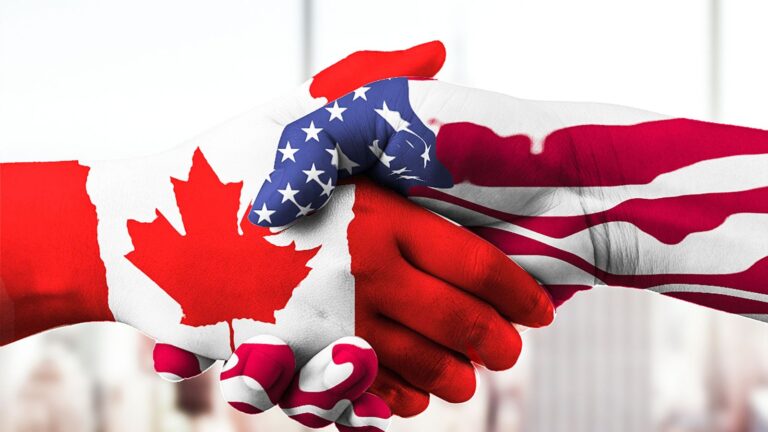
At one of North America’s most recognizable symbols of cross-border friendship, Canadians and Americans are trying to keep political tensions from becoming personal ones. Residents from both countries gathered at the Peace Arch border on September 26, calling for stronger relations as an escalating Canada-U.S. trade dispute increasingly shapes British Columbia’s provincial election campaign.
The gathering was not a one-off event. Participants have been meeting regularly since March 2025, when tariffs and U.S. President Donald Trump’s repeated comments about Canada becoming a 51st state put unusual strain on the relationship. Now, with British Columbians voting in a provincial election on October 24, the same border has become both a meeting place for people promoting friendship and a political backdrop for arguments over how B.C. should respond to Washington.
A Grassroots Border Gathering Has Lasted More Than a Year
Canadians and Americans Rally at Peace Arch for Better Ties as Trade Fight Hits B.C. Election
- A Grassroots Border Gathering Has Lasted More Than a Year
- Few Places Carry More Cross-Border Symbolism Than Peace Arch
- The Trade Dispute Has Moved Far Beyond Political Rhetoric
- B.C. Has More at Stake Than Its Distance From Washington Might Suggest
- The U.S. Fight Is Now Part of the B.C. Election Campaign
- Conservatives Are Offering a Different Argument About Economic Strength
- Cross-Border Travel Shows How Complicated the Relationship Has Become
- Diversification and Cooperation Are Happening at the Same Time
The September 26 gathering brought together Canadians, Americans and dual citizens at Peace Arch Park, continuing a movement that began in March 2025. The group now meets every other Saturday, according to CBC reporting, with participants describing the events as a way to maintain personal connections even as the relationship between the two national governments has deteriorated. Similar gatherings during the movement’s early months attracted residents carrying Canadian and American flags, friendship signs and, in some cases, ending events with a hockey-style handshake between participants from the two countries.
For people such as B.C. resident Janice Young, the effort is deliberately personal. Young, a church minister, told CBC that worsening political tensions made her think about what it actually meant to know and care about neighbours across the border. American participant Peter Andrews, who lives in Ferndale, Washington, has been attending since the early events. Dual citizen Susan McClung described the deterioration in relations in family-like terms, illustrating why the dispute can feel much more intimate in communities where marriages, friendships, shopping trips and work routinely cross the international boundary.
Few Places Carry More Cross-Border Symbolism Than Peace Arch
The location gives those gatherings significance beyond the size of the crowd. The 67-foot Peace Arch stands directly on the international boundary between Surrey, British Columbia, and Blaine, Washington. Dedicated in 1921, it was built as a monument to the long period of peace between the United States and its northern neighbour. One of its best-known inscriptions reads, “May These Gates Never Be Closed,” a message that has acquired renewed relevance during periods when the border relationship has come under pressure.
The surrounding park is itself unusual. Peace Arch Provincial Park on the Canadian side and Peace Arch Historical State Park in Washington effectively create a shared green space at the boundary. Washington State Parks notes that the site has repeatedly served as a gathering place, from historic public events to meetings between families separated by pandemic-era border restrictions. BC Parks says the Canadian portion was officially dedicated in 1939. More than a century after the monument opened, its original purpose makes it an especially striking setting for residents arguing that political disputes should not erase the social ties connecting the two countries.
The Trade Dispute Has Moved Far Beyond Political Rhetoric
The people meeting at Peace Arch are doing so against a much more serious economic backdrop than existed when the gatherings began. Ottawa said the United States imposed 50 per cent tariffs on approximately $27.6 billion worth of Canadian goods in August 2026. Canada responded with counter-tariffs covering an equivalent $27.6 billion of U.S. imports, with rates of 15, 25 or 50 per cent depending on the product. Those Canadian measures took effect September 8 and include goods in areas such as steel, dairy, appliances, agricultural equipment, pulp and paper, plastics and electronics.
The two governments sharply disagree over responsibility for the escalation. The Trump administration has argued that certain Canadian policies discriminate against U.S. commerce and has used American trade law to justify additional duties. Ottawa has described the U.S. tariffs as unjustified and says it suspended negotiations rather than accept terms it considered harmful to Canadian workers and industries. That distinction matters: the dispute is no longer simply about angry statements from politicians. Businesses are now dealing with actual tariff costs, investment uncertainty and the possibility that supply chains developed over decades may have to change.
B.C. Has More at Stake Than Its Distance From Washington Might Suggest
British Columbia is less dependent on the American market than several other Canadian provinces, but the United States remains enormously important to its economy. In 2024, B.C. exported $28.7 billion worth of goods to the United States, representing 52.8 per cent of all provincial merchandise exports. China accounted for 15.6 per cent, Japan 10.4 per cent and South Korea 6.6 per cent. The province therefore enters the trade conflict with more geographic diversification than some parts of Canada, but losing easy access to the American market would still affect a substantial share of exporters.
The company-level numbers show the connection another way. Statistics Canada reported that 6,296 of British Columbia’s 7,597 exporting establishments sold goods to the United States in 2025 — about 82.9 per cent. Energy, forestry, mining, manufacturing, agriculture and other industries all depend to varying degrees on cross-border demand. More recent provincial figures show the adjustment already under way: B.C. reported that total goods exports were up 4.2 per cent year-to-date through July 2026, while exports to destinations outside the United States rose 16 per cent. Diversification may provide a cushion, but it cannot make the American market irrelevant.
The U.S. Fight Is Now Part of the B.C. Election Campaign
British Columbia’s election officially began on September 22, with Final Voting Day scheduled for October 24. Voters will elect 93 members of the Legislative Assembly. Premier and B.C. NDP Leader David Eby called the election less than two years into the government’s current mandate and explicitly connected his decision to the economic and political uncertainty coming from the United States. He has described the Trump administration’s trade actions as an extraordinary threat requiring the province to make major economic choices.
The location chosen for one of Eby’s first campaign events made that strategy unmistakable. On September 23, he appeared at Peace Arch Provincial Park with the international border behind him and argued that B.C. should strengthen its economy while resisting U.S. pressure. His announcement there also focused on recruiting American health-care workers, with the NDP proposing to increase funding for that campaign to $15 million. Eby said an earlier $5-million effort resulted in 800 health-care workers being hired from the United States. His campaign has also proposed stronger B.C. and Canadian purchasing requirements for publicly funded infrastructure.
Conservatives Are Offering a Different Argument About Economic Strength
B.C. Conservative Leader Lorne Doerkson has rejected the NDP’s attempt to frame the election around which party can most effectively confront the Trump administration. His party argues that the province should focus more heavily on becoming economically strong enough to withstand external pressure. Conservatives have pointed to long-running U.S. duties on Canadian softwood lumber and earlier tariffs on Canadian steel and aluminum as evidence that cross-border trade problems predate the current election campaign.
Doerkson has also criticized Eby’s newly announced domestic-procurement policies, arguing that some public projects were already trying to purchase Canadian materials before the campaign began. The Conservatives have used issues including the Trans Mountain pipeline and BC Ferries’ overseas shipbuilding contracts to question the NDP’s broader record on supporting Canadian industry. Those claims are part of a political dispute rather than settled conclusions about which strategy would produce better results. What is clear is that both major parties are now talking about resilience to American pressure, even while disagreeing sharply over the province’s economic record and the best policies for reducing vulnerability.
Cross-Border Travel Shows How Complicated the Relationship Has Become
Trade statistics tell only part of the story because the Canada-U.S. relationship is also built on millions of individual trips. Statistics Canada recorded roughly 2.6 million Canadian-resident return trips from the United States in August 2026, up 8.8 per cent from August 2025. U.S. residents made about 2.4 million trips to Canada that month, an increase of 2.4 per cent from a year earlier. Those figures suggest some recovery in travel compared with the especially strained period of 2025.
The longer comparison tells a different story. Canadian return trips from the United States by automobile in August 2026 remained 27.4 per cent below their August 2024 level. Those are national figures rather than numbers specific to Peace Arch, but they help explain why border communities pay close attention to political relations. Blaine businesses, for example, have historically depended heavily on Canadian visitors, while residents in the Lower Mainland regularly cross into Washington for recreation, shopping, family visits and travel. The recurring Peace Arch gatherings exist within that everyday cross-border world, where diplomatic tension can eventually be felt at restaurants, hotels, stores and family dinner tables.
Diversification and Cooperation Are Happening at the Same Time
The larger economic response is not simply a choice between trading with the United States and abandoning the American market. Canada and British Columbia have increasingly been pursuing additional markets while maintaining the enormous North American relationship. Nationally, the U.S. share of Canadian merchandise exports fell from 75.9 per cent in 2024 to 71.7 per cent in 2025, while exports to countries other than the United States increased 17.2 per cent. B.C. has an additional advantage because Pacific ports give exporters relatively direct access to Asian markets. LNG exports from Kitimat have already created a new overseas destination for natural gas that historically went almost entirely south.
At the same time, North American trade rules remain important. During the July 2026 review of the Canada-United States-Mexico Agreement, the United States declined to renew the agreement in its current form. That did not terminate CUSMA: both U.S. and Canadian officials confirm that the agreement remains in force while negotiations continue. That combination — deeper diversification alongside continued dependence on continental trade — captures the tension behind the Peace Arch gatherings. Participants cannot resolve tariff negotiations, and their views should not be treated as representative of everyone in either country. What they demonstrate is that government disputes and personal relationships do not always move in the same direction. As B.C.’s election campaign unfolds, that distinction is becoming increasingly visible right at the border.
This Options Discord Chat is The Real Deal
While the internet is scoured with trading chat rooms, many of which even charge upwards of thousands of dollars to join, this smaller options trading discord chatroom is the real deal and actually providing valuable trade setups, education, and community without the noise and spam of the larger more expensive rooms. With a incredibly low-cost monthly fee, Options Trading Club (click here to see their reviews) requires an application to join ensuring that every member is dedicated and serious about taking their trading to the next level. If you are looking for a change in your trading strategies, then click here to apply for a membership.