35,000+ smart investors are already getting financial news, market signals, and macro shifts in the economy that could impact their money next with our FREE weekly newsletter. Get ahead of what the crowd finds out too late. Click Here to Subscribe for FREE.
With European security facing mounting uncertainty and Canada’s relationship with Washington under pressure, Prime Minister Mark Carney is strengthening diplomatic ties across the Atlantic.
On November 12, 2026, Carney joined European leaders in Dublin, Ireland, for a high-level gathering focused on Ukraine, regional security, economic resilience and international cooperation. His participation comes as Ottawa seeks to diversify its partnerships without abandoning its longstanding relationship with the United States.
The meeting also follows a significant expansion of Canada-European Union relations, including new defence cooperation and an ambitious economic partnership announced in October.
For Canada, the Dublin discussions represent more than another diplomatic appearance. They offer an opportunity to strengthen the country’s influence over decisions affecting international security, Canadian businesses and the future of transatlantic cooperation.
Canada Takes an Unusual Seat at Europe’s Security Table
Carney Joins European Leaders in Dublin for Security Talks as Canada Looks Beyond Washington
- Canada Takes an Unusual Seat at Europe’s Security Table
- Ukraine’s Future Dominates the Security Discussions
- Trump’s Trade Policies Are Reshaping Canada’s Diplomatic Priorities
- A New Canada-EU Alliance Is Already Taking Shape
- European Defence Cooperation Opens New Doors for Canadian Companies
- Canada’s European Trade Relationship Is Becoming More Important
- Cybersecurity and Hybrid Threats Add Urgency to the Summit
- Arctic Security and Energy Cooperation Offer New Opportunities
- Canada Is Already Helping Defend Europe’s Eastern Flank
- Meetings With Greece and Cyprus Could Strengthen Important Diplomatic Relationships
- Dublin Marks Another Step in Canada’s Wider Global Strategy
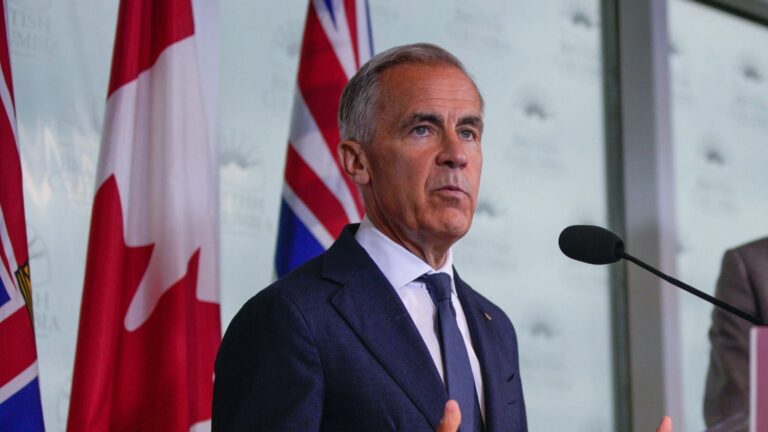
Prime Minister Mark Carney attended the ninth European Political Community summit in Dublin on November 12, joining leaders from across Europe for discussions about the continent’s increasingly complicated security environment. The gathering was co-chaired by Irish Prime Minister Micheál Martin and European Council President António Costa. Representatives from 48 countries were invited, including the European Union’s 27 member states and countries such as Britain, Ukraine, Norway and Switzerland. Canada participated as a special guest, making its presence particularly noteworthy in a forum designed primarily for European governments.
Carney’s invitation reflects Canada’s growing involvement in European political discussions. He became the first non-European leader to participate in the European Political Community when he attended its May 2026 meeting in Armenia. His return demonstrates how the relationship is developing beyond traditional diplomatic exchanges. For Ottawa, direct access to European leaders creates opportunities to discuss security, economic cooperation and international challenges without relying exclusively on Washington as its principal diplomatic partner.
Ukraine’s Future Dominates the Security Discussions
Russia’s war against Ukraine was one of the central issues in Dublin, with Ukrainian President Volodymyr Zelenskyy attending as renewed U.S.-mediated negotiations generated both hope and concern. The latest round of discussions involving Ukraine and Russia had taken place in Abu Dhabi earlier in the week. American envoys Steve Witkoff and Jared Kushner were expected to travel to Dublin after meeting Russian President Vladimir Putin in Moscow. For European governments, the danger is that decisions shaping their security could be made without their full participation. Carney’s presence gives Canada a direct place in those conversations.
European Council President António Costa used his opening remarks to insist that Ukraine must be able to choose its own future and that European countries need a voice in decisions about continental security. Carney also emphasized that security guarantees would involve Europe, Canada and the United States. Those positions matter because ending fighting is not the same as establishing a durable peace. Any agreement would raise difficult questions about deterrence, reconstruction and the protection of Ukraine’s sovereignty. Canada’s involvement connects its support for Kyiv with a broader debate over who will help uphold a future settlement.
Trump’s Trade Policies Are Reshaping Canada’s Diplomatic Priorities
The Dublin visit takes place against the backdrop of a strained Canada-U.S. relationship. President Donald Trump’s tariffs and repeated suggestions that Canada could become America’s 51st state have intensified Canadian concerns about relying too heavily on one partner. Ottawa’s response has not been to declare an end to cross-border cooperation. Instead, Carney is seeking additional commercial and diplomatic options, particularly with European countries that share Canadian interests in predictable rules and stable institutions. It is an attempt to increase Canada’s room to manoeuvre rather than substitute one dependency for another.
Statistics Canada reported that the U.S. share of Canadian merchandise exports fell from 75.9% in 2024 to 71.7% in 2025, while exports to destinations outside the United States increased by 17.2%. Those figures show both the scale of Canada’s exposure and early signs of diversification. The United States remains essential to Canada’s economy, border management and continental defence through NORAD. Stronger European ties therefore serve as an additional source of resilience, not an immediate replacement for the deep geographic and industrial connections across North America.
A New Canada-EU Alliance Is Already Taking Shape
Carney arrived in Dublin with a recent diplomatic agreement already in hand. At the Canada-EU summit in Montréal on October 29 and 30, 2026, leaders announced an Alliance for the Future designed to bring their economies and strategic priorities closer together. Its six areas include trade, technology, critical resources, finance, security and connections between people. The agreement seeks to reduce vulnerabilities in supply chains while giving businesses and researchers more opportunities to cooperate. Rather than treating diplomacy and economics as separate subjects, the alliance places them inside a shared discussion about long-term security.
The most ambitious element is the proposal to develop a closer form of association between Canada and the European Union, short of full EU membership. Leaders committed to defining that relationship by the 2027 Canada-EU summit. The exact rights, obligations and institutional arrangements have not yet been established, so describing Canada as an EU member would be incorrect. Nevertheless, the idea illustrates how far the relationship has moved. Dublin offers another opportunity to develop the political trust needed to turn an unusual proposal into a workable arrangement.
European Defence Cooperation Opens New Doors for Canadian Companies
The defence relationship is already producing tangible changes. Canada and the EU signed a Security and Defence Partnership in Brussels in June 2025, creating a framework for cooperation on military capabilities, maritime security, cyber threats and crisis management. A separate agreement opened the EU’s Security Action for Europe initiative, known as SAFE, to Canadian participation. The EU Council formally concluded that agreement in June 2026, and it entered into force in August. Canada became the first non-European country to secure this access, an important development for its defence industry.
SAFE is a €150-billion European instrument intended to help member states finance joint purchases and increase defence production. Canadian suppliers can now participate in eligible procurement alongside European companies, although access does not guarantee contracts. For Canadian manufacturers, the opportunity could mean new customers for equipment, components and specialized technology. For European governments, Canadian participation offers another potential source of capacity at a time when equipment shortages and long production schedules are pressing concerns. The arrangement also shows that Ottawa’s European strategy extends beyond speeches into commercial and industrial security cooperation.
Canada’s European Trade Relationship Is Becoming More Important
Although the Dublin meeting is primarily political, economic security is part of its agenda. The European Union is already Canada’s second-largest trading partner, and EU figures put two-way trade in goods and services at roughly €130 billion in 2025, more than 80% above its 2016 level. Much of that relationship rests on the Comprehensive Economic and Trade Agreement, or CETA, which has been applied provisionally since September 2017. EU trade authorities say the agreement has eliminated duties on 99% of tariff lines, making transatlantic business easier for many companies.
The economic connection is visible in everyday products and industrial supply chains. Eurostat reported that the EU exported €5.5 billion in pharmaceuticals and €5.4 billion in vehicles and related products to Canada in 2025. The Montréal alliance also includes work on reducing regulatory barriers and a newly negotiated digital trade framework. These measures could eventually make it easier for Canadian firms to sell services and products in Europe. Still, diversification takes time: European demand cannot instantly replace the massive U.S. market, and new agreements will need implementation before businesses see their full benefits.
Cybersecurity and Hybrid Threats Add Urgency to the Summit
Security in Dublin was not only a subject inside the conference rooms. In the days leading up to the summit, airlines and media organizations across Europe received bomb threats, prompting disruption and heightened police attention. Irish broadcaster RTÉ was among the affected organizations. Authorities had not established who was responsible, and reports suggesting a coordinated campaign did not amount to proof of Russian involvement. The uncertainty itself illustrates a modern security problem: a relatively inexpensive warning can disrupt travel, alarm families and consume public resources without any confirmed explosive device.
Canada and the EU have already identified this wider category of threat as a shared concern. Their October agreement proposes deeper exchanges of cyber-threat intelligence, coordination on incident response and a dedicated dialogue against foreign information manipulation and interference. They also plan to cooperate on protecting elections and critical infrastructure, including threats involving artificial intelligence. For Canadian businesses and institutions, such arrangements could help security teams recognize malicious campaigns sooner. The challenge will be translating diplomatic commitments into reliable channels for sharing information and responding when attacks occur.
Arctic Security and Energy Cooperation Offer New Opportunities
The Canada-Europe agenda extends northward into the Arctic, where geography connects the two partners as closely as diplomacy does. At their October summit, Ottawa and Brussels agreed to launch a dedicated Arctic dialogue, including cooperation on security, sustainable development and the effects of climate change. Their plans also address the protection of maritime infrastructure and links between Canadian and European ports. Those commitments matter because northern shipping routes, communications systems and critical infrastructure are increasingly important to both economic activity and national security.
Energy and strategic resources provide another practical reason to work together. Canada and the European Commission have agreed to examine the feasibility of increased Canadian liquefied natural gas exports to Europe, while exploring investment in critical-mineral extraction, processing and refining. They also intend to study more secure transatlantic communications cables. None of those studies is the same as a completed pipeline, shipping contract or cable installation. Nevertheless, they show how the broader security relationship could eventually support Canadian workers, resource communities and technology companies while helping Europe reduce vulnerabilities in essential supplies.
Canada Is Already Helping Defend Europe’s Eastern Flank
Canada’s stake in European security is not limited to diplomatic statements. Under Operation REASSURANCE, the Canadian Armed Forces maintain approximately 2,000 personnel in Latvia, where Canada leads a multinational NATO brigade. The mission brings together soldiers from numerous allied countries to reinforce the alliance’s eastern flank. Its work includes training, coordination and maintaining the capacity to respond to threats. For Canadian military families, European security is therefore an immediate reality, with deployments and operational commitments extending well beyond any single international summit.
In July 2026, Canada also joined Latvia and Denmark as a framework nation for NATO’s Multinational Division North. Carney announced that Operation REASSURANCE would be extended through 2031, giving the commitment a longer planning horizon. The mission demonstrates why stronger ties with European governments can reinforce, rather than replace, Canada’s NATO obligations. It also gives Ottawa direct experience of the practical defence challenges European leaders are discussing in Dublin, from troop readiness and interoperability to maintaining a credible deterrent in the Baltic region.
Meetings With Greece and Cyprus Could Strengthen Important Diplomatic Relationships
Beyond the large group discussions, Carney’s Dublin schedule included separate meetings with Cypriot President Nikos Christodoulides and Greek Prime Minister Kyriakos Mitsotakis. The Canadian government’s published itinerary placed those meetings in the afternoon of November 12. Such encounters are an important feature of the European Political Community: leaders can discuss sensitive issues directly, often without the lengthy preparations required for formal bilateral summits. The existence of a meeting does not establish what was agreed, however, and its value should not be measured through assumed announcements.
Greece and Cyprus are also significant to Canada’s trade agenda. Both remain among the EU countries that have not completed national ratification of CETA. According to the European Commission, nine of the bloc’s 27 members had yet to do so. Much of the agreement already operates provisionally, but full ratification remains unfinished business. Whether or not the subject is raised in Dublin, cultivating relationships with individual European capitals matters because some decisions about Canada’s future EU partnership still depend on national governments.
Dublin Marks Another Step in Canada’s Wider Global Strategy
Dublin is only the opening stop of Carney’s November 11–19 international trip. From Ireland, his itinerary takes him to the Philippines for an ASEAN summit, then Cambodia for a Francophonie gathering and China for an Asia-Pacific Economic Cooperation meeting. Ottawa says the Asian portion of the journey is intended to expand trade and investment opportunities, including work on proposed trade agreements with ASEAN and the Philippines. Canada recorded $52.5 billion in two-way merchandise trade with ASEAN countries in 2025, demonstrating why diversification cannot be confined to Europe.
The European Political Community itself has limitations: it is an informal forum, not a body that can automatically enact trade deals, deploy forces or bind governments to a common defence policy. Dublin may help shape negotiations, but the real tests will come afterward. Canadian firms will look for contracts, exporters for practical market access and security officials for operational cooperation. Carney’s wider strategy will succeed only if those meetings produce measurable opportunities and stronger protection for Canadians while Canada continues managing its indispensable, if strained, relationship with Washington.
This Options Discord Chat is The Real Deal
While the internet is scoured with trading chat rooms, many of which even charge upwards of thousands of dollars to join, this smaller options trading discord chatroom is the real deal and actually providing valuable trade setups, education, and community without the noise and spam of the larger more expensive rooms. With a incredibly low-cost monthly fee, Options Trading Club (click here to see their reviews) requires an application to join ensuring that every member is dedicated and serious about taking their trading to the next level. If you are looking for a change in your trading strategies, then click here to apply for a membership.