35,000+ smart investors are already getting financial news, market signals, and macro shifts in the economy that could impact their money next with our FREE weekly newsletter. Get ahead of what the crowd finds out too late. Click Here to Subscribe for FREE.
An escalating military and maritime standoff near Taiwan has brought Canada and the United States together in a renewed diplomatic warning to China. Despite disagreements between Ottawa and Washington on trade and economic policy, both governments have joined other G7 nations in expressing concern about Beijing’s increasingly assertive activities near the self-governing island.
The warning, issued following high-level meetings in Paris, highlights growing international concerns about Chinese naval operations, maritime security and the possibility of a future blockade of Taiwan.
For Canada, the stakes extend well beyond diplomatic relations. Taiwan’s strategic location and importance to international commerce mean that a serious confrontation could affect global shipping, technology supply chains and economic stability across North America.
A United G7 Warning Sends a Message to Beijing
Canada and Trump’s U.S. Join G7 Warning Over Chinese Military Activity Near Taiwan
- A United G7 Warning Sends a Message to Beijing
- Chinese Coast Guard Patrols Have Expanded Into Taiwan’s Eastern Waters
- Why Taiwan’s Eastern Waters Are Critical to Preventing a Blockade
- Chinese Aircraft Carrier Drills Add to Regional Security Concerns
- Canada and the United States Find Common Ground Despite Trade Disputes
- Canada’s Taiwan Policy Balances Diplomacy With Economic Interests
- Beijing Rejects the Warning and Defends Its Position on Taiwan
- Taiwan Welcomes International Support and Promises Stronger Defences
- Global Shipping and Semiconductor Supplies Face Potential Disruption
- What Happens Next Could Determine Whether Tensions Escalate
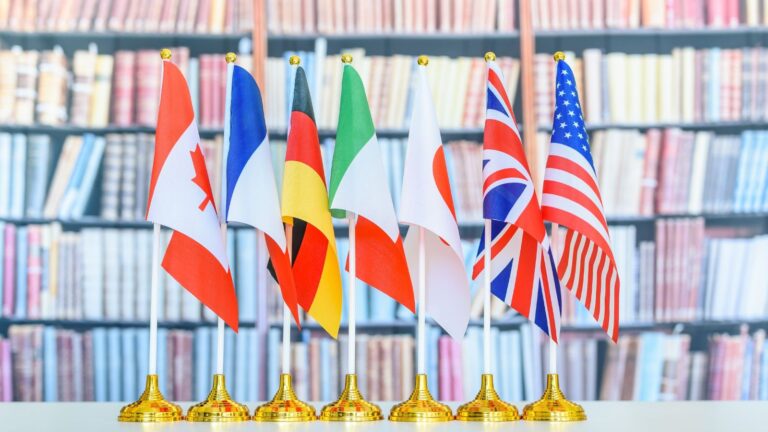
Foreign ministers representing Canada, the United States, Japan, France, Germany, Italy and the United Kingdom gathered in Paris on November 9 and 10, 2026, under France’s G7 presidency. The European Union’s top foreign policy representative also participated. Their joint declaration, published November 11, specifically addressed China’s growing activities in the waters east of Taiwan. The ministers warned that these operations threaten regional stability, freedom of navigation and the safety of international shipping.
The significance lies in the collective nature of the warning. Although several Western governments had previously expressed concerns about Chinese operations near Taiwan, the latest declaration brought all seven countries together behind a common diplomatic position. The ministers opposed attempts to change the existing situation through force, coercion or threats, emphasizing that disputes should instead be resolved through constructive dialogue. Importantly, the declaration did not announce new sanctions or military deployments. Its immediate purpose was to demonstrate shared opposition to escalating pressure around Taiwan.
Chinese Coast Guard Patrols Have Expanded Into Taiwan’s Eastern Waters
Taiwan’s eastern coastline has become an increasingly important focus of Chinese maritime operations since June 2026. The shift matters because it extends pressure beyond the Taiwan Strait toward the Pacific-facing side of the island. On September 29, Taiwan’s Coast Guard Administration reported tracking two Chinese vessels, the Zhujiajian and Chongming, operating in the area. Taiwanese authorities deployed their own patrol vessels to monitor the activity. Beijing has characterized such operations as legitimate law enforcement, while Taipei argues that China is attempting to establish jurisdiction over waters administered by Taiwan.
The disagreement intensified during another patrol reported on November 1. Taiwanese officials identified two Chinese coast guard ships, Hushi and Meishan, and accused Beijing of using law-enforcement activities to harass shipping and challenge Taiwan’s maritime authority. Although these encounters do not constitute a declared blockade, their repetition has raised concerns. Regular patrols could gradually make a heightened Chinese presence appear normal, increasing the risk of confrontation involving civilian vessels and coast guard personnel.
Why Taiwan’s Eastern Waters Are Critical to Preventing a Blockade
Taiwan’s eastern coastline holds strategic importance because it could provide alternative routes for international assistance during a conflict. While the Taiwan Strait separates the island from mainland China, its eastern waters open directly into the Pacific Ocean. Ports such as Hualien and Su’ao are considerably smaller than major western commercial facilities, but could become more important if shipping access elsewhere were restricted. Taiwanese officials regard these eastern approaches as potentially essential routes for receiving supplies from international partners.
Research from the Center for Strategic and International Studies distinguishes between a military blockade and a maritime quarantine conducted primarily by law-enforcement vessels. A blockade would involve military forces restricting access, whereas a quarantine could impose inspections and shipping controls without immediately triggering open warfare. Taiwanese officials suspect China’s combination of naval forces, coast guard vessels and civilian assets could be preparation for such operations. However, this remains a security assessment rather than confirmation of an imminent blockade. Even limited interference with commercial shipping could create difficult decisions for international governments and transport companies.
Chinese Aircraft Carrier Drills Add to Regional Security Concerns
The maritime pressure is not limited to coast guard patrols. On November 10, Taiwan’s Defence Minister Wellington Koo said China was conducting anti-access and area-denial exercises in the Western Pacific involving the Liaoning aircraft carrier group and other naval formations. These operations are designed to complicate the ability of outside military forces to enter or operate within a contested region. In a Taiwan confrontation, such capabilities could potentially make intervention by the United States or its partners more difficult.
The announcement followed reports of unusually extensive Chinese naval activity. Taiwan’s National Security Council Secretary-General Joseph Wu had identified deployments involving more than 100 Chinese naval and coast guard vessels operating across waters near Taiwan, the South China Sea and the wider Pacific. That figure covered a broad geographic area rather than ships exclusively surrounding Taiwan. Beijing previously described the Liaoning’s Pacific training as routine and unrelated to any particular country. Nevertheless, Taiwanese authorities said they were monitoring the activities through surveillance systems and intelligence exchanges with international partners, reflecting the heightened security concerns.
Canada and the United States Find Common Ground Despite Trade Disputes
Canada’s endorsement of the Taiwan warning comes during a particularly difficult period in its relationship with Washington. Prime Minister Mark Carney recently emphasized that President Donald Trump’s administration remains Canada’s principal counterpart in trade negotiations, despite Democratic gains in the U.S. midterm elections. American tariffs continue to create economic tensions, with significant disagreements remaining unresolved. Nevertheless, Canadian Foreign Minister Anita Anand and U.S. Secretary of State Marco Rubio participated in the same G7 diplomatic effort addressing Chinese activity near Taiwan.
The situation demonstrates how two neighbouring countries can disagree strongly on economic policy while maintaining common security interests. Ottawa and Washington may have competing priorities concerning tariffs, automobile manufacturing and trade agreements, but both have an interest in preventing a destabilizing confrontation in the Indo-Pacific. Canada’s participation also reflects its commitment to international cooperation on security issues. The joint declaration does not resolve bilateral trade disputes or establish new military obligations. Instead, it demonstrates that diplomatic coordination can continue even when other aspects of the Canada-U.S. relationship are under significant strain.
Canada’s Taiwan Policy Balances Diplomacy With Economic Interests
Canada’s position involves an important diplomatic distinction. Ottawa maintains a longstanding One China policy, recognizing the People’s Republic of China as China’s sole legitimate government while neither endorsing nor challenging Beijing’s position regarding Taiwan. Canada therefore maintains unofficial rather than formal diplomatic relations with Taipei. Its Canadian Trade Office in Taipei facilitates economic and cultural connections, allowing cooperation to continue without changing Canada’s established recognition policy.
The economic relationship is substantial. According to Global Affairs Canada’s merchandise trade data, Canadian imports from Taiwan reached approximately C$8 billion in 2025. Canadian business interests include information technology, aerospace, biotechnology, clean energy and other advanced industries. Government briefing materials prepared in June 2026 also reaffirmed Canada’s opposition to attempts to change the Taiwan Strait’s status quo through force. This combination of diplomatic caution and economic engagement helps explain Ottawa’s approach. Canada can support regional stability, oppose coercive military activities and strengthen commercial ties with Taiwan while continuing to recognize Beijing as the government of China.
Beijing Rejects the Warning and Defends Its Position on Taiwan
China responded sharply to the G7 declaration. During a November 12 foreign ministry briefing, spokesperson Mao Ning accused the participating countries of misrepresenting the situation and interfering in China’s internal affairs. She criticized the G7 for what Beijing considers Cold War-style bloc politics. Chinese authorities maintain that Taiwan is part of China’s territory, while Taiwan’s democratically elected government rejects Beijing’s sovereignty claim. These opposing positions explain why maritime operations that China describes as legitimate enforcement activities are viewed by Taiwan as attempts at intimidation.
On the same day, Chinese President Xi Jinping addressed a ceremony commemorating the 160th anniversary of revolutionary leader Sun Yat-sen’s birth. Xi reiterated Beijing’s determination to achieve eventual reunification with Taiwan and expressed support for a peaceful approach under the proposed one country, two systems framework. However, China has never formally ruled out using force, and Taiwan’s major political parties reject that arrangement. Although Xi’s remarks were not necessarily a direct response to the G7 declaration, they reinforced Beijing’s longstanding territorial position and the difficulty of reaching a mutually acceptable political settlement.
Taiwan Welcomes International Support and Promises Stronger Defences
Taiwan’s government reacted positively to the G7 warning. On November 12, Presidential Office spokesperson Karen Kuo emphasized that peace and stability in the Taiwan Strait and broader Indo-Pacific region are essential to international security and prosperity. She thanked G7 countries for their continued attention to cross-strait developments and support for Taiwan’s meaningful participation in international organizations. For Taipei, international diplomatic attention provides reassurance as Chinese maritime patrols and military exercises create growing security challenges.
Taiwan also committed to strengthening its self-defence capabilities and what officials describe as whole-of-society resilience. This approach extends beyond military readiness to the ability of civilian institutions and communities to function during emergencies. Kuo said Taiwan would continue cooperating with like-minded international partners, including G7 members, to support democratic values and regional security. Executive Yuan spokesperson Michelle Lee separately welcomed the declaration. However, these responses did not indicate that an attack was inevitable or that G7 members had made new military commitments. The immediate outcome was stronger diplomatic messaging alongside Taiwan’s continued emphasis on preparedness and international cooperation.
Global Shipping and Semiconductor Supplies Face Potential Disruption
Although the G7 warning focuses on waters east of Taiwan, the economic consequences of a confrontation could extend across surrounding maritime routes. Research published by the Center for Strategic and International Studies in July 2026 estimated that more than US$2.4 trillion worth of goods passed through the Taiwan Strait in 2024, representing approximately 21% of global maritime trade. While that figure measures shipping through the strait rather than the specific eastern patrol area, it illustrates the region’s commercial importance. Even without direct military conflict, escalating maritime tensions could force shipping companies to reconsider routes, accept delays or face higher insurance costs.
Taiwan’s semiconductor industry creates another major vulnerability. According to a U.S. government commercial guide published in December 2025, the island accounts for more than 90% of global leading-edge chip manufacturing. These components power smartphones, artificial intelligence infrastructure, modern vehicles and industrial equipment. For Canadian manufacturers and technology businesses, disruption around Taiwan could therefore create supply shortages and higher costs. The economic stakes explain why governments far beyond East Asia consider stability around the island an international priority rather than a purely regional issue.
What Happens Next Could Determine Whether Tensions Escalate
The G7 declaration emphasized peaceful engagement rather than immediate punitive action. Ministers called for constructive dialogue across the Taiwan Strait and rejected unilateral attempts to alter the existing situation through force or coercion. They also supported Taiwan’s meaningful participation in international organizations while emphasizing freedom of navigation and international law. Concerns about maritime activity in the East and South China Seas appeared in the same declaration, highlighting the broader importance of regional security and established international rules.
The effectiveness of the warning will ultimately depend on developments at sea. Taiwan has promised to monitor Chinese operations closely, while Beijing has rejected international criticism of its activities. Further coast guard confrontations, expanded naval exercises or interference with commercial vessels could intensify diplomatic tensions. Conversely, better communication and restraint could reduce the possibility of miscalculation. For Canada and the United States, the immediate challenge is maintaining a united position on regional stability while avoiding unnecessary escalation. The Paris declaration established common diplomatic ground, but whether it influences China’s future actions remains uncertain.
This Options Discord Chat is The Real Deal
While the internet is scoured with trading chat rooms, many of which even charge upwards of thousands of dollars to join, this smaller options trading discord chatroom is the real deal and actually providing valuable trade setups, education, and community without the noise and spam of the larger more expensive rooms. With a incredibly low-cost monthly fee, Options Trading Club (click here to see their reviews) requires an application to join ensuring that every member is dedicated and serious about taking their trading to the next level. If you are looking for a change in your trading strategies, then click here to apply for a membership.