35,000+ smart investors are already getting financial news, market signals, and macro shifts in the economy that could impact their money next with our FREE weekly newsletter. Get ahead of what the crowd finds out too late. Click Here to Subscribe for FREE.
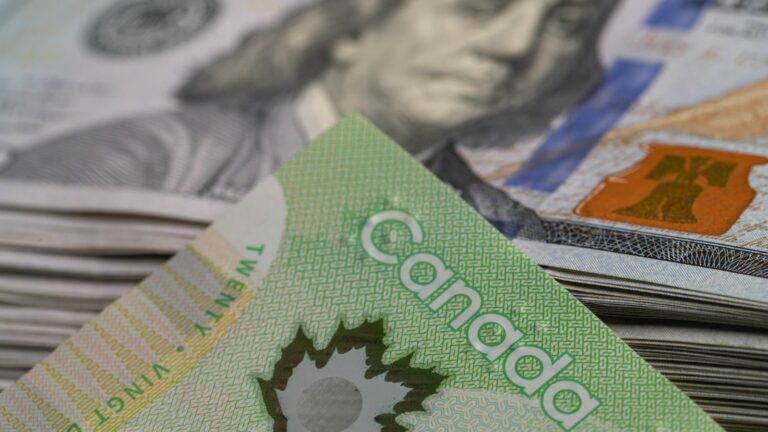
The Canadian dollar is ending the week under renewed pressure, caught between a more aggressive U.S. Federal Reserve and a Bank of Canada that has so far kept borrowing costs unchanged. By Friday, September 18, the loonie was trading near C$1.4010 per U.S. dollar, or roughly 71.4 U.S. cents, after briefly touching its weakest level since early August.
More striking than any single exchange-rate level is the persistence of the move. The currency was on course for an eighth consecutive daily decline, which would make it the longest losing streak since May. Behind that slide is a widening gap between Canadian and U.S. bond yields, strengthening demand for U.S.-dollar assets just as Canada navigates softer employment, trade uncertainty and lingering inflation pressure.
The Loonie’s Losing Streak Is Starting to Stand Out
Canadian Dollar Slides Toward Longest Losing Streak Since May as U.S.-Canada Rate Gap Widens
- The Loonie’s Losing Streak Is Starting to Stand Out
- The Fed and Bank of Canada Are Moving in Different Directions
- Why a Wider Rate Gap Can Push the Canadian Dollar Lower
- Canada’s Economy Is Sending Mixed Signals
- Inflation Is Complicating the Bank of Canada’s Choices
- Trade Is Another Source of Pressure on the Currency
- Even $100 Oil Has Not Been Enough to Rescue the Loonie
- A Weaker Dollar Has Real Consequences for Canadians
- The Next Few Weeks Could Be Crucial
Friday’s move pushed the Canadian dollar to around C$1.4010 per U.S. dollar, after it touched approximately C$1.40144 earlier in the session. That was its weakest intraday point since August 7. The loonie was also down roughly 1% for the week and heading toward an eighth consecutive daily loss. For a currency that often moves by only a fraction of a percentage point in an ordinary session, a string of declines this long attracts attention even when the cumulative move is not historically extreme.
The change becomes clearer when compared with earlier in September. The Bank of Canada’s indicative daily rate showed one U.S. dollar costing C$1.3784 on September 8. By September 17, that had climbed to C$1.3988. The direction matters because USD/CAD rises when the Canadian dollar weakens. The loonie has therefore moved from roughly 72.6 U.S. cents to around 71.4 cents in a little over a week, a meaningful adjustment in one of the world’s most heavily traded currency pairs.
The Fed and Bank of Canada Are Moving in Different Directions
The biggest immediate catalyst is the growing divide between Canadian and U.S. interest rates. The Bank of Canada held its overnight rate at 2.25% on September 2, extending a run of unchanged decisions that stretches back to late 2025. Two weeks later, the Federal Reserve raised its target range by a quarter percentage point to 3.75%–4.00%, citing elevated inflation and continued resilience in the U.S. economy.
Using the midpoint of the Fed’s range, the policy-rate difference is now about 1.625 percentage points in favour of the United States. Financial markets are reflecting that divergence as well. On Friday, Canada’s two-year government bond yield was about 142 basis points below the comparable U.S. yield, the widest gap since July 28. That difference is particularly important because short-term bond yields tend to reflect expectations about where central-bank rates are heading. For currency traders, the signal is straightforward: holding short-duration U.S. assets currently offers a substantially higher yield than comparable Canadian assets.
Why a Wider Rate Gap Can Push the Canadian Dollar Lower
Currencies are not determined by interest rates alone, but yield differences can exert powerful pressure. When U.S. securities offer a higher return than similar Canadian securities, investors have a greater incentive to own dollar-denominated assets. That can increase demand for U.S. dollars relative to Canadian dollars, particularly when markets expect the interest-rate difference to remain in place rather than disappear quickly.
Bank of Canada research illustrates the mechanism. In a simplified example, the Bank has estimated that if a one-year Canadian interest rate moves one percentage point below the equivalent U.S. rate, the Canadian dollar may initially depreciate by roughly 1% to compensate investors for the lower return. Real markets are more complicated: risk sentiment, trade policy, commodity prices and expectations all matter. Bank researchers have found that risk premiums can sometimes explain more currency movement than rates themselves. Still, the latest decline fits the textbook pattern unusually well. The front end of the U.S. yield curve has become more attractive just as the Fed has signalled that additional tightening could still be necessary.
Canada’s Economy Is Sending Mixed Signals
The Bank of Canada is not dealing with a uniformly weak economy. Canadian real GDP rose 0.8% in the second quarter of 2026, equivalent to roughly 3.3% growth at an annualized pace. That was a sharp improvement from the first quarter and was supported by exports, household spending and business investment. June GDP also increased 0.3%, marking a third consecutive monthly gain.
More recent indicators, however, have been less reassuring. Employment declined by 42,000 in August, while the unemployment rate remained at 6.4%. Youth unemployment stood at 12.9%, and average hourly wage growth slowed to 2.0% year over year. Statistics Canada’s preliminary estimate also suggested real GDP was essentially unchanged in July. This leaves the Bank of Canada with an awkward mix: growth has improved from earlier weakness, but the labour market is hardly booming. Raising rates aggressively to support the currency could therefore create additional pressure for households and businesses at a time when parts of the economy remain vulnerable.
Inflation Is Complicating the Bank of Canada’s Choices
Normally, weaker employment and uneven growth would give a central bank more freedom to keep borrowing costs low. Inflation is making that decision more complicated. Canada’s consumer price index was up 3.0% year over year in August, unchanged from July and sitting at the upper boundary of the Bank of Canada’s 1%–3% inflation-control range.
The details are somewhat less alarming than the headline figure. Gasoline prices have been a major contributor, while inflation excluding gasoline was 2.4%. The Bank of Canada’s preferred CPI-trim and CPI-median measures were around 1.9% and 2.0%, respectively, indicating that underlying inflation has been considerably calmer than the headline rate. The United States, meanwhile, reported 3.4% annual CPI inflation in August, with prices rising 0.4% during the month. That stronger U.S. inflation backdrop, combined with a relatively resilient labour market, helps explain why the Fed has moved more aggressively while the Bank of Canada has remained on hold.
Trade Is Another Source of Pressure on the Currency
Canada’s latest trade figures add another layer of uncertainty. Merchandise exports fell 2.3% in July while imports rose 2.2%, shrinking the country’s goods trade surplus from C$4.2 billion in June to just C$769 million. Exports to the United States fell an especially sharp 6.6%, the largest percentage decrease since April 2025, while imports from the U.S. increased 1.8%.
There is a brighter side to those numbers. Canadian exports to countries other than the United States increased 7.4% in July to a record C$25.6 billion, suggesting exporters are finding customers elsewhere. Even so, the United States remains enormously important to Canadian trade, making uncertainty surrounding tariffs and bilateral negotiations relevant to currency markets. The Bank of Canada has specifically cited new U.S. tariffs and Canadian countermeasures as risks to growth and inflation. Uncertainty itself can matter: investors often demand an additional risk premium when future trade rules are difficult to predict, which can weigh on a country’s currency even before the full economic impact appears in official data.
Even $100 Oil Has Not Been Enough to Rescue the Loonie
The loonie has traditionally been described as a commodity currency, particularly because Canada is a major energy exporter. That makes the latest weakness noteworthy. U.S. crude was trading above US$100 per barrel on Friday amid continued geopolitical and supply concerns, conditions that at other points in Canadian history might have offered a clearer lift to the currency.
The relationship between oil and the Canadian dollar, however, is no longer as simple as it once was. Bank of Canada analysis has found that oil-price movements have become less important to currency dynamics in recent years. One reason is that Canada’s energy sector has become more capital-efficient, meaning higher crude prices do not necessarily generate the same surge in new investment — and demand for Canadian dollars — that they once did. Oil still matters, particularly for export revenues and Canada’s terms of trade, but it is competing with a powerful interest-rate story. At the moment, the widening Canada-U.S. yield gap appears to be winning that contest.
A Weaker Dollar Has Real Consequences for Canadians
Foreign-exchange moves can feel abstract until they show up in everyday transactions. At an exchange rate of roughly C$1.4010 per U.S. dollar, US$1,000 costs approximately C$1,401 before bank or credit-card fees. At the Bank of Canada’s September 8 rate of C$1.3784, the same US$1,000 would have cost about C$1,378. That is a difference of more than C$22 in little more than a week.
The effects extend beyond vacations and cross-border shopping. Canadian companies importing machinery, components, food or consumer products priced in U.S. dollars face higher costs when the loonie depreciates. Some of those costs can eventually reach shoppers, although research shows that exchange-rate changes are rarely passed through to retail prices immediately or completely. There is also a beneficiary: Canadian exporters can become more competitive because foreign buyers need fewer U.S. dollars to purchase Canadian-dollar goods and services. That is why the Bank of Canada describes the floating exchange rate as an economic “shock absorber” rather than treating a stronger currency as automatically better.
The Next Few Weeks Could Be Crucial
Attention will now shift to Bank of Canada Governor Tiff Macklem, who is scheduled to speak about economic developments in Halifax on Monday, September 21. Markets will be watching closely for any indication that policymakers have become more concerned about inflation, the Canadian dollar or the widening interest-rate differential. The Bank’s next scheduled policy decision arrives on October 28.
As of Friday, investors were assigning roughly a 60% probability to a Bank of Canada rate increase at that meeting. Currency strategists are not uniformly pessimistic about the loonie over a longer horizon. A Reuters poll of 32 foreign-exchange analysts conducted around the beginning of September produced a median forecast near C$1.39 per U.S. dollar in three months and C$1.36 in 12 months, based partly on expectations that trade tensions and the rate gap could eventually ease. The Canadian dollar has already weakened beyond that three-month median forecast, underscoring how quickly assumptions can change. For now, the direction of Canadian and U.S. interest rates may matter more than almost anything else.
This Options Discord Chat is The Real Deal
While the internet is scoured with trading chat rooms, many of which even charge upwards of thousands of dollars to join, this smaller options trading discord chatroom is the real deal and actually providing valuable trade setups, education, and community without the noise and spam of the larger more expensive rooms. With a incredibly low-cost monthly fee, Options Trading Club (click here to see their reviews) requires an application to join ensuring that every member is dedicated and serious about taking their trading to the next level. If you are looking for a change in your trading strategies, then click here to apply for a membership.