35,000+ smart investors are already getting financial news, market signals, and macro shifts in the economy that could impact their money next with our FREE weekly newsletter. Get ahead of what the crowd finds out too late. Click Here to Subscribe for FREE.
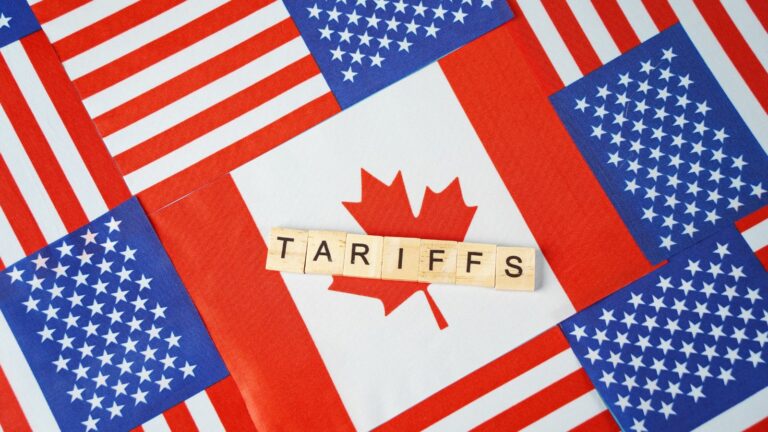
Canada’s latest trade fight with the United States is no longer confined to steel mills, auto plants and multinational manufacturers. A new wave of 50% U.S. tariffs is reaching machinery makers, food producers, wood businesses, packaging companies and even creative firms that built their business models around relatively frictionless access to American customers. The United States imposed the duties on roughly C$27.6 billion worth of Canadian goods beginning August 22, while Canada answered with counter-tariffs covering a similar value of U.S. imports on September 8. For small businesses, the consequences can arrive quickly: a suddenly uneconomic quotation, a postponed expansion or an American customer simply deciding not to place the order. Nearly half of small Canadian exporters surveyed by the Canadian Federation of Independent Business now report direct exposure to the latest tariffs.
A 50% Tariff Can Make a Small-Business Order Uneconomic Overnight
50% U.S. Tariffs Are Costing Canadian Small Businesses Orders as Trade War Spreads Beyond Big Industry
- A 50% Tariff Can Make a Small-Business Order Uneconomic Overnight
- The Exposure Has Spread Far Beyond Steel and Automobiles
- CUSMA Compliance Is No Longer a Complete Shield
- Orders Can Disappear Even When the Product Is Not Directly Tariffed
- Canada’s Honey Industry Shows How a Niche Sector Can Be Hit Hard
- Canadian Retaliation Creates a Second Cost Problem
- For Smaller Firms, the Real Threat Is Often Cash Flow
- Ottawa Has Expanded Relief, but Getting It to the Right Firms Matters
- The Product Lists Are Still Changing
- Diversification Is Accelerating, but the U.S. Market Is Difficult to Replace
The problem is easy to see when the tariff is applied to expensive, specialized equipment. Revival Stillworks, a Vancouver Island manufacturer that designs and builds distilling equipment, told The Associated Press that its stills, fermenters and other products now face a 50% charge when entering the United States. Co-founder Darcy Lane said the equipment can cost anywhere from roughly $250,000 to $2 million. Even when the American importer technically pays the border duty, the Canadian supplier can lose the business when the final landed price suddenly becomes difficult to justify.
The company illustrates why percentages that look abstract in trade announcements become very concrete on a shop floor. Lane said Revival had millions of dollars in potential orders expected during the next four to six months, while U.S. customers represent about half of its business. One American customer had already cancelled a project during an earlier tariff scare. Revival is consequently exploring other work that could use the same engineers, welders and fabricators, including opportunities in the local marine sector. For a specialized manufacturer, replacing a large American order is rarely as simple as finding another buyer the next morning.
The Exposure Has Spread Far Beyond Steel and Automobiles
The newest tariff lists help explain why the dispute increasingly resembles a Main Street problem rather than only an industrial one. CFIB said in August that the affected products stretch across 18 pages and include goods commonly sold by smaller Canadian exporters. Machinery and equipment, wood and building products, plastics and packaging, agricultural products, food and beverages, jewellery, art and other creative goods were among the categories the organization identified as especially exposed. The U.S. measures also cover numerous electronics, home goods, sporting goods, clothing and manufacturing inputs.
Early estimates suggested 40% of small exporters would be affected. Once the tariffs were in place, CFIB’s September survey found the share reporting direct exposure had reached 46%. Another 49% of small importers said their products were affected by Canadian counter-tariffs. Manufacturing, wholesale trade, retail and construction were among the sectors reporting the greatest exposure. The same CFIB research put the median monthly cost reported by affected businesses at about $65,000—a scale of expense that can be significant for a privately owned company with limited working capital.
CUSMA Compliance Is No Longer a Complete Shield
For years, Canadian exporters invested time and money in structuring supply chains around the Canada-U.S.-Mexico Agreement. Goods that met its rules of origin could generally receive preferential tariff treatment. The latest Section 338 action changes that calculation for covered products. The White House has explicitly said the new Section 338 tariffs apply to covered Canadian goods regardless of whether they qualify as originating goods under USMCA/CUSMA. That means a business can satisfy the continental trade agreement’s origin rules and still face the additional 50% duty if its product falls on the new lists.
Washington used Section 338 of the Tariff Act of 1930, which permits additional duties of up to 50% under specified circumstances involving what the U.S. administration determines to be discriminatory foreign trade treatment. The administration says its measures respond to Canadian policies involving alcohol, dairy and motor vehicles. Canada disputes Washington’s broader trade approach and has responded with reciprocal measures. Trade advisers have noted that Section 338 has rarely been used in modern trade policy. For small exporters accustomed to treating CUSMA compliance as their central defence against border duties, the shift adds another layer of customs risk and pricing uncertainty.
Orders Can Disappear Even When the Product Is Not Directly Tariffed
Direct duties are only part of the damage. Trade uncertainty can persuade customers to wait, switch suppliers or avoid cross-border transactions even when a particular item escapes the tariff list. CFIB reported earlier this year that 75% of surveyed small businesses said the trade dispute had strained relationships with American partners or customers. By April, only 40% of small firms viewed the United States as a reliable trading partner, according to subsequent CFIB research. Those figures capture a problem that cannot be measured simply by adding up customs payments.
The phenomenon is visible on both sides of the border. AP reported that AmpRx, a Tennessee manufacturer of equipment used by musicians and recording studios, had seen demand from Canadian customers weaken even though its bestselling product was not covered by the new U.S. tariffs. A Vermont cheesemaker similarly reported cancelled Canadian holiday orders. Those cases do not prove that every lost order results from political sentiment or tariff fears, but they demonstrate how uncertainty can spread beyond the goods formally listed in a tariff proclamation. For a Canadian exporter, that means market damage can begin before a customs broker ever calculates a duty.
Canada’s Honey Industry Shows How a Niche Sector Can Be Hit Hard
Honey provides another example of how a relatively small industry can have unusually concentrated exposure to the American market. Agriculture and Agri-Food Canada reported that the United States received 56.1% of Canadian honey exports by volume in 2025, or 5,354 metric tonnes. By value, the U.S. represented 52.9% of Canadian honey exports. Those percentages matter because a producer cannot instantly recreate that scale of demand elsewhere when a major market becomes dramatically more expensive.
Peter Awram, CEO of British Columbia’s family-owned Worker Bee Honey Co., told AP that the new U.S. tariff on Canadian honey was creating additional pressure on an industry already dealing with difficult pricing conditions. Awram estimated that roughly 60% of Canadian honey export volume had historically gone to the United States, broadly consistent with recent federal statistics. If exporters redirect more product into Canada because American sales weaken, the additional domestic supply could put downward pressure on local prices. The story demonstrates why a tariff covering only a small portion of total Canada-U.S. commerce can still be severe for a producer whose particular commodity depends heavily on one destination.
Canadian Retaliation Creates a Second Cost Problem
Ottawa’s response protects some Canadian producers by making competing U.S. products more expensive, but it also creates costs for Canadian companies that rely on American inputs. Canada imposed counter-tariffs of 15%, 25% and 50% beginning September 8, covering C$27.6 billion in U.S. imports. The measures target sectors including steel and aluminum, dairy, appliances, agricultural equipment, pulp and paper, plastics and electronics. Certain steel and aluminum products that had faced 25% Canadian counter-tariffs were moved to 50%.
That matters because small Canadian firms are often importers even when they are not exporters. CFIB says roughly 20% of small firms export while more than half import from the United States. Its September research found businesses responding to tariff expenses in very different ways: 42% expected to absorb most of the additional costs, while 41% expected to pass most of them along. Others were changing suppliers, reducing purchases or delaying hiring and investment. A Canadian business can therefore be squeezed from both directions—losing competitiveness when selling into America while simultaneously paying more for an American component, machine or material used at home.
For Smaller Firms, the Real Threat Is Often Cash Flow
Large corporations can sometimes endure a temporary shock by moving production, drawing on credit facilities or spreading the cost across multiple markets. A small company with a handful of major customers may have fewer options. CFIB’s September survey found that 18% of tariff-affected small exporters said their businesses would cease to be financially viable if the trade dispute lasted three months or more. Among affected importers, the comparable figure reported in CFIB’s September 3 release was 11%.
The vulnerability is understandable. Payroll, rent, insurance and debt payments continue even while orders are delayed. A manufacturer may already have purchased materials for a U.S. customer before discovering that the customer no longer wants to absorb the tariff. Another business may cut its own price in an effort to preserve the account, effectively sharing part of the tariff burden through a lower margin. CFIB’s survey of 1,545 business owners found major negative effects from the new U.S. tariffs reported by 26% of respondents and major negative effects from Canadian counter-tariffs reported by 28%. Those figures suggest the conflict is increasingly affecting ordinary business planning, rather than remaining an issue limited to trade negotiators and corporate headquarters.
Ottawa Has Expanded Relief, but Getting It to the Right Firms Matters
The federal government has responded with a new C$7.5 billion package for tariff-affected workers and businesses. It includes an additional C$1.5 billion for the Regional Tariff Response Initiative, a C$500 million BDC liquidity stream, C$2 billion for the Canada Strong Diversification Fund and C$3.5 billion in rapid-response supports for workers and employers. Ottawa has also kept a tariff-remission process available in cases where companies cannot reasonably source affected inputs domestically or from non-U.S. suppliers.
The Regional Tariff Response Initiative is particularly relevant to smaller firms. In British Columbia, for example, eligible businesses can access as much as C$3 million in non-repayable support, including up to C$2 million for liquidity and C$1 million for pivot projects. Eligibility rules still matter: regional guidance generally requires businesses to have been viable before the tariffs and to meet minimum revenue thresholds. Meanwhile, the separate Canada Strong Diversification Fund primarily supports much larger projects, with its main project stream focused on proposals carrying more than C$20 million in eligible costs. The challenge is therefore not merely announcing large support totals, but ensuring smaller companies with immediate order losses can reach programs suited to their scale.
The Product Lists Are Still Changing
Business planning has become harder because the tariff regime itself continues to move. U.S. modifications that took effect September 15 added some Canadian products to the 50% tariff lists while removing others. The administration has said products such as certain cement and rock salt items were removed while other goods, including additional dairy products and all-terrain vehicles, were added. For an exporter, such changes can alter a quotation, contract or inventory decision with relatively little lead time.
An even sharper change is scheduled for September 29. Washington has announced import bans covering certain Canadian alcoholic beverages, dairy-related goods and other specified products that had previously faced the 50% duty. Separate measures also cover selected motorcycles. Goods subject to those prohibitions that entered before the effective date but have not yet cleared consumption can remain subject to the existing 50% rate under the proclamations. Whether negotiations change those measures remains uncertain. The immediate lesson for smaller exporters is that today’s tariff rate may not necessarily be the rule governing an order scheduled to cross the border several weeks from now.
Diversification Is Accelerating, but the U.S. Market Is Difficult to Replace
Canadian companies are clearly looking elsewhere. Export Development Canada’s latest Trade Confidence Index found that 72% of exporters planned to pursue new markets over the next two years, up from 65% five months earlier. That survey was completed before the August 22 Section 338 tariffs took effect, meaning the newest escalation was not yet reflected in the responses. CFIB separately found that 48% of SMEs doing business with the United States had already shifted toward non-U.S. suppliers or customers, with many looking first to the Canadian market and others exploring Asia and Europe.
Canada’s national trade numbers show that diversification is possible, although the data should not be treated as proof that tariffs caused every shift. Statistics Canada reported that goods exports to the United States fell 6.6% in July, largely because of lower crude oil and gold exports. At the same time, exports to non-U.S. markets rose 7.4% to a record C$25.6 billion, accounting for 33.7% of Canadian goods exports that month. For a multinational commodity producer, redirecting shipments can sometimes occur relatively quickly. For the Vancouver Island fabricator, family beekeeper or small packaging company that built years of customer relationships just across the border, replacing the American market is a much slower undertaking.
This Options Discord Chat is The Real Deal
While the internet is scoured with trading chat rooms, many of which even charge upwards of thousands of dollars to join, this smaller options trading discord chatroom is the real deal and actually providing valuable trade setups, education, and community without the noise and spam of the larger more expensive rooms. With a incredibly low-cost monthly fee, Options Trading Club (click here to see their reviews) requires an application to join ensuring that every member is dedicated and serious about taking their trading to the next level. If you are looking for a change in your trading strategies, then click here to apply for a membership.