35,000+ smart investors are already getting financial news, market signals, and macro shifts in the economy that could impact their money next with our FREE weekly newsletter. Get ahead of what the crowd finds out too late. Click Here to Subscribe for FREE.
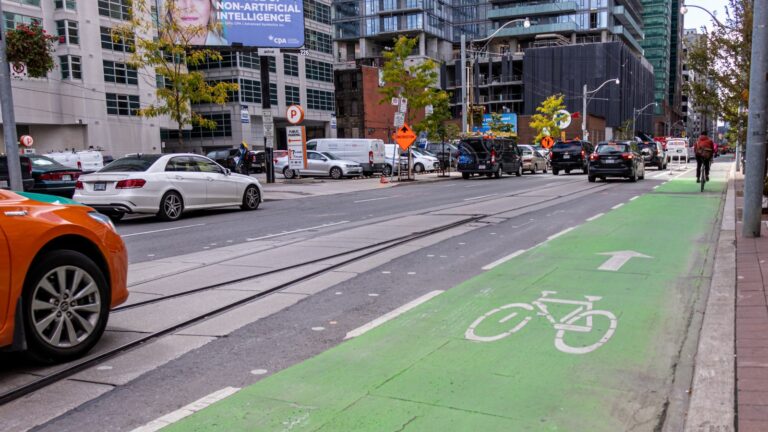
A fight over a stretch of Toronto pavement has become a much larger argument about who gets to make public policy in Ontario. The Ford government has won a major appeal that removes the constitutional barrier preventing it from reconfiguring roughly 19 kilometres of protected bike lanes on Bloor Street, Yonge Street and University Avenue.
The unanimous Court of Appeal decision reverses a 2025 ruling that found the province’s plan violated Charter protections because removing physical separation would expose cyclists to greater danger. The new judgment does not conclude that removing the lanes will improve congestion or make Toronto safer. Instead, it says those policy questions are for elected governments, provided their legislation stays within constitutional limits. With the legal roadblock lifted, attention now shifts from the courthouse to Queen’s Park, Toronto City Hall and the streets themselves.
Ontario’s Top Court Hands the Ford Government a Major Win
Ford Government Wins Court Fight Clearing Way to Remove 19 km of Toronto Bike Lanes
- Ontario’s Top Court Hands the Ford Government a Major Win
- The Fight Began With Ontario’s Bill 212
- A Lower Court Had Found the Plan Unconstitutional
- The Appeal Court Rejected a Constitutional Right to Keep the Lanes
- The Targeted Routes Carry Far More Than Recreational Riders
- Safety Evidence Remains at the Centre of the Dispute
- The Congestion Argument Is Still Far From Settled
- Removing the Infrastructure Could Cost More Than Building It Did
- Toronto Is Still Searching for a Political Compromise
- The Case May Not Be Finished Yet
Ontario’s Court of Appeal ruled unanimously in favour of the provincial government on August 14, overturning the Superior Court decision that had prevented the targeted bike lanes from being dismantled. The three-judge panel concluded that the lower court had interpreted section 7 of the Canadian Charter of Rights and Freedoms too broadly. That provision protects life, liberty and security of the person, but the appeal judges determined it does not constitutionally guarantee continued access to infrastructure such as protected bicycle lanes.
The significance goes well beyond whether concrete barriers remain on Bloor or University. Justice Grant Huscroft’s reasons stressed that courts determine whether legislation is constitutional, not whether governments have chosen the smartest transportation policy. Transportation Minister Prabmeet Sarkaria welcomed the result as a victory for the proper division of responsibilities between elected legislatures and courts. For the province, the ruling restores the legal authority it had been trying to exercise since late 2024.
The Fight Began With Ontario’s Bill 212
The dispute traces back to the Reducing Gridlock, Saving You Time Act, passed in November 2024. Among its transportation provisions, the legislation specifically directed Ontario’s transportation minister to remove bicycle lanes on Bloor Street, University Avenue and Yonge Street and restore space for motor vehicles. The government also created a broader provincial approval system for municipal bike-lane projects that remove a vehicle lane, fundamentally increasing Queen’s Park’s role in decisions previously handled largely by cities.
The wording changed in June 2025. Through the Plan to Protect Ontario Act, the province replaced the explicit direction to “remove” the targeted lanes with a requirement to restore motor-vehicle capacity by “reconfiguring” bicycle lanes. Avenue Road was also added to the statutory language. Regulations can still require bicycle infrastructure to be removed. The change became important during the litigation because the government argued that the original constitutional dispute had effectively changed. The lower court disagreed, concluding that eliminating physical protection would produce substantially the same outcome for cyclists.
A Lower Court Had Found the Plan Unconstitutional
Cycling organization Cycle Toronto and two individual cyclists challenged the law under section 7 of the Charter. The individual applicants brought a practical dimension to what could otherwise sound like an abstract constitutional dispute: one was a university student who relied on the targeted infrastructure, while another worked as a bicycle delivery rider. Their case focused on what happens when a government deliberately removes a safety feature from streets where people are legally entitled to cycle.
Superior Court Justice Paul Schabas sided with them in July 2025. He found that removing the protected character of the lanes would increase the risk of injury and death and therefore engage the rights to life and security of the person. He also concluded that the measure was arbitrary because the evidence before him indicated that restoring motor-vehicle lanes would not achieve the stated objective of relieving congestion. Ontario quickly announced an appeal, setting up the much broader constitutional confrontation decided a year later.
The Appeal Court Rejected a Constitutional Right to Keep the Lanes
The Court of Appeal approached the dispute differently. Its central concern was what would happen if infrastructure created through ordinary legislation effectively became constitutionally protected simply because removing it could increase risk. The judges concluded that legislatures must remain able to change policies established by previous governments. In their reasoning, ordinary legislation can create benefits and protections without permanently transforming those measures into constitutional entitlements that future legislatures are prohibited from altering.
The court therefore characterized the challenge as effectively seeking a constitutional right to the existing bicycle lanes, even though the applicants had rejected that description. It also criticized portions of the lower-court reasoning for entering the territory of political and transportation policy. The appeal judges emphasized that governments do not have to follow expert policy recommendations simply because those recommendations appear persuasive. A law can be controversial, inefficient or opposed by specialists without automatically becoming unconstitutional. That distinction ultimately decided Ontario’s appeal.
The Targeted Routes Carry Far More Than Recreational Riders
The lanes at the centre of the dispute form major pieces of Toronto’s cycling network rather than isolated recreational paths. Toronto staff calculated that the Bloor corridor under consideration stretched about 13.4 kilometres in the city’s analysis, while the relevant Yonge Street corridor covered approximately 3.2 kilometres and the University Avenue–Queen’s Park corridor another 3.6 kilometres. News coverage of the constitutional challenge has generally described approximately 19 kilometres of protected infrastructure as being directly targeted.
City data also show why the corridors became so politically important. Toronto estimated that approximately 300,000 residents and jobs were located within 250 metres of the three bikeways. Thirty-six schools were within the same distance. Bike Share stations along Bloor, Yonge and University had already recorded more than 750,000 trip starts or endings during 2024 when the city prepared its report. Depending on the location, daily cycling counts ranged from hundreds of riders to more than 6,000, illustrating how differently individual sections are used.
Safety Evidence Remains at the Centre of the Dispute
Winning the constitutional case did not erase the safety evidence presented against removal. Toronto reported that on Bloor Street between Avenue Road and Shaw Street, cycling volumes rose by roughly 40 to 90 per cent after bicycle infrastructure was installed, while the rate of cyclist injury collisions fell substantially. The city calculated a 56 per cent reduction in the cyclist collision rate on that stretch, while reported pedestrian and motorist injuries also declined compared with the earlier period examined.
Academic research points in a similar direction. A Toronto study published in Accident Analysis & Prevention examined separated cycle tracks and found cycling volumes were 2.57 times higher after installation while collision risk for cyclists decreased after accounting for the growth in riding. Separately, evidence disclosed during the Ford government litigation included a government-commissioned engineering assessment estimating that removal of the targeted protection could produce more than a 54 per cent increase in total collisions involving all road users. Those findings remain relevant even though they did not determine the appeal.
The Congestion Argument Is Still Far From Settled
The Ford government’s stated purpose has consistently focused on gridlock. Sarkaria argues that valuable road capacity should not be removed from Toronto’s busiest streets for bicycle lanes and says cycling infrastructure belongs on secondary streets when necessary. The province has framed the policy as part of a broader attempt to address congestion, which it says imposes tens of billions of dollars in economic costs across Ontario each year.
Yet documents disclosed during the court proceedings complicated that message. Internal Ministry of Transportation material warned that removing bicycle lanes might not produce the desired congestion reduction. A government-commissioned engineering report also indicated that extra vehicle capacity could provide little or only temporary relief. One explanation is induced demand: when additional driving capacity becomes available, more motorists can be encouraged to use the road until congestion begins rebuilding. The Court of Appeal did not rule that Ontario’s congestion theory was correct. It ruled that disagreement over whether a transportation policy will succeed does not, by itself, make the legislation unconstitutional.
Removing the Infrastructure Could Cost More Than Building It Did
The physical work could become another source of controversy. Toronto estimated in 2024 that more than $27 million had already been invested since 2016 in installing and upgrading the bicycle infrastructure on the three main corridors. Its preliminary estimate for removing the lanes and reconstructing road space for motor vehicles exceeded $48 million, excluding some possible contract-related costs. The province disputed the city’s assessment when it was initially released, but the estimate remains the most detailed publicly available municipal calculation.
Construction would also create the unusual prospect of worsening congestion while work intended to fight congestion is underway. Toronto warned that Bloor Street reconstruction could stretch across multiple construction seasons. For one section between Spadina Avenue and Avenue Road, the city anticipated months of lane restrictions and a temporary full intersection closure at St. George Street. Southbound University Avenue between College and Dundas could require approximately nine months of reduced capacity under the city’s preliminary scenario.
Toronto Is Still Searching for a Political Compromise
Mayor Olivia Chow has generally resisted presenting the disagreement as a contest between cyclists and drivers. Her office said after the appeal ruling that Toronto would continue working with Ontario on approaches that improve traffic movement while retaining safe infrastructure for people cycling. One concept already discussed publicly involves restoring additional vehicle capacity on sections such as Bloor Street West without eliminating safe cycling connections entirely.
That political route matters because the court decision gives Queen’s Park authority, not an obligation to immediately send construction crews onto all three streets. As of the ruling, the province had not announced a timetable for removing the roughly 19 kilometres at issue. Cycling advocates, meanwhile, argue that the practical evidence remains unchanged regardless of the constitutional outcome. Cycle Toronto executive director Michael Longfield said the appeal decision did not overturn the underlying transportation and safety evidence presented during the case. The next phase may therefore depend as much on negotiations between the province and city as on the legal victory itself.
The Case May Not Be Finished Yet
The August ruling clears the immediate constitutional obstacle, but it may not be the final legal word. Cycle Toronto and its lawyers were reviewing the decision and had not ruled out seeking leave to appeal to the Supreme Court of Canada. Unlike an appeal to Ontario’s Court of Appeal, a Supreme Court case would normally require permission from the country’s highest court, meaning another hearing is possible but far from guaranteed.
There is also a broader constitutional question hanging over the decision. The Court of Appeal acknowledged continuing uncertainty about how far section 7 applies outside traditional interactions between individuals and the justice system, an issue arising in other litigation now attracting Supreme Court attention. For Toronto commuters, however, the immediate issue is more concrete. The lanes remain in place for now, but the legal protection that stopped Ontario from acting has been removed. What happens next will reveal whether the Ford government uses its courtroom victory to proceed with removal, negotiate a redesign, or pursue a combination of both.
This Options Discord Chat is The Real Deal
While the internet is scoured with trading chat rooms, many of which even charge upwards of thousands of dollars to join, this smaller options trading discord chatroom is the real deal and actually providing valuable trade setups, education, and community without the noise and spam of the larger more expensive rooms. With a incredibly low-cost monthly fee, Options Trading Club (click here to see their reviews) requires an application to join ensuring that every member is dedicated and serious about taking their trading to the next level. If you are looking for a change in your trading strategies, then click here to apply for a membership.