35,000+ smart investors are already getting financial news, market signals, and macro shifts in the economy that could impact their money next with our FREE weekly newsletter. Get ahead of what the crowd finds out too late. Click Here to Subscribe for FREE.
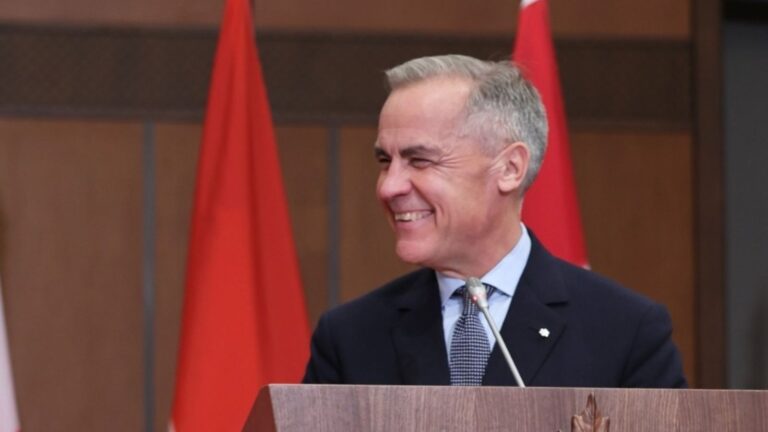
Canada’s immigration debate is entering another turning point. After months of emphasizing lower temporary-resident inflows and slower population growth, Prime Minister Mark Carney has raised the possibility of eventually resuming a “controlled increase” in the population. Conservative immigration critic Michelle Rempel Garner immediately pushed back, saying immigration levels should move in the opposite direction.
The disagreement comes as Ottawa prepares its 2027–2029 immigration plan and as the effects of previous reductions become increasingly visible. Canada’s population reached an estimated 41.8 million on July 1, 2026, but annual growth slowed to just 0.5%. Meanwhile, non-permanent residents still represented 6.7% of the population, above the federal government’s goal of getting the temporary-resident share below 5% by the end of 2027.
Carney’s Comment Opens the Door Without Setting a New Target
Carney Floats a ‘Controlled Increase’ in Immigration as Conservatives Say Levels Need to Go Down
- Carney’s Comment Opens the Door Without Setting a New Target
- Conservatives Argue the System Needs More Time at Lower Levels
- The Current Plan Is Already Far Below the Earlier 500,000 Path
- Population Growth Has Slowed Dramatically
- Housing Pressure Has Eased, but the Supply Problem Has Not Disappeared
- The Economic Argument Is About More Than Headline GDP
- The 2027–2029 Plan Will Put a Number on the Debate
Carney’s language represents a notable change in emphasis, but not yet a change in policy. In a recent interview with The New York Times, he said the government had focused first on getting immigration “under control” and that the question was becoming when Canada should resume a controlled increase in population. Earlier in the summer, Carney publicly said Ottawa had “taken back control” of immigration, pointing to reductions in asylum claims, temporary foreign-worker arrivals and international-student arrivals. His government has consistently described the objective as rebuilding a system that is more predictable and better matched to housing, infrastructure and labour-market capacity.
What Carney did not announce was a new immigration target. Immigration Minister Lena Diab’s office told The Canadian Press that the upcoming 2027–2029 plan would keep immigration at sustainable levels, without confirming that admissions would actually rise next year. That distinction matters because “population growth” can involve permanent immigration, temporary workers, students and changes in how many temporary residents leave or transition to permanent status. For now, the government’s existing targets remain in effect. The next formal plan will provide the clearest indication of whether Carney’s remarks signal an immediate numerical increase or simply a longer-term intention to allow population growth to accelerate again after the current slowdown.
Conservatives Argue the System Needs More Time at Lower Levels
The Conservative response was immediate. Rempel Garner, the party’s immigration critic, said on social media that “immigration levels need to go down, not up.” Her position is consistent with arguments she has made in Parliament that immigration should be more closely connected to available housing, employment opportunities and provincial capacity. During House of Commons proceedings in May, she pressed Immigration Minister Lena Diab on temporary foreign workers and argued that provinces were carrying increased demands for housing, health care, education and other services.
The labour market provides part of the backdrop to that argument, although the data do not establish that immigration alone determines unemployment. Statistics Canada reported an unemployment rate of 6.4% in August 2026, with youth unemployment at 12.9%. Employment fell by 42,000 during the month. TD Economics previously estimated that Canada’s unemployment rate would have been at least one percentage point higher if the earlier pace of immigration growth had continued, illustrating how population growth can affect both labour supply and unemployment statistics. That estimate is a modelling exercise rather than a direct measurement of what would have happened. The political disagreement is therefore partly about how much labour-market slack Ottawa should tolerate before increasing admissions again.
The Current Plan Is Already Far Below the Earlier 500,000 Path
Any discussion of increasing immigration starts from a much different baseline than Canada was contemplating several years ago. Ottawa previously planned to raise permanent-resident admissions to 500,000 annually, but subsequent plans reversed that trajectory. Under the official 2026–2028 Immigration Levels Plan, permanent-resident admissions are targeted at 380,000 in each of 2026, 2027 and 2028. New temporary-resident arrivals are targeted at 385,000 in 2026 and 370,000 in each of the next two years. For 2026, that temporary figure includes 230,000 workers and 155,000 international students. Economic immigration is scheduled to account for roughly 64% of permanent admissions by 2027 and 2028.
There is another wrinkle in the numbers. Ottawa is also implementing two one-time initiatives during 2026 and 2027: processing permanent residence for up to 115,000 eligible protected persons and accelerating permanent residence for 33,000 workers already established in Canada. IRCC says these admissions are outside the regular targets. However, most of the people involved are already living in Canada, meaning a change from temporary or protected status to permanent residence does not have the same immediate population effect as bringing an equivalent number of new residents from abroad. Ottawa has separately committed to reducing temporary residents to less than 5% of Canada’s population by the end of 2027 and keeping permanent admissions below 1% of the population after 2027.
Population Growth Has Slowed Dramatically
The effects of the policy reversal are increasingly visible in Statistics Canada’s demographic numbers. Canada had an estimated population of 41,798,407 on July 1, 2026, only 189,425 higher than one year earlier. That represents annual growth of 0.5%, down sharply from 2.8% during the July 2023-to-July 2024 period. Statistics Canada said the latest percentage increase was the lowest July-to-July population growth rate recorded since 1915–1916. The agency attributed most of the dramatic swings in population growth since 2020 to changes in international migration.
The temporary population is also declining, although it remains well above Ottawa’s stated objective. Statistics Canada estimated 2,779,774 non-permanent residents on July 1, equal to 6.7% of Canada’s population. That was 154,614 fewer than a year earlier, marking the largest annual decline since comparable records began in the early 1970s. Study-permit holders accounted for a major part of that reduction. Getting from 6.7% to below 5% by the end of 2027 would require further changes in the balance between new arrivals, departures and people transitioning to permanent residence. Statistics Canada also cautions that its latest quarterly population estimates are preliminary and can be revised as more complete administrative information becomes available.
Housing Pressure Has Eased, but the Supply Problem Has Not Disappeared
Housing is one of the clearest areas where immigration levels intersect with everyday economic conditions. An October 2025 analysis from TD Economics concluded that the slowdown in population growth was reducing demand pressure in the rental market. Its economists estimated that rent growth would average roughly two percentage points less than under a hypothetical scenario in which the previous higher rate of population growth had continued. They also found some of the largest declines in condominium asking rents in jurisdictions that had been particularly exposed to changes in immigration.
That does not mean slower immigration has solved Canada’s housing shortage. CMHC’s September 2026 Housing Supply Report estimated that Canada would need roughly 417,000 to 469,000 new homes annually to restore affordability to pre-pandemic levels by 2036. CMHC said rental markets have become more balanced as population growth slows and rental construction remains relatively strong, but ownership-oriented construction has weakened substantially. Its projections still leave Canada with a long-term annual supply gap of roughly 187,000 to 238,000 homes over the next decade. Immigration policy can therefore change housing demand relatively quickly, while zoning, infrastructure, construction capacity and financing determine how rapidly supply can respond.
The Economic Argument Is About More Than Headline GDP
Carney has framed population growth partly as an economic issue, telling The New York Times that slower population gains were affecting overall economic growth. There is a demographic basis for that concern. Statistics Canada reported that Canada’s median age had climbed to 40.9 years by July 2026 as the unusually rapid immigration of earlier years faded. The Bank of Canada has similarly said trend labour input is expected to remain essentially flat as slower population growth combines with population aging and lower labour-force participation. Its 2026 assessment projected potential-output growth of about 1.2% this year before modest increases in subsequent years.
At the same time, more people do not automatically translate into stronger living standards. The size of the economy, output per person, productivity, wages, housing availability and capital investment can move differently. Current labour conditions also complicate arguments based simply on worker shortages: the Bank of Canada described hiring as subdued this summer and said businesses generally had enough capacity to meet demand, while Statistics Canada placed unemployment at 6.4% in August. That makes the composition and timing of immigration important alongside the total number. Ottawa’s current plan reflects that approach by putting a larger share of permanent admissions into economic categories and emphasizing health care, skilled trades, technology and other identified labour needs rather than treating every type of immigration as interchangeable.
The 2027–2029 Plan Will Put a Number on the Debate
The key unanswered question is what “controlled increase” will mean when translated into actual targets. Federal, provincial and territorial immigration ministers have already been working on the 2027–2029 plan, discussing regional labour shortages, rural and northern needs, Provincial Nominee Programs and the overall pace of immigration. Under the Immigration and Refugee Protection Act, the immigration minister must table the annual report to Parliament by November 1, subject to provisions covering occasions when Parliament is not sitting. Ottawa has said the new three-year levels plan will be released this fall.
Outside government, there is no consensus that admissions should rise. The C.D. Howe Institute’s Immigration Targets Council recommended in September that permanent-resident admissions be set at 380,000 in 2027, 350,000 in 2028 and 340,000 in 2029. It also recommended treating a 5% non-permanent-resident share as a ceiling before moving toward roughly 3% over the longer term, and called for all permanent-resident admissions to be transparently counted under a single headline target. Those are independent recommendations, not government policy. Carney’s remarks therefore establish the direction of a debate rather than its outcome: the next federal plan will reveal whether Ottawa keeps current levels stable, reduces them further or begins translating the prime minister’s proposed future population increase into policy.
This Options Discord Chat is The Real Deal
While the internet is scoured with trading chat rooms, many of which even charge upwards of thousands of dollars to join, this smaller options trading discord chatroom is the real deal and actually providing valuable trade setups, education, and community without the noise and spam of the larger more expensive rooms. With a incredibly low-cost monthly fee, Options Trading Club (click here to see their reviews) requires an application to join ensuring that every member is dedicated and serious about taking their trading to the next level. If you are looking for a change in your trading strategies, then click here to apply for a membership.