35,000+ smart investors are already getting financial news, market signals, and macro shifts in the economy that could impact their money next with our FREE weekly newsletter. Get ahead of what the crowd finds out too late. Click Here to Subscribe for FREE.
A federal grant announced after Toronto’s waterfront had gone quiet again has put fresh attention on the enormous human machinery behind the Toronto Caribbean Carnival. On August 4, Ottawa confirmed $61,000 for the Festival Management Committee through the Building Communities through Arts and Heritage program. The government said the support is connected to the participation of 9,630 local artists, artisans and heritage performers.
The amount is modest beside the scale of the celebration, yet the announcement carries significance beyond a single cheque. It recognizes a cultural institution now in its 59th year and the thousands of people who transform steelpan, calypso, masquerade, dance, design and storytelling into one of Toronto’s defining summer traditions. It also renews a difficult question: how should governments value festivals whose cultural reach, volunteer labour and economic impact extend far beyond their operating budgets?
What Ottawa Actually Announced
Ottawa Announces $61,000 for Toronto Caribbean Carnival Involving 9,630 Artists
- What Ottawa Actually Announced
- Why the 9,630 Figure Matters
- A Festival Much Larger Than One Parade
- From a Centennial Gift to a Toronto Institution
- What the Federal Program Is Designed to Do
- A Small Grant Inside a Much Bigger Funding Story
- The Economic Case Comes With Big Numbers
- Culture Is Preserved Through Participation
- What the Announcement Signals Next
The August 4 funding announcement came from Canadian Heritage and was delivered by Karim Bardeesy, parliamentary secretary to the minister of industry and MP for Taiaiako’n–Parkdale–High Park. He spoke on behalf of Marc Miller, minister of Canadian identity and culture. The recipient is the Festival Management Committee, the Black-led not-for-profit organization responsible for producing the annual Toronto Caribbean Carnival.
Ottawa identified the $61,000 as support from the Building Communities through Arts and Heritage program. The release did not provide a line-by-line spending plan or say that the money would be divided directly among participants. Instead, it tied the investment to opportunities for 9,630 local artists, artisans and heritage performers to present their work. A simple division works out to about $6.33 per listed participant, but that figure is only a scale comparison—not an artist payment. Festival grants generally help cover shared production needs that make participation and public presentation possible.
Why the 9,630 Figure Matters
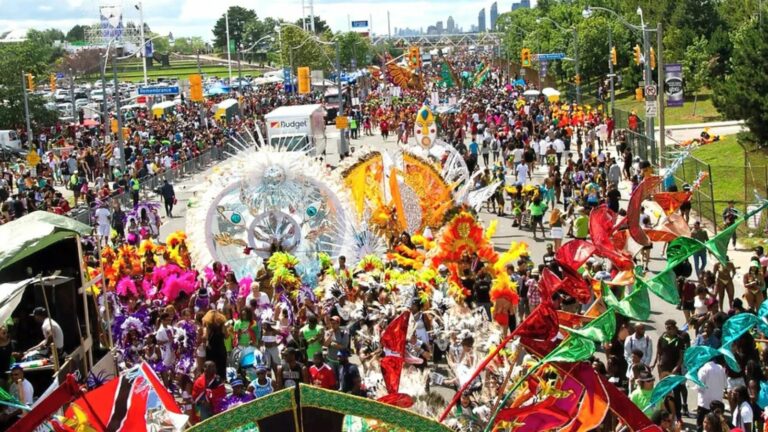
The standout number is not the grant itself but the 9,630 people whose participation Ottawa says it supports. That group includes steelpan musicians, calypsonians, dancers, masquerade designers, artisans, educators and heritage specialists. Many are not visible during the final hours of the Grand Parade. Their work begins months earlier in rehearsal rooms, mas camps, workshops and community spaces where costumes are built, music is arranged and younger performers learn traditions by doing.
This broader definition of cultural labour changes how the carnival is understood. Spectators may remember towering costumes, feathered bands and the pulse of soca along Lake Shore Boulevard, but every public moment rests on teams of wire-benders, seamstresses, choreographers, musicians, drivers, coordinators and volunteers. The federal figure captures that ecosystem more clearly than attendance alone. It presents the carnival not merely as a large event consumed by crowds, but as a production platform where thousands of local creators gain an audience and cultural knowledge passes between generations.
A Festival Much Larger Than One Parade
The Grand Parade remains the carnival’s most recognizable event, but the 2026 program stretched across several weeks and multiple parts of Toronto. The official calendar included a June launch at Scarborough Town Centre, a Junior King and Queen Showcase, the Junior Carnival Parade in Malvern, a calypso competition, the King and Queen Showcase, the Panorama steelband competition and the August 1 Grand Parade around Exhibition Place and the lakeshore.
Each event highlights a different discipline. Calypso foregrounds lyrical storytelling and social commentary. Panorama places orchestras of steelpan musicians at the centre. The King and Queen Showcase turns costume engineering into theatre, with elaborate structures designed to move with a masquerader’s body. Youth events give children a public role rather than treating cultural preservation as an adult-only project. Seen together, the schedule explains why thousands of participants can be involved. Carnival is not one afternoon of spectacle; it is a season of rehearsals, competitions, craftsmanship, food, commerce and community gathering.
From a Centennial Gift to a Toronto Institution
Toronto’s Caribbean Carnival began in 1967 as Caribana, created by Caribbean community leaders during Canada’s Centennial year. The inaugural celebration gave a growing Caribbean population a highly visible way to share music, costume, food and performance with the wider city. Organizers say the first parade drew more than 50,000 people—a striking beginning for an event that would eventually become one of North America’s largest Caribbean festivals.
The 2026 edition marked the festival’s 59th year. Over nearly six decades, its name, management structure, routes and funding arrangements have changed, but its cultural core remains connected to Caribbean carnival traditions, especially mas, steelpan and calypso. That continuity matters in a city where migration constantly reshapes neighbourhoods and identities. For families who have attended across generations, the event is more than an annual attraction. It can be a place where grandparents recognize sounds from home, parents see their histories represented publicly and children encounter those traditions as part of Canadian life.
What the Federal Program Is Designed to Do
The Building Communities through Arts and Heritage program is intended to increase opportunities for local artists, artisans, heritage performers, cultural specialists and Indigenous cultural carriers to take part in community festivals and commemorative projects. Its Local Festivals stream supports recurring events that publicly present local creative and heritage work. In that sense, the Toronto grant fits the program’s purpose closely: it helps connect community-based cultural production with a large public audience.
The program’s design also explains why Ottawa emphasized participation rather than tourism totals. This funding was not described as a general tourism subsidy or a rescue package for every carnival expense. It is targeted cultural support, focused on the people who make traditions visible and accessible. That can include the infrastructure surrounding a performance as well as the performance itself. A steelband cannot appear without rehearsal space and technical coordination; a masquerade costume cannot reach the road without design, fabrication and safe staging. The grant therefore supports cultural presentation, even if it represents only a small portion of the festival’s total costs.
A Small Grant Inside a Much Bigger Funding Story
The $61,000 announcement arrives against a long-running debate over how the carnival is financed. The Festival Management Committee has said the full event costs more than $3 million to produce and has pointed to steep increases in security, venue, labour and production expenses. On that benchmark, the new grant equals roughly two per cent of a $3-million operating cost. It is meaningful support, but not a complete answer to the organization’s financial pressures.
The carnival has received larger public investments through other programs and funding cycles. In 2022, the federal government provided $1 million through the Tourism Relief Fund to modernize the event, improve digital tools and expand year-round offerings. In late 2024, the committee said it had secured a $3.5-million federal commitment over two years after warning that parts of the festival could be cancelled without additional support. The latest $61,000 should therefore be read as one targeted contribution within a layered funding picture involving federal, provincial, municipal and private-sector assistance.
The Economic Case Comes With Big Numbers
Public officials often describe the carnival as both a cultural celebration and an economic engine. A 2022 federal release said the festival typically attracted more than 1.2 million people, including about 180,000 tourists, and brought an estimated $338 million into Ontario’s economy each year. More recent figures promoted by the Festival Management Committee are higher: it says the event contributes $467 million to Canada’s gross domestic product, supports more than 3,000 small businesses and creates more than 3,341 jobs.
Those estimates should be presented with their source and year because event-impact studies can use different geographic boundaries and assumptions. Even so, the underlying economic pattern is easy to see. Visitors spend on hotels, restaurants, taxis, flights, clothing, tickets and food vendors, while bands and performers purchase fabric, feathers, instruments, welding, printing, sound services and transportation. A small restaurant near a busy event site or a costume supplier working through the night experiences the carnival economy in practical terms. Cultural spending circulates through many businesses that never appear on the parade route.
Culture Is Preserved Through Participation
The strongest case for the funding may be cultural rather than financial. Carnival traditions survive when people are given real opportunities to practise them, teach them and present them publicly. A child appearing in the Junior Carnival Parade learns more than choreography; the experience can involve family history, costume-making, teamwork and the meaning carried by music and masquerade. An emerging pan player gains confidence by performing inside an orchestra rather than only rehearsing in private.
The Festival Management Committee also points to educational and youth initiatives beyond the headline events, including carnival arts programming connected with the Toronto District School Board and leadership or mentorship programs for young people. These efforts place the celebration within a year-round network of cultural learning. Ottawa’s announcement explicitly recognizes artists, artisans, educators and heritage performers as the people who keep that network alive. The $61,000 cannot represent the full value of their labour, but it gives public recognition to a central fact: the carnival’s legacy is renewed through active participation, not simply preserved in archives.
What the Announcement Signals Next
Because the funding was announced on August 4, three days after the 2026 Grand Parade, it functions partly as recognition of work already visible across the city. It also keeps attention on the festival as organizers look toward its 60th year. Milestone editions often bring larger expectations, from expanded programming and international promotion to stronger infrastructure and greater support for the artists who carry the celebration.
The unanswered issue is sustainability. The federal release celebrated the carnival’s cultural contribution but did not outline a multi-year plan for this specific $61,000 grant. Organizers, meanwhile, have repeatedly argued that predictable funding is essential because planning, costume construction, rehearsals, permits and contracting begin far in advance. For Toronto, the policy question is no longer whether the carnival matters; its longevity and scale have settled that. The question is whether funding systems can match the year-round labour behind a festival experienced by the public as a burst of colour over a few summer days.
This Options Discord Chat is The Real Deal
While the internet is scoured with trading chat rooms, many of which even charge upwards of thousands of dollars to join, this smaller options trading discord chatroom is the real deal and actually providing valuable trade setups, education, and community without the noise and spam of the larger more expensive rooms. With a incredibly low-cost monthly fee, Options Trading Club (click here to see their reviews) requires an application to join ensuring that every member is dedicated and serious about taking their trading to the next level. If you are looking for a change in your trading strategies, then click here to apply for a membership.