35,000+ smart investors are already getting financial news, market signals, and macro shifts in the economy that could impact their money next with our FREE weekly newsletter. Get ahead of what the crowd finds out too late. Click Here to Subscribe for FREE.
Canada’s migration story looks very different in 2026 than it did just a year or two ago. Overall urban growth has cooled, but the pull of certain mid-sized and second-tier cities has not disappeared. In fact, the latest population, housing, and local-economy data suggest that many households are still shifting toward places that offer a better balance of jobs, housing options, and day-to-day livability.
The 15 cities below keep showing up for a reason. Some are leading the country in population growth. Others are winning more newcomers than they used to, building out stronger job bases, or giving people a more manageable alternative to Canada’s most expensive metros. Together, they form a revealing map of where momentum is quietly gathering now.
1. Calgary, Alberta
15 Canadian Cities People Are Quietly Flocking To in 2026
- 1. Calgary, Alberta
- 2. Edmonton, Alberta
- 3. Moncton, New Brunswick
- 4. Halifax, Nova Scotia
- 5. Québec City, Quebec
- 6. Ottawa–Gatineau, Ontario–Quebec
- 7. London, Ontario
- 8. Windsor, Ontario
- 9. Kitchener–Cambridge–Waterloo, Ontario
- 10. Saskatoon, Saskatchewan
- 11. Regina, Saskatchewan
- 12. Kelowna, British Columbia
- 13. Nanaimo, British Columbia
- 14. Fredericton, New Brunswick
- 15. St. John’s, Newfoundland and Labrador
- 19 Things Canadians Don’t Realize the CRA Can See About Their Online Income

Calgary still feels like the clearest signal in the national migration story. The latest Statistics Canada estimates show the Calgary CMA grew 2.9% from July 2024 to July 2025, and it remained one of the country’s top destinations for interprovincial migration. That matters because it suggests the city is not relying on only one stream of growth. Canadians from other provinces are still choosing it as they weigh job prospects, taxes, commute times, and housing math.
The city’s appeal is also broader than the old energy narrative. Calgary Economic Development says the tech workforce grew 61.1% between 2021 and 2024, adding 24,500 jobs. At the same time, Rentals.ca put the average one-bedroom rent at $1,535 in January 2026. That is not a bargain-basement number, but it still looks more workable than Toronto or Vancouver for many professionals. Calgary increasingly reads like a place where ambition and relative affordability still overlap.
2. Edmonton, Alberta

If Calgary is the polished magnet, Edmonton is the value play that keeps getting stronger. Statistics Canada says Edmonton posted the fastest population growth of any CMA in the country from July 2024 to July 2025 at 3.0%, and it also recorded the biggest interprovincial migration gain. That is a powerful combination. It suggests people are not just ending up there by accident; they are actively moving there for a different cost-to-opportunity equation.
That equation is easy to understand. Edmonton’s average one-bedroom rent was $1,279 in January 2026, according to Rentals.ca, well below most large Canadian cities. The region’s own 2025 economic update also pointed to solid growth in education, public administration, and transportation, while IRCC’s local economy profile shows a large working-age base and strong employment in health care, retail, and construction. For households that want room to breathe without giving up big-city infrastructure, Edmonton looks increasingly hard to ignore.
3. Moncton, New Brunswick

Moncton has spent several years moving from “surprising Atlantic success story” to something much more durable. Statistics Canada ranked it among the three fastest-growing CMAs in the country from July 2024 to July 2025, with 2.9% growth. Even more telling, local Moncton figures show the city itself rose from 98,727 residents in 2024 to 102,378 in 2025. That is serious momentum for a city once treated mainly as a regional service hub.
The labour story helps explain why the move is holding. IRCC’s local economic profile says Moncton’s workforce grew 7.3% while the province’s shrank, and the number of immigrant workers jumped 130%. That kind of shift changes a city’s feel fast. It means more employers, more services, and more confidence that population growth is translating into actual economic capacity. Moncton still feels easier and less expensive than the country’s largest cities, but it no longer feels peripheral. It feels like a place that has found its lane.
4. Halifax, Nova Scotia

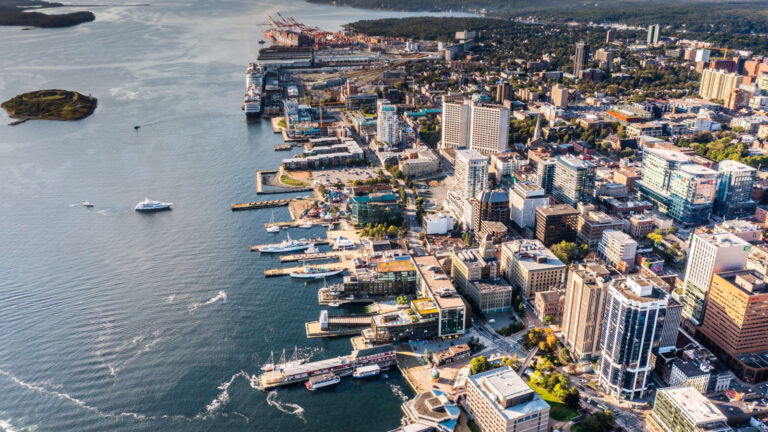
Halifax is no longer under the radar, but it still carries the kind of momentum that draws people looking for an urban life that feels more human in scale. Halifax Partnership’s 2025 index says the metro population reached 503,037 in 2024, up by 11,600 in one year, and the municipality added more than 46,000 residents from 2021 to 2024. Crossing the half-million mark matters symbolically, but it also reflects a city that has become a real destination rather than just a regional capital.
It is not the cheapest place on this list. Rentals.ca put Halifax’s average one-bedroom rent at $2,052 in January 2026, which is high by Atlantic standards. Still, people keep coming because Halifax offers a rare mix: coastline, universities, hospitals, government work, a real downtown, and growing cultural heft. The city’s inclusive economic strategy is openly planning for more growth, aiming for 525,000 people and a larger labour force by 2027. In other words, Halifax is not stumbling into expansion. It is actively building around it.
5. Québec City, Quebec

Québec City may be one of the most underrated migration stories in the country. Statistics Canada says the share of immigrants settling in the Québec CMA rose from 6.7% to 14.7% over five years, more than doubling as Montréal’s dominance weakened. That is a meaningful shift in where newcomers see opportunity in the province. It suggests Québec City is increasingly being chosen not just for tourism appeal or lifestyle, but as a place to actually build a life.
Its affordability helps. Rentals.ca listed the average one-bedroom rent in Québec City at $1,364 in January 2026, a figure that looks striking beside Canada’s larger metros. The economic backdrop is improving too. Québec International says the region has more than 120 life sciences businesses and about 80 research centres, chairs, and groups, while the Quebec government renewed its life sciences strategy for 2025 to 2028 with nearly $271.5 million in support. The result is a city that feels historic on the surface but increasingly future-facing underneath.
6. Ottawa–Gatineau, Ontario–Quebec

Ottawa is rarely framed as a migration darling, but the latest numbers say it deserves a closer look. Statistics Canada says the Ontario side of Ottawa–Gatineau increased its share of Ontario’s new immigrants from 6.4% to 12.5% over five years. That is a major rebalancing away from Toronto. For families and professionals who want stability, public-sector depth, and a cleaner housing tradeoff than the GTA, Ottawa is quietly becoming a much more logical first choice.
It is not a cheap market, but it is often a more predictable one. Rentals.ca put Ottawa’s average one-bedroom rent at $1,945 in January 2026, below Toronto while still anchored by a large, diversified employment base. The city is also planning for long-range growth: updated projections show Ottawa could rise from just over 400,000 households in 2021 to nearly 700,000 by 2051. That kind of forecast does not happen by accident. It reflects a capital region with lasting institutional gravity and growing appeal well beyond government alone.
7. London, Ontario

London keeps gaining ground because it solves a problem for a lot of Ontario households: it is big enough to offer jobs and services, but not so large that daily life feels punishing. London Economic Development describes it as a mid-sized city of more than 540,000 people and one of the country’s fastest-growing urban centres. IRCC’s local profile says London–Middlesex has more than 500,000 residents, with 22% of employed residents being immigrants and 41% of jobs concentrated in health care, retail, and manufacturing.
The city also benefits from being in a corridor that is becoming more strategically important. Southwestern Ontario’s manufacturing base is thickening, and nearby St. Thomas is home to Volkswagen’s massive battery plant investment. Developers are clearly watching the region too: C.D. Howe noted that mid-sized cities such as London posted housing starts comparable with Toronto in 2024. With average two-bedroom rent around $2,051 in January 2026 on Rentals.ca, London is not “cheap,” but it still offers many households a more realistic Ontario upgrade path.
8. Windsor, Ontario

Windsor’s case is increasingly industrial, practical, and compelling. IRCC’s Windsor profile says the region’s population grew 32% from 2011 to 2021, compared with 11% for Ontario overall. That is a remarkable pace for a city long treated as cyclical and vulnerable. Instead, Windsor is now benefiting from a reindustrialization story tied to autos, batteries, border logistics, and manufacturing supply chains.
That story became much more concrete in 2026. Federal and provincial announcements marked the completion and grand opening of NextStar Energy’s new battery facility, with a target of 2,500 jobs in Windsor and the surrounding region. For a city of this size, that kind of anchor project has ripple effects far beyond the plant gates. It affects suppliers, housing demand, training pipelines, and local confidence. Add a January 2026 average one-bedroom rent of $1,523 on Rentals.ca, and Windsor starts to look less like a backup plan and more like a city with fresh momentum.
9. Kitchener–Cambridge–Waterloo, Ontario

Kitchener–Cambridge–Waterloo has been growing for years, but it still feels underappreciated in national conversations. IRCC says the region’s population increased 21% over the last decade, compared with 11% for Ontario overall. The Region of Waterloo estimated its population at 678,170 at the end of 2024, while provincial projections point to 923,000 people by 2051. That is not just steady growth. That is a region turning into one of Ontario’s major urban engines.
The economic identity is also unusually strong for a metro of this size. Waterloo EDC calls it Canada’s most dynamic tech ecosystem and highlights the presence of major firms such as Google and Apple alongside startups and scaleups. That gives the region a blend many movers want: innovation jobs without Toronto-level intensity. Rentals.ca put the average one-bedroom rent in Kitchener at $1,819 in January 2026, which is hardly light, but still easier to justify for many workers when paired with the area’s tech, education, and manufacturing depth.
10. Saskatoon, Saskatchewan

Saskatoon is one of those cities people often overlook until they start comparing actual numbers. IRCC’s local economy profile shows a population of 266,141, with 24% of employed residents being immigrants and 40% of jobs concentrated in health care, retail trade, and educational services. That is a useful mix because it means the city is not hanging on one sector. It has a broad service base, a university presence, and the kind of economic backbone that tends to make mid-sized cities feel more resilient.
The affordability picture is another part of the appeal. Rentals.ca listed the average one-bedroom rent in Saskatoon at $1,350 in January 2026, which makes the city much easier to model for renters than most of Ontario or coastal B.C. The City of Saskatoon’s economic profile also emphasizes a diverse economy, healthy real estate conditions, and rising incomes. That combination does not generate as many headlines as Calgary or Halifax, but it is exactly the kind of quiet strength that draws families, newcomers, and professionals who are more interested in quality of life than buzz.
11. Regina, Saskatchewan

Regina’s pitch is not flashy, but that may be part of its strength. IRCC’s local economy profile puts the population at 249,217 and shows that 39% of jobs are concentrated in health care, retail trade, and public administration. Those sectors may not sound glamorous, but they tend to create stability. They also make Regina a city where people can build predictable careers without getting trapped in the kind of housing pressure that defines larger metros.
There are also signs of longer-term confidence. Economic Development Regina said the broader region was expected to reach 293,000 people in 2025, and the city’s updated growth planning is designed to support a population of 370,000 by 2051. That tells a simple story: local leaders are planning for more people, not less. Rentals.ca pegged the average one-bedroom rent at $1,255 in January 2026, giving Regina one of the strongest affordability cases of any city on this list. For households looking for steady footing, Regina has become much more competitive than it once seemed.
12. Kelowna, British Columbia

Kelowna has long attracted attention for lifestyle, but the 2026 case for it is not just wine-country romance. IRCC’s local economy profile says the city has 144,576 residents, with 41% of jobs concentrated in health care, retail trade, and construction. The Central Okanagan’s 2026 economic update adds another useful clue: the region recorded 10,261 job postings in 2025, led by health care and social assistance. That suggests the labour market is still active even as growth cools from its hottest years.
Housing remains expensive by Prairie or Quebec standards, yet the pressure has eased a little. Rentals.ca put Kelowna’s average one-bedroom rent at $1,686 in January 2026, and the B.C. government said two-bedroom asking rents in Kelowna were down 10.8% year over year in early 2026. That kind of softening matters because it can make an aspirational market suddenly feel reachable. Kelowna still offers mountains, lake life, and a growing innovation identity, but it is increasingly pairing that lifestyle with a more grounded economic story.
13. Nanaimo, British Columbia

Nanaimo is one of the clearest examples of how smaller coastal cities have moved from niche to mainstream. IRCC’s local profile says Nanaimo’s population grew 19% over the last decade, compared with 14% for British Columbia overall. Statistics Canada’s latest estimates put the greater Nanaimo area at 129,750 people in 2025, up 1.17% from the year before. That is slower than the pandemic-era rush, but it still shows sustained demand for a city that offers Vancouver Island living without Victoria’s scale or Vancouver’s cost base.
Its renter math is not exactly soft, but it is still more approachable than bigger B.C. markets. Rentals.ca and local reporting put Nanaimo’s average one-bedroom rent at roughly $1,812 in early 2026. That remains substantial, yet for many movers the tradeoff is worth it: ocean access, a milder climate, and a smaller-city pace with real urban amenities. Nanaimo also skews older than many growth markets, which tells its own story. It is attracting not just one type of mover, but a mix of retirees, remote workers, and households rethinking where “good life” begins.
14. Fredericton, New Brunswick

Fredericton does not always get the spotlight that Moncton and Halifax do, but the growth signals are hard to dismiss. The City of Fredericton says its population reached 122,500 in 2024, up 3,700 from the year before, and that it captured more than 63% of metro growth over that 12-month span. The metro also welcomed an estimated 2,118 immigrants from outside Canada plus another 1,374 net non-permanent residents. Those are big numbers for a city of Fredericton’s size.
What makes the city especially interesting is the type of economy it is building. Fredericton’s economic development pages emphasize entrepreneurial support, talent attraction, and a knowledge-based business ecosystem led by Ignite and local institutions. That gives the city a different flavour from more purely lifestyle-driven places. It feels purposeful. The appeal is not just that Fredericton is smaller and calmer. It is that it is trying to scale intelligently while keeping those advantages intact. For many movers, that combination is exactly what “quietly attractive” looks like.
15. St. John’s, Newfoundland and Labrador

St. John’s is one of the more intriguing late entries into the national conversation. The city’s 2025 economic review says the St. John’s CMA grew 1.3% to 243,478 people, while employment rose 3.1%, adding 3,800 jobs. Real GDP grew 5.0%, driven largely by offshore oil production, with service industries also contributing. That matters because it shows a city that is not just stabilizing. It is expanding, even if the growth is not as loud as it is in Alberta.
The affordability contrast is part of the story too. Rentals.ca put the average one-bedroom rent in St. John’s at just $1,086 in January 2026, making it one of the cheapest urban rental markets on this list. That gives St. John’s something many Canadian cities no longer have: breathing room. It will not be the right fit for everyone, and the economy still has sector concentration risks, but the latest numbers suggest it deserves far more attention than it gets. For people priced out elsewhere, St. John’s is starting to look less remote and more rational.
19 Things Canadians Don’t Realize the CRA Can See About Their Online Income

Earning money online feels simple and informal for many Canadians. Freelancing, selling products, and digital services often start as side projects. The problem appears at tax time. Many people underestimate how much information the CRA can access. Online platforms, banks, and payment processors create detailed records automatically. These records do not disappear once money hits an account. Small gaps in reporting add up quickly.
Here are 19 things Canadians don’t realize the CRA can see about their online income.
This Options Discord Chat is The Real Deal
While the internet is scoured with trading chat rooms, many of which even charge upwards of thousands of dollars to join, this smaller options trading discord chatroom is the real deal and actually providing valuable trade setups, education, and community without the noise and spam of the larger more expensive rooms. With a incredibly low-cost monthly fee, Options Trading Club (click here to see their reviews) requires an application to join ensuring that every member is dedicated and serious about taking their trading to the next level. If you are looking for a change in your trading strategies, then click here to apply for a membership.