35,000+ smart investors are already getting financial news, market signals, and macro shifts in the economy that could impact their money next with our FREE weekly newsletter. Get ahead of what the crowd finds out too late. Click Here to Subscribe for FREE.
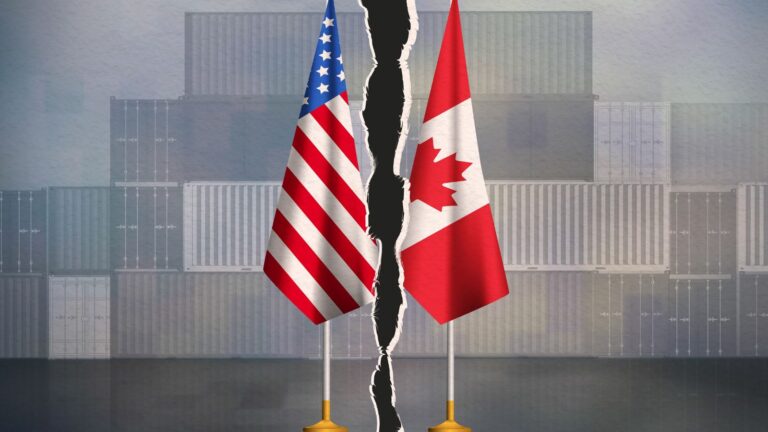
Canada’s appetite for pushing back against the United States is extending beyond tariffs on physical goods. New Ipsos polling conducted for Global News finds that roughly two-thirds of Canadians support an “aggressive” tax on U.S. technology giants operating in Canada, adding another potentially explosive option to an already tense cross-border dispute.
The finding arrives as Ottawa prepares matching counter-tariffs on billions of dollars of American goods after trade negotiations with Washington broke down. It is particularly striking because Canada has been down this road before. A previous digital services tax became such a serious irritant for President Donald Trump that it helped derail trade discussions in 2025 before Ottawa ultimately abandoned and later repealed the measure. Public sentiment, however, appears to have hardened considerably as the latest confrontation expands.
Canadians Are Showing a New Appetite for Hitting Big Tech
Two-Thirds of Canadians Back an ‘Aggressive’ Tax on U.S. Tech Giants as Trump Fight Widens
- Canadians Are Showing a New Appetite for Hitting Big Tech
- The Tech-Tax Finding Is Part of a Much Broader Hard-Line Mood
- Canada Has Already Tried a Digital Tax — and Then Reversed Course
- Trump Has Already Shown How Seriously Washington Takes Tech Taxes
- An ‘Aggressive’ Tax Still Has No Defined Policy Behind It
- Younger Canadians Are More Cautious About the Cost of Escalation
- Canada Has Leverage, but the Economic Relationship Remains Enormous
The Ipsos poll found that two-thirds of respondents supported imposing what was described as an “aggressive” tax on American technology giants operating in Canada. The result came from interviews with 1,001 Canadian adults conducted online between August 26 and 27. Ipsos weighted the sample to reflect Canadian census characteristics and reported a credibility interval of plus or minus 3.8 percentage points, 19 times out of 20.
The wording matters. Respondents were not presented with a detailed piece of tax legislation, a proposed rate or a list of companies that would be affected. The finding therefore reflects support for the broad idea of using taxation as economic leverage against major U.S. technology companies rather than approval of one specific policy. Even with that qualification, the number stands out. Only a year earlier, taxing large American digital businesses had been a major point of friction with Washington. What once looked like a diplomatic liability is now attracting support from a substantial majority of Canadians.
The Tech-Tax Finding Is Part of a Much Broader Hard-Line Mood
The appetite for taxing technology companies does not exist in isolation. The same Ipsos research found that 63 per cent of Canadians believed the country was right to stand firm in negotiations even if the consequences included higher costs and job losses. Just 18 per cent thought Canada should have made additional sacrifices to secure an agreement with Washington.
Support was even stronger for direct retaliation. Seventy-three per cent backed Ottawa’s plan for dollar-for-dollar counter-tariffs, while similarly large majorities supported measures involving critical minerals and energy. Eighty per cent favoured prioritizing Canadian materials and contracts in government purchasing and infrastructure projects. Ottawa, meanwhile, has announced tariffs of 15, 25 and 50 per cent on $27.6 billion worth of U.S. imports beginning September 8. That combination of public opinion and government action suggests the dispute has moved well beyond a conventional negotiation over tariff schedules. Economic nationalism has become a much larger part of the Canadian political conversation.
Canada Has Already Tried a Digital Tax — and Then Reversed Course
Canada’s previous Digital Services Tax offers an important guide to what is at stake. The former policy imposed a 3 per cent levy on certain revenues connected to online marketplaces, targeted advertising, social-media services and sales or licensing of Canadian user data. It applied to large corporate groups with at least €750 million in global revenue and more than $20 million in qualifying Canadian digital revenue.
The measure was financially significant. Budget 2024 projected that the tax could raise about $5.9 billion over five years. It was also unusual because the initial liability included qualifying revenues dating back to 2022. But the tax never developed into a lasting source of federal revenue. Ottawa halted collection in June 2025 while attempting to restart negotiations with Washington. Parliament later went much further: the Digital Services Tax Act and its regulations were formally repealed through Bill C-15, which received royal assent in March 2026, with the repeal made retroactive to the law’s original 2024 enactment.
Trump Has Already Shown How Seriously Washington Takes Tech Taxes
The history of the old tax makes the new polling particularly sensitive. In June 2025, Trump abruptly announced that the United States was ending trade discussions with Canada because of the digital services tax, describing the measure as an attack on the United States. Ottawa announced its decision to rescind the tax only two days later, clearing the way for discussions to resume.
American objections predated Trump’s intervention. The Office of the U.S. Trade Representative had challenged Canada’s digital tax under the Canada-U.S.-Mexico trade agreement in 2024, arguing that it appeared to treat U.S. businesses less favourably than Canadian businesses. Washington had opposed the measure for years and repeatedly encouraged Canada to rely instead on multilateral negotiations over international digital taxation. That history means a new measure explicitly designed around American technology companies would enter an already well-defined area of conflict. Ottawa would have to weigh potential revenue and political appeal against the possibility of another immediate trade response from Washington.
An ‘Aggressive’ Tax Still Has No Defined Policy Behind It
One of the most important limitations of the new finding is that “aggressive tax” is a political description, not a tax design. The Ipsos question did not establish whether such a measure would resemble Canada’s former 3 per cent digital services tax, target profits instead of revenue, apply only above certain thresholds or use an entirely different framework. It also does not show whether Canadians would support the same policy once its potential economic consequences were explained in detail.
That distinction matters because tax architecture can determine everything from the amount of revenue raised to the risk of retaliation. The former Canadian DST, for example, applied to both domestic and foreign businesses that met its thresholds even though American technology companies were central to the political dispute surrounding it. A future policy aimed explicitly at U.S. companies could create different legal and trade questions. For now, the poll demonstrates a desire for tougher leverage. It does not provide Ottawa with a ready-made blueprint for how that leverage should be constructed.
Younger Canadians Are More Cautious About the Cost of Escalation
The headline numbers also hide an important generational divide. Ipsos found considerably less enthusiasm for confrontation among younger adults than among older Canadians. Only 48 per cent of Generation Z respondents supported standing firm in negotiations despite possible higher costs and job losses. Support among Millennials was 57 per cent, compared with roughly four in five older baby boomers.
The difference became even more visible when Canadians were asked how much economic pain they were personally prepared to absorb. Overall, 52 per cent said they were willing to endure significant economic hardship to help Canada withstand the trade dispute. Among Generation Z, that fell to 41 per cent; among boomers, it reached 67 per cent. The gap offers an important reality check for political leaders. A retiree with a paid-off home and established savings can experience a trade confrontation differently from a younger household dealing with rent, mortgage payments, childcare expenses or a less secure job. National resolve may be broad, but the financial ability to sustain it is uneven.
Canada Has Leverage, but the Economic Relationship Remains Enormous
Calls for stronger retaliation are occurring within one of the world’s deepest trading relationships. Statistics Canada reported that 71.7 per cent of Canadian merchandise exports still went to the United States in 2025, even after that share fell sharply from 75.9 per cent a year earlier. Canadian exports to the U.S. declined 5.8 per cent during 2025, while exports to countries outside the United States grew substantially.
That dependence explains why Ottawa is combining retaliation with economic support. The federal government has announced a new $7.5-billion package for businesses and workers affected by U.S. tariffs, on top of previously announced assistance. Counter-tariffs covering $27.6 billion of U.S. imports are scheduled to begin September 8 and concentrate on sectors including steel, dairy, appliances, agricultural equipment, pulp and paper, plastics and electronics. A tax on American technology giants would therefore represent another escalation rather than an isolated policy experiment. The political question is whether growing public anger gives Ottawa enough room to take that additional risk.
This Options Discord Chat is The Real Deal
While the internet is scoured with trading chat rooms, many of which even charge upwards of thousands of dollars to join, this smaller options trading discord chatroom is the real deal and actually providing valuable trade setups, education, and community without the noise and spam of the larger more expensive rooms. With a incredibly low-cost monthly fee, Options Trading Club (click here to see their reviews) requires an application to join ensuring that every member is dedicated and serious about taking their trading to the next level. If you are looking for a change in your trading strategies, then click here to apply for a membership.