35,000+ smart investors are already getting financial news, market signals, and macro shifts in the economy that could impact their money next with our FREE weekly newsletter. Get ahead of what the crowd finds out too late. Click Here to Subscribe for FREE.
The sudden loss of a marquee U.S. fighter from Toronto’s Labour Day weekend air show landed in a political atmosphere already charged by a bitter Canada-U.S. trade dispute. That made the obvious question almost unavoidable: was Washington sending a message? Organizers of the Canadian International Air Show say no. Executive director Lori Duthie said President Donald Trump and the recent cross-border rhetoric had “absolutely nothing” to do with the U.S. Air Force F-16 Viper Demonstration Team’s withdrawal. The team itself cited a scheduling conflict. With the F-16 now absent, attention shifts to how an overlapping U.S. booking created the problem, why speculation spread so quickly, and what remains in a Toronto lineup that still carries unusual significance in 2026.
Organizers Say It Was a Scheduling Problem — Nothing More
Toronto Air Show Says Trump Had ‘Absolutely Nothing’ to Do With U.S. F-16 Team Pulling Out
- Organizers Say It Was a Scheduling Problem — Nothing More
- Why Trump Speculation Spread So Quickly
- The Calendar Shows a Real Conflict
- Toronto Is Losing One of the Weekend’s Biggest Draws
- The Remaining Toronto Lineup Is Still Substantial
- The Snowbirds’ Farewell Season Changes the Meaning of the Weekend
- Toronto’s Air Show Has Become an End-of-Summer Institution
- Last-Minute Changes Are Built Into Military Air Shows
- One Cancellation Does Not Define Canada-U.S. Military Ties
- What the Evidence Supports — and What It Does Not
The most important fact in the story is also the simplest: both sides are publicly describing the withdrawal as a scheduling problem, not a political decision. The Canadian International Air Show announced earlier in the week that the F-16 Viper Demonstration Team could no longer participate and said last-minute schedule changes are a normal part of real-time air-show operations. Lori Duthie, the show’s executive director, later told reporters that the Trump administration’s rhetoric toward Canada had “absolutely nothing” to do with the change.
The U.S. team offered the same explanation from its side. Staff Sgt. Steven Cardo, a public-affairs representative for the F-16 Viper Demonstration Team, said a scheduling conflict made the team unable to appear in Toronto and apologized to organizers, Canadian partners and aviation fans. That matters because the explanation did not come only from Toronto. The unit that was supposed to fly also attributed the absence to logistics, giving the cancellation a consistent explanation from both the host and performer.
Why Trump Speculation Spread So Quickly
Speculation nevertheless had fertile ground. On August 27, Trump signed Executive Order 14422 directing U.S. federal agencies to use “Lake America” in place of Lake Ontario, a move that arrived in the middle of a widening trade dispute with Canada. For a Toronto air show staged directly over Lake Ontario, the symbolism was impossible to miss. Days later, U.S. Treasury Secretary Scott Bessent mocked Canada’s military strength during a CNBC interview, joking about submarines once displayed at West Edmonton Mall.
Those events did not prove any connection to the F-16 cancellation, but they explain why a routine scheduling announcement quickly became a political story. The timing encouraged people to join unrelated developments into one narrative: a U.S. military team disappears from a Canadian event just as officials in Washington are escalating their language toward Canada. Organizers pushed back precisely because that interpretation was spreading. Their position is that the rhetoric and the air-show scheduling issue happened at the same time, not that one caused the other.
The Calendar Shows a Real Conflict
The 2026 air-show calendar provides a practical clue to what went wrong. When the F-16 Viper Demonstration Team’s season was announced, Toronto was listed for September 5 through 7. The same schedule also placed the team at Wings Over Batavia in western New York on September 5 and 6. That is a direct overlap on the busiest two days of Toronto’s Labour Day weekend program, and the Batavia event still lists the F-16 team among its performers.
That conflict makes the cancellation less mysterious than the surrounding politics can make it appear. Demonstration teams travel with pilots, maintainers, support personnel and aircraft requirements that cannot simply be duplicated at will. A performer appearing on two event calendars is therefore not the same as two independent entertainment bookings that can be staffed separately. Toronto lost the slot; Batavia kept it. The available evidence does not disclose how the double booking happened, but it does show that an actual calendar collision existed before the political speculation took hold.
Toronto Is Losing One of the Weekend’s Biggest Draws
The F-16 was not a minor supporting act. Toronto had promoted Maj. Taylor “FEMA” Hiester and the Viper Demonstration Team as a showcase of the F-16C Fighting Falcon’s performance. The U.S. Air Force describes the F-16 as a compact, highly maneuverable multirole fighter built for both air-to-air and air-to-surface missions. Its published specifications include speeds of about Mach 2 at altitude and a service ceiling above 50,000 feet, figures that help explain why a single-aircraft demonstration can become one of an air show’s loudest and most anticipated moments.
The team’s performances also depend on far more than the pilot. U.S. Air Force material on the 2026 team describes dedicated crew chiefs and specialists responsible for keeping the aircraft mission-ready, while Hiester had to complete a certification flight before the season began. Losing that act therefore removes a carefully prepared military demonstration rather than simply one airplane from a roster. For enthusiasts who bought tickets expecting the Viper, the disappointment is real even if the cause is administrative.
The Remaining Toronto Lineup Is Still Substantial
Toronto’s program, however, did not collapse with the F-16 withdrawal. The Canadian International Air Show’s current 2026 performer list still includes the Canadian Forces Snowbirds, the RCAF CF-18 demonstration, the CP-140 Aurora, a Royal Canadian Air Force Heritage Flight, the CH-146 Griffon, a T-33 and multiple civilian aerobatic acts. Organizers also highlighted the Griffon’s search-and-rescue demonstration as an addition, with 424 Squadron from Trenton scheduled to show some of the helicopter’s SAR capabilities over Lake Ontario.
The Heritage Flight gives the weekend a particularly Canadian shape. CIAS says it will bring together a Hawker Hurricane, Supermarine Spitfire, CT-114 Tutor and CF-18 Hornet, putting aircraft from different eras into one formation. That combination changes the character of the show but still gives spectators a mix of modern military power, vintage aircraft and aerobatics. The absence of the American F-16 is conspicuous because it had been heavily promoted, yet the remaining schedule is not a stripped-down program. It is still built around several major RCAF appearances.
The Snowbirds’ Farewell Season Changes the Meaning of the Weekend
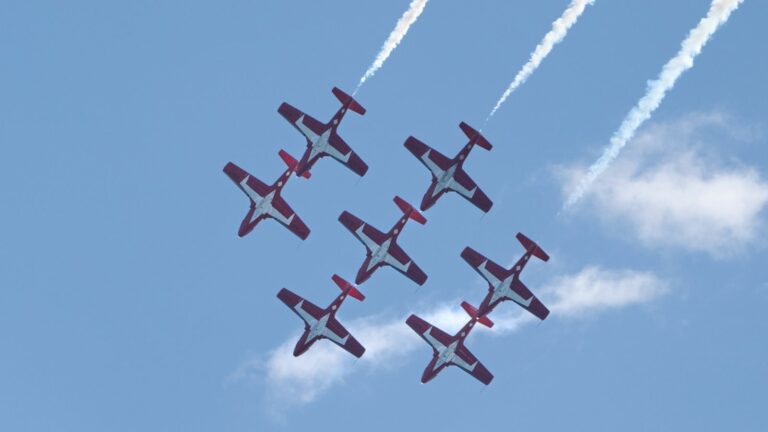
The Snowbirds may now carry even more emotional weight than originally expected. The team is marking its 55th anniversary in 2026, and National Defence has confirmed that this is the final air-show season for the CT-114 Tutor fleet. The aircraft first entered Royal Canadian Air Force service as a jet trainer in 1963 and has been flown by the Snowbirds since 1971. After more than six decades of service, the Tutor is reaching the end of its operational life.
Canada has already chosen the CT-157 Siskin II, the Pilatus PC-21, for a future Snowbirds capability. National Defence says the replacement team is expected to become operational in the early 2030s, meaning there will be a gap after the 2026 season. That makes Toronto more than another annual stop. For many spectators along the waterfront, it may be the last chance to see the familiar nine-plane Tutor formation there for years. The F-16 cancellation removes one headline act, but the Snowbirds’ farewell season gives the weekend its own historic significance.
Toronto’s Air Show Has Become an End-of-Summer Institution
The setting also explains why any lineup change attracts outsized attention. The Canadian International Air Show describes itself as North America’s longest-running air show and is staging its 77th edition in 2026. This year’s public performances run September 5 through 7 from noon to 3:40 p.m., with a practice period on September 4. The Canadian National Exhibition runs from August 21 through Labour Day, so the air show arrives as one of the fair’s most visible closing-weekend attractions.
That placement has made the sound and spectacle of the event part of Toronto’s end-of-summer rhythm. The flying display takes place over the waterfront, while the ticketed viewing zone sits at Marilyn Bell Park and other sightlines extend along the lakeshore. The CNE itself warns visitors that its final weekend is particularly noisy and crowded because of air-show practice and performances. In that environment, the disappearance of a headline fighter is noticed well beyond dedicated aviation circles. It affects a major holiday-weekend event whose audience includes both ticket holders and people watching from across the city’s waterfront.
Last-Minute Changes Are Built Into Military Air Shows
Air-show schedules are unusually vulnerable to change because the aircraft are not ordinary touring performers. CIAS tells visitors that participating acts can change because of weather and maintenance, and it publishes each day’s flying order only on the morning of the show. The event also says military units confirm closer to the weekend and that performers remain subject to operational realities. That policy is important context for a cancellation that otherwise looks unusually abrupt from outside the aviation world.
The U.S. team’s own preparation illustrates the same point. Hiester’s 2026 certification flight had to be reviewed and approved before the demonstration season, and the aircraft is supported by maintenance personnel whose job is to keep it ready to fly. Military demonstration teams operate within service requirements that take priority over public entertainment. None of that proves exactly why Toronto lost out to Batavia; officials have not released a detailed internal scheduling account. It does show why “last-minute schedule changes” is more than a generic disclaimer. The entire performance depends on aircraft availability, qualified personnel, maintenance and operational approval aligning at once.
One Cancellation Does Not Define Canada-U.S. Military Ties
The cancellation is also a poor measure of the broader Canada-U.S. military relationship. Canada and the United States have jointly defended North American airspace through NORAD since 1958. The Canadian NORAD Region includes both Royal Canadian Air Force and U.S. Air Force participation, while Canada contributes fighter aircraft, bases, air-to-air refuelling capability and roughly 1,000 personnel to the continental mission. Those ties continue regardless of the political temperature around trade or presidential rhetoric.
That does not mean defence relations are insulated from politics. Ottawa is reviewing major procurement choices, including the future of its fighter fleet, while bilateral economic tensions are plainly affecting the wider relationship. But an air-show cancellation should not be confused with a break in operational cooperation unless evidence establishes that link. In fact, CIAS organizers emphasized that they work closely with both Canadian and U.S. military counterparts across North America. Against a backdrop of nearly seven decades of integrated aerospace defence, one scheduling conflict is noteworthy for fans and organizers but far smaller than the institutional relationship connecting the two air forces.
What the Evidence Supports — and What It Does Not
The evidence available as the Labour Day weekend begins supports a narrow conclusion. The F-16 Viper Demonstration Team was expected in Toronto, an overlapping appearance existed in Batavia, and both the Canadian organizers and the American team say a scheduling conflict caused the withdrawal. No public evidence has surfaced showing that Trump, the White House or a U.S. political official ordered the team to stay away from Toronto. That is why the organizers’ unusually emphatic denial matters: it separates a documented scheduling problem from a politically tempting theory.
The broader context should not be erased. Trump’s Lake Ontario renaming order, the tariff fight and dismissive comments from U.S. officials created exactly the kind of atmosphere in which people would suspect a political motive. But timing is not proof of causation. Toronto will still host a substantial three-day program, including the CF-18, Heritage Flight and a milestone Snowbirds appearance. Unless new evidence emerges, the most defensible reading is the one supported by the calendars and statements already on the record: the Viper’s absence is logistical, not presidential.
This Options Discord Chat is The Real Deal
While the internet is scoured with trading chat rooms, many of which even charge upwards of thousands of dollars to join, this smaller options trading discord chatroom is the real deal and actually providing valuable trade setups, education, and community without the noise and spam of the larger more expensive rooms. With a incredibly low-cost monthly fee, Options Trading Club (click here to see their reviews) requires an application to join ensuring that every member is dedicated and serious about taking their trading to the next level. If you are looking for a change in your trading strategies, then click here to apply for a membership.