35,000+ smart investors are already getting financial news, market signals, and macro shifts in the economy that could impact their money next with our FREE weekly newsletter. Get ahead of what the crowd finds out too late. Click Here to Subscribe for FREE.
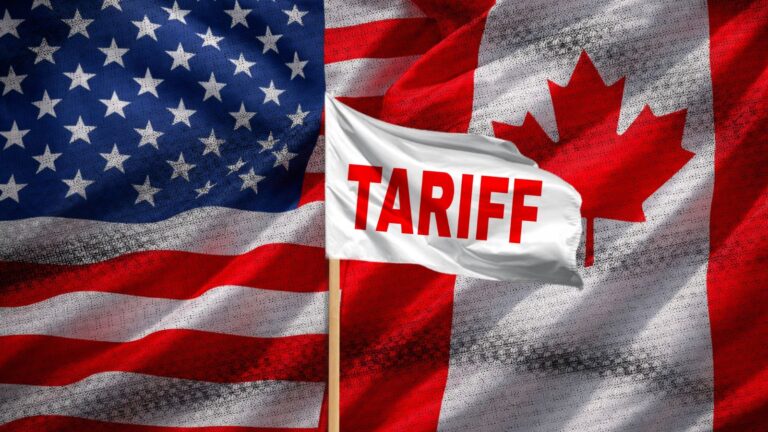
Donald Trump’s escalating trade confrontation with Canada was designed to demonstrate economic strength, but less than two weeks before the November 3 midterm elections, it has become increasingly difficult for Republicans to separate the policy from Americans’ frustration over the cost of living. The problem is especially visible in states tied closely to Canadian trade, where Republican candidates are defending tariffs while simultaneously asking the White House for exemptions.
The political pressure comes as inflation has accelerated again and voters increasingly connect Washington’s policies with what they pay at stores, gas stations and businesses. Canada is hardly the only factor behind higher prices, but tariffs have turned an international dispute into something that can be felt much closer to home — and vulnerable Republicans are being forced to respond.
A Tariff Carveout Lands Days Before Voters Decide
Trump’s Trade War With Canada Becomes an Election Liability as Republicans Face Voter Anger Over Prices
- A Tariff Carveout Lands Days Before Voters Decide
- The Price Backlash Is No Longer Just Democratic Messaging
- Tariffs Reach Consumers Through More Than the Customs Bill
- Canada Is Woven Deeply Into U.S. Regional Economies
- Border-State Republicans Are Splitting on How to Respond
- Canada’s Retaliation Makes the Economic Pressure Two-Way
- Trump Still Has a Political Case for Tariffs
- The November 3 Stakes Extend Far Beyond Trade
The clearest sign that the Canada dispute has become politically uncomfortable came on October 23. Trump signed an order removing the 50% tariff from selected Canadian products, including plywood sheets, some paper goods, machinery, refrigeration equipment, packing crates and boxes. The changes take effect October 30 — just four days before Americans vote in the November 3 midterms.
The timing matters because Republican Sen. Susan Collins of Maine had been lobbying the administration for relief while fighting a close reelection race against Democrat Troy Jackson. Maine farmers and businesses told policymakers that some Canadian equipment and packaging materials were difficult or expensive to replace domestically. Wild blueberry producers, for example, use specialized Canadian harvesting boxes compatible with existing processing equipment. Yet the administration did not simply dismantle the tariffs. It added other Canadian products, including carpets, paints, shampoos, certain air-conditioning equipment and other goods, to the 50% list. The result looks less like a retreat from the trade confrontation than an attempt to reduce its most politically painful effects.
The Price Backlash Is No Longer Just Democratic Messaging
Republicans’ difficulty goes beyond attacks from Democratic campaigns. The strongest warning signs are now appearing inside Trump’s own political coalition. An October Reuters/Ipsos survey found that 78% of Americans believed Trump administration policies deserved at least some blame for prices rising faster than earnings. That included 64% of Republicans and 76% of independents. More strikingly, 57% of Republican respondents said their living costs were increasing faster than their paychecks.
Those perceptions are emerging against a difficult economic backdrop. The Bureau of Labor Statistics reported that consumer prices rose 0.6% in September alone and were 3.7% higher than a year earlier. Gasoline jumped 9.1% during the month, while the broader energy index increased 5.2%. Energy prices were 20.4% above their level a year earlier. The Canada tariffs are not responsible for all of that increase; energy disruptions, housing costs and other economic forces are significant contributors. Politically, however, voters do not necessarily separate every source of inflation. When trade policy raises the price of additional products at the same time, it reinforces a broader affordability problem already damaging the governing party.
Tariffs Reach Consumers Through More Than the Customs Bill
One reason the political argument has become difficult for Republicans is that tariffs are collected from importers in the United States rather than directly from foreign governments. Businesses then decide whether to absorb the expense, negotiate lower prices with suppliers, reduce purchases or pass part of the cost to customers. The final effect can vary substantially across products, but economic research increasingly shows that American companies and consumers bear meaningful portions of the burden.
Research published by economists through the National Bureau of Economic Research in 2026 estimated that roughly 90% of the recent tariff increase was passed through to tariff-inclusive prices paid by U.S. importers. Separate research examining consumer prices estimated that around 26% of tariff increases eventually passed through to retail customers, with indirect effects emerging as businesses paid more for imported components and domestic competitors faced less price pressure. Federal Reserve researchers also found measurable retail-price pass-through and a disproportionately large welfare burden on lower-income households. That distinction matters politically: a 50% tariff does not automatically produce a 50% increase at the checkout, but it can still make already expensive goods noticeably more costly.
Canada Is Woven Deeply Into U.S. Regional Economies
The economic relationship with Canada makes these tariffs different from measures aimed at a relatively small supplier. U.S. goods and services trade with Canada totaled an estimated $872.3 billion in 2025, according to the Office of the U.S. Trade Representative. American companies exported more than $333 billion in goods north of the border while importing roughly $382 billion. Canada consequently remains one of the most important markets for American manufacturers, farmers and service companies.
That integration becomes even more visible at the state level. In Maine, Canada accounted for 69% of imports and 41% of exports in 2025, according to Census Bureau data cited by Reuters. More than 80% of Maine’s heating oil and gasoline comes from Canada, while industries involving blueberries, lumber and seafood depend heavily on cross-border commerce. Michigan faces a different version of the same problem because auto components, manufacturing inputs and wood products routinely move across the border. A tariff imposed in Washington can therefore become a production cost for an American factory or farm hundreds of miles away, which helps explain why lawmakers who generally support Trump’s economic agenda have sought exemptions.
Border-State Republicans Are Splitting on How to Respond
The political response has been anything but uniform. Collins has openly opposed the escalating Canada tariffs and sought exclusions for products important to Maine. Michigan Republican Senate candidate Mike Rogers has taken a more supportive approach, arguing that tariffs can be necessary while also acknowledging that they are not appropriate for every industry. Both strategies reveal the same underlying dilemma: Republican candidates need Trump-aligned voters, but competitive statewide elections also require independents and voters whose economic interests depend on predictable Canadian trade.
Polling helps explain the discomfort. A Reuters/Ipsos survey conducted after the latest escalation found Americans were roughly four times more likely to blame Washington than Ottawa for the trade dispute. Only about 20% supported increasing tariffs on Canadian goods. Maine and Michigan have consequently become important tests of whether Trump’s trade nationalism can survive contact with highly integrated local economies. The problem is not necessarily that voters have suddenly embraced unrestricted trade. Rather, businesses that need Canadian fertilizer, packaging, construction materials or industrial components tend to focus on whether a tariff makes operating more expensive. That produces pressure Republican candidates cannot easily dismiss as partisan criticism.
Canada’s Retaliation Makes the Economic Pressure Two-Way
The American tariffs also triggered a Canadian response, ensuring that the economic consequences do not end when Canadian goods cross the U.S. border. Ottawa introduced matching countermeasures in September covering roughly C$27.6 billion worth of American products, with tariff rates of 15%, 25% or 50% depending on the category. The targeted sectors include steel and aluminum, dairy products, appliances, agricultural equipment, pulp and paper, plastics and electronics. Existing measures affecting American vehicles also remain in place.
Canadian officials have explicitly described the retaliation as strategically designed to create political pressure in the United States. That matters because retaliatory tariffs can affect American exporters even when they never purchase a Canadian product themselves. A U.S. manufacturer may find its machinery more expensive for a Canadian buyer, while an agricultural producer may suddenly compete against products from countries unaffected by Ottawa’s countermeasures. Historically, that is one of the political complications of trade wars: governments can select retaliation that concentrates losses in electorally important industries. Instead of forcing Canada alone to absorb the cost, the dispute has created constituencies on both sides of the border demanding relief.
Trump Still Has a Political Case for Tariffs
The White House has not abandoned its underlying argument. The administration says Canada has discriminated against American commerce and that Section 338 tariffs are intended to offset disadvantages faced by U.S. producers. Its October 23 tariff revisions were formally presented as an effort to better serve the public interest while continuing to protect American farmers, manufacturers and workers. Removing tariffs from some Canadian goods while applying them to others therefore fits the administration’s strategy of using trade barriers as negotiating leverage rather than ending the confrontation outright.
That message still has political appeal among voters who believe decades of globalization weakened American manufacturing or allowed trading partners to benefit from unfair arrangements. The difficulty is timing. Benefits claimed for industrial protection — such as additional investment, domestic capacity or negotiating concessions — generally take time to appear and can be uncertain. Import costs arrive much sooner. Research on the 2025-26 tariff wave found that price effects began appearing quickly for imported products while indirect effects continued moving through supply chains for months. For a voter facing an election in days rather than years, immediate prices can matter more than promised long-term industrial gains.
The November 3 Stakes Extend Far Beyond Trade
The Canada dispute is unfolding in an election where control of Congress is genuinely at risk. Republicans currently hold the smallest possible House majority, with 218 members, and roughly three dozen races are considered competitive. Democrats face a harder path in the Senate, where they need four additional seats, but contests in Maine and Michigan are among the races that could determine whether Republicans maintain control. In that environment, even a trade issue concentrated in a handful of states can carry national consequences.
The larger danger for Republicans is that tariffs are merging with a much broader cost-of-living referendum. Reuters polling indicates that roughly half of voters consider the cost of living the single most important issue in the congressional elections. Democrats have also gained an advantage in perceptions of economic management after Republicans traditionally held stronger ratings on the issue. Canada alone will not determine the midterms, and tariff policy is only one part of voters’ economic frustrations. But the October exemptions show that the White House recognizes where trade policy and election politics are colliding. For vulnerable Republicans, the challenge is no longer theoretical: they are campaigning while trying to persuade their own administration to reduce the costs of one of its signature policies.
This Options Discord Chat is The Real Deal
While the internet is scoured with trading chat rooms, many of which even charge upwards of thousands of dollars to join, this smaller options trading discord chatroom is the real deal and actually providing valuable trade setups, education, and community without the noise and spam of the larger more expensive rooms. With a incredibly low-cost monthly fee, Options Trading Club (click here to see their reviews) requires an application to join ensuring that every member is dedicated and serious about taking their trading to the next level. If you are looking for a change in your trading strategies, then click here to apply for a membership.