35,000+ smart investors are already getting financial news, market signals, and macro shifts in the economy that could impact their money next with our FREE weekly newsletter. Get ahead of what the crowd finds out too late. Click Here to Subscribe for FREE.
A debate Quebec appeared to have settled four years ago has returned to the political stage. Shale gas and hydraulic fracturing are again being discussed during the 2026 provincial election campaign, this time against a very different backdrop: an increasingly difficult economic relationship with the United States and growing interest in reducing external dependencies.
The change is political, not yet legal. Quebec continues to prohibit hydrocarbon exploration and production, and no decision has been made to restart drilling. What has changed is the argument surrounding the issue. Fracking is no longer being discussed only through the familiar lenses of climate, groundwater and local opposition. Supporters are increasingly presenting domestic natural gas as a question of economic resilience and energy autonomy.
A Debate That Looked Finished Is Back on the Campaign Trail
Quebec Reopens Fracking Debate as U.S. Trade Tensions Drive Calls for Energy Independence
- A Debate That Looked Finished Is Back on the Campaign Trail
- Quebec’s 2022 Hydrocarbon Ban Has Not Gone Anywhere
- The U.S. Trade Fight Has Changed the Political Meaning of “Energy Independence”
- Quebec Uses Significant Amounts of Natural Gas but Produces None
- The Utica Shale Is Enormous, but Its Commercial Value Is Still Uncertain
- Environmental Research Offers Evidence — but Not a Simple Answer
- Promised Economic Benefits Would Have to Survive a New Reality Check
- “Social Acceptance” Could Become the Hardest Test of All
- Energy Independence Does Not Have a Single Definition in Quebec
The immediate spark came during the Quebec election campaign, when Coalition Avenir Québec leader Christine Fréchette said she believed Quebecers had become more receptive to discussing shale gas. She stopped well short of promising to restart development, emphasizing that any future move would require social acceptance. That distinction matters: the CAQ government previously helped shut the industry down, while Fréchette is now leaving open the possibility of reconsidering that decision under different economic circumstances.
The latest polling helps explain why politicians are testing the issue again. A Synopsis-La Presse poll reported by The Canadian Press found 38% of respondents supported exploiting Quebec’s shale-gas reserves, while 37% opposed it and 25% were undecided. The Quebec Conservatives have taken a clearer pro-development position, while Québec solidaire has rejected a return to shale gas. What once looked like a settled environmental fight has therefore become an active political dividing line again.
Quebec’s 2022 Hydrocarbon Ban Has Not Gone Anywhere
For all the renewed discussion, companies cannot simply begin drilling in the St. Lawrence Lowlands. Quebec’s prohibition on hydrocarbon exploration and production has been in force since August 23, 2022. The law ended the previous licensing framework and prohibits both exploration and production of hydrocarbons across the province. Quebec’s government describes itself as the first jurisdiction in North America to enact such a broad prohibition.
The practical legacy of that decision is still unfolding. Provincial authorities have been overseeing the permanent closure and restoration of dozens of former hydrocarbon wells, with the government identifying 61 wells and one stratigraphic borehole covered by its closure program. Reopening shale-gas development would therefore require much more than a ministerial announcement. At minimum, a future government would have to change the legislation that currently forbids the activity, then establish whatever regulatory, environmental and authorization system would govern a new industry.
The U.S. Trade Fight Has Changed the Political Meaning of “Energy Independence”
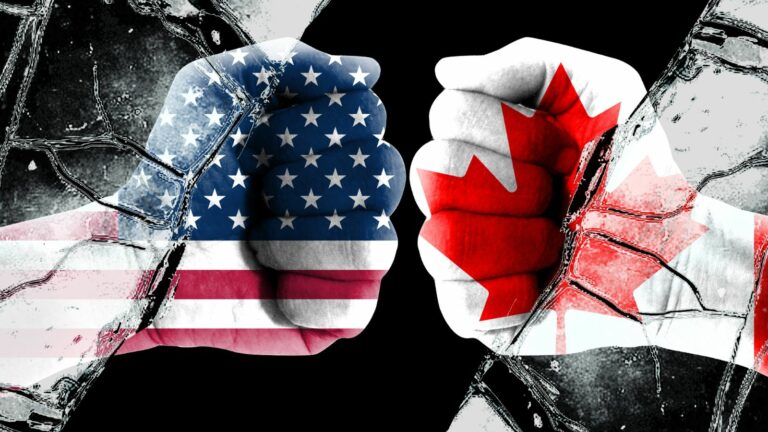
The strongest new argument for revisiting shale gas is not that Quebec suddenly discovered hydrocarbons. It is that economic dependence on the United States feels politically riskier than it did several years ago. U.S.-Canada trade tensions have become a major issue in Quebec’s election campaign, and provincial leaders are debating how much exposure Quebec should tolerate to decisions made in Washington.
The broader trade numbers illustrate why the argument resonates. Quebec exported approximately $121.6 billion in goods internationally in 2025, with about $84.8 billion going to the United States — roughly seven dollars out of every ten in international merchandise exports. Quebec also imported about $41.6 billion in U.S. goods. That economic integration is far broader than energy, but it gives the shale-gas debate a new vocabulary. Instead of asking only whether Quebec should extract fossil fuels, supporters increasingly ask whether relying heavily on external suppliers and markets leaves the province vulnerable when political relationships deteriorate.
Quebec Uses Significant Amounts of Natural Gas but Produces None
Quebec’s electricity system can make the province look almost entirely detached from fossil fuels. Hydroelectricity dominates power generation, homes are more heavily electrified than in many other provinces, and renewable power is central to Quebec’s economic identity. Yet natural gas still has an important role, particularly in industry. Canada Energy Regulator data show Quebec consumed about 590 million cubic feet of natural gas per day in 2023.
Industry accounted for approximately 385 million cubic feet per day of that consumption, compared with about 150 million for commercial users and 56 million for residential customers. At the same time, Quebec has no commercial natural-gas production. Its supplies arrive from outside the province through interconnected pipeline systems. Historically, much of the gas came from Western Canada, while infrastructure changes have also allowed U.S.-produced gas to reach Quebec through Ontario. That makes Quebec dependent on outside gas, though not exclusively on the United States.
The Utica Shale Is Enormous, but Its Commercial Value Is Still Uncertain
The geological reason this discussion keeps returning lies beneath the St. Lawrence Lowlands. Natural Resources Canada says Quebec’s Utica shale extends across nearly 16,000 square kilometres, including areas of Montérégie, Centre-du-Québec and Chaudière-Appalaches. The rock formation contains natural gas, and its characteristics attracted considerable exploration activity before political and environmental opposition brought development to a halt.
Yet the existence of gas should not be confused with proof of a commercially viable industry. Federal resource information currently says the limited number of wells drilled in Quebec has not been sufficient to establish a reliable estimate of technically recoverable resources. Earlier exploration between 2006 and 2010 included 28 wells, 18 of which underwent hydraulic fracturing, according to peer-reviewed research examining the region. Those wells generated valuable geological information, but Quebec never progressed to large-scale commercial shale-gas production. Any new economic case would therefore have to demonstrate recoverability, production rates and costs under today’s conditions rather than rely solely on older resource estimates.
Environmental Research Offers Evidence — but Not a Simple Answer
Groundwater has always been one of the most sensitive parts of Quebec’s fracking debate. Research conducted in the Utica region has helped establish an important baseline. A multidisciplinary study of roughly 500 square kilometres near Saint-Édouard found naturally occurring methane in shallow groundwater, including locally elevated concentrations. Researchers found no evidence in that pre-development setting of fluids migrating upward over large vertical distances from the deeper shale formation.
That finding does not establish that large-scale hydraulic fracturing would be risk-free. Other Quebec-focused research has examined methane released during the handling and degassing of flowback water created by hydraulic fracturing. Scientists have also emphasized potential risks associated with well integrity, surface operations, wastewater management and accidental releases. Quebec’s Bureau d’audiences publiques sur l’environnement spent much of 2014 examining these questions through an extensive public process. The scientific record therefore provides useful evidence, but it does not reduce the policy choice to a claim that fracking is either automatically harmless or inevitably contaminating.
Promised Economic Benefits Would Have to Survive a New Reality Check
The economic case advanced by shale-gas supporters can sound straightforward: replace imported gas with a resource located inside Quebec, create investment and jobs, collect royalties and potentially sell surplus production elsewhere. The Quebec Conservatives have made that logic part of their anti-tariff strategy, arguing that Utica development could reduce reliance on U.S.-linked gas supplies and generate substantial economic benefits.
Those claims would still require independent testing before becoming a credible development forecast. Natural Resources Canada currently avoids assigning Quebec a definitive technically recoverable gas estimate because exploration data remain limited. A project would also need wells, gathering systems, processing and connections to existing transmission infrastructure, along with environmental compliance and agreements with affected communities. Commodity prices add another uncertainty: possessing gas underground does not guarantee that extracting it will compete economically with large, mature producing regions elsewhere in Canada and the United States. A credible restart would therefore require updated production tests and cost modelling rather than simply reviving projections developed more than a decade ago.
“Social Acceptance” Could Become the Hardest Test of All
Quebec’s shale-gas geography helps explain why the issue produced such intense opposition during its first major political cycle. The Utica resource does not sit in an isolated northern resource district. It stretches beneath parts of the populated St. Lawrence Lowlands, including agricultural communities and municipalities between the Montreal and Quebec City regions. Development would therefore involve decisions about wells, roads, truck traffic, water use and industrial infrastructure close to places where people live and farm.
That is why Fréchette’s repeated reference to “social acceptance” is more than political language. Even a province-wide poll showing increased openness cannot establish whether individual communities would accept drilling nearby. The latest polling itself demonstrates uncertainty: the difference between support and opposition is only one percentage point, while one-quarter of respondents remain undecided. Quebec’s earlier BAPE process also concentrated heavily on Montérégie, Centre-du-Québec and Chaudière-Appalaches. Any serious revival would likely shift the debate quickly from abstract energy independence to specific questions about where development would occur and under what local conditions.
Energy Independence Does Not Have a Single Definition in Quebec
Fracking is only one possible answer to the vulnerability exposed by geopolitical and trade disruptions. Quebec is simultaneously spending heavily on a strategy built around electrification, efficiency and renewable energy. Its 2026-2031 implementation plan for the Plan for a Green Economy provides $8.2 billion over five years, including more than $5.6 billion directed toward decarbonization, lower petroleum imports and improved energy efficiency.
Hydro-Québec is pursuing its own expansion, with a goal of adding 11,000 megawatts of generation capacity by 2035 while freeing another 3,500 megawatts through greater energy savings. Quebec has also pursued renewable natural gas as a substitute for part of conventional gas consumption. These strategies and shale-gas development represent very different ways of thinking about resilience. The renewed fracking debate is therefore larger than a fight over one drilling technology. It is becoming a question of what Quebec means by energy security — more domestic fossil-fuel production, faster displacement of imported fuels, or some combination of both. For now, the prohibition remains in force, and that choice remains political rather than operational.
This Options Discord Chat is The Real Deal
While the internet is scoured with trading chat rooms, many of which even charge upwards of thousands of dollars to join, this smaller options trading discord chatroom is the real deal and actually providing valuable trade setups, education, and community without the noise and spam of the larger more expensive rooms. With a incredibly low-cost monthly fee, Options Trading Club (click here to see their reviews) requires an application to join ensuring that every member is dedicated and serious about taking their trading to the next level. If you are looking for a change in your trading strategies, then click here to apply for a membership.