35,000+ smart investors are already getting financial news, market signals, and macro shifts in the economy that could impact their money next with our FREE weekly newsletter. Get ahead of what the crowd finds out too late. Click Here to Subscribe for FREE.
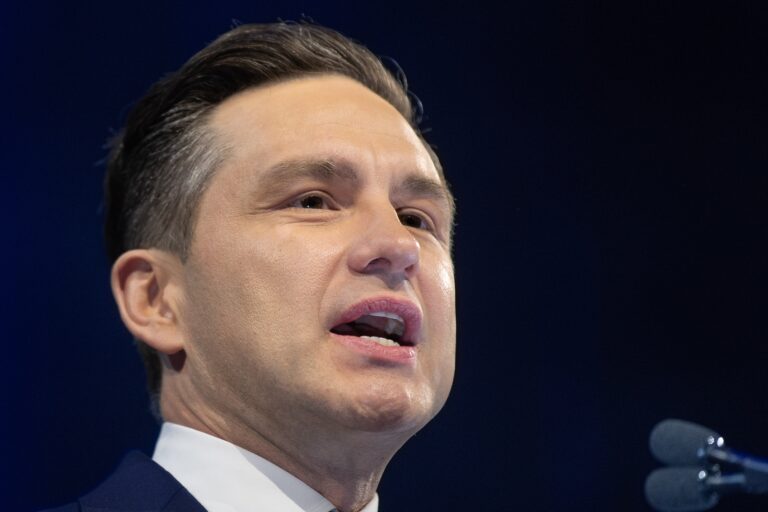
Pierre Poilievre is preparing to remake the Conservative opposition bench at a consequential point in the parliamentary cycle. Conservative sources say changes are coming to critic assignments and the party’s front bench as it adjusts to Prime Minister Mark Carney’s majority government. MPs elected for the first time in 2025 are expected to receive greater prominence.
The move also carries the hallmarks of a performance review. Months earlier, existing critics were reportedly asked to provide examples of their work and indicate whether they wanted to remain in their positions. The names, timing and full scale of the changes have not been publicly confirmed, but the exercise offers Poilievre an opportunity to sharpen the party’s message, showcase new talent and decide which MPs are best equipped to challenge a government that no longer depends on opposition support to survive.
A Majority Government Changes the Opposition’s Assignment
Poilievre Prepares Major Shakeup of Conservative Opposition Team
- A Majority Government Changes the Opposition’s Assignment
- New Conservative MPs Could Finally Move Forward
- Current Critics Were Asked to Show Their Work
- A Large Front Bench Offers Strengths and Complications
- Economic Credibility Remains the Central Battlefield
- The 2025 Election Still Defines the Party’s Dilemma
- Poilievre Is Strong Inside the Party but Faces a Wider Test
- The Real Test Will Come After the Promotions
Carney’s Liberals currently hold 174 of the 343 seats in the House of Commons, giving the government the votes required to pass legislation without negotiating routinely with opposition parties. The Conservatives remain the Official Opposition with 140 MPs, but their influence now depends less on extracting concessions during confidence votes and more on winning arguments in Parliament and before the public.
That makes the selection of critics especially important. The Opposition receives the opening questions during the House’s daily 45-minute Question Period, while individual critics are expected to understand complicated portfolios, challenge ministers and explain Conservative alternatives. A finance critic may have only hours to examine a major economic announcement before appearing in front of cameras. A defence or foreign affairs critic must respond carefully to events that can change by the hour. Under a majority government, those performances may not stop legislation, but they can shape whether voters believe the Conservatives are presenting a credible government-in-waiting.
New Conservative MPs Could Finally Move Forward
Poilievre’s first post-election opposition team, announced in May 2025, was deliberately broad. It placed 73 MPs in leadership or critic positions, including 48 principal critics and 14 associate critics. Most major portfolios remained with experienced parliamentarians, although newly elected Alberta MP Billy Morin was assigned Indigenous services and British Columbia newcomer Ellis Ross received the environment and climate-change file.
At the time, the Conservatives said newer MPs would be given time to learn parliamentary procedures and demonstrate their abilities before more of them received important assignments. The upcoming changes appear positioned to deliver on that commitment. A first year in Ottawa can be overwhelming: new MPs must establish constituency offices, learn committee rules, absorb briefing material and adjust to the speed of national media. Elevating the strongest members of the 2025 class would refresh the Conservative public image while giving those MPs meaningful experience well before the next election campaign. It would also reveal which newcomers Poilievre believes could eventually be considered for cabinet positions.
Current Critics Were Asked to Show Their Work
The reported shuffle did not emerge without warning. Nearly three months earlier, Conservative MPs holding critic positions received a request from the leader’s office asking for examples of the work they had completed and whether they were interested in continuing. No public scorecard has been released, and there has been no confirmed list of MPs who may be promoted, moved or returned to the back benches.
Still, the request suggests that incumbency alone will not guarantee a position. Critic work can include preparing Question Period material, examining legislation, participating in committee studies, consulting affected industries and responding publicly when the government makes an announcement. Much of that work happens away from television cameras, making it difficult for the public to judge. Inside a leader’s office, however, preparation, reliability and message discipline are closely observed. Asking MPs to document their output turns the shuffle into more than a routine redistribution of titles. It creates an opportunity to reward active performers while replacing critics who have struggled to establish ownership of their files.
A Large Front Bench Offers Strengths and Complications
The 2025 Conservative team was larger than the Liberal ministry it was created to scrutinize. It included dozens of specialized positions, associate critics, regional advisers and members responsible for internal parliamentary operations. That structure allowed Poilievre to involve a substantial share of his caucus and assign MPs to narrowly defined issues such as nuclear energy, regional economic development, artificial intelligence and interprovincial trade.
A large team can provide policy depth, particularly when Canada is managing several major challenges at once. The disadvantage is that too many overlapping titles can make it harder for voters to identify the party’s leading voices. When several MPs speak about related economic or public-safety issues, responsibility can become blurred. A smaller front bench would create clearer accountability and make promotions more meaningful, while a broad one would continue giving more caucus members experience and public exposure. There has been no authoritative confirmation that Poilievre intends to reduce the number of positions, but the final size of the team will offer an early clue about whether he values concentration or caucus-wide participation.
Economic Credibility Remains the Central Battlefield
The reshuffle comes as the Conservatives continue to trail the Liberals nationally. A Liaison Strategies survey conducted from June 14 to June 27 placed the Liberals at 42 per cent among decided and leaning voters, compared with 34 per cent for the Conservatives. The same survey measured Carney’s approval at 58 per cent, while Poilievre recorded a 37 per cent favourable rating and a 50 per cent unfavourable rating.
Economic conditions nevertheless leave room for an effective opposition message. The Bloomberg-Nanos Canadian Confidence Index stood at 50.88 in late June, close to neutral and below its longer-term average of 54.73. The figures suggest that Canadians are not uniformly pessimistic, but many remain cautious about their finances and the economy’s direction. Finance, housing, employment, industry, trade and government spending will therefore remain high-pressure Conservative assignments. The MPs selected for those files must do more than criticize individual government decisions. They will be expected to translate statistics and policy disputes into understandable consequences for families, workers and businesses while offering alternatives that appear practical enough to implement.
The 2025 Election Still Defines the Party’s Dilemma
The Conservatives emerged from the 2025 election with 144 seats after recounts, giving them one of the largest opposition caucuses in recent Canadian history. Yet they still failed to form government, and Poilievre lost the Carleton riding he had represented in different forms since 2004. That combination produced a difficult political verdict: the Conservative coalition had expanded substantially, but not enough to defeat the Liberals.
Poilievre returned to the House through an August 2025 byelection in Alberta’s Battle River—Crowfoot, receiving 80.9 per cent of the vote. The result restored his place in Parliament and allowed him to resume the formal role of Opposition leader, but winning one of Canada’s safest Conservative ridings did not answer the party’s broader electoral questions. The new critic team must help demonstrate that Conservatives can connect beyond their strongest regions. Promotions involving newer MPs, urban representatives, Quebec voices or members with specialized professional experience could signal where the party believes further growth is possible.
Poilievre Is Strong Inside the Party but Faces a Wider Test
Poilievre’s authority within Conservative ranks was reinforced in January 2026 when 87.4 per cent of delegates voted to retain him during a mandatory leadership review. That result comfortably exceeded the informal expectations discussed by party observers and gave him a strong mandate to rebuild after the election loss. A leader with that level of internal support has considerable freedom to promote new figures, remove familiar ones and reorganize responsibilities.
Support inside a party, however, is different from support across the electorate. Recent polling indicates that the Conservative vote remains competitive while Poilievre’s personal ratings present a more complicated picture. A well-designed front bench could help broaden the party’s appeal by allowing Canadians to see more Conservative representatives discussing issues in their areas of expertise. It could also reduce the burden on Poilievre to serve as the principal messenger on nearly every controversy. The challenge will be giving critics enough independence to develop recognizable public profiles without producing inconsistent positions or distracting internal competition.
The Real Test Will Come After the Promotions
Attention will initially focus on who gains a prestigious portfolio and who loses one, but the lasting significance of the shakeup will be measured in Parliament. Strong critics must identify weaknesses in legislation, ask concise questions, build relationships with affected communities and remain prepared when an unexpected issue suddenly dominates the news. A promotion can create an opportunity, but it cannot guarantee that an MP will become an effective national voice.
The final lineup will also indicate how Poilievre intends to confront a government that may remain in office until the next scheduled election. A team dominated by familiar veterans would emphasize experience and continuity. A larger role for the 2025 class would suggest generational renewal. A streamlined economic group would point toward affordability and growth as the central strategy, while elevated trade, defence and foreign-policy roles would reflect Canada’s increasingly uncertain international environment. Until the assignments are formally announced, those choices remain unresolved. Once the team is in place, its performances—not its titles—will determine whether the shuffle strengthens the Conservatives’ case for government.
This Options Discord Chat is The Real Deal
While the internet is scoured with trading chat rooms, many of which even charge upwards of thousands of dollars to join, this smaller options trading discord chatroom is the real deal and actually providing valuable trade setups, education, and community without the noise and spam of the larger more expensive rooms. With a incredibly low-cost monthly fee, Options Trading Club (click here to see their reviews) requires an application to join ensuring that every member is dedicated and serious about taking their trading to the next level. If you are looking for a change in your trading strategies, then click here to apply for a membership.