35,000+ smart investors are already getting financial news, market signals, and macro shifts in the economy that could impact their money next with our FREE weekly newsletter. Get ahead of what the crowd finds out too late. Click Here to Subscribe for FREE.
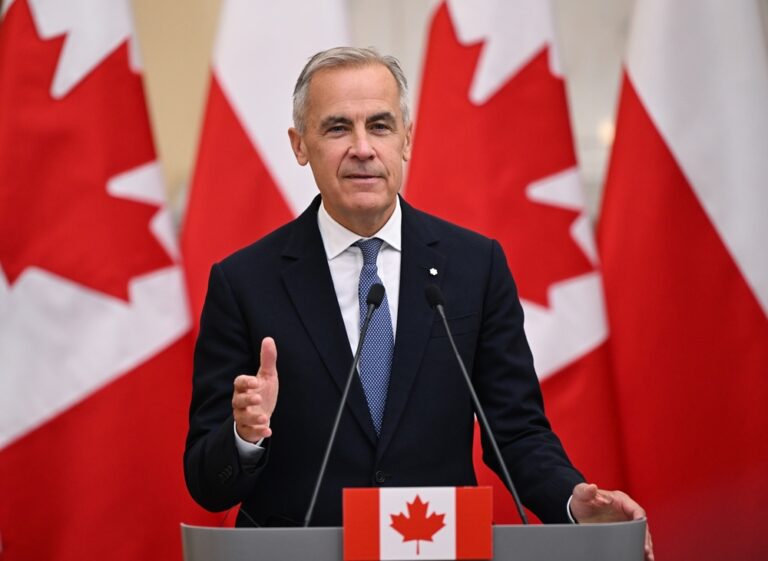
A relationship once driven largely by cultural ties and tourism is becoming increasingly commercial, technological and strategic. Prime Minister Mark Carney and Croatian Prime Minister Andrej Plenković are placing defence technology near the centre of their countries’ growing partnership, with Croatian drone manufacturer Orqa and Canadian company Remote Robotic preparing a strategic agreement involving artificial intelligence, unmanned systems and military training support.
The announcement arrives as both governments look for dependable partners in an increasingly unsettled global economy. However, the headline-grabbing 500% trade figure requires context: it originated from an earlier increase in Canadian exports to Croatia, rather than a recent fivefold jump in all two-way trade. Even so, newer aircraft, shipbuilding and technology deals show that commercial ties have advanced well beyond their historically modest base.
A Croatian Visit With Bigger Commercial Stakes
Carney Welcomes Canada–Croatia Drone Deal as Bilateral Trade Jumps 500%
- A Croatian Visit With Bigger Commercial Stakes
- The Drone Partnership at the Centre of the Visit
- Why Orqa Has Attracted International Attention
- What “Sovereign AI” Means in This Context
- The 500% Trade Figure Needs Important Context
- CETA Helped Create a Clearer Path for Business
- Aircraft and Ships Are Already Changing the Numbers
- Defence Cooperation Fits Carney’s Diversification Strategy
- The Agreement Is a Starting Point, Not the Finish Line
Plenković’s June 22–24 visit to Canada was designed as more than a ceremonial meeting between two NATO allies. His itinerary included talks with Carney in Ottawa, meetings with business leaders, engagement with Croatian communities in Ontario and an appearance at the University of Toronto’s Munk School. Defence, technology, tourism and economic cooperation were all identified as priorities.
The timing added an unusually public backdrop. Plenković was also scheduled to attend Croatia’s World Cup match against Panama in Toronto, giving the visit cultural and sporting significance alongside its diplomatic purpose. Yet the most consequential discussions were expected to happen away from the stadium. Croatian Economy Minister Ante Šušnjar and Tourism and Sports Minister Tonči Glavina accompanied the prime minister, while a Croatian-Canadian business forum was expected to bring together approximately 50 companies. That combination of political leaders, commercial representatives and diaspora organizations illustrates how both governments are trying to turn a historically friendly relationship into a more structured economic partnership.
The Drone Partnership at the Centre of the Visit
The planned agreement brings together Orqa, a Croatian company based in Osijek, and Remote Robotic, a Canadian enterprise robotics business headquartered in Mississauga. Croatian government reporting described it as a strategic defence-industry partnership involving sovereign artificial intelligence, advanced manufacturing of unmanned aircraft systems and support for Canadian Armed Forces training.
Public reporting ahead of the meeting described the agreement as scheduled to be signed under government auspices. That distinction matters because a company partnership is not necessarily the same as a completed Canadian government procurement contract. No publicly disclosed purchase quantity, contract price or delivery schedule accompanied the initial announcement. Its immediate significance is therefore industrial and strategic: a growing Croatian technology company is establishing a closer relationship with a Canadian operator that already works with drones, land robots and remote systems. For both sides, the agreement may provide a platform for future manufacturing, integration, training and commercialization opportunities.
Why Orqa Has Attracted International Attention
Orqa began as a Croatian technology startup focused on first-person-view equipment and unmanned aircraft components. It has since pursued expansion beyond Croatia through manufacturing and technology partnerships in several international markets. The company says its products and components are used in dozens of countries, including NATO member states, while its broader strategy emphasizes greater control over manufacturing and supply chains.
That approach fits a wider shift in defence technology. Governments increasingly want sensitive systems to rely on secure components, trusted suppliers and production networks that can be maintained during geopolitical disruptions. Orqa has responded by expanding its manufacturing ambitions and establishing partnerships outside Croatia, including arrangements connected to production in the United States and cooperation with Ukrainian industry. Its Canadian agreement follows that same model: rather than simply shipping a finished product overseas, the company is seeking local partners capable of providing integration, operational support and access to domestic institutions. For Croatia, that represents an export of specialized knowledge from a smaller European economy into a larger allied market.
What “Sovereign AI” Means in This Context
“Sovereign AI” has become a frequent phrase in government and technology announcements, but its meaning is broader than national ownership of an artificial-intelligence model. It generally refers to maintaining meaningful domestic or allied control over data, computing infrastructure, software, intellectual property and the systems used to deploy AI. In defence and public-safety settings, those considerations can be especially important.
Canada has already made technological sovereignty a central part of its industrial policy. Its Defence Industrial Strategy identifies digital systems, sensors, training, simulation and uncrewed autonomous systems as priority capabilities. The federal government has also announced more than $900 million for defence-related innovation, including a new drone innovation hub and support for dual-use technologies. Against that backdrop, cooperation with a Croatian company is not necessarily inconsistent with a “buy Canadian” approach. The government’s strategy also permits collaboration with trusted allies when partnerships strengthen Canadian production, expertise and supply-chain resilience. The key test will be how much development, employment, intellectual property and long-term support ultimately remain in Canada.
The 500% Trade Figure Needs Important Context
The claim that Canada–Croatia trade jumped 500% can easily be misunderstood. The documented figure dates to a 2019 visit by then-Croatian president Kolinda Grabar-Kitarović. In an interview after meeting Canadian leaders, she said then-prime minister Justin Trudeau had highlighted a 500% increase in Canadian exports to Croatia. That was not the same as saying total bilateral trade had recently risen fivefold.
The distinction is important because percentage increases can appear dramatic when they begin from a small base. Canada and Croatia have traditionally described their commercial relationship as modest but growing. More recent trade figures nevertheless show substantial progress. United Nations trade data indicate that Canadian merchandise exports to Croatia reached approximately US$216 million in 2025. Aircraft and spacecraft accounted for roughly US$181 million—more than four-fifths of the total. Large individual purchases can therefore transform annual trade figures between two comparatively small trading partners. The 500% figure captures genuine growth, but it should not be treated as a current measure of the entire relationship.
CETA Helped Create a Clearer Path for Business
Croatia has been an enthusiastic supporter of the Comprehensive Economic and Trade Agreement between Canada and the European Union. It became the third EU member state to ratify CETA nationally, doing so on June 30, 2017. The agreement provisionally entered into force later that year and reduced or eliminated barriers across a wide range of goods and services.
CETA does not guarantee that companies will find customers, but it gives businesses a clearer framework for tariffs, market access and commercial rules. That can be particularly valuable for smaller countries whose companies may have limited experience operating across the Atlantic. Croatian firms gain more predictable access to Canada, while Canadian companies can use Croatia as an entry point into an EU member state with connections to Central and southeastern Europe. The Orqa partnership shows how the relationship is moving beyond traditional merchandise exports. Instead of being centred only on products crossing a border, newer deals can include software, technical knowledge, training, maintenance and collaborative development.
Aircraft and Ships Are Already Changing the Numbers
Defence technology is only one part of the commercial story. Croatia Airlines has been renewing its fleet with Airbus A220 aircraft assembled in Mirabel, Quebec. Those aircraft help explain why aerospace products dominated Canadian exports to Croatia in 2025. A single fleet program can be worth far more than years of smaller consumer-goods transactions, producing a sudden rise in bilateral statistics.
Trade has also been flowing in the opposite direction. Croatia’s Treći maj shipyard in Rijeka has been building vessels for Algoma Central Corporation, a Canadian marine transportation company. Ships and floating structures became a major Croatian export category to Canada in 2025. Together, the aircraft and shipbuilding deals give the relationship a tangible human dimension: workers in Quebec assemble aircraft for a Croatian carrier, while shipbuilders on the Adriatic construct vessels for a Canadian operator. These transactions support skilled employment, supplier networks and long-term maintenance relationships that can continue well after the initial delivery.
Defence Cooperation Fits Carney’s Diversification Strategy
Carney’s government has repeatedly linked national security with economic resilience. Canada’s Defence Industrial Strategy aims to reduce dependence on vulnerable supply chains, expand domestic production and increase defence exports by 50%. The plan identifies approximately $180 billion in potential defence procurement and $290 billion in defence-related capital investment over the coming decade.
Partnerships with countries such as Croatia fit that strategy because Canada is attempting to work with a wider network of trusted allies rather than relying too heavily on one supplier or market. Croatia is a member of both NATO and the European Union, while Canada has been pursuing deeper security and industrial relationships with European partners. Croatian officials also said they expected Carney to discuss his concept for a multilateral defence bank during the visit, although its structure and Croatia’s possible involvement remained matters for discussion. Supporters may view these arrangements as practical diversification. Critics will still expect transparency, competitive procurement and evidence that Canadian taxpayers and workers receive measurable benefits.
The Agreement Is a Starting Point, Not the Finish Line
The political value of announcing a high-technology partnership is immediate, but its economic value will depend on execution. The most important unanswered questions include whether production will take place in Canada, how Canadian intellectual property will be protected, whether the companies will employ Canadian engineers and technicians, and whether the partnership produces firm commercial orders.
The same caution applies to broader trade claims. Aircraft and ship contracts have already lifted the value of commerce, but sustainable growth requires a wider range of companies to participate. Tourism offers another opportunity: Croatian reporting said arrivals and overnight stays by Canadian visitors increased 10% during the first five months of 2026 compared with the same period a year earlier. The diaspora can also help companies identify partners and navigate unfamiliar markets. If the drone agreement leads to manufacturing, research or exports—and if business-forum introductions produce additional deals—the Carney-Plenković meeting could mark a durable expansion of the relationship. For now, it is best understood as a credible opening rather than a guaranteed economic breakthrough.
This Options Discord Chat is The Real Deal
While the internet is scoured with trading chat rooms, many of which even charge upwards of thousands of dollars to join, this smaller options trading discord chatroom is the real deal and actually providing valuable trade setups, education, and community without the noise and spam of the larger more expensive rooms. With a incredibly low-cost monthly fee, Options Trading Club (click here to see their reviews) requires an application to join ensuring that every member is dedicated and serious about taking their trading to the next level. If you are looking for a change in your trading strategies, then click here to apply for a membership.