35,000+ smart investors are already getting financial news, market signals, and macro shifts in the economy that could impact their money next with our FREE weekly newsletter. Get ahead of what the crowd finds out too late. Click Here to Subscribe for FREE.
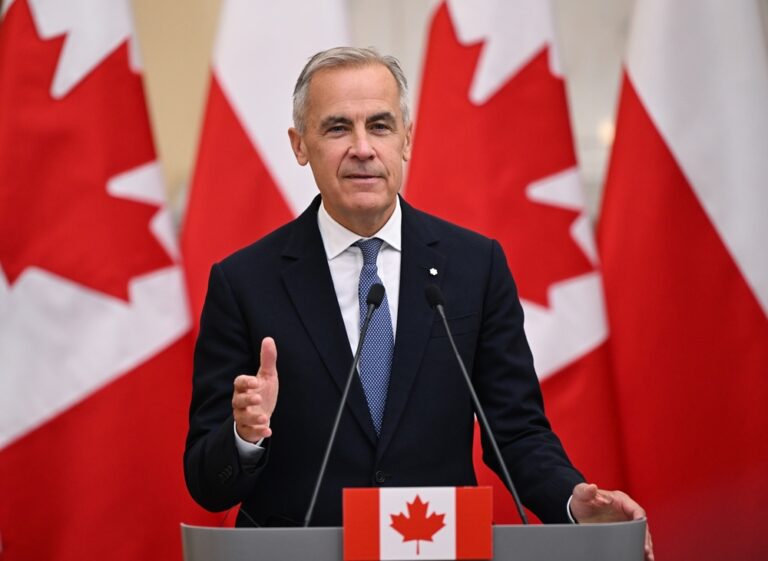
The grocery aisle has become one of Canada’s most politically charged places, where every cart tells a story about shrinking household budgets and stubbornly high food costs. Prime Minister Mark Carney’s new food strategy puts that pressure at the centre of federal economic policy, promising more than $3 billion over 10 years to reshape how food is grown, processed, moved, and sold across the country.
At the heart of the plan is a $1 billion push to build food terminals and hubs that could give independent grocers more power to buy directly from farmers and processors. The goal is clear: loosen the grip of major chains, strengthen Canadian food security, and give shoppers more affordable choices. But with grocery inflation still running above overall inflation, the question is whether Ottawa’s big bet can reach the checkout quickly enough.
Grocery Pain Has Become a Political Problem
Carney Takes Aim at Grocery Giants With $1B Food Push as Prices Keep Biting
- Grocery Pain Has Become a Political Problem
- The $1B Bet Is About Wholesale Power
- Big Chains Are the Unspoken Target
- Local Food Is Being Recast as Security Policy
- The Processing Push Tries to Keep More Value at Home
- Greenhouses Are the Year-Round Fresh Food Play
- Why Prices May Not Drop Quickly
- Affordability Pressure Is Showing Up Beyond the Checkout
- The Test Will Be Whether Canadians Notice
Food prices have eased from the worst inflation spikes of recent years, but the relief has not felt meaningful for many households. In April 2026, food purchased from stores was still up 3.8% year over year, compared with 2.8% for the overall Consumer Price Index. That gap matters because groceries are not a luxury purchase. Families can delay a vacation, cut streaming subscriptions, or postpone buying clothes, but milk, eggs, meat, produce, and pantry staples have to be bought week after week.
The longer-term numbers explain why the public mood remains tense. Canada’s Food Price Report 2026 forecast overall food price increases of 4% to 6% this year and estimated that a family of four could spend $17,571.79 on food, nearly $995 more than the previous year. The same report said food prices were 27% higher than five years earlier. For a household already juggling rent, mortgage payments, gas, childcare, and debt, even a slower rate of increase still feels like another bite out of the paycheque.
The $1B Bet Is About Wholesale Power
Carney’s headline move is not a direct grocery rebate or a temporary tax holiday. It is a supply-chain intervention. Ottawa says $1 billion will go toward new and expanded food terminals and hubs, designed to help independent grocers buy and move competitively priced products without relying as heavily on supply systems controlled by larger retail chains. In plain terms, the government wants to change who has access to food before it ever reaches the store shelf.
The model already exists in Toronto. The Ontario Food Terminal, established in 1954, describes itself as Canada’s largest wholesale fruit and produce distribution centre and the third largest in North America. It distributes more than 2 billion pounds of produce annually and serves thousands of registered buyers. That matters because wholesale infrastructure can act like a public marketplace for food, allowing small retailers, restaurants, institutions, and produce shops to source goods in ways they could not manage alone. Carney’s plan is essentially an attempt to replicate that competitive pressure beyond one major terminal.
Big Chains Are the Unspoken Target
The strategy does not name a single villain, but its target is obvious: market concentration. The federal government says five large retailers dominate 75% of Canada’s grocery market and much of the food distribution system behind it. U.S. agriculture reporting has put the concentration figure closer to 80% when looking at the five leading retailers. Either way, the picture is the same. Canada’s grocery sector is controlled by a small group of powerful players, while independent stores often have less bargaining power and fewer supply options.
That is why the plan also includes nearly $130 million for the Competition Bureau and Competition Tribunal to investigate, prevent, and combat anti-competitive business practices. The Competition Bureau’s earlier grocery market study argued that more competition can lead to lower prices, more convenience, and more innovation. Ottawa is now trying to turn that diagnosis into policy. The practical test will be whether enforcement and infrastructure together can give smaller grocers enough room to compete on price, not just survive as niche neighbourhood stores.
Local Food Is Being Recast as Security Policy
Carney’s food push is about prices, but it is also about national resilience. Agriculture and Agri-Food Canada says the country imports 88% of its fresh fruits and nuts and 72% of its vegetables. Those numbers are striking for a country that sees itself as a global food producer. They also help explain why droughts abroad, shipping disruptions, currency swings, conflicts, and tariffs can eventually show up in Canadian shopping carts.
The government’s argument is that Canada grows plenty of food but does not always process, distribute, or retail enough of it through domestic channels. In practice, that can mean Canadian crops are exported, processed elsewhere, and later bought back as higher-value finished goods. The new strategy frames that as both an affordability problem and a sovereignty problem. It is a notable shift in language: food policy is no longer being treated only as farm policy or consumer policy, but as part of the same resilience agenda as energy, trade, and national security.
The Processing Push Tries to Keep More Value at Home
A second major piece of the strategy is aimed at food processing. Ottawa plans to launch a $1 billion Agri-food Project Finance Fund through Farm Credit Canada, along with a $150 million Food Security Fund for small and medium-sized businesses and a $100 million Collaborative Food Innovation Fund. The idea is to help Canadian businesses buy equipment, expand capacity, modernize operations, and turn more Canadian-grown inputs into finished products at home.
That could matter for communities far from the political spotlight. A small processor in Saskatchewan turning chickpeas into packaged snacks, a vegetable packer in southern Ontario, or a seafood processor in Atlantic Canada can all face the same barrier: demand may exist, but scaling up requires expensive machinery, reliable financing, and access to buyers. If more processing happens closer to where food is grown or harvested, Canada could capture more jobs and value domestically. Still, the payoff is likely to be gradual. Factories, cold storage, processing lines, and distribution networks take time to build.
Greenhouses Are the Year-Round Fresh Food Play
Fresh produce is where shoppers often feel price swings most sharply. A cucumber, pepper, head of lettuce, or box of berries can jump in price depending on weather, imports, fuel costs, and growing conditions thousands of kilometres away. Carney’s plan includes $750 million for controlled environment agriculture, including greenhouses, vertical farms, and other enclosed growing spaces. The goal is to expand year-round Canadian production of fruits and vegetables, including in rural and northern communities.
This is one of the more ambitious parts of the plan because Canada’s growing season is naturally short in much of the country. More domestic greenhouse capacity could make certain fresh items less vulnerable to foreign weather events or transportation disruptions. It could also help northern and remote communities, where fresh food often arrives by long-distance shipping and can be expensive or limited. But greenhouses are not magic. They require capital, energy, skilled labour, and reliable markets. They can help with some crops, especially leafy greens, tomatoes, cucumbers, and peppers, but they will not replace every imported fruit or vegetable in Canadian kitchens.
Why Prices May Not Drop Quickly
The political challenge for Carney is that grocery shoppers want lower bills now, while the strategy mostly works through long-term systems. Food terminals, processing plants, greenhouses, competition studies, and regulatory reforms can improve market structure, but they do not instantly cut the price of a basket of groceries. Reuters reported that University of Guelph food economist Michael von Massow welcomed the strategy while warning that many causes of food inflation sit outside federal control, including climate change, extreme weather, and volatile geopolitics.
Statistics Canada’s April inflation report showed how quickly outside forces can affect household costs. Energy prices rose 19.2% year over year, and gasoline prices jumped 28.6%. Those costs do not stay isolated at the pump. Food has to be grown, chilled, packaged, transported, stocked, and sold, which means energy and transportation pressures can ripple through the system. Even if Ottawa succeeds in creating more competition, the results may appear slowly: better wholesale access, more local supply, more pressure on margins, and eventually more meaningful price discipline.
Affordability Pressure Is Showing Up Beyond the Checkout
Food affordability is not just showing up in opinion polls or social media complaints. Food Banks Canada reported more than 2.16 million food bank visits in March 2025, nearly double the number recorded in 2019. Children accounted for one-third of visits, and 19% of food bank clients reported employment as their main source of income. Those figures complicate the old assumption that food insecurity is limited to people outside the workforce. Increasingly, it includes people with jobs who still cannot make the math work.
That is why the government is pairing structural food-system reform with income and community supports. Its earlier affordability measures include the Canada Groceries and Essentials Benefit, a permanent National School Food Program, and $20 million for food banks and community food organizations. Those measures are designed to ease immediate pressure, while the new strategy tries to tackle deeper supply problems. The risk for Ottawa is that Canadians judge the plan not by how well it reads on paper, but by whether the weekly grocery bill finally stops feeling like a moving target.
The Test Will Be Whether Canadians Notice
The food strategy gives Carney a way to confront grocery giants without directly imposing price controls or turning the issue into a simple fight over corporate profits. It aims to build alternative routes around concentrated supply chains, finance more Canadian processing, expand year-round production, and strengthen the watchdogs responsible for policing competition. That is a more durable approach than a one-time rebate, but it is also harder to explain and slower to prove.
For consumers, the measure of success will be practical. A parent comparing flyers on a Thursday night will not care whether a lower price came from a new terminal, a stronger independent grocer, a greenhouse expansion, or a better processing network. They will care whether the same bag of groceries costs less, lasts longer, and offers more Canadian options. Carney’s $1 billion food infrastructure push may be a serious attempt to rebalance the system. Now it has to survive the most unforgiving test in politics: the receipt.
This Options Discord Chat is The Real Deal
While the internet is scoured with trading chat rooms, many of which even charge upwards of thousands of dollars to join, this smaller options trading discord chatroom is the real deal and actually providing valuable trade setups, education, and community without the noise and spam of the larger more expensive rooms. With a incredibly low-cost monthly fee, Options Trading Club (click here to see their reviews) requires an application to join ensuring that every member is dedicated and serious about taking their trading to the next level. If you are looking for a change in your trading strategies, then click here to apply for a membership.