35,000+ smart investors are already getting financial news, market signals, and macro shifts in the economy that could impact their money next with our FREE weekly newsletter. Get ahead of what the crowd finds out too late. Click Here to Subscribe for FREE.
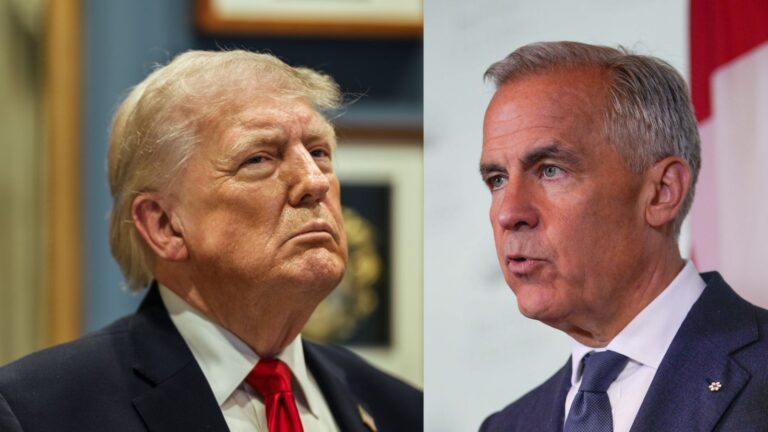
Canada’s relationship with the United States is facing another test after the Pentagon publicly questioned Ottawa’s military readiness and commitment to defending North America. Yet Prime Minister Mark Carney says those concerns have never been raised directly with him by U.S. President Donald Trump.
Speaking on November 25, 2026, Carney defended Canada’s military investments and international contributions, emphasizing that conversations with Trump have focused on resolving global conflicts rather than disagreements over defence spending.
The exchange follows unusually sharp criticism from U.S. Defense Secretary Pete Hegseth’s department, which accused Canada of falling short of its responsibilities. Ottawa’s response has been equally firm, with senior ministers defending Canadian sovereignty while acknowledging that years of military underinvestment have created challenges that cannot be fixed overnight.
Carney Says Trump Has Not Personally Raised the Pentagon’s Concerns
Carney Says Trump Has Never Raised Pentagon’s Defence Complaints With Him as Canada Pushes Back Against Washington
- Carney Says Trump Has Not Personally Raised the Pentagon’s Concerns
- Pentagon Accuses Canada of Falling Short on North American Defence
- Canada’s Own Military Readiness Figures Reveal Significant Challenges
- Ottawa Responds by Defending Canada’s Sovereignty
- NATO’s New Spending Target Creates a Much Bigger Financial Challenge
- Canada’s Defence Budget Is Growing, but Questions Remain About Delivery
- The F-35 Fighter Jet Review Has Become a Major Source of Tension
- NORAD Cooperation Continues Despite the Political Disagreement
- Arctic Defence Investments Are Becoming a Major Canadian Priority
- Canada’s NATO Deployment in Latvia Strengthens Ottawa’s Argument
- Political Pressure Is Growing as Canada and Washington Remain Divided
Prime Minister Mark Carney told reporters in Ottawa on Wednesday, November 25, that President Donald Trump had not personally confronted him about the Pentagon’s recent criticism of Canada’s military capabilities. Speaking before a Liberal caucus meeting on Parliament Hill, Carney explained that his discussions with the American president had instead concentrated on international conflict resolution. He emphasized that Trump, as commander-in-chief of the U.S. military, ultimately holds authority over American defence policy, making the absence of those complaints from their conversations particularly noteworthy.
The distinction matters because the Pentagon’s criticism has been unusually direct for two countries that have maintained one of the world’s closest military relationships. Carney did not suggest that Washington had withdrawn its concerns or that Trump personally disagreed with his defence secretary. Instead, his comments highlighted the difference between public statements coming from the American defence establishment and the issues being discussed by the two national leaders. For Ottawa, maintaining that direct communication remains important as disagreements over trade, sovereignty and military procurement continue to complicate relations.
Pentagon Accuses Canada of Falling Short on North American Defence
The controversy escalated on Monday, November 23, when the Pentagon released a strongly worded fact sheet criticizing Canada’s defence spending and military modernization efforts. The document accused Ottawa of failing to make difficult decisions necessary to rebuild its armed forces and argued that insufficient investment had weakened Canada’s contribution to continental security. American officials also questioned whether Canada had developed a credible, fully costed strategy to meet NATO’s new spending commitments. The Pentagon’s message was blunt, warning that Canada needed to become more serious about addressing its military shortcomings.
The criticism went beyond ordinary disagreements about defence budgets. The Pentagon accused Canadian governments of relying too heavily on American taxpayers to support continental security, a longstanding complaint from Washington that has taken on greater significance under the Trump administration. It also raised concerns about the condition of Canadian military equipment and uncertainty surrounding major weapons purchases. Canadian officials countered that Ottawa had already committed substantial new resources, including $81.8 billion in defence investments announced in Budget 2025. The disagreement reflects competing assessments of whether Canada’s recent spending commitments are translating into meaningful military improvements.
Canada’s Own Military Readiness Figures Reveal Significant Challenges
The Pentagon’s criticism was particularly uncomfortable because several of the readiness problems it highlighted are documented in Canada’s own military reporting. The Department of National Defence’s 2025-26 results showed that only 41.9% of key aerospace fleets were serviceable for training and operational requirements. The equivalent figure for maritime fleets was approximately 53.9%, while land equipment serviceability stood at 48%. These measurements do not mean that the same percentages of Canada’s entire military were combat-ready, but they illustrate substantial limitations in the availability of important equipment.
Canada’s defence department also reported that 61% of force elements met established operational readiness targets in 2025-26, compared with its longer-term objective of at least 90%. Aging equipment, maintenance requirements, supply-chain problems and personnel shortages contributed to the difficulties. Stephen Fuhr, Canada’s secretary of state for defence procurement, acknowledged on November 25 that military readiness remained below desired levels. However, he argued that procurement was accelerating and recruitment was improving. His position underscored an important distinction: Ottawa recognizes the capability gaps but disputes the suggestion that it is failing to take action.
Ottawa Responds by Defending Canada’s Sovereignty
Canada’s Defence Minister David McGuinty delivered one of the government’s strongest responses to Washington on November 24, rejecting any suggestion that Canadian military decisions should be dictated by American officials. Speaking to reporters, McGuinty declared that Canada was a sovereign nation and stated, “We don’t report to the United States.” His remarks came after the Pentagon questioned whether Ottawa was doing enough to defend North America. Rather than directly challenging every criticism, McGuinty emphasized that Canada’s defence priorities and spending decisions ultimately remain the responsibility of its elected government.
The response reflected growing sensitivity in Ottawa about American pressure extending beyond traditional military cooperation. Trump’s repeated suggestions that Canada could become America’s 51st state, combined with tariffs affecting Canadian industries, have made questions about sovereignty especially politically charged. McGuinty maintained that Canada was following through on its spending commitments and strengthening its military capabilities. He also emphasized that cooperation through NATO and the North American Aerospace Defense Command continued without interruption. Ottawa’s position was that maintaining a strong defence partnership with Washington does not require accepting American oversight of Canadian government decisions.
NATO’s New Spending Target Creates a Much Bigger Financial Challenge
Canada’s defence spending commitments have changed dramatically since NATO adopted more ambitious targets in June 2025. Under the agreement reached at The Hague summit, alliance members committed to investing the equivalent of 5% of their gross domestic product annually in defence and related security measures by 2035. At least 3.5% must support core military requirements, including personnel, equipment and operational capabilities. The remaining 1.5% can cover eligible security-related investments such as critical infrastructure, cybersecurity and emergency preparedness. NATO also agreed to review the spending trajectory and balance in 2029.
Canada has already achieved the previous NATO benchmark of 2% of GDP, which the Carney government announced in March 2026. Its latest federal budget projects combined defence and security spending reaching 4.1% of GDP in 2027-28, including 2.6% for core defence. However, that distinction has become central to the dispute with Washington. The Parliamentary Budget Officer noted that Budget 2026 does not provide a spending projection extending to 2035, leaving the complete financing path to NATO’s ultimate target unresolved. Ottawa maintains that it remains committed to meeting the pledge, while Washington is demanding greater certainty about how those promises will become operational military capabilities.
Canada’s Defence Budget Is Growing, but Questions Remain About Delivery
The Canadian government’s spending plans represent a substantial shift from the country’s previous defence funding levels. Budget 2026 projects core defence spending, measured on the cash basis used by NATO, increasing from approximately $75.1 billion in 2026-27 to $99.2 billion in 2030-31. The five-year total reaches about $451.3 billion for core military spending alone. Those figures help explain why Carney and his ministers argue that American criticism fails to recognize the scale of Canada’s recent policy changes. However, announcing spending and successfully delivering new military equipment are two different achievements.
The Parliamentary Budget Officer has raised concerns about the financial implications of Canada’s longer-term commitments. Its November 17 assessment found that the federal budget does not incorporate the additional spending that would be needed beyond its projection period to achieve the full NATO target. Meeting that commitment could therefore produce higher deficits and debt than currently forecast. Military modernization also involves practical obstacles, including construction schedules, equipment procurement, staffing requirements and training. For Canadian taxpayers, the central issue is whether substantial new funding will deliver measurable improvements in readiness, rather than simply increasing the amount of money allocated to defence.
The F-35 Fighter Jet Review Has Become a Major Source of Tension
One of Washington’s most specific complaints concerns Canada’s ongoing review of its planned purchase of 88 American-made F-35 fighter jets. The government has committed to acquiring the first 16 aircraft, but the remaining portion of the order remains under political review. Pentagon officials have expressed frustration with the uncertainty, arguing that operating different fighter aircraft could increase maintenance complexity, strain personnel resources and complicate cooperation through NORAD. The original acquisition program was designed to replace Canada’s aging CF-18 fleet with a modern aircraft capable of meeting domestic and international defence requirements.
Carney ordered the review against the backdrop of deteriorating Canada-U.S. relations, including American tariffs and threats to Canadian sovereignty. Ottawa has considered Sweden’s Saab Gripen fighter as an alternative that could potentially generate Canadian manufacturing opportunities. The choice involves more than the initial purchase price. Training systems, spare parts, compatibility with allied forces and long-term operating costs all matter. Government project reporting anticipates the first F-35 aircraft arriving in Canada in 2028. For Washington, the unresolved procurement decision represents a potential operational complication. For Ottawa, it has become a test of whether Canada can diversify its military suppliers without weakening its existing defence partnerships.
NORAD Cooperation Continues Despite the Political Disagreement
The North American Aerospace Defense Command remains one of the most important institutions connecting the Canadian and American militaries. Established in 1958, NORAD coordinates aerospace warning, aerospace control and maritime warning across North America. Its responsibilities include detecting potential threats approaching either country’s airspace and helping coordinate defensive responses. Canadian and American military personnel work together through shared command structures, surveillance systems and operational procedures. This cooperation has considerable practical importance because threats approaching North America may require coordinated decisions and responses regardless of which country’s territory is initially affected.
Despite the public disagreement, Canadian officials insist that these core military arrangements remain intact. McGuinty said existing cooperation through NORAD and NATO had not changed. The Pentagon has also indicated that recent restrictions on military engagement do not affect formal operations or intelligence sharing. Those restrictions followed a classified directive from Hegseth that reportedly limited some informal interactions, including participation in conferences and social engagements. Republican Senator Mike Rounds characterized the changes as primarily affecting informal activities rather than operational cooperation. The distinction offers some reassurance, although continued political friction could make broader military and diplomatic coordination more difficult over time.
Arctic Defence Investments Are Becoming a Major Canadian Priority
Canada’s northern territories have become increasingly important to discussions about continental security, particularly as governments invest in surveillance systems designed to detect potential threats approaching North America. Ottawa is pursuing several major projects intended to strengthen its ability to monitor Arctic airspace and respond more effectively. One example is the Arctic Over-the-Horizon Radar program, valued at more than $6 billion. Canada formalized an acquisition partnership with Australia in June 2026, with initial capability anticipated by December 2029. The technology is designed to detect threats at distances beyond the range of conventional radar systems.
Another significant initiative involves discussions with Sweden’s Saab about acquiring six GlobalEye airborne early-warning and control aircraft. In September, Canada signed a non-binding term sheet establishing a framework for further negotiations, although no final aircraft procurement contract had been concluded. The proposed aircraft would improve long-range detection and surveillance, including across remote northern regions. Canada is also advancing plans for replacement submarines and other equipment. These projects support Ottawa’s argument that modernization is already underway. However, many of the new capabilities will take years to become operational, leaving a period in which Canada’s existing equipment must continue meeting defence requirements.
Canada’s NATO Deployment in Latvia Strengthens Ottawa’s Argument
Carney has repeatedly pointed to Canada’s military presence in Latvia as evidence that the country is making substantial contributions to collective security. Through Operation REASSURANCE, Canada leads a multinational NATO brigade intended to strengthen deterrence along the alliance’s eastern flank. The Department of National Defence reported approximately 2,000 Canadian Armed Forces members deployed in Latvia under the operation. In July 2026, Carney announced that the mission would be extended through 2031, with plans to increase Canada’s persistently deployed personnel to as many as 2,600. The mission also includes naval and air-support activities elsewhere in Europe.
These contributions provide an important counterpoint to claims that Canada’s military commitments are inadequate. Canadian soldiers serving in Latvia participate in multinational training, planning and deterrence activities alongside personnel from numerous NATO allies. Carney has also emphasized improvements in compensation for service members. Under changes announced in 2025, entry-level regular-force personnel in certain ranks received a 20% increase in gross pay, while many other service members received substantial adjustments. Such measures are intended to improve recruitment and retention, both essential to rebuilding military readiness. The challenge is sustaining these improvements while maintaining overseas commitments and addressing equipment shortages at home.
Political Pressure Is Growing as Canada and Washington Remain Divided
The controversy has created an unusual degree of agreement between Canada’s government and opposition on one fundamental point: Washington should not control Canadian defence policy. Conservative Leader Pierre Poilievre said on November 25 that Hegseth should not dictate how Ottawa spends its military funding. However, Poilievre also criticized the Liberal government’s handling of defence expenditures, arguing that too much money was benefiting corporations and lobbyists instead of reaching military personnel. His position reflected a distinction between rejecting foreign pressure and holding the Canadian government accountable for delivering on its own promises.
The dispute could become more serious if Washington escalates beyond public criticism. A senior Pentagon official told journalists that the United States could consider more significant measures if Canada failed to translate its spending commitments into credible investments supporting North American defence. No specific new operational restrictions were announced as part of that warning. Ottawa, meanwhile, has maintained that procurement decisions will reflect Canadian interests while preserving cooperation with American forces. Carney’s statement that Trump has not personally raised these complaints leaves an important question unresolved: whether the disagreement remains primarily within the defence bureaucracy or eventually becomes a direct issue between the two leaders. For Canada, the longer-term test will be demonstrating that greater military independence and continued continental cooperation can coexist.
This Options Discord Chat is The Real Deal
While the internet is scoured with trading chat rooms, many of which even charge upwards of thousands of dollars to join, this smaller options trading discord chatroom is the real deal and actually providing valuable trade setups, education, and community without the noise and spam of the larger more expensive rooms. With a incredibly low-cost monthly fee, Options Trading Club (click here to see their reviews) requires an application to join ensuring that every member is dedicated and serious about taking their trading to the next level. If you are looking for a change in your trading strategies, then click here to apply for a membership.