35,000+ smart investors are already getting financial news, market signals, and macro shifts in the economy that could impact their money next with our FREE weekly newsletter. Get ahead of what the crowd finds out too late. Click Here to Subscribe for FREE.
A new Democratic majority is preparing to take control of both chambers of the U.S. Congress in January, just as Ottawa searches for relief from President Donald Trump’s tariffs. The timing has prompted a pointed question from former Conservative cabinet minister James Moore: Why should Canada commit to an agreement with Trump now when the political landscape in Washington is about to change?
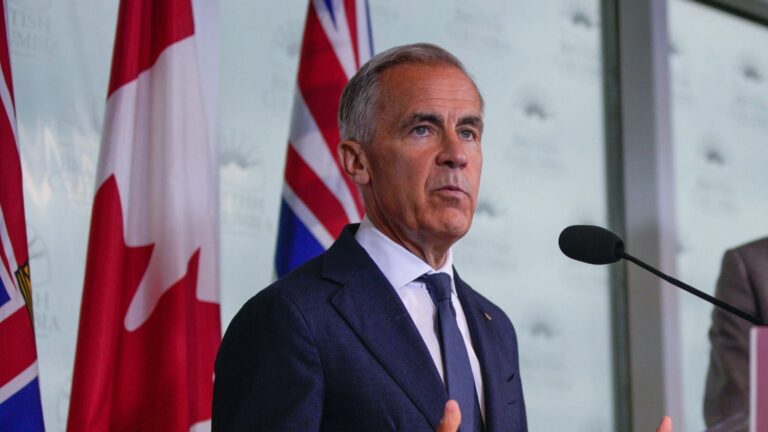
Prime Minister Mark Carney faces growing pressure to protect Canadian manufacturers, exporters, and workers from escalating trade restrictions. Yet Moore’s intervention raises a larger concern about whether accepting a compromise today could weaken Canada’s negotiating position tomorrow. At stake is not simply how quickly Ottawa can secure tariff relief, but whether the resulting agreement provides lasting economic stability.
Former Harper Minister Challenges Carney’s Trade Strategy
Former Harper Minister Questions Why Carney Is Pursuing Trump Tariff Deal Before New Democratic Congress Takes Power
- Former Harper Minister Challenges Carney’s Trade Strategy
- Democrats’ Midterm Victory Changes Washington’s Political Landscape
- Ottawa Is Pursuing a Deal Despite Unresolved Trade Disputes
- Trump’s January Tariff Threat Creates Immediate Pressure
- Moore Warns Canada Could Sacrifice Existing CUSMA Protections
- Questions Grow Over Transparency and Parliamentary Oversight
- Congressional Opposition to Trump’s Tariffs Is Already Taking Shape
- A Democratic Congress Cannot Simply Override Trump
- Canadian Workers and Businesses Have Much More at Stake Than Politics
- Carney Faces a Difficult Choice Between Immediate Relief and Long-Term Leverage
James Moore, who served as a cabinet minister under former prime minister Stephen Harper, has entered the Canada–U.S. trade debate with a series of pointed questions about Ottawa’s negotiating strategy. In a November 24 commentary, Moore questioned the wisdom of concluding an agreement with the Trump administration before the newly elected U.S. Congress takes office. His concern centres on timing, particularly because Democrats have captured both congressional chambers and signalled their intention to challenge Trump’s tariff policies.
Moore’s criticism goes beyond whether Canada can negotiate lower tariffs. He wants Canadians to understand what Ottawa might surrender in exchange for immediate relief, including whether existing trade protections could be weakened. He also questions whether a new agreement would provide meaningful safeguards against future American trade restrictions. For manufacturers considering investments and workers concerned about their livelihoods, these are substantial issues. A reduction in tariffs could offer immediate breathing room, but a deal that establishes permanent trade barriers could create problems lasting well beyond Trump’s presidency.
Democrats’ Midterm Victory Changes Washington’s Political Landscape
The November 3 U.S. midterm elections dramatically changed the balance of power in Washington. Democrats secured majorities in both the House of Representatives and the Senate, ending Republican control of Congress. By November 23, Democrats had won at least 258 House seats and secured a 56-seat Senate majority. The incoming Congress, scheduled to begin its term on January 3, 2027, will have greater authority to scrutinize the Trump administration and shape legislative priorities, including trade policy.
For Canada, the election creates a potential opening that did not exist earlier in negotiations. Democratic lawmakers have criticized tariffs for increasing costs and disrupting economic relationships, and their new majorities will give them control over congressional committees and legislative agendas. However, a change in congressional leadership does not automatically remove tariffs imposed through presidential authority. Trump will remain president, retaining significant control over trade decisions. That distinction complicates Moore’s argument: waiting could strengthen Canada’s bargaining position, but the new Congress cannot simply erase every trade restriction once Democrats take their seats.
Ottawa Is Pursuing a Deal Despite Unresolved Trade Disputes
Canada’s negotiations with Washington have regained momentum, although significant differences remain. On November 22, U.S. Trade Representative Jamieson Greer said the two countries were close to finding an acceptable compromise, describing recent discussions as constructive. Canadian officials have been more cautious. Chief trade negotiator Janice Charette has identified multiple outstanding issues, with automotive tariffs representing one of the biggest obstacles. Negotiations had previously collapsed in August after Ottawa rejected last-minute American demands, including proposed restrictions on Canada’s ability to negotiate trade agreements with other countries.
Canada–U.S. Trade Minister Dominic LeBlanc has indicated that Ottawa would like to reach an interim agreement before the end of 2026, but he has emphasized that the government is not committed to an artificial deadline. An agreement could come in January or February if additional negotiations are necessary. This distinction matters because the government’s position is not explicitly that Canada must sign before Democrats assume control of Congress. Instead, Ottawa appears focused on securing meaningful relief whenever acceptable terms become available. Moore’s challenge is whether the government should deliberately use the approaching congressional transition to strengthen its bargaining position.
Trump’s January Tariff Threat Creates Immediate Pressure
The strongest argument for moving quickly comes from the automotive sector. Following the collapse of trade negotiations in August, Trump threatened to increase tariffs on Canadian cars, trucks, and automotive parts to 50% beginning January 1, 2027, effectively doubling the existing 25% rate. Although the threatened increase had not been formally implemented as of late November, the prospect has created serious uncertainty for manufacturers. Companies operating factories on both sides of the border must plan production, purchasing, and investment decisions without knowing what their trade costs will look like in the new year.
The automotive threat also comes on top of existing tariffs affecting Canadian steel, aluminum, lumber, and other exports. In August, Washington imposed 50% duties under Section 338 of the Tariff Act of 1930 on approximately $27.6 billion worth of Canadian products, prompting Ottawa to introduce retaliatory measures. These overlapping restrictions help explain why Canadian officials want an interim agreement rather than an indefinite negotiating process. For businesses already facing higher costs, waiting for a potentially better political environment carries its own financial risks. The challenge is determining whether those risks outweigh the possibility of securing stronger protections in January.
Moore Warns Canada Could Sacrifice Existing CUSMA Protections
One of Moore’s most significant concerns involves the Canada–United States–Mexico Agreement, known as CUSMA. The agreement entered into force in July 2020 and continues to allow most qualifying Canadian goods to enter the American market duty-free. Although Washington has imposed tariffs on selected industries, large portions of bilateral trade still benefit from preferential treatment. Moore questions whether a new agreement might establish permanent minimum tariffs on products that currently enjoy exemptions, effectively converting temporary trade restrictions into accepted features of the Canada–U.S. relationship.
The concern is particularly important because CUSMA itself faces an uncertain future. During the agreement’s July 2026 joint review, the United States declined to renew it in its existing form, while Canada and Mexico supported an extension. The agreement remains legally in force, but additional reviews will continue unless all three countries agree on renewal. For Ottawa, accepting new tariff commitments outside that framework could complicate future negotiations. There is no public evidence that a finalized deal would necessarily eliminate existing exemptions, making this a potential risk rather than an established outcome. Nevertheless, Moore argues that the government needs to explain precisely what protections Canadians would retain before committing to new terms.
Questions Grow Over Transparency and Parliamentary Oversight
Moore has also raised concerns about how much information Canadians would receive before an agreement is finalized. He wants the government to disclose the proposed tariffs for individual industries, explain how they compare with conditions before the trade war, and identify which businesses or sectors were consulted. Another question is whether Parliament would have an opportunity to examine or vote on the agreement. Canada’s treaty-making procedures generally provide for agreements to be tabled in the House of Commons for 21 sitting days, although the precise requirements depend on the legal form of the arrangement and whether implementing legislation is necessary.
Equally important is what happens after the agreement is signed. Moore questions whether Canada could rely on enforceable dispute-resolution procedures or other protections if Washington imposed additional tariffs. A negotiated reduction would provide limited certainty if the American administration could subsequently increase duties without meaningful consequences. For a Canadian steel producer negotiating supply contracts or an automotive company planning a factory expansion, the reliability of a trade agreement can be as important as the tariff rate itself. Moore’s argument is that Canadians deserve to understand both the immediate concessions and the long-term enforcement mechanisms before Ottawa presents any agreement as a diplomatic success.
Congressional Opposition to Trump’s Tariffs Is Already Taking Shape
Moore’s argument is supported by developments on Capitol Hill. On February 11, the Republican-controlled House of Representatives voted 219 to 211 in favour of a resolution challenging Trump’s emergency tariffs on Canada. Six Republicans joined nearly all Democrats in supporting the measure, demonstrating that opposition to certain trade restrictions extends beyond party lines. Although the resolution did not ultimately remove the tariffs, it revealed divisions within Congress over the president’s approach. More recently, Hakeem Jeffries, who is positioned to become House Speaker, identified ending Trump’s tariffs as a priority for the incoming Democratic majority’s first 100 days.
The Senate could become another source of pressure. Oregon Democrat Ron Wyden, who is expected to lead the Senate Finance Committee, has identified tariffs on Canadian products as an early target for repeal. These developments suggest that Canada may soon have more influential supporters in Washington willing to challenge existing trade measures. For Moore, that strengthens the argument for allowing the congressional transition to unfold before making substantial concessions. New legislative initiatives, congressional hearings, and closer scrutiny of presidential trade powers could increase pressure on the administration. Whether those developments would produce meaningful concessions remains uncertain, but they represent opportunities Ottawa did not previously have.
A Democratic Congress Cannot Simply Override Trump
Despite the political advantages of waiting, congressional arithmetic presents an obstacle. Democrats will control both chambers, but they will not have the two-thirds majorities necessary to override a presidential veto without substantial Republican support. Most major Senate legislation also faces procedural requirements that can demand 60 votes to advance. Trump has already emphasized his willingness to use his veto against Democratic legislation. As a result, even a Congress determined to dismantle his tariff policies could struggle to deliver immediate relief. The incoming majority can increase scrutiny and introduce legislation, but turning political opposition into enforceable changes will require cooperation that is far from guaranteed.
Some Democrats have therefore encouraged Canada to pursue a different approach. Delaware Senator Chris Coons told CBC’s Power & Politics on November 20 that Ottawa should accept a worthwhile interim agreement and allow the new Congress to pursue stronger long-term arrangements afterward. LeBlanc has expressed similar caution about assuming a Democratic majority will automatically solve Canada’s trade problems. The difference between this position and Moore’s argument is significant. One approach prioritizes immediate reductions while preserving opportunities for future negotiations. The other emphasizes the danger of accepting concessions before the balance of political power changes. Neither strategy guarantees a favourable result.
Canadian Workers and Businesses Have Much More at Stake Than Politics
The economic consequences of prolonged trade restrictions are already substantial. In its October 2026 assessment, Canada’s Parliamentary Budget Officer estimated that trade measures introduced since early 2025 could leave the country’s real GDP approximately 1.4% lower after five years than it would have been under a pre-tariff trading relationship. If the tariffs became permanent, the analysis projected employment could decline by as many as 185,000 jobs at the peak of their impact, compared with that baseline. These are economic projections rather than confirmed job losses, but they illustrate the potential cost of allowing trade barriers to become entrenched.
The wider labour market is also showing signs of strain. Statistics Canada reported that employment declined by 4,700 positions in October, while the unemployment rate increased to 6.7%. Those national figures cannot be attributed solely to tariffs, but they provide context for the pressure facing policymakers. In manufacturing communities, uncertainty surrounding cross-border trade affects businesses that depend on predictable production schedules and access to American customers. A supplier deciding whether to purchase equipment or expand its workforce may hesitate when future tariffs remain unknown. For Carney, the immediate employment risks make delaying negotiations difficult, even when waiting could potentially produce better political leverage.
Carney Faces a Difficult Choice Between Immediate Relief and Long-Term Leverage
Carney’s government is attempting to balance the need for short-term economic stability against the importance of protecting Canada’s long-term trade interests. In August, the prime minister emphasized that Ottawa would not accept an agreement at any price or simply to meet a deadline. More recently, Carney and Trump discussed their ongoing negotiations during a November 18 meeting in Shenzhen, China, agreeing to continue working toward a mutually beneficial arrangement. LeBlanc has suggested that an interim agreement could reduce existing tariffs and help restart formal CUSMA negotiations, potentially creating opportunities for further improvements.
The central question is whether such an arrangement would strengthen Canada’s position or restrict its future options. A narrowly defined interim agreement that delivers immediate tariff relief while preserving existing trade rights could offer valuable protection for Canadian businesses. A broader agreement that permanently accepts higher trade barriers or limits Canada’s economic independence would deserve considerably more scrutiny. As of November 26, no finalized agreement has been publicly announced. Moore’s intervention highlights why the details matter more than the prospect of a signing ceremony. With a Democratic Congress approaching and major Canadian industries facing continued uncertainty, the government must weigh the benefits of acting quickly against the possibility that waiting could produce a more durable and favourable agreement.
This Options Discord Chat is The Real Deal
While the internet is scoured with trading chat rooms, many of which even charge upwards of thousands of dollars to join, this smaller options trading discord chatroom is the real deal and actually providing valuable trade setups, education, and community without the noise and spam of the larger more expensive rooms. With a incredibly low-cost monthly fee, Options Trading Club (click here to see their reviews) requires an application to join ensuring that every member is dedicated and serious about taking their trading to the next level. If you are looking for a change in your trading strategies, then click here to apply for a membership.