35,000+ smart investors are already getting financial news, market signals, and macro shifts in the economy that could impact their money next with our FREE weekly newsletter. Get ahead of what the crowd finds out too late. Click Here to Subscribe for FREE.
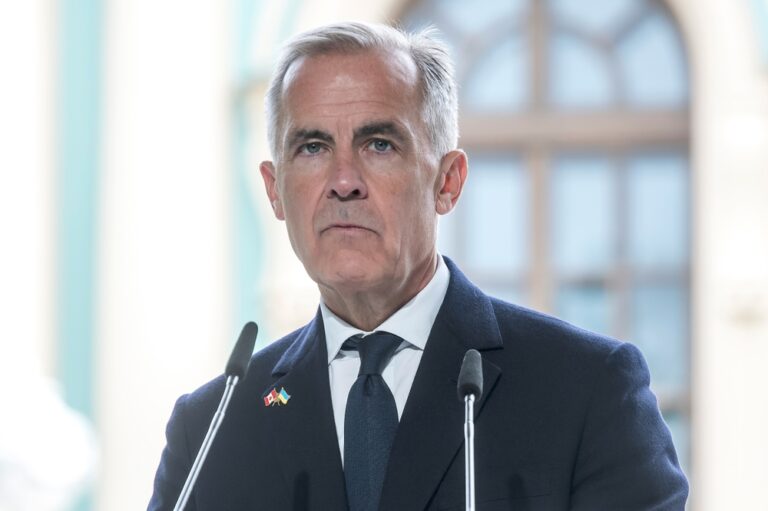
Canada’s trade debate has stopped sounding abstract. When Prime Minister Mark Carney warned in Vancouver that the country has “fallen way behind” on port productivity, he was pointing to something larger than cranes, docks, and containers. Ottawa’s push to reduce economic dependence on the United States now runs straight through marine terminals, rail links, and inland corridors that were built for an older trading reality.
That makes ports a sovereignty story as much as a logistics one. Canada can sign new agreements, court new buyers, and talk about resilience, but none of that matters much if goods cannot move quickly, predictably, and at scale. The pressure on Ottawa is no longer just to diversify trade on paper. It is to build the physical system that makes diversification real.
A Wake-Up Call From Vancouver
Carney Says Canada Has ‘Fallen Way Behind’ on Ports as Ottawa Races to Escape U.S. Dependence
- A Wake-Up Call From Vancouver
- The Old Model Still Dominates
- Ports Are Really Productivity Machines
- Canada’s Maritime Position Has Slipped
- The West Coast Is Canada’s Fastest Route to Diversification
- The East Coast and St. Lawrence Are Not Secondary Stories
- Corridors Fail When One Link Breaks
- The Arctic Is Starting to Move From Concept to Corridor
- Speed Will Mean Very Little Without Trust
- What Success Would Actually Look Like
Carney’s warning landed because it was unusually blunt. He did not describe ports as a long-term modernization issue or a technical problem to be studied. He described them as a national weakness that now stands in the way of economic resilience. That framing matters. For years, Canadian conversations about trade infrastructure often felt regional, with West Coast port issues treated as a B.C. concern and St. Lawrence expansion framed as a Quebec file. Carney’s remarks pulled those threads together into a national story: Canada cannot seriously talk about escaping U.S. dependence if its own trade corridors are too slow, too fragmented, or too vulnerable to disruption.
There is also a practical truth behind the rhetoric. A port is only as useful as the system attached to it. Ships can arrive on time, but if containers sit too long, rail connections are weak, or inland bottlenecks pile up, the value of that marine access fades quickly. That is why Carney singled out both port capacity and rail interconnections. It was a reminder that the real competition is not only between countries, but between supply chains. The exporter that gets product to Asia or Europe faster and more reliably usually wins the customer, even before price enters the conversation.
The Old Model Still Dominates
Canada’s problem is not that it lacks trading partners. It is that the United States still towers over the country’s export map. Even after recent efforts to widen the customer base, Reuters reported in April 2026 that Canada still sends nearly 70% of its exports to the U.S. Statistics Canada’s numbers showed some movement away from that concentration in 2025, but not a clean break: the U.S. share of Canadian exports fell to 68.3% in May 2025, down from a 2024 monthly average of 75.9%. That is meaningful progress, but it still leaves Canada heavily exposed to policy shocks, tariff threats, and political mood swings south of the border.
That exposure is bigger than trade headlines. Global Affairs Canada says trade represents roughly two-thirds of Canada’s GDP, while exports alone support nearly 3.3 million jobs. In other words, this is not a narrow issue for shipping executives or port authorities. It reaches factory floors, grain movements, auto supply chains, mining operations, and household costs. A country can live comfortably with deep U.S. integration when the relationship is predictable. It becomes far more uncomfortable when access feels conditional, volatile, or openly politicized. That is why Ottawa’s current diversification drive has a different urgency than older versions. It is less about chasing optional growth and more about reducing strategic vulnerability.
Ports Are Really Productivity Machines
Ports are often discussed as physical gateways, but their bigger economic role is productivity. When goods move quickly from ship to rail to warehouse to final buyer, capital turns faster, inventories shrink, and businesses can plan with more confidence. When that flow slows down, costs rise quietly and then all at once. Transport Canada’s new Trade Diversification Corridors Fund was designed around exactly that logic. Its stated purpose is not simply to pour concrete. It aims to expand trade infrastructure, reduce delays, and close the gaps that hold back national and regional growth.
That distinction is important because Canada’s challenge is not only about having enough space at the waterfront. It is also about moving goods efficiently across a huge geography. A manufacturer in Ontario, a grain exporter in Saskatchewan, and a mineral producer in northern Canada all depend on a corridor, not just a terminal. If the corridor works, overseas diversification becomes plausible. If it does not, new foreign demand can end up exposing old domestic weaknesses. That is why the current push around ports has started to sound like a productivity agenda. Ottawa is implicitly acknowledging that a slower logistics system is not just inconvenient. It is a tax on national competitiveness.
Canada’s Maritime Position Has Slipped
The Bank of Canada gave Carney’s political argument a hard statistical backbone. In a May 2026 analysis, the Bank found that between 2016 and 2023 Canada’s top five ports all became less central in global shipping networks. That may sound technical, but the underlying point is simple: Canada became less directly connected to the major routes that move goods around the world. That matters because indirect routes usually mean longer transit times, more reliance on foreign hubs, and greater exposure when something goes wrong elsewhere in the chain.
The numbers are even more striking when measured by shipping capacity. The Bank found that total deadweight tonnage moving through Canadian ports fell from 167 million metric tons in 2016 to 119 million in 2023, a 28% decline. Over that same span, Canada’s global ranking by that measure dropped from sixth to twenty-third. Those are not the numbers of a country comfortably positioned for a new era of global trade competition. They suggest a country that is still important, but less central than it used to be, at a time when centrality increasingly shapes cost, resilience, and bargaining power. Carney’s warning sounded political, but the central bank’s research suggests it was also descriptively accurate.
The West Coast Is Canada’s Fastest Route to Diversification
If Ottawa wants quicker access to Asia, the West Coast is the most obvious place to start. Vancouver remains the country’s largest port and a vital outlet for commodities, containerized imports, and energy shipments. Business in Vancouver reported that the Port of Vancouver handled a record 170.4 million metric tonnes of cargo in 2025, helped by stronger trade with Indo-Pacific markets. That kind of volume matters because it shows demand for non-U.S. trade routes is not theoretical. The traffic is there. So is the strategic logic.
Prince Rupert tells a similar story from a different scale. The Prince Rupert Port Authority said the port handled 26.3 million tonnes of cargo in 2025, up 14% from the previous year, while intermodal traffic at Fairview Container Terminal climbed 20% to 885,797 TEUs. Port leadership also tied that performance directly to diversification, noting that roughly $60 billion in trade flows through the gateway annually. The message from the Pacific coast is fairly clear: Canada already has assets that can serve a broader trade strategy. The challenge is to add enough capacity, reliability, and downstream connections so those assets do not become new chokepoints just as Ottawa asks more of them.
The East Coast and St. Lawrence Are Not Secondary Stories
The tendency in Canadian trade debates is to treat diversification as mostly a Pacific question, but the eastern network may end up being just as important. Montreal, Halifax, and the wider St. Lawrence system offer Canada routes to Europe, the Mediterranean, and beyond. They also provide redundancy, which matters in a world where resilience is now part of economic strategy. The Port of Montreal has become central to that conversation. Carney personally broke ground on the Contrecœur terminal expansion in April 2026, and the project is enormous by Canadian standards. Ottawa says it will add up to 1.15 million TEUs of annual capacity and increase the port’s capacity by 60%, making it the largest eastern port expansion in Canadian history.
The project also shows what Ottawa means when it talks about nation-building infrastructure. The Port of Montreal says Contrecœur could create about 4,000 jobs during construction and generate roughly $1.5 billion a year in business revenue once operational. Halifax is also showing why the East matters. The Halifax Port Authority reported 502,000 TEUs in containerized cargo for 2025, with measurable growth in trade from China, India, Bangladesh, and Vietnam. That matters because diversification is not only about replacing U.S. trade. It is also about widening Canada’s commercial map in multiple directions at once. East Coast strength gives Ottawa more than additional capacity. It gives the country strategic flexibility.
Corridors Fail When One Link Breaks
One lesson of the past few years is that Canada does not need a total system collapse to suffer major supply-chain pain. It only needs one critical link to fail. That is why Carney’s reference to rail interconnections was so important. The waterfront can function well, but if rail access is jammed, work stops anyway. The older National Trade Corridors Fund recognized that reality by funding not just ports, but also railways, access roads, and related transportation facilities. The newer diversification push follows the same logic on a larger scale. Ottawa is finally talking about gateways and corridors as one system instead of treating them as separate policy boxes.
The country has learned this the hard way. A House of Commons committee report on the 2023 British Columbia ports strike said Transport Canada officials estimated recovery took four to six weeks, while industry groups said some backlogs lingered for two or three months. That is a long aftershock from a relatively short disruption. It also helps explain why businesses keep returning to the same complaint: Canada can be rich in resources and market access, yet still lose credibility if moving goods feels fragile. For an exporter, reliability often matters almost as much as price. A corridor that works only when conditions are perfect is not a serious foundation for a diversification strategy.
The Arctic Is Starting to Move From Concept to Corridor
One of the more interesting shifts in Ottawa’s thinking is that the Arctic is no longer being discussed only in terms of sovereignty or defence. It is increasingly being framed as trade infrastructure too. Transport Canada’s Arctic Infrastructure Fund, worth $1 billion, is explicitly aimed at dual-use transportation projects such as roads, ports, airports, and bridges that can support both community priorities and national strategic needs. That language is telling. It suggests Ottawa now sees northern transport links not as remote extras, but as part of the country’s future economic architecture.
The Grays Bay Road and Port project is a useful example. Ottawa recently approved up to $50 million in planning and preconstruction support through the First and Last Mile Fund to advance the proposed deepwater Arctic port and a roughly 230-kilometre all-season road. The Major Projects Office describes it as an Inuit-linked project with the potential to create critical export links, support mineral development, and eventually help establish the first all-season road connection linking Nunavut to the National Highway System. That does not make it simple or quick. But it does show how far the conversation has moved. Northern infrastructure is no longer only about access. It is increasingly about trade routes, mineral strategy, and long-term resilience.
Speed Will Mean Very Little Without Trust
The political temptation in moments like this is to talk only about acceleration. Canada wants projects built faster, reviews shortened, and bottlenecks removed. But the projects most often cited in this debate are also the ones that show why trust matters as much as speed. Transport Canada’s current consultation on strengthening trade and transportation runs from May 8 to June 7, 2026, and specifically says the government is looking for input from First Nations, Inuit, and Métis governments and rights holders alongside industry. That is not just process language. It is a recognition that major corridor projects will not endure if they are seen as imposed rather than built in partnership.
The details of real projects point in the same direction. The Major Projects Office says the Grays Bay initiative involves ongoing community consultations and Indigenous-led studies to reduce impacts on wildlife and marine ecosystems. The Port of Montreal’s Contrecœur material likewise emphasizes community integration and environmental processes. Those points may sound less dramatic than speeches about economic sovereignty, but they are central to whether Ottawa’s agenda succeeds. Canada does not simply need faster approvals. It needs approvals that are durable enough to survive legal, political, and social scrutiny. Otherwise, every attempt to move quickly risks becoming another long delay by different means.
What Success Would Actually Look Like
Success for Ottawa will not be measured by announcements alone. It will show up in quieter signals: more direct sailings, fewer inland delays, stronger east-west redundancy, and export growth that does not rely on one market absorbing nearly everything Canada sells. It will also show up when businesses stop treating logistics workarounds as a normal cost of doing business. A prairie producer should not have to wonder whether a distant strike, a crowded terminal, or a weak rail handoff will erase the advantage of winning a customer overseas.
There are already hints that diversification demand exists. Statistics Canada said exports to countries other than the United States reached a record high in May 2025, even as the U.S. share of exports fell. That should encourage Ottawa, but it should also sharpen the pressure. Demand without capacity only creates new frustration. Carney is right that ports now sit at the heart of Canada’s economic resilience debate. The harder question is whether Ottawa can turn that diagnosis into an enduring logistics upgrade rather than another burst of urgency that fades once the headlines move on.
This Options Discord Chat is The Real Deal
While the internet is scoured with trading chat rooms, many of which even charge upwards of thousands of dollars to join, this smaller options trading discord chatroom is the real deal and actually providing valuable trade setups, education, and community without the noise and spam of the larger more expensive rooms. With a incredibly low-cost monthly fee, Options Trading Club (click here to see their reviews) requires an application to join ensuring that every member is dedicated and serious about taking their trading to the next level. If you are looking for a change in your trading strategies, then click here to apply for a membership.