35,000+ smart investors are already getting financial news, market signals, and macro shifts in the economy that could impact their money next with our FREE weekly newsletter. Get ahead of what the crowd finds out too late. Click Here to Subscribe for FREE.
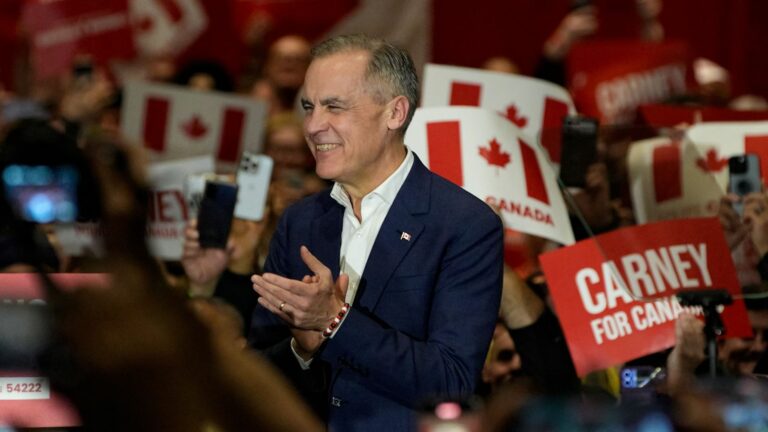
Prime Minister Mark Carney has revealed that he and U.S. President Donald Trump have spoken “a couple of times” in recent days, an unexpectedly active line of communication at a moment when the economic relationship between their countries is becoming more confrontational. Carney said the conversations touched on Ukraine, Iran and other international developments, while offering few details about whether the leaders discussed their escalating trade dispute.
The timing matters. Formal trade negotiations broke down in August, Canada has since imposed a fresh round of counter-tariffs, and Washington has answered with additional restrictions on Canadian products. Yet the two leaders are still talking. That does not amount to a trade breakthrough, but it shows that one of the world’s most economically integrated relationships has not lost its highest-level diplomatic channel.
The Calls Show the Relationship Is Not Completely Frozen
Carney Reveals ‘a Couple’ of Recent Calls With Trump Even as Canada–U.S. Trade War Deepens
- The Calls Show the Relationship Is Not Completely Frozen
- The Breakdown in Trade Talks Was Only Weeks Ago
- Washington Has Since Taken the Fight Beyond Ordinary Tariffs
- Canada’s Own Counter-Tariffs Are Now Fully in the Fight
- The Trade Numbers Explain Why Neither Side Can Simply Walk Away
- Ukraine and Iran Show Why the Relationship Is Bigger Than Trade
- The Costs of Escalation Eventually Reach Businesses and Households
- The Phone Calls Preserve an Off-Ramp, but They Are Not Yet a Breakthrough
Carney disclosed the recent conversations during a September 10 media appearance with Ukrainian President Volodymyr Zelenskyy in Calgary. He said he remained in regular contact with Trump and had spoken with him several times during the preceding days. The topics Carney identified included Ukraine, Iran and other global developments. Reuters reported that he offered no additional details, while the Prime Minister’s Office separately confirmed that contact between the two leaders had taken place. That distinction is important because Canadians looking for evidence of renewed trade negotiations did not receive confirmation that formal bargaining had restarted.
Instead, Carney presented the conversations as an example of governments continuing to work together where their interests overlap. The Canadian Press reported that he described the ability to separate international cooperation from the bilateral trade fight. That is a striking position considering how quickly commercial relations have deteriorated. Ottawa and Washington are exchanging tariffs and trade restrictions, but the premiers, ministers and businesses affected by those decisions still operate inside an extraordinarily interconnected North American economy. Leader-to-leader communication therefore offers a diplomatic pressure valve even when the negotiating table itself remains largely empty.
The Breakdown in Trade Talks Was Only Weeks Ago
The calls come less than a month after Carney ordered Canadian negotiators home. On August 21, he announced that Canada was suspending trade negotiations after what Ottawa described as last-minute changes to the U.S. position. The government said those proposed terms were unfair, economically damaging and serious enough to raise questions about whether an agreement would provide the stability Canadian companies needed. Washington was preparing at the same time to impose 50 per cent tariffs on roughly C$28 billion worth of Canadian goods.
Carney expanded on the rupture the next day. He said Canada had been prepared to make significant concessions as part of a broader agreement, including removing retaliatory measures affecting steel, aluminum and autos if Washington substantially lowered its own tariffs. Ottawa was also prepared to encourage provinces to restore U.S. alcohol to store shelves. There were limits, however. Carney said Canada would not compromise sovereignty, strategic industries, supply management itself or protections connected with French language and culture. The disagreement therefore went beyond the headline tariff rate. It became a fight over how much policy freedom Canada would surrender in return for greater access to its largest export market.
Washington Has Since Taken the Fight Beyond Ordinary Tariffs
The confrontation intensified again on September 8. The White House announced five presidential proclamations responding to Canada’s retaliation, including measures designed to exclude certain Canadian alcoholic beverages, dairy products and motor-vehicle-related goods from the U.S. market. The import bans are scheduled to apply beginning September 29, while other changes to the products covered by U.S. tariffs are set to begin September 15. That creates a more complicated commercial environment than a simple across-the-board tariff, because some exporters could face complete loss of access for particular products rather than merely paying a higher border charge.
Washington also moved against Canadian participation in U.S. federal procurement. The White House said Trump directed the U.S. Trade Representative and General Services Administration to remove Canadian-origin products from the GSA Multiple Award Schedules, a procurement system that manages more than US$50 billion in federal purchasing. Yet Carney’s immediate public response was comparatively restrained. Associated Press reported that he characterized the latest measures as “relatively modest” in the broader context of the dispute and did not signal an automatic new round of retaliation. That restraint suggests Ottawa is trying to preserve room for negotiation rather than answering every American measure immediately with another escalation.
Canada’s Own Counter-Tariffs Are Now Fully in the Fight
Canada is hardly standing still. Effective September 8, Ottawa introduced counter-tariffs of 15, 25 and 50 per cent on C$27.6 billion worth of U.S. imports. The federal government says the rates were designed to match the corresponding American measures dollar for dollar and rate for rate. Targeted products include goods in sectors such as steel, dairy, appliances, agricultural equipment, pulp and paper and electronics. Canadian counter-tariffs already applied to other areas, including autos, and those measures remain in place.
Ottawa paired the tariffs with a C$7.5 billion package intended to cushion businesses and workers from the disruption. It includes another C$1.5 billion for the Regional Tariff Response Initiative, C$500 million in additional Business Development Bank of Canada liquidity, C$2 billion for a diversification fund and C$3.5 billion in rapid-response support for workers and employers. The government says those measures build on nearly C$25 billion in support introduced since U.S. tariffs began affecting Canadian industries. For a manufacturer facing weaker American orders or a small supplier suddenly paying more for imported components, those programs may matter almost as much as the political argument over who started the dispute.
The Trade Numbers Explain Why Neither Side Can Simply Walk Away
Canada has made diversification a central part of its response, and there is evidence that trade patterns are already changing. Statistics Canada reported that Canadian merchandise exports to the United States fell 6.6 per cent in July, the largest percentage decline since April 2025. The bilateral merchandise trade surplus narrowed sharply, falling from C$10.3 billion in June to C$5.9 billion in July. Those monthly numbers can be volatile, but they illustrate how quickly shifts in energy, vehicles and other major categories can move the overall relationship.
At the same time, Canadian exports to markets outside the United States rose 7.4 per cent in July to a record C$25.6 billion, accounting for 33.7 per cent of merchandise exports that month. That is an important sign of diversification, but it should not be mistaken for independence from the American market. For all of 2025, the United States still received 71.7 per cent of Canadian merchandise exports, down from 75.9 per cent in 2024. In other words, Canada is successfully selling more elsewhere while remaining deeply exposed to decisions made in Washington. That combination helps explain why Carney can advocate economic independence and still keep Trump’s number close at hand.
Ukraine and Iran Show Why the Relationship Is Bigger Than Trade
The substance Carney publicly attached to his Trump conversations was international security rather than tariffs. That was particularly relevant on September 10 because Zelenskyy was visiting Canada. Ottawa says Canada has provided more than C$8.5 billion in military assistance to Ukraine since Russia’s full-scale invasion, along with more than C$750 million for recovery and reconstruction. During the Calgary meeting, Carney and Zelenskyy discussed air defence, drone production, energy security and additional military assistance as Ukraine prepares for another difficult winter.
That context helps explain why communication with Washington continues even while the economic relationship deteriorates. The United States remains central to Western efforts involving Ukraine and is also a dominant actor in the conflict with Iran that Carney said had featured in his conversations with Trump. Canada cannot treat those security relationships as though they disappear whenever tariffs rise. The same governments arguing about cars, steel, dairy products and procurement rules may need to coordinate hours later on war, sanctions, energy markets or continental security. The ability to compartmentalize is therefore more than a diplomatic talking point; it is increasingly a practical requirement of a relationship under stress.
The Costs of Escalation Eventually Reach Businesses and Households
Tariff fights often sound abstract until higher border costs begin appearing in business invoices or retail prices. Bank of Canada researchers examined an earlier round of Canadian retaliatory tariffs using daily price information from seven major retailers. Their June 2026 working paper found that prices of tariffed goods rose gradually and peaked about 6 per cent higher after three months. The researchers estimated that roughly one-quarter of the 25 per cent tariff examined in their study was passed through to retail prices. Those findings do not predict the precise effect of the newest measures, but they demonstrate that tariffs do not simply remain at customs checkpoints.
The wider economic uncertainty matters as well. In its July outlook, the Bank of Canada identified the evolution of the Canada–U.S. trade relationship, alongside the Middle East conflict, as one of the most important risks facing inflation. It warned that prolonged trade uncertainty could weaken business investment and household spending and contribute to layoffs in exposed sectors. Those risks help put Carney’s relatively measured response into perspective. Ottawa wants leverage against Washington, but each additional restriction can also generate costs at home. Maintaining direct contact with Trump therefore serves an economic purpose even before any formal negotiations resume.
The Phone Calls Preserve an Off-Ramp, but They Are Not Yet a Breakthrough
The larger question is whether regular contact can eventually reopen a path toward a trade settlement. The institutional framework has not disappeared. Canada, the United States and Mexico conducted the first mandatory CUSMA joint review on July 1. Washington declined to renew the agreement in its current form, but CUSMA itself remains in force and Canada says it can continue until 2036. That matters enormously because Canadian and U.S. trade in goods and services reached roughly C$3.5 billion per day in 2025. Untangling that relationship would involve factories, energy networks, farms, transportation systems and investment flows spread across both countries.
Carney is also still publicly leaving the door open. Reporting on his September 10 comments said he reiterated that Canada remained prepared to strike a fair agreement with the United States. What has not happened is equally important: there has been no confirmed announcement that the suspended negotiations have formally restarted, and Carney did not reveal a new tariff compromise emerging from his calls with Trump. For now, the conversations are best understood as a channel rather than a settlement. They show that political communication has survived the trade war. Whether that channel becomes the route back to serious negotiations will depend on what Ottawa and Washington are willing to change once the conversation turns from Ukraine and Iran back to tariffs.
This Options Discord Chat is The Real Deal
While the internet is scoured with trading chat rooms, many of which even charge upwards of thousands of dollars to join, this smaller options trading discord chatroom is the real deal and actually providing valuable trade setups, education, and community without the noise and spam of the larger more expensive rooms. With a incredibly low-cost monthly fee, Options Trading Club (click here to see their reviews) requires an application to join ensuring that every member is dedicated and serious about taking their trading to the next level. If you are looking for a change in your trading strategies, then click here to apply for a membership.