35,000+ smart investors are already getting financial news, market signals, and macro shifts in the economy that could impact their money next with our FREE weekly newsletter. Get ahead of what the crowd finds out too late. Click Here to Subscribe for FREE.
Canada is making a major pitch to Asian energy buyers, and Prime Minister Mark Carney wants a proposed pipeline carrying one million barrels of oil a day to become part of that relationship.
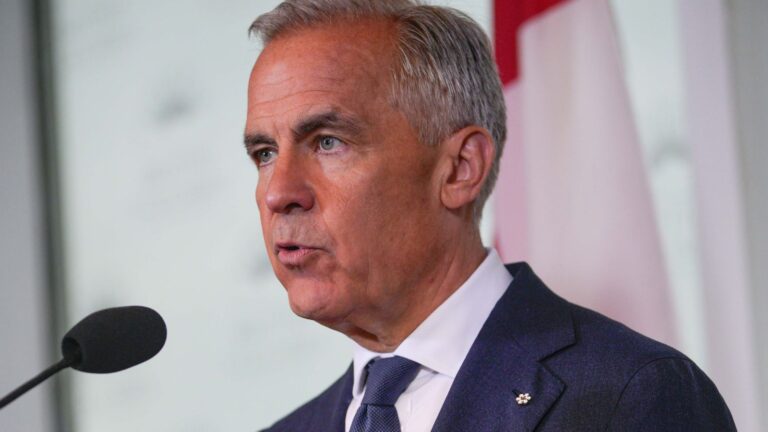
Speaking at the Asia-Pacific Economic Cooperation (APEC) CEO Summit in Shenzhen, China, on November 18, 2026, Carney promoted the Pacific Link pipeline as a way to connect Alberta’s oil industry directly with international customers and reduce Canada’s overwhelming dependence on the United States.
The proposal comes at a critical moment for Canadian trade. Despite growing exports to Asia, the United States still purchased more than 90% of Canada’s crude oil exports in 2025.
With billions of dollars in potential investment, thousands of projected jobs, and significant environmental and legal challenges, Pacific Link represents much more than another energy project. It is becoming a major test of Canada’s economic independence.
Carney Takes Canada’s Pipeline Pitch Directly to Asian Business Leaders
Carney Pitches 1-Million-Barrel-a-Day Oil Pipeline to Asia as Canada Tries to Cut U.S. Dependence
- Carney Takes Canada’s Pipeline Pitch Directly to Asian Business Leaders
- The United States Still Dominates Canada’s Oil Exports
- The Proposed Pipeline Would Stretch 1,250 Kilometres to British Columbia
- Trans Mountain Has Already Demonstrated the Potential of Asian Oil Exports
- Asian Buyers Could Give Canada More Options in a Competitive Global Market
- Ottawa Hopes More Export Competition Will Strengthen Canadian Oil Prices
- The Pipeline Carries an Estimated Price Tag of Up to $43.7 Billion
- Ottawa Projects Major Economic Benefits, but the Jobs Are Not Guaranteed
- British Columbia and First Nations Remain Central to the Project’s Future
- Climate Concerns and Construction Timelines Will Shape What Happens Next
Prime Minister Mark Carney used his November 18 appearance at the APEC CEO Summit in Shenzhen to promote Canada as a reliable supplier of energy to the Asia-Pacific region. Among the projects highlighted was Pacific Link, a proposed pipeline designed to transport an additional one million barrels of Canadian crude oil daily to the Pacific coast. Carney presented the development as part of Canada’s effort to expand international trade relationships rather than continue relying so heavily on American customers.
The setting was significant. Instead of making the announcement exclusively to a domestic audience, Carney was speaking directly to business leaders from economies that Canada hopes will purchase more of its energy. He described Canada as a Pacific nation and emphasized the opportunities created by stronger regional partnerships.
The prime minister also highlighted Canada’s growing liquefied natural gas industry, saying shipments to Asia had exceeded 11 million tonnes since LNG Canada’s first export in June 2025. He outlined ambitions to quadruple Asian LNG exports by the end of the decade, positioning Pacific Link within a broader effort to make Canadian energy more competitive internationally.
The United States Still Dominates Canada’s Oil Exports
Canada’s dependence on American oil customers remains one of the defining features of its energy industry. According to the Canada Energy Regulator, the country exported approximately 4.3 million barrels of crude oil per day in 2025. Of that total, 90.1%, or roughly 3.9 million barrels daily, went to the United States. Canadian crude exports were valued at approximately $140 billion that year, with $126.1 billion attributable to American customers.
The relationship developed over decades because of geography, established pipelines, and refinery investments. Many facilities in the American Midwest and Gulf Coast are specifically equipped to process heavier grades of Canadian crude. Canada also supplied 63.4% of all crude oil imported by the United States in 2025, illustrating how closely connected the two energy markets remain.
However, economic integration creates vulnerabilities when trade policies change. American tariffs, shifting political priorities, and transportation constraints can affect Canadian producers even when demand remains strong. Pacific Link is designed to provide another major export option, allowing producers to diversify their customer base without abandoning the American market that continues to support much of Canada’s oil industry.
The Proposed Pipeline Would Stretch 1,250 Kilometres to British Columbia
Pacific Link would be one of Canada’s largest new energy infrastructure projects. Federal planning documents describe a pipeline approximately 1,250 kilometres long, beginning near Bruderheim, Alberta, northeast of Edmonton, and extending westward to a proposed deepwater marine terminal near Delta, British Columbia. The system would carry approximately one million barrels of crude oil per day, primarily serving international export markets.
The proposed infrastructure includes a receiving terminal in Alberta, approximately 11 pumping stations, storage facilities, and marine loading infrastructure capable of handling very large crude carriers. These ships would transport Canadian oil across the Pacific to overseas refineries. The project would largely follow existing transportation corridors associated with the Trans Mountain pipeline, although its precise alignment remains subject to engineering studies, consultation, and regulatory conditions.
The southern route is particularly important because the federal government has committed to maintaining the oil tanker ban along British Columbia’s northern coast. Rather than pursue a northern export terminal, Ottawa and Alberta are concentrating on access through southern British Columbia. Even with existing infrastructure nearby, constructing a new pipeline and marine terminal remains a technically demanding undertaking involving mountains, rivers, communities, and sensitive ecosystems.
Trans Mountain Has Already Demonstrated the Potential of Asian Oil Exports
Canada’s existing Trans Mountain system provides an early example of what expanded access to Pacific markets can accomplish. The Trans Mountain Expansion Project began operating in May 2024, increasing the system’s transportation capacity from approximately 300,000 barrels per day to 890,000 barrels. The expansion allowed western Canadian producers to move substantially more crude oil to British Columbia for shipment to international customers.
The results are visible in national export figures. Canada Energy Regulator data show that crude oil exports to countries other than the United States reached approximately 403,000 barrels per day in 2025, compared with about 90,000 barrels daily in 2021. That increase reflected a meaningful shift in Canada’s ability to reach customers beyond North America.
China has emerged as an especially important destination. Research published by the Canada China Business Council and the University of Alberta’s China Institute shows Canadian crude exports to China reached approximately $3.54 billion during the third quarter of 2026, an increase of 158.6% from the same period a year earlier. Export volumes approached 327,000 barrels daily. Those figures demonstrate that demand for Canadian oil already exists in Asia, although future sales still depend on pricing and competition.
Asian Buyers Could Give Canada More Options in a Competitive Global Market
China is not the only prospective customer for additional Canadian crude. Japan and South Korea are also important Asian refining markets, and industry reporting indicates that both countries have increased their interest in Canadian oil shipments. For refiners seeking reliable supplies, Canada offers a politically stable source of crude that can complement purchases from the Middle East, the United States, and other producing regions.
Supply security has become increasingly important amid disruptions to international energy shipping routes. Asian refiners have faced higher transportation costs and uncertainty surrounding crude deliveries from the Middle East. Having access to additional Canadian shipments could provide flexibility when traditional supply routes experience interruptions. That does not guarantee contracts, however. Canadian producers must still compete on price, crude quality, transportation costs, and delivery reliability.
Long-term demand also presents uncertainty. The International Energy Agency’s November 2026 outlook forecast a decline of approximately 2.7 million barrels per day in global oil demand during 2026, followed by a projected recovery of two million barrels daily in 2027. Such changes underline why a pipeline designed to operate for decades must be evaluated against multiple possible market conditions, rather than assuming Asian demand will continuously increase.
Ottawa Hopes More Export Competition Will Strengthen Canadian Oil Prices
One of the economic arguments for Pacific Link concerns the prices Canadian producers receive for their crude. Western Canadian Select, a major benchmark for Canada’s heavy oil, typically trades below the American West Texas Intermediate benchmark. The difference reflects crude quality, transportation expenses, refinery requirements, and market conditions. Limited export capacity can make that discount larger by reducing the number of destinations available to Canadian producers.
The financial consequences can be substantial. In early November 2026, Western Canadian Select was trading more than US$30 per barrel below West Texas Intermediate, according to Reuters reporting on Canadian producer Cenovus Energy. Although industry executives attributed much of the weakness to global market conditions, the widening discount highlighted the commercial pressures facing western Canadian producers.
Supporters argue that another Pacific export route would give producers additional bargaining power by expanding access to international buyers. However, more pipeline capacity does not automatically eliminate discounts, since heavy crude will continue to have different processing and transportation costs. Carney’s larger strategy is to double Canada’s exports to non-U.S. markets over the coming decade. The goal is greater commercial flexibility and resilience, not an immediate end to the deeply established Canada-U.S. energy relationship.
The Pipeline Carries an Estimated Price Tag of Up to $43.7 Billion
Building Pacific Link would require an enormous financial commitment. Federal planning documents estimate the project could cost between C$35.2 billion and C$43.7 billion, including contingencies but excluding some potential escalation and financing costs. That means the eventual total could change as engineering, construction schedules, labour requirements, and financing arrangements become clearer.
Ottawa and Alberta have outlined a shared public ownership structure, while Pembina Pipeline Corporation has proposed taking a 10% economic interest during construction, with the opportunity to increase its stake after operations begin. Trans Mountain Corporation is expected to lead development and construction. However, Pembina’s participation remains subject to a final investment decision, and major commercial arrangements have yet to be completed.
Independent financial analysis illustrates the risks. Scotiabank’s October 2026 assessment modelled a base-case completion in 2034 at approximately C$43.7 billion. Its downside scenario estimated costs could reach C$65.6 billion if construction delays and inflation became significant. Securing long-term shipping commitments will be particularly important because investors need confidence that producers will use the pipeline enough to justify its cost.
Ottawa Projects Major Economic Benefits, but the Jobs Are Not Guaranteed
The federal government has presented Pacific Link as a major economic development opportunity. Ottawa projects that the pipeline could support up to 140,000 jobs across Canada, contribute more than C$20 billion annually to gross domestic product, and generate over C$100 billion in government revenue by 2060. These estimates form a central part of Carney’s argument that expanding energy exports could strengthen public finances and support economic growth.
For communities in Alberta and British Columbia, the potential benefits extend beyond oil producers. Major pipeline construction requires engineers, welders, heavy-equipment operators, transportation services, construction materials, and specialized contractors. Businesses providing accommodation, meals, equipment maintenance, and other services could also benefit from a prolonged period of construction activity.
Nevertheless, projected employment should not be confused with permanent positions. Reuters reported in October that increasing automation and improved operating efficiency are limiting job growth in Canada’s oil sands industry. Energy Safety Canada projections suggested oil sands employment could decline by approximately 4% by 2035 even as production increases 6%. Pacific Link could create substantial construction activity without restoring the large, permanent employment boom associated with earlier periods of oil sands expansion.
British Columbia and First Nations Remain Central to the Project’s Future
Despite strong support from Ottawa and Alberta, Pacific Link faces significant political, environmental, and legal challenges in British Columbia. Premier David Eby’s government negotiated an agreement with Ottawa that maintains the federal North Coast tanker ban and establishes a framework for compensation related to environmental risks from any future pipeline. The agreement reflects British Columbia’s efforts to secure economic benefits while protecting sensitive marine and coastal environments.
Indigenous consultation is another major issue. The federal government says its Major Projects Office engaged with more than 130 Indigenous communities before granting Pacific Link national-interest designation on October 1. Ottawa has also proposed offering Indigenous communities a minimum 10% ownership interest through government-backed loan guarantee programs. However, financial participation does not automatically resolve questions about land rights, marine safety, or consent.
Several First Nations subsequently launched legal challenges seeking to overturn the project’s designation, arguing that consultation was insufficient before Ottawa accelerated the approval process. The Union of B.C. Indian Chiefs has raised concerns about potential impacts on salmon rivers, fishing rights, and the Salish Sea. These disputes create uncertainty for the development schedule and demonstrate that government support alone cannot settle the project’s social and environmental challenges.
Climate Concerns and Construction Timelines Will Shape What Happens Next
Pacific Link is also closely connected to Ottawa and Alberta’s proposed Pathways carbon capture initiative. Their broader agreement aims to reduce oil sands emissions by 16 million tonnes annually through a combination of carbon capture and additional emissions-reduction measures, with different targets extending to 2045. Supporters argue that expanding oil exports while lowering production emissions would improve the industry’s long-term competitiveness.
Environmental researchers dispute whether those reductions would offset the effects of additional oil production. A November 12 report from the Pembina Institute estimated that Pacific Link could be associated with 676 million to 900 million tonnes of additional greenhouse gas emissions over a 30-year operating life, depending on future production and development assumptions. Those are modelling estimates rather than measured emissions, but they illustrate the scale of the climate debate.
Meanwhile, the federal Major Projects Office is targeting September 1, 2027, to finalize regulatory conditions. Government project materials suggest commercial operations could begin between 2032 and 2034, although independent analysts warn that financing, legal challenges, and construction difficulties could push completion further into the future.
For Carney, the strategic objective is clear: give Canada more customers, more export routes, and greater control over its economic future. Whether Pacific Link delivers those benefits will depend on turning an ambitious international sales pitch into a commercially viable, environmentally defensible project that can actually be built.
This Options Discord Chat is The Real Deal
While the internet is scoured with trading chat rooms, many of which even charge upwards of thousands of dollars to join, this smaller options trading discord chatroom is the real deal and actually providing valuable trade setups, education, and community without the noise and spam of the larger more expensive rooms. With a incredibly low-cost monthly fee, Options Trading Club (click here to see their reviews) requires an application to join ensuring that every member is dedicated and serious about taking their trading to the next level. If you are looking for a change in your trading strategies, then click here to apply for a membership.