35,000+ smart investors are already getting financial news, market signals, and macro shifts in the economy that could impact their money next with our FREE weekly newsletter. Get ahead of what the crowd finds out too late. Click Here to Subscribe for FREE.
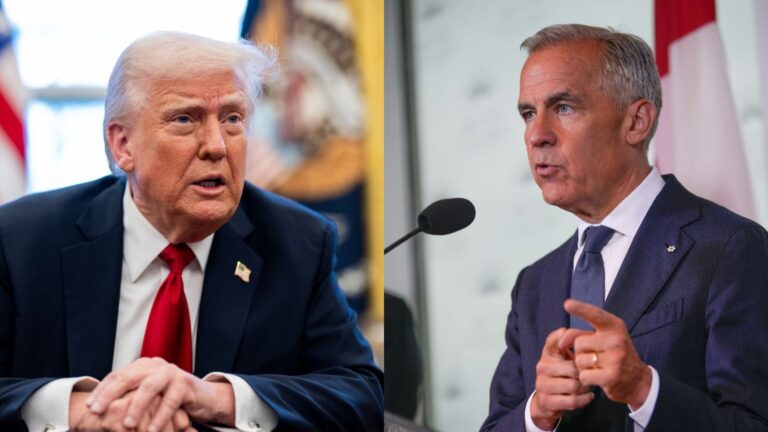
A conversation lasting less than 20 minutes has become a revealing moment in Canada’s increasingly complicated relationship with the United States. Prime Minister Mark Carney and President Donald Trump met in Shenzhen, China, on November 18, 2026, alongside the Asia-Pacific Economic Cooperation summit, with some of Washington’s most senior trade and foreign-policy officials in attendance.
The encounter was not listed on Carney’s public schedule, yet it came at a critical point: bilateral trade negotiations remain unresolved, American tariffs are affecting Canadian industries, and Ottawa is forging new commercial arrangements with China. The leaders agreed to keep working toward a deal. Whether that brief conversation helps produce one remains an open question.
A Brief Encounter That Was Not on the Public Schedule
Carney and Trump Hold Surprise 20-Minute Meeting in China With Rubio, Lutnick and Top U.S. Trade Officials
- A Brief Encounter That Was Not on the Public Schedule
- The Senior Officials Standing Beside Both Leaders
- What Ottawa’s Official Statement Actually Said
- Carney Says a Deal Is Possible, but Not Close Enough
- Why the Tariff Fight Has Become So Costly
- The North American Trade Agreement Remains Unsettled
- Canadian Auto Jobs Remain a Central Test
- China Had Just Offered Canada Fresh Tariff Relief
- The Steel and Aluminum Concessions Were Narrowly Defined
- Carney Says China Is Not Trump’s Main Concern
- Chinese Electric Vehicles Add Pressure to the Talks
- What’s Next After the Handshake in Shenzhen
The meeting took place on Wednesday evening in Shenzhen, where Carney and Trump were attending the APEC Economic Leaders’ Meeting. According to the Prime Minister’s Office, the conversation lasted just under 20 minutes. It was absent from Carney’s published itinerary, which had included a business summit speech, a media availability and the leaders’ dinner. Reporting from the summit described it as an informal pull-aside rather than a scheduled, extended bilateral negotiation. That distinction matters: the leaders had an opportunity to speak directly, but the encounter should not be mistaken for a completed negotiating session.
The surprise was therefore more about the format than the possibility of contact. Carney had told reporters earlier that day he expected to meet Trump while in China. The discussion unfolded amid a crowded diplomatic calendar involving Chinese President Xi Jinping and other regional leaders. In a summit where dozens of conversations can take place away from the cameras, even a short exchange between Canada’s prime minister and the U.S. president carried significance because the trade dispute has continued for months.
The Senior Officials Standing Beside Both Leaders
This was not simply a private exchange between two heads of government. The American side included Secretary of State Marco Rubio, Commerce Secretary Howard Lutnick, U.S. Trade Representative Jamieson Greer and White House chief of staff Stephen Miller. Canada’s delegation included Foreign Affairs Minister Anita Anand and Carney’s chief of staff, Marc-André Blanchard. Their presence gave the encounter a broad diplomatic and economic dimension, placing officials involved in trade rules, international relations and White House decision-making within the same conversation.
Greer’s attendance was particularly relevant because his office is responsible for U.S. trade negotiations, while Lutnick oversees a department closely linked to industrial and commercial policy. Rubio’s participation reflected the wider foreign-policy context of a meeting held in China. None of that, however, proves a new offer was made or accepted. The Canadian government’s published readout did not record what individual participants said. For Canadian exporters waiting for clarity, the important fact was that senior decision-makers were in the room; the unanswered question was whether they moved the dispute any closer to resolution.
What Ottawa’s Official Statement Actually Said
The Prime Minister’s Office released a short readout describing the purpose of the conversation as work toward a mutually beneficial trade agreement. Ottawa said such an agreement should support jobs, improve affordability and fully respect Canada’s languages, culture and sovereignty. Those priorities are important because Canada’s disagreements with Washington extend beyond tariff percentages to the freedom to set domestic policies and pursue commercial relationships elsewhere. The carefully chosen words described the kind of agreement Carney wants, not a package of concessions already settled by both governments.
The announcement’s most concrete outcome was an agreement to continue the work and maintain close contact. It did not identify tariff reductions, announce a negotiating deadline or describe a signed framework. Nor did it provide evidence that Washington had abandoned its demands. That restraint is essential when assessing a high-profile meeting: diplomatic contact can keep a difficult process alive without producing an immediate breakthrough. The difference is especially meaningful for manufacturers making investment decisions and families hoping for more stable prices.
Carney Says a Deal Is Possible, but Not Close Enough
Carney’s comments later on November 18 underscored the gap between dialogue and agreement. Speaking remotely from Shenzhen during the New York Times DealBook Summit, he described the conversation with Trump as a nice discussion and maintained that a very good trade arrangement was achievable. But he also made clear that Canada was not yet at the finish line. He argued that an acceptable outcome should have been reached months earlier and that Ottawa would not sign an agreement that failed to serve Canadian interests.
The prime minister contrasted the United States with negotiations involving other partners. His description of the American process as more complicated came after trade talks broke down in August and relations became increasingly strained. He also indicated Canada would continue pursuing other opportunities rather than wait indefinitely. For businesses, that combination presents a familiar dilemma: the door to a North American deal remains open, yet there is still no date at which they can confidently plan around a settlement. The Shenzhen encounter kept communication going, but left those commercial uncertainties intact.
Why the Tariff Fight Has Become So Costly
The negotiations are unfolding against a concrete set of trade restrictions, not merely unfriendly rhetoric. On August 22, 2026, the United States imposed additional 50% tariffs under Section 338 of the Tariff Act of 1930 on a range of Canadian products. The affected categories include items such as furniture, machinery, paper products, plastics and electronics, with product coverage changing through later U.S. actions. Canada responded on September 8 with counter-tariffs covering C$27.6 billion worth of American goods. These measures added to existing disputes over vehicles, metals and other sectors.
A particularly difficult feature of the Section 338 tariffs is that qualifying for preferential treatment under the Canada-United States-Mexico Agreement does not automatically exempt an affected product. An exporter therefore cannot assume that the familiar North American rules remove every new charge. For a smaller manufacturer with a customer across the border, the impact may appear in a revised quotation, a delayed order or a decision to postpone equipment purchases. Those practical decisions help explain why a 20-minute diplomatic meeting drew attention well beyond political circles.
The North American Trade Agreement Remains Unsettled
The future of the Canada-United States-Mexico Agreement, known in Canada as CUSMA, is another part of the backdrop. The pact entered into force in July 2020, replacing NAFTA, and underwent its first scheduled joint review on July 1, 2026. At that review, Washington declined to extend the agreement in its existing form. That decision did not immediately terminate CUSMA: it remains in force, with annual reviews required unless the three countries eventually agree on an extension. Its current sunset provision points to 2036 if no extension is agreed.
Canada and Mexico have continued emphasizing their support for renewal. In Shenzhen on November 17, Carney met Mexican President Claudia Sheinbaum, and both leaders reaffirmed that position. Their governments also reported that bilateral merchandise trade rose 19% during the first nine months of 2026 compared with the same period a year earlier. The figures underline a larger reality: North American integration is not a Canada-U.S. issue alone. Rules affecting factories, farms and freight routes involve three economies, and unresolved questions over the agreement can complicate investments long before any formal expiry date.
Canadian Auto Jobs Remain a Central Test
For Canadian workers, the auto industry makes the stakes immediate. Federal figures show that more than 90% of vehicles made in Canada and approximately 60% of Canadian-made automotive parts are exported to the United States. The industry supports roughly 125,000 direct jobs, according to Ottawa, and a much larger workforce when related activity is included. Assembly operations and parts suppliers are concentrated in communities where an announcement about cross-border production can quickly become a question about the next shift, a supplier contract or a family’s income.
Production has long relied on components moving between Canada, the United States and Mexico, sometimes crossing a border several times before a finished vehicle reaches a showroom. U.S. vehicle tariffs and disputes over where future models will be built have placed additional pressure on that model. Carney has insisted that any American trade deal must leave Canada with a viable manufacturing industry. That condition gives the Shenzhen meeting particular importance for Ontario’s automotive communities: a successful settlement would need to address not only tariffs but the confidence required to keep production and investment in Canadian plants.
China Had Just Offered Canada Fresh Tariff Relief
Trump’s meeting with Carney came one day after the Canadian leader met Xi Jinping and announced expanded trade arrangements with Beijing. Ottawa said the revised agreement would provide tariff relief beginning in January 2027 on approximately C$400 million in additional Canadian exports, including about C$116 million in frozen pork cuts and C$285 million in seafood. The products covered include cold-water shrimp, Pacific spot prawns, geoduck, sea cucumber and Greenland halibut. For a farmer raising hogs or a fishing business selling into Asia, lower trade barriers can translate into access to buyers that previously faced higher costs.
The changes build on earlier relief for products such as canola meal, peas, crab and lobster. Canada said that market access had been restored for more than 90% of exports previously affected by Chinese tariff measures, representing nearly C$7.5 billion in trade. These numbers are government assessments, not guarantees that every exporter will achieve new sales. Still, they give Ottawa a tangible development to point to while negotiations with its much larger American customer remain difficult. The contrast in outcomes was hard to miss at the summit.
The Steel and Aluminum Concessions Were Narrowly Defined
The China agreement was not a one-sided removal of tariffs. In exchange for additional relief on Canadian farm and seafood exports, Ottawa agreed to extend existing remission measures for certain Chinese steel and aluminum products through December 31, 2028. It also expanded coverage to 32 tariff classifications: 23 involving steel and nine involving aluminum. The Canadian government’s explanation was that domestic supply for these specific products was insufficient or unavailable. That is much narrower than eliminating tariffs on all Chinese metal shipments.
The distinction matters for Canadian manufacturers and metal producers, whose interests can differ. A business unable to source a specialized input domestically may welcome a temporary reduction in import costs; a Canadian mill may worry about competition from foreign material. Ottawa’s challenge is to distinguish genuine supply gaps from changes that could undermine local capacity. The reciprocal arrangement also demonstrates how tariff negotiations involve trade-offs: helping a seafood exporter reach a foreign customer can require concessions affecting an entirely different Canadian industry. Whether Washington views those choices as compatible with North American trade priorities remains a politically sensitive question.
Carney Says China Is Not Trump’s Main Concern
Before meeting Trump, Carney told reporters he did not believe Canada’s closer economic relationship with China ranked among the president’s highest priorities. He said Trump had asked where Ottawa was heading in its dealings with Beijing, while acknowledging that he could not speak for the American leader. Carney distinguished Canadian sales of products such as canola, pork, seafood, oil and liquefied natural gas from the advanced technology and strategic industries at the heart of U.S.-China tensions. That was his assessment of the president’s priorities, not a public endorsement from Trump.
The remarks followed criticism from White House trade adviser Peter Navarro, who objected to the possibility of closer Canadian ties with Chinese automakers. The size of the two relationships helps explain why the issue is so sensitive. Canadian government figures put bilateral merchandise trade with China at C$125.6 billion in 2025, while Statistics Canada reported that 71.7% of Canada’s merchandise exports went to the United States that year. Expanding sales to China can diversify Canada’s customers, but it does not erase the economic weight of its southern neighbour or the questions Washington has raised about Chinese industrial influence.
Chinese Electric Vehicles Add Pressure to the Talks
Automobiles are where Canada’s China strategy comes into direct contact with its U.S. trade dispute. Under a January 2026 agreement, Ottawa allowed an initial quota of up to 49,000 Chinese electric vehicles to enter at a 6.1% tariff, replacing the earlier 100% surtax for those imports within the arrangement. The federal government said the quota represented less than 3% of Canada’s new-vehicle market and expected it to encourage investment in Canadian production. Those anticipated investments are a policy objective, not proof that new factories have already opened.
Carney has since said that if North American trade arrangements fail to protect Canadian auto manufacturing, Ottawa could consider partnerships with European, Japanese or Chinese automakers. He has also said Chinese involvement would need substantial manufacturing in Canada, appropriate labour standards and growing domestic supply chains rather than simple assembly of imported kits. Ontario Premier Doug Ford has warned that the Chinese EV policy could threaten jobs and access to the U.S. market. That competing concern illustrates the difficult choice: diversification might create manufacturing opportunities, but a poorly managed approach could put existing North American relationships at greater risk.
What’s Next After the Handshake in Shenzhen
No timetable emerged from the November 18 encounter, and neither a tariff rollback nor a new trade framework was announced. The next meaningful sign of progress would be a specific commitment: resumed formal negotiations, identified concessions, an agreed schedule or a deal that companies can examine. Carney’s administration continues to say that a workable agreement with the United States is a priority, even as the prime minister argues that Canada cannot make its entire economic future dependent on one partner’s decisions.
That strategy is already visible elsewhere. Canada announced in November that it had concluded free trade negotiations with the Philippines and substantially concluded negotiations with the Association of Southeast Asian Nations, with signatures targeted for 2027. Ottawa estimates the ASEAN deal, once in force, could support nearly 14,000 Canadian jobs; that remains a projection rather than a result. Canada has also announced a trade mission to China for 2027. For now, the brief Carney-Trump exchange is best understood as an opening for continued talks, not a resolution. The true measure will be what changes for workers, businesses and consumers after the leaders leave Shenzhen.
This Options Discord Chat is The Real Deal
While the internet is scoured with trading chat rooms, many of which even charge upwards of thousands of dollars to join, this smaller options trading discord chatroom is the real deal and actually providing valuable trade setups, education, and community without the noise and spam of the larger more expensive rooms. With a incredibly low-cost monthly fee, Options Trading Club (click here to see their reviews) requires an application to join ensuring that every member is dedicated and serious about taking their trading to the next level. If you are looking for a change in your trading strategies, then click here to apply for a membership.