35,000+ smart investors are already getting financial news, market signals, and macro shifts in the economy that could impact their money next with our FREE weekly newsletter. Get ahead of what the crowd finds out too late. Click Here to Subscribe for FREE.
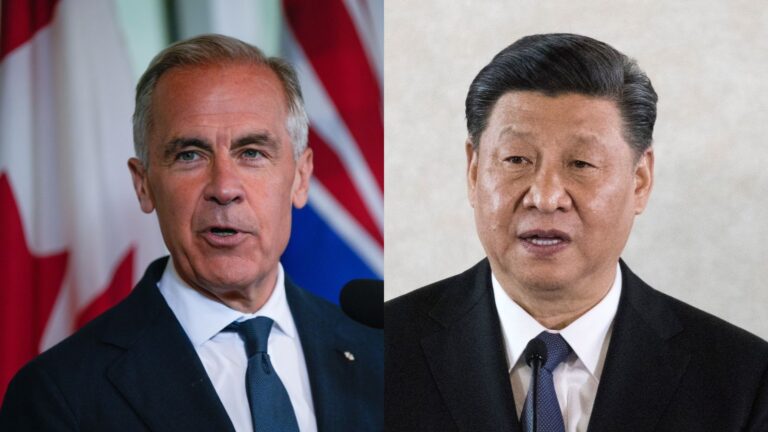
Prime Minister Mark Carney is heading to China for a closely watched meeting with President Xi Jinping, opening another chapter in Canada’s effort to rebuild its relationship with Beijing while navigating increasingly unpredictable global trade politics.
The November 16 visit comes as U.S. President Donald Trump prepares for his own consequential talks with Xi and Russian President Vladimir Putin, placing China at the centre of several major diplomatic negotiations.
For Canada, the stakes extend well beyond political symbolism. Chinese investment, electric vehicle manufacturing, agricultural exports and relations with Washington are all intertwined with Carney’s agenda. The competing diplomatic priorities highlight a difficult challenge for Ottawa: expanding economic opportunities with China without undermining Canada’s most important trading relationship.
Carney Arrives at a Pivotal Moment for Canada-China Relations
Carney Heads to China for Xi Meeting as Trump Prepares His Own High-Stakes Summit
- Carney Arrives at a Pivotal Moment for Canada-China Relations
- A Diplomatic Reset After Years of Deep Mistrust
- Canadian Farmers Have Already Seen Results From the China Reset
- Chinese Electric Vehicles Put Canadian Manufacturing at a Crossroads
- Trump’s Trade Policies Are Influencing Canada’s Decisions
- Trump’s Meeting With Xi and Putin Raises the Global Stakes
- A Fragile U.S.-China Trade Truce Adds Pressure to the Summit
- APEC Gives Canada Opportunities Beyond China and the United States
- Security Concerns Could Limit How Far Canada-China Cooperation Goes
- The Real Measure of Success Will Come After the Summits
Carney is travelling from Phnom Penh, Cambodia, to Shenzhen, China’s major technology and manufacturing hub, after participating in the Francophonie summit. His meeting with Xi is scheduled for Tuesday morning, November 17, local time, corresponding to late Monday evening in Ottawa. The discussion precedes the Asia-Pacific Economic Cooperation (APEC) Economic Leaders’ Meeting, scheduled for November 18 and 19. The gathering brings together representatives of 21 economies and offers Canada an opportunity to strengthen relationships across a region that accounts for a substantial share of global economic activity.
The trip is also part of a broader international tour that began November 11, taking Carney through Ireland, the Philippines and Cambodia before China. Ottawa has presented the journey as an effort to attract investment, strengthen trade relationships and reduce Canada’s exposure to economic uncertainty. According to the Prime Minister’s Office, APEC’s member economies accounted for 80.6% of Canada’s merchandise trade in 2025. That makes the Shenzhen gathering more than another diplomatic appearance. It puts Carney in direct contact with leaders whose decisions influence Canadian exports, supply chains, industrial investment and employment.
A Diplomatic Reset After Years of Deep Mistrust
Carney’s return to China marks another stage in a relationship that was strained for much of the previous decade. Relations deteriorated sharply after Huawei executive Meng Wanzhou was arrested in Vancouver in December 2018 on a U.S. extradition request. China subsequently detained Canadians Michael Kovrig and Michael Spavor, whom Ottawa considered arbitrarily imprisoned. Both men were released in September 2021, but the episode left lasting political and security concerns. Carney’s January 2026 visit to Beijing was the first by a Canadian prime minister since 2017, underscoring the significance of the diplomatic reopening.
During that January meeting, Carney and Xi announced a strategic partnership covering five major areas: energy, economic cooperation, public safety and security, multilateralism, and cultural exchanges. The two governments also established a framework for addressing trade disputes and maintaining dialogue. Canada’s economic interests are substantial. According to federal figures, two-way merchandise trade with China reached $125.7 billion in 2025, an increase of 5.7% from the previous year. However, rebuilding commercial relationships does not mean the countries have resolved their political differences. Carney’s challenge is to turn renewed engagement into practical results while maintaining clear boundaries around national security and Canadian interests.
Canadian Farmers Have Already Seen Results From the China Reset
Agriculture represents one of the clearest examples of what improved relations with Beijing can deliver. In January, Canada and China reached an arrangement to reduce significant trade barriers affecting Canadian agricultural exports. By March 1, China’s combined tariff on Canadian canola seed had fallen from nearly 85% to 14.9%. Beijing also suspended additional tariffs on Canadian canola meal, peas, lobster and crab. The changes mattered particularly in Western Canada, where canola is a major crop and Chinese demand can influence prices received by producers. For farmers facing volatile costs and uncertain export markets, greater access to China offers an important opportunity.
The progress continued in November. On November 4, Canada announced that China had agreed to extend favourable market access for canola meal, peas, lobster and crab until the end of 2028. The Canola Council of Canada reported that exports of Canadian canola products to China totalled approximately $2.4 billion during the first eight months of 2026, an increase of 28% from the same period a year earlier. Nevertheless, important restrictions remain, including China’s 100% tariff on Canadian canola oil. Those unresolved measures give Carney a reason to pursue additional concessions rather than treating the agricultural dispute as completely settled.
Chinese Electric Vehicles Put Canadian Manufacturing at a Crossroads
One of the most closely watched issues surrounding Carney’s meeting with Xi is the future of Chinese investment in Canada’s automotive industry. Under their January agreement, Canada introduced an annual import quota initially allowing 49,000 Chinese electric vehicles to enter at a 6.1% tariff, replacing the previous 100% surtax on qualifying imports. The arrangement, implemented March 1, was designed to encourage investment while giving Canadian consumers access to more affordable electric vehicles. Ottawa also expects the proportion of lower-priced vehicles within the quota to increase over time, with a target of 50% priced at $35,000 or less by 2030.
However, importing vehicles is different from building them domestically. Speaking in Cambodia on November 16, Carney indicated that Chinese automakers could become potential partners if Canada cannot preserve its integrated North American automotive industry through negotiations with Washington. He emphasized that any Chinese investment would need to create meaningful manufacturing jobs, meet labour standards and develop Canadian supply chains rather than simply assemble vehicles from imported components. The issue is politically sensitive in Ontario, where Premier Doug Ford has warned that greater access for Chinese vehicles could threaten domestic employment and complicate relations with American automakers.
Trump’s Trade Policies Are Influencing Canada’s Decisions
Carney’s outreach to China is taking place against the backdrop of unresolved trade negotiations with the United States. Washington remains Canada’s dominant export destination despite recent efforts to diversify. Statistics Canada reported that 71.7% of Canadian merchandise exports went to the United States in 2025, down from 75.9% in 2024. That concentration gives American trade decisions enormous influence over Canadian manufacturers, resource producers and exporters. Although China offers a large alternative market, it cannot quickly replace the geographic advantages and deeply integrated supply chains that have developed between Canada and the United States.
The automotive industry illustrates those dependencies particularly clearly. Manufacturers such as Ford, General Motors and Stellantis operate production networks spanning Canada, the United States and Mexico. Tariffs and uncertainty over North American trade rules have complicated those operations. Carney said on November 14 that discussions with Trump and American officials were making progress toward a possible bilateral agreement, but acknowledged that a deal had not yet been reached. The Canada-U.S.-Mexico Agreement also remains in force despite an unsettled renewal process. As Carney approaches Xi, Canada’s negotiating position is therefore shaped by two realities: maintaining American market access remains essential, but Ottawa wants credible economic alternatives if negotiations fail.
Trump’s Meeting With Xi and Putin Raises the Global Stakes
While Carney is focused heavily on investment and commercial relationships, Trump is preparing for discussions involving some of the world’s most consequential security questions. The White House, Kremlin and Chinese government have confirmed plans for Trump, Xi and Putin to meet in Shenzhen on November 19. The unprecedented three-way gathering is expected to address nuclear weapons, strategic stability and the ongoing war involving the United States and Iran. Trump is also scheduled to hold separate bilateral discussions with Xi. The summit gives all three leaders an opportunity to demonstrate their international influence, although officials have cautioned against expecting an immediate agreement.
The nuclear issue is particularly significant because the New START treaty, which restricted deployed American and Russian strategic nuclear weapons, expired on February 5, 2026. Trump wants to explore a new arrangement that includes China, whose arsenal is considerably smaller than those of the United States and Russia. Meanwhile, questions about Ukraine have complicated preparations. American officials initially indicated the war would not be discussed, but Trump subsequently said he intended to raise it. For Canada and its European allies, the concern is whether decisions affecting international security could emerge from discussions in which smaller countries have no direct representation.
A Fragile U.S.-China Trade Truce Adds Pressure to the Summit
Trump’s discussions with Xi will also take place under the shadow of unresolved economic competition between Washington and Beijing. The two countries have extended a trade truce until January 10, 2027, temporarily easing the risk of renewed tariff escalation while leaving major disagreements unresolved. American officials have pressed China over agricultural purchases, access to critical minerals and compliance with existing trade commitments. Beijing, meanwhile, has pushed back against American restrictions on its technology sector. Both governments have reasons to preserve stability, but neither appears ready to abandon policies intended to strengthen its own industrial and strategic position.
Technology has become another flashpoint. On November 16, the Trump administration introduced additional restrictions intended to prevent Chinese companies from accessing advanced American artificial intelligence chips through data centres in third countries. The measure comes amid intensified scrutiny of semiconductor export controls in Washington. These developments are relevant to Canada’s economic ambitions because Canadian companies operate within international technology and manufacturing supply chains influenced by decisions in both countries. A more confrontational American approach toward Chinese technology could complicate Ottawa’s efforts to attract investment in advanced manufacturing, batteries and other strategic industries. Even if the U.S.-China summit preserves the current trade truce, broader competition between the two economies is unlikely to disappear.
APEC Gives Canada Opportunities Beyond China and the United States
Although Carney’s meeting with Xi will attract considerable attention, the wider APEC gathering offers Canada opportunities that extend beyond its relationships with the world’s two largest economies. The organization includes countries such as Japan, South Korea, Australia, Mexico, Vietnam and Indonesia, making it a significant venue for trade diversification. APEC’s latest economic outlook, released November 15, projects regional growth of 3.4% in 2026, supported by technology investment and international trade. However, the organization also warns that energy costs, geopolitical tensions and growing trade restrictions could weaken economic performance in 2027.
Canada enters these discussions with recent progress in Southeast Asia. On November 14, Ottawa announced the conclusion of negotiations for a free trade agreement with the Philippines and the substantial conclusion of negotiations for a broader agreement with ASEAN. The proposed ASEAN agreement would provide access to a market approaching 700 million people and, once implemented, is expected by Ottawa to contribute nearly $2 billion to Canada’s economy and support approximately 14,000 jobs. These agreements still require additional steps before their full economic benefits can be realized. Nevertheless, they demonstrate that Carney’s broader strategy is not simply to replace American trade with Chinese trade. The objective is to establish more commercial options across multiple regions.
Security Concerns Could Limit How Far Canada-China Cooperation Goes
Despite improving commercial relations, significant security and political disagreements remain between Ottawa and Beijing. Canada has repeatedly expressed concerns involving foreign interference, human rights and China’s approach to Taiwan and Hong Kong. On November 6, Canada joined nine other governments in condemning the sentencing of Hong Kong democracy activist Joshua Wong to 10 years in prison under national security legislation. The statement called on Chinese and Hong Kong authorities to respect their international human rights commitments. Carney has also indicated that he intends to raise concerns about foreign interference directly with Xi, highlighting the limits of an exclusively economic approach to bilateral relations.
These disagreements matter because Canada must decide which types of Chinese investment are beneficial and which could create unacceptable vulnerabilities. Canada’s official China trade guidance identifies risks involving intellectual property theft, uneven regulatory enforcement and the potential diversion of sensitive civilian technology to military applications. Its Indo-Pacific strategy also emphasizes economic security, cybersecurity and resistance to coercive behaviour. Consequently, closer cooperation in areas such as renewable energy and automotive manufacturing does not automatically imply unrestricted access to critical infrastructure or sensitive technology. The central challenge is establishing commercial relationships that benefit Canadian workers and businesses without weakening the country’s ability to protect its security, democratic institutions and independent foreign policy.
The Real Measure of Success Will Come After the Summits
Carney’s meeting with Xi may produce new commitments, but the longer-term value will depend on whether those commitments lead to measurable economic results. Canada has already set a target of increasing exports to China by 50% by 2030. The relationship has shown encouraging momentum: federal figures released November 9 indicated Canadian goods exports to China had increased substantially during the first nine months of 2026 compared with the same period in 2025. The two governments have also been expanding their financial cooperation, including a November 9 meeting in Vancouver involving senior Canadian ministers and Chinese Vice Premier He Lifeng. Those discussions resulted in new arrangements for financial and regulatory dialogue.
The next steps will be closely watched by Canadian manufacturers, agricultural producers and investors. Further reductions in Chinese tariffs, meaningful automotive investment, stronger energy partnerships and clear implementation schedules would offer evidence that the diplomatic reset is delivering practical benefits. However, a meeting without a major announcement would not necessarily mean negotiations had failed, particularly when industrial investments and regulatory agreements can take years to complete. Meanwhile, Trump’s summit with Xi and Putin could influence the broader geopolitical environment in which Canada’s decisions must be made. For Ottawa, the ultimate goal is not choosing between Washington and Beijing. It is securing enough economic flexibility to protect Canadian interests even when powerful trading partners change course.
This Options Discord Chat is The Real Deal
While the internet is scoured with trading chat rooms, many of which even charge upwards of thousands of dollars to join, this smaller options trading discord chatroom is the real deal and actually providing valuable trade setups, education, and community without the noise and spam of the larger more expensive rooms. With a incredibly low-cost monthly fee, Options Trading Club (click here to see their reviews) requires an application to join ensuring that every member is dedicated and serious about taking their trading to the next level. If you are looking for a change in your trading strategies, then click here to apply for a membership.