35,000+ smart investors are already getting financial news, market signals, and macro shifts in the economy that could impact their money next with our FREE weekly newsletter. Get ahead of what the crowd finds out too late. Click Here to Subscribe for FREE.
Canada’s fighter jet debate has taken an unexpected turn after an internal Royal Canadian Air Force document revealed a vision for the country’s future combat fleet that centres on American F-35s and Canadian-developed drones while making no mention of Sweden’s Gripen.
The document, known as Project Arrow, emerged as Prime Minister Mark Carney’s government continues reviewing its planned purchase of 88 American fighter jets amid tensions with Washington. Although the Department of National Defence insists the proposal is not official policy, its priorities raise questions about where military planners believe Canada’s air force should be heading.
The debate now extends beyond choosing between two fighter jets. It involves Canada’s defence independence, domestic aerospace industry, technological capabilities and ability to protect its vast northern territory.
An Internal Air Force Document Reveals a Different Vision for Canada’s Fighter Fleet
Canadian Air Force’s Internal Fighter Jet Plan Includes American F-35s and Canadian Drones but Leaves Out Sweden’s Gripen
- An Internal Air Force Document Reveals a Different Vision for Canada’s Fighter Fleet
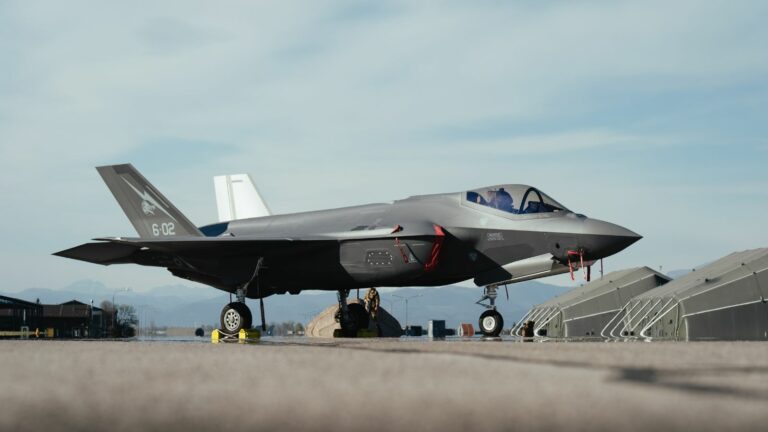
- Canada Has Already Started Receiving Its American F-35 Fighter Jets
- Sweden’s Gripen Is Missing Despite Ottawa’s Continuing Interest
- Canadian-Made Combat Drones Could Become a Major Part of the Future Fleet
- The Air Force Wants Canada to Own More of Its Military Technology
- An Ottawa Company Is Already Developing a Canadian Combat Drone
- Canada Is Looking Beyond the F-35 Toward Sixth-Generation Fighter Aircraft
- Dependence on American Military Technology Remains a Major Concern
- Defending Canada’s Arctic Is Becoming Central to the Fighter Jet Debate
- Ottawa Must Balance Military Capability, Canadian Jobs and the Cost of a Mixed Fleet
The document at the centre of the controversy is called Project Arrow, an internal discussion paper obtained by CBC News and reported on November 24, 2026. It outlines how Canada’s future air combat capabilities could evolve around three priorities: integrating American F-35 fighter jets, developing Canadian-made autonomous combat drones and participating more extensively in international sixth-generation fighter technology. Notably, the proposal does not mention the Swedish Gripen, despite the aircraft remaining under consideration by the federal government.
The Department of National Defence confirmed the document’s authenticity and explained that it originated within the Royal Canadian Air Force’s autonomous collaborative platform program. Officials emphasized that the paper was developed to encourage discussion rather than establish formal procurement policy. Nevertheless, the proposal offers a revealing look at the direction some military planners are exploring. While politicians continue weighing the advantages of American and Swedish aircraft, Project Arrow suggests that at least one branch of the air force sees the F-35 as the foundation for a much broader transformation involving drones, advanced software and future combat aircraft.
Canada Has Already Started Receiving Its American F-35 Fighter Jets
Canada originally announced an agreement in January 2023 to acquire 88 Lockheed Martin F-35A fighter jets to replace its aging CF-18 Hornets. The aircraft were selected to strengthen Canada’s ability to defend its airspace, participate in NATO operations and meet commitments to the North American Aerospace Defense Command, commonly known as NORAD. However, the planned acquisition became politically contentious after relations with Washington deteriorated and Carney ordered a review in March 2025.
Despite that review, the purchase has already moved beyond planning. Canada has committed to acquiring at least 16 F-35s and has begun making advance payments for long-lead components associated with 14 additional aircraft. On October 22, 2026, the Royal Canadian Air Force accepted its first two CF-35A fighters at Luke Air Force Base in Arizona, where Canadian personnel will train. The first aircraft are scheduled to arrive in Canada in 2028, with initial operational capability targeted for 2029 and full operational capability around 2033. These milestones mean any decision to change the fleet’s composition must account for aircraft, training arrangements and infrastructure investments already underway.
Sweden’s Gripen Is Missing Despite Ottawa’s Continuing Interest
One of Project Arrow’s most significant details is what it leaves out. Saab’s Gripen E was a finalist in Canada’s original fighter competition, and the Swedish manufacturer has renewed its efforts to secure a Canadian order as Ottawa reassesses its dependence on American military equipment. Supporters of the Gripen proposal argue that the aircraft could provide Canada with another operational option while opening opportunities for domestic manufacturing and maintenance. Yet the internal air force paper gives no indication of how the Swedish fighter would fit into its proposed long-term structure.
Saab has continued strengthening its Canadian industrial proposal. On October 27, 2026, the company identified CAE, IMP Aerospace & Defence and Magellan Aerospace as principal partners for a potential Canadian Gripen program. Its proposal includes domestic final assembly, aerospace manufacturing, training and long-term support, provided Ottawa selects the aircraft. Project Arrow’s emphasis on developing capabilities beyond final assembly may therefore invite comparisons with Saab’s offer. However, the omission of Gripen should not be mistaken for an official rejection. The government maintains that its fighter review remains open, and no Canadian order for Gripen aircraft has been announced.
Canadian-Made Combat Drones Could Become a Major Part of the Future Fleet
Project Arrow places considerable importance on autonomous collaborative aircraft, often described as combat drones or uncrewed wingmen. Unlike conventional surveillance drones, these aircraft are being developed to work alongside piloted fighters during demanding military operations. Depending on their equipment and mission, they could help gather intelligence, detect threats, conduct electronic warfare or carry weapons. Their purpose is to expand the capabilities of crewed aircraft while reducing the need to expose pilots to particularly dangerous situations.
The concept is already progressing internationally. Australia’s MQ-28 Ghost Bat, developed through cooperation between Boeing and the Royal Australian Air Force, has demonstrated the potential of collaborative combat aircraft. In December 2025, Australian officials announced that the aircraft had successfully engaged an airborne target with an air-to-air missile during testing alongside crewed military aircraft. For Canada, similar technology could eventually allow a smaller number of expensive fighter jets to operate alongside additional uncrewed platforms. However, Canadian-developed combat drones remain a proposed capability rather than an operational fleet, and turning the concept into reliable military equipment would require substantial development, testing and investment.
The Air Force Wants Canada to Own More of Its Military Technology
A particularly important feature of Project Arrow is its emphasis on Canadian ownership of intellectual property associated with future combat drones. Rather than simply purchasing completed aircraft from foreign manufacturers, the concept envisions Canadian companies developing technology that the country could continue improving and supporting. This distinction matters because modern combat aircraft increasingly depend on software, communications networks, electronic warfare systems and advanced sensors as much as their physical airframes.
Canada already participates extensively in international aerospace manufacturing. According to federal defence documents released in 2026, more than 110 Canadian companies have received approximately C$5.2 billion in contracts connected to the global F-35 program. However, manufacturing components for an international aircraft program is different from controlling the intellectual property behind a Canadian-developed system. Project Arrow appears to seek a larger domestic role in designing and adapting future technologies, while continuing cooperation with foreign allies. If successful, that approach could provide Canadian engineers and defence companies with more influence over future upgrades and technical development. Whether those ambitions translate into funded projects will depend on government decisions and the ability of Canadian firms to deliver working systems.
An Ottawa Company Is Already Developing a Canadian Combat Drone
One company positioned to benefit from Canada’s growing interest in autonomous aircraft is Ottawa-based Dominion Dynamics. The defence technology firm is developing an uncrewed aircraft called Dominion Scout, designed to operate alongside conventional fighter jets and support military missions in challenging environments, particularly the Arctic. The company has described an initial C$50-million investment in the project, highlighting its intention to develop a domestically centred aerospace capability rather than rely entirely on imported aircraft.
The project gained momentum in November 2026. On November 17, Dominion announced a collaboration with Pratt & Whitney Canada to develop Scout around a Canadian-built PW300-series engine. Three days later, the company unveiled a consortium of 12 participating businesses, including Telesat, Thales Canada and Top Aces. The initiative brings together expertise in propulsion, communications, aircraft structures, sensors and flight testing. Dominion says Scout is being designed for long distances, extreme cold and limited northern infrastructure. However, the federal government has not placed an order for the aircraft, and key questions remain about its eventual capabilities, development costs and delivery schedule. Its progress illustrates the potential industrial opportunities associated with Project Arrow, but also the uncertainty surrounding an emerging technology.
Canada Is Looking Beyond the F-35 Toward Sixth-Generation Fighter Aircraft
Project Arrow’s ambitions extend beyond aircraft entering service over the coming decade. The document also encourages greater Canadian participation in the Global Combat Air Programme, or GCAP, a multinational effort involving the United Kingdom, Italy and Japan. The initiative aims to develop a sixth-generation combat aircraft targeted for service around 2035, potentially incorporating advanced stealth, sophisticated communications and closer integration with uncrewed systems.
Canada became the program’s first observer nation on July 21, 2026, giving it access to discussions about future capabilities, industrial cooperation and potential partnerships without immediately committing to purchase aircraft or fund the development program. Canadian companies have already begun exploring related opportunities. On October 28, Bombardier and British defence manufacturer BAE Systems announced a memorandum of understanding covering potential cooperation in aircraft design, mission systems, digital engineering and advanced manufacturing. The agreement is exploratory rather than a production contract, but it illustrates how Canada could participate in future fighter technology without immediately choosing another operational aircraft. Project Arrow effectively connects today’s F-35 introduction with a longer-term ambition to develop Canadian aerospace expertise for the next generation of combat aviation.
Dependence on American Military Technology Remains a Major Concern
One of the biggest questions surrounding Canada’s fighter procurement is how much control the country should retain over its military equipment. The F-35 provides advanced stealth technology, integrated sensors and interoperability with numerous NATO allies. However, its international support arrangements involve American-led infrastructure, supply chains and software development. Critics argue that relying heavily on one foreign supplier could create vulnerabilities if political relations deteriorate or access to essential support becomes uncertain.
Retired lieutenant-general Yvan Blondin, a former commander of the Royal Canadian Air Force, expressed concern to CBC News that Project Arrow places too much confidence in continued reliance on American technology. He warned about the potential influence a future U.S. administration could exercise over Canada’s fighter and drone capabilities. That concern should be distinguished from claims that Washington can remotely disable Canadian F-35s. The Department of National Defence has explicitly stated that the aircraft have no such remote kill switch and that Canada participates in multinational arrangements governing upgrades and mission data. The underlying debate concerns long-term strategic dependence, supply-chain reliability and Canada’s ability to maintain operational independence during periods of political disagreement.
Defending Canada’s Arctic Is Becoming Central to the Fighter Jet Debate
Canada’s enormous northern territory creates military challenges that cannot be addressed through fighter aircraft alone. Surveillance coverage, long-distance operations, severe weather, limited infrastructure and the ability to detect incoming threats all influence how the Royal Canadian Air Force prepares for future missions. Canadian defence planning increasingly emphasizes the Arctic as Russia and China develop military capabilities that could challenge North American security. Against that backdrop, Project Arrow’s interest in autonomous aircraft designed for Canadian conditions has particular relevance.
Ottawa is already pursuing complementary investments. In June 2026, Canada advanced a partnership with Australia to develop an Arctic Over-the-Horizon Radar system valued at more than C$6 billion, intended to improve long-range detection of threats approaching North America. Separately, the federal government entered negotiations with Saab over a potential purchase of six GlobalEye airborne early-warning aircraft, although the September agreement remained non-binding. These systems would help detect and track threats, while fighters and potentially collaborative drones could respond. The distinction is important: even if Gripen fighters never enter Canadian service, Saab could still play a role in Canadian air defence. The larger question is how these different capabilities can operate together effectively across an immense territory.
Ottawa Must Balance Military Capability, Canadian Jobs and the Cost of a Mixed Fleet
The financial implications of Canada’s fighter decision are substantial. A 2025 report from the Auditor General found that the estimated acquisition cost of the F-35 project had increased from C$19 billion in 2022 to C$27.7 billion by 2024. The audit also identified additional infrastructure and weapons requirements that were not included in that estimate, along with personnel shortages and construction delays. Introducing a second fighter type could create further costs for training, spare parts, maintenance and support, although the expense of a specific mixed-fleet proposal has not been publicly established.
The debate has also drawn direct criticism from Washington. In November 2026, the Pentagon argued that Canada’s reconsideration of its F-35 purchase could complicate NORAD planning and that operating a mixed fighter fleet might aggravate existing military staffing pressures. Ottawa has defended its right to make independent procurement decisions. Prime Minister Carney has also acknowledged that the Gripen decision involves military capabilities, strategic dependencies and economic benefits. Those competing priorities explain why Project Arrow matters. It offers insight into one possible military direction, but cannot settle the political and financial questions. Ultimately, Canada must determine not simply which fighters to purchase, but what combination of aircraft, Canadian technology and international partnerships will provide a sustainable air force for decades.
This Options Discord Chat is The Real Deal
While the internet is scoured with trading chat rooms, many of which even charge upwards of thousands of dollars to join, this smaller options trading discord chatroom is the real deal and actually providing valuable trade setups, education, and community without the noise and spam of the larger more expensive rooms. With a incredibly low-cost monthly fee, Options Trading Club (click here to see their reviews) requires an application to join ensuring that every member is dedicated and serious about taking their trading to the next level. If you are looking for a change in your trading strategies, then click here to apply for a membership.