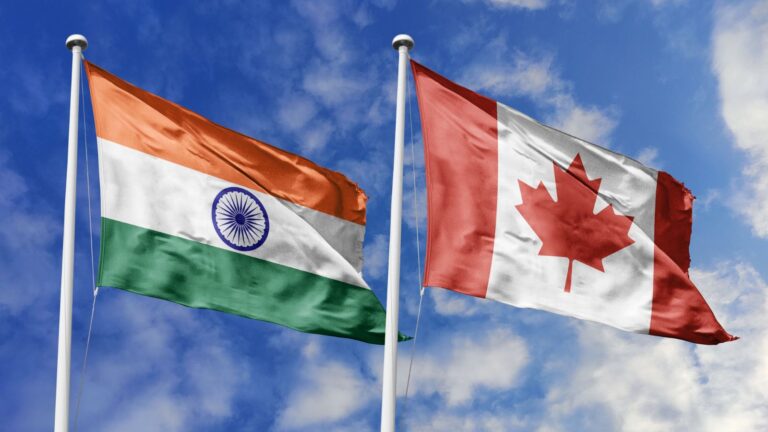
Canada’s effort to reduce its economic dependence on the United States is increasingly taking Ottawa toward some of the world’s fastest-growing markets, and India has moved close to the centre of that strategy. International Trade Minister Maninder Sidhu is in Mumbai on September 18 and 19 as Canadian and Indian negotiators work through another round of talks toward a comprehensive trade agreement.
The ambition is substantial. Canada and India want annual two-way trade to rise to C$70 billion by 2030, up from C$30.4 billion in goods and services in 2025. At the same time, Ottawa is pursuing a broader objective of doubling Canadian exports to markets outside the United States by 2035. Together, the targets show how quickly trade diversification has shifted from a long-term aspiration into an economic priority.
A $70-Billion Target From a $30.4-Billion Base
Canada Targets $70 Billion in India Trade as Ottawa Pushes to Double Exports Beyond the U.S.
- A $70-Billion Target From a $30.4-Billion Base
- Trade Talks Now Carry a 2026 Deadline
- The Services Relationship Is Bigger Than It Looks
- Energy Could Become the Biggest Growth Engine
- Agriculture Gives the Strategy a Prairie-to-India Connection
- Canadian Capital Is Already Deeply Embedded in India
- Talent and Technology Are Becoming Commercial Priorities
- U.S. Tariff Pressure Is Changing Canada’s Trade Math
- India Is Only One Part of Ottawa’s Wider Asia Push
- The Diplomatic Reset Still Matters to the Economics
- The Real Test Will Be Whether Diversification Becomes Durable
The most important distinction in Ottawa’s C$70-billion goal is that it refers to two-way trade, not simply Canadian exports to India. Canada and India exchanged C$30.4 billion worth of goods and services in 2025, including C$13.6 billion in merchandise. Getting that total above C$70 billion within four years would therefore require an increase of well over 100 per cent. It would represent a major change in a commercial relationship that, while already meaningful, remains small compared with Canada’s extraordinarily integrated trade relationship with the United States.
The target also gives businesses something more concrete than the usual language about “deepening ties.” Canadian companies can see where governments want the relationship to go, while Indian investors and exporters are receiving a similar signal about Canada. The scale, however, means the increase cannot realistically come from one industry alone. Energy, agriculture, services, technology, investment and advanced manufacturing would all have to contribute. A successful trade agreement could lower barriers, but companies would still need to turn that improved access into actual sales, contracts and investment.
Trade Talks Now Carry a 2026 Deadline
Canada and India have already completed three rounds of negotiations toward a Comprehensive Economic Partnership Agreement, or CEPA, with a fourth round taking place this week. Both governments have publicly committed to trying to conclude negotiations before the end of 2026. That deadline adds urgency to Sidhu’s Mumbai meetings with Indian Commerce and Industry Minister Piyush Goyal, government officials and business representatives.
The pace is notable because formal trade negotiations had been paused in August 2023 amid a severe deterioration in diplomatic relations. Engagement began rebuilding during 2025, and the two governments ultimately launched a new CEPA process. Prime Ministers Mark Carney and Narendra Modi finalized the terms of reference during Carney’s India visit in early 2026. The proposed framework is broader than cutting tariffs on physical products. Ottawa has identified goods and services, investment, agriculture and agri-food, digital trade, mobility and sustainable development among the areas expected to be covered, giving negotiators a complicated package to finish on a relatively tight timeline.
The Services Relationship Is Bigger Than It Looks
Merchandise figures alone significantly understate Canada’s existing economic relationship with India. Canadian goods exports to India amounted to C$3.9 billion in 2025, led by vegetables, mineral fuels and oils, and wood pulp. Canada imported C$9.7 billion in Indian merchandise, including precious stones and metals, machinery and pharmaceuticals. On goods alone, the relationship therefore runs substantially in India’s favour.
Services tell a very different story. Canadian services exports to India were valued at C$15.2 billion in 2025, while services imports were C$4.5 billion. Education-related travel represented the largest component of Canadian service exports. Spending by international students is recorded as a Canadian service export, which helps explain why education and people-to-people links carry unusual economic weight in this relationship. That structure is important when considering the C$70-billion target. Expanding energy shipments or agricultural sales may attract more attention, but education, commercial services, technology and other less visible cross-border activity could be just as important to reaching the final number.
Energy Could Become the Biggest Growth Engine
Few sectors demonstrate the scale of the opportunity as clearly as energy. During Carney’s March visit to India, Saskatoon-based Cameco signed a long-term agreement worth an estimated C$2.6 billion to supply the Indian government with nearly 22 million pounds of uranium. Deliveries are scheduled to run from 2027 through 2035. The contract alone is large enough to materially affect bilateral trade flows and gives Saskatchewan a direct stake in the expansion of Canada-India commerce.
The two governments are looking well beyond uranium. Their Strategic Energy Partnership covers LNG, LPG, oil, critical minerals, renewable energy, hydrogen and other clean-energy technologies. India has also signalled an interest in sourcing Canadian LNG, while discussions are underway around what could become India’s first long-term LPG supply arrangement with Canada. These plans reflect complementary pressures: India requires enormous quantities of energy as its economy grows, while Canada is looking for large overseas customers capable of reducing the country’s reliance on traditional North American energy markets.
Agriculture Gives the Strategy a Prairie-to-India Connection
Canadian agriculture already has a tangible foothold in India, particularly through pulses. Agriculture and Agri-Food Canada reported that India was among the main markets for Canadian lentils during the 2025-26 crop year, when lentil exports reached roughly 2.5 million tonnes. Saskatchewan remains overwhelmingly dominant in Canadian lentil production, meaning changes in Indian demand can be felt directly in Prairie farming communities, grain terminals and transportation networks.
The governments are also trying to move the relationship beyond simply shipping bulk crops. Carney and Modi backed plans for a Canada-India Pulse Protein Centre of Excellence at NIFTEM Kundli in India. The proposed initiative would bring together Canada’s strength in pulse production with India’s position as the world’s largest producer and consumer of pulses, focusing on processing, research and fortified food development. That is representative of the larger trade strategy: rather than competing exclusively on commodity volumes, Canada is attempting to attach research, technology and value-added processing to sectors in which commercial connections already exist.
Canadian Capital Is Already Deeply Embedded in India
Trade in products is only one side of the economic relationship. Canadian institutional capital has built a much larger presence in India than merchandise statistics might suggest. Finance Canada said in August that total direct and indirect Canadian investment in India surpassed C$110 billion in 2024. Major Canadian pension funds and other institutional investors have long treated Indian infrastructure, real estate and other assets as opportunities for long-duration investment.
That financial relationship is now becoming more institutionalized. Canada and India held their inaugural Finance Ministers’ Economic and Financial Dialogue in August, discussing capital markets, financial technology, payments modernization, critical minerals and greater interaction between financial institutions. Officials even identified possible partnerships that could broaden the use of India’s Unified Payments Interface in Canada. These initiatives matter because reaching C$70 billion in annual trade will require more than exporters finding customers. Businesses need financing, predictable investment rules, payment infrastructure and capital capable of supporting large projects. In this area, the two countries are starting from a significantly stronger base than the merchandise numbers suggest.
Talent and Technology Are Becoming Commercial Priorities
Education has traditionally dominated the people-to-people economic relationship, but Ottawa and New Delhi are trying to broaden those connections into research and technology. During the 2026 reset, the countries announced or welcomed partnerships covering artificial intelligence, digital infrastructure, clean hydrogen, climate resilience, supply-chain research and space technology. More than 20 education-related memorandums of understanding were highlighted during Carney’s India visit.
The developing talent strategy also includes plans for approximately 300 Indian undergraduate students each year to undertake research placements at Canadian universities through an expanded MITACS Globalink program. More than 85 Canadian graduate students and researchers from 11 Canadian institutions were also identified for research activity in India under Canada’s Indo-Pacific scholarships program. These numbers are modest beside conventional trade flows, but the economic logic is longer term. Technology companies often expand through networks of researchers, engineers, universities and startups before large trade volumes appear. Building those connections now could therefore support future exports in sectors where intellectual property and expertise matter more than shipping containers.
U.S. Tariff Pressure Is Changing Canada’s Trade Math
Canada’s India initiative is unfolding against a much bigger shift in the country’s trading patterns. Global Affairs Canada reported that Canadian goods and services exports to the United States declined 3.7 per cent in 2025, while exports to non-U.S. markets increased 11.1 per cent. Markets outside the United States consequently accounted for 32.8 per cent of Canadian exports, their highest share in more than four decades.
Merchandise figures tell a similarly striking story. Statistics Canada found that the U.S. share of Canadian merchandise exports declined from 75.9 per cent in 2024 to 71.7 per cent in 2025 as companies adapted to tariffs and trade-policy uncertainty. The United States remains, by a huge margin, Canada’s most important trading partner, and geographic proximity means that relationship cannot simply be replaced. Ottawa’s strategy is instead about reducing concentration risk. Doubling non-U.S. exports by 2035 would create a larger second pillar for Canadian trade, making markets such as India more economically significant even if the American market remains dominant.
India Is Only One Part of Ottawa’s Wider Asia Push
Sidhu’s itinerary illustrates how broadly Canada is casting its net. After his September 18-19 meetings in Mumbai, the trade minister is scheduled to travel to Manila for the ASEAN Economic Ministers-Canada Consultation on September 21 and 22. Ottawa is simultaneously pursuing an agreement with India, an ASEAN-Canada free trade agreement and a separate Canada-Philippines trade agreement.
The numbers explain the attraction. Canada-ASEAN merchandise trade reached C$52.5 billion in 2025, up 23.7 per cent from C$42.4 billion in 2024. Sidhu said Canada currently has preferential market access covering about 1.5 billion consumers and argues that concluding the agreements under negotiation could expand that reach to roughly 3 billion. India is therefore not being treated as a standalone replacement for U.S. trade. It is part of a network strategy in which Canadian businesses gain more routes into Asia, potentially spreading export risk across several large and rapidly developing markets rather than relying on one bilateral relationship.
The Diplomatic Reset Still Matters to the Economics
The speed of the commercial push can obscure how recently Canada-India relations were in serious difficulty. Trade talks were suspended in 2023 as political and security disputes intensified, and diplomatic representation was sharply reduced. Canada and India restored high commissioners in 2025 as part of a gradual normalization process, while subsequent meetings expanded cooperation in trade, energy, science, education, security and other areas. By September 2026, both governments were again publicly committing to completing CEPA negotiations.
That history matters because ambitious trade agreements depend on more than tariff schedules. Companies investing for decades need confidence that political channels will remain functional, disputes can be managed and officials will continue implementing what leaders announce. The relationship now has stronger institutional mechanisms, but the C$70-billion target remains an objective rather than a guaranteed outcome. Signing CEPA would be a major milestone. The more difficult measure of success will come afterward: whether Canadian and Indian businesses actually turn improved diplomatic access, financing and trade rules into lasting commercial relationships.
The Real Test Will Be Whether Diversification Becomes Durable
Canada has already begun shifting some trade away from its historic concentration in the United States, but reaching Ottawa’s longer-term goal will require that recent changes become structural rather than temporary. Global Affairs Canada noted that part of the 2025 increase in non-U.S. exports came from exceptional growth in gold shipments, along with higher energy exports. Those gains demonstrate that Canadian trade can move, but they also show why diversification cannot be judged from a single strong year.
India offers something potentially more durable: a large consumer market combined with demand for energy, food, infrastructure, capital, technology and expertise. The C$70-billion target provides a measurable objective, while the CEPA talks provide a mechanism for trying to reach it. Whether the target is achieved will ultimately depend on commercial decisions made far from negotiating rooms—in Saskatchewan mines and farms, Canadian universities and financial institutions, Indian energy companies, technology businesses and supply chains. For Ottawa, that is the larger challenge behind diversification: turning diplomatic momentum into trade that continues even after the geopolitical pressure that accelerated the strategy begins to change.
This Options Discord Chat is The Real Deal
While the internet is scoured with trading chat rooms, many of which even charge upwards of thousands of dollars to join, this smaller options trading discord chatroom is the real deal and actually providing valuable trade setups, education, and community without the noise and spam of the larger more expensive rooms. With a incredibly low-cost monthly fee, Options Trading Club (click here to see their reviews) requires an application to join ensuring that every member is dedicated and serious about taking their trading to the next level. If you are looking for a change in your trading strategies, then click here to apply for a membership.