35,000+ smart investors are already getting financial news, market signals, and macro shifts in the economy that could impact their money next with our FREE weekly newsletter. Get ahead of what the crowd finds out too late. Click Here to Subscribe for FREE.
For thousands of Quebec families, the approaching school year is bringing a familiar calculation: how to buy the backpack, lunchbox, pencils and notebooks without taking too much from the grocery or housing budget. That pressure is becoming increasingly visible through Opération Sac à Dos, a Regroupement Partage program preparing to support more than 12,000 children and teenagers in 2026.
The organization plans to distribute more than $2.5 million worth of school supplies and essential items across Quebec in August. The figure is best understood as the program’s assistance target rather than a government estimate of every child experiencing financial hardship. Even so, its expanding scale offers a striking snapshot of how affordability pressures are reaching families just before classes resume.
The 12,000-Child Target Marks Another Expansion
Back-to-School Squeeze Deepens as Quebec Program Says More Than 12,000 Children Need Help
- The 12,000-Child Target Marks Another Expansion
- Demand Has Been Moving Higher, Not Lower
- “Free” Public Schooling Still Comes With a Shopping List
- Quebec Provides $127, but Families Can Still Face a Gap
- Grocery Inflation Is Competing for the Same Household Dollars
- Food Insecurity Shows How Thin Some Budgets Already Are
- Bulk Purchasing Turns Donations Into Far More Merchandise
- The Program Is Spreading Beyond Montreal
- Behind the Statistics Is a Very Ordinary Family Decision
Regroupement Partage officially launched its 2026 Opération Sac à Dos campaign on August 10, saying it expects to assist more than 12,000 children and teenagers. Distributions are scheduled for August 13 through August 23 at 30 service locations across Quebec. Twenty-three of those locations are in Montreal, while seven serve communities elsewhere in the province.
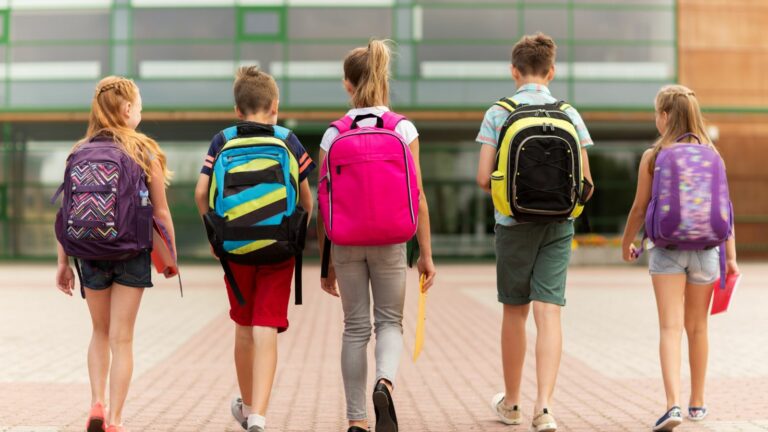
The scale is significant because the program has been operating since 2002, rather than emerging as a temporary response to one difficult year. Each participating child can receive a new backpack, insulated lunchbox, pencil case and roughly 30 basic school supplies. The children are also allowed to choose among different backpack styles and designs. That relatively small detail makes the distribution feel less like receiving a standardized emergency package and more like preparing for school in the same way classmates might.
Demand Has Been Moving Higher, Not Lower
The 2026 goal is larger than the program’s target one year earlier. Opération Sac à Dos set out to help 11,000 children in 2025, meaning this year’s target is at least 1,000 higher. In 2024, Regroupement Partage had aimed to support more than 10,000 children after reporting that 7,400 had received assistance in 2023. The direction over several years is difficult to miss.
Those numbers should not be interpreted as a precise measure of child poverty across Quebec. Program capacity, fundraising and geographic expansion all influence how many children an organization can serve. They do, however, show that Regroupement Partage has repeatedly enlarged its back-to-school operation instead of scaling it down. As assistance spreads beyond Montreal, families in places including Longueuil, Shawinigan, Mont-Tremblant, L’Assomption and Sainte-Agathe-des-Monts are now part of the network as well.
“Free” Public Schooling Still Comes With a Shopping List
Quebec guarantees access to many educational services and materials, but provincial rules make an important distinction between what schools must provide and what remains a family responsibility. Personal-use items such as pencils, erasers, agendas, pencil cases and school bags are not covered by the right to free educational services. Neither are various notebooks, binders, calculators, geometry instruments and other commonly requested materials.
That explains why August can become surprisingly expensive even for parents whose children attend public schools. A supply list may involve individually inexpensive products, yet the total climbs quickly once a backpack, lunchbox, indoor shoes, physical-education clothing and other necessities enter the calculation. Families with two or three school-age children face the same spending cycle simultaneously. Programs such as Opération Sac à Dos therefore address expenses that are routine parts of attending school, even though they sit outside many of the materials supplied directly by the education system.
Quebec Provides $127, but Families Can Still Face a Gap
There is provincial help. For the 2026-27 school year, Quebec’s school-supplies supplement is $127 per eligible child. The payment is not income-tested and is automatically added in July to the Family Allowance received by eligible families. Generally, it covers children aged four through 16, with eligibility extending to age 17 in certain cases involving the supplement for a disabled child.
Yet the value Regroupement Partage places on its own complete package illustrates how quickly expenses can surpass that payment. The organization says a backpack filled with school supplies has a retail value of approximately $185. That is about $58 more than the provincial supplement before considering every other possible back-to-school expense. The comparison does not mean every family spends $185, but it helps show why a $127 payment can provide welcome relief without necessarily eliminating the financial pressure surrounding the start of school.
Grocery Inflation Is Competing for the Same Household Dollars
School costs are arriving while everyday expenses remain elevated. Statistics Canada reported that Canadian grocery prices were 3.9% higher in June 2026 than a year earlier. Quebec’s overall Consumer Price Index, meanwhile, was up 3.2% year over year in June. National headline inflation was 2.8%, meaning food bought from stores was still rising more quickly than the overall Canadian consumer basket.
That matters because families do not maintain separate pools of money for groceries and school supplies. A household spending more on bread, meat, fruit and packed lunches has fewer dollars available for notebooks or new shoes unless income has increased enough to compensate. The tension becomes particularly visible in late summer, when multiple costs arrive at nearly the same time. A backpack may be purchased only once a year, but it must be paid for while rent, food, transportation and utility bills continue arriving on schedule.
Food Insecurity Shows How Thin Some Budgets Already Are
The Institut de la statistique du Québec provides a broader picture of that strain. Its March 2026 analysis found that 19% of Quebec households experienced some level of food insecurity in 2023, representing approximately 733,900 households. That was up from 14% in 2018. Severe food insecurity affected about 179,000 households, and approximately 55,000 children were living in households experiencing the severe category.
Families with children were especially exposed. The institute estimated food insecurity at roughly 36% among lone-parent households in 2023, compared with about 22% among two-parent families with children. Geographically, Montreal and Laval also stood out, with household food-insecurity rates of 22% and 23%, respectively. Those figures help explain why back-to-school assistance is heavily concentrated around Montreal while expanding into other regions: many households were already making difficult decisions about essentials well before school lists arrived.
Bulk Purchasing Turns Donations Into Far More Merchandise
One of the more striking aspects of Opération Sac à Dos is the difference between retail value and what the organization says it pays. A complete set of supplies valued at about $185 at retail can be acquired through bulk purchasing for approximately $33.50. That purchasing power allows donations to stretch considerably further than they would if every family received the same amount in ordinary retail spending money.
The organization expects to distribute more than $2.5 million in retail-value supplies and essential materials during this year’s operation. Its 2026 background material also records the scale of the previous year’s mobilization: more than 1,000 volunteers contributed thousands of hours to the effort in 2025. This is therefore not simply a backpack drive built around donated leftovers. It is a coordinated purchasing and distribution network designed to combine fundraising, wholesale buying, volunteers and community organizations to move large quantities of supplies where they are needed.
The Program Is Spreading Beyond Montreal
Montreal remains the centre of the 2026 operation, accounting for 23 of the 30 service locations announced by Regroupement Partage. But the remaining locations reveal an important shift. The program is also operating in communities including Laval-Chomedey, Longueuil, Nicolet-Yamaska, Mont-Tremblant, Sainte-Agathe-des-Monts, L’Assomption and Shawinigan, expanding the initiative’s footprint beyond the island.
That geographic reach serves another purpose. Families attending the distributions can be introduced to community organizations and services that remain available after the first day of school. Regroupement Partage describes Opération Sac à Dos as an entry point into a wider support network rather than a one-day exchange of goods. For a household dealing simultaneously with food costs, housing pressure or unstable income, discovering nearby assistance may matter long after the pencils and notebooks have been packed into a school bag.
Behind the Statistics Is a Very Ordinary Family Decision
The human side of the squeeze can be easy to lose among figures measured in thousands of children and millions of dollars. In announcing the 2026 campaign, Regroupement Partage included the experience of a mother from Montreal’s Mercier-Ouest neighbourhood who had previously received assistance. She described the program as removing a substantial financial burden at the beginning of the school year and expressed hope that she could eventually help another family herself.
That experience captures what the larger numbers mean. School supplies are rarely the biggest item in a household budget, but they arrive at a moment when families cannot easily postpone the purchase. Children need the materials when classes begin. With more than 12,000 young people now included in this year’s Opération Sac à Dos target, Quebec’s back-to-school season is becoming another place where the province’s wider affordability pressures are showing up—in backpacks, lunchboxes and household budgets.
This Options Discord Chat is The Real Deal
While the internet is scoured with trading chat rooms, many of which even charge upwards of thousands of dollars to join, this smaller options trading discord chatroom is the real deal and actually providing valuable trade setups, education, and community without the noise and spam of the larger more expensive rooms. With a incredibly low-cost monthly fee, Options Trading Club (click here to see their reviews) requires an application to join ensuring that every member is dedicated and serious about taking their trading to the next level. If you are looking for a change in your trading strategies, then click here to apply for a membership.